


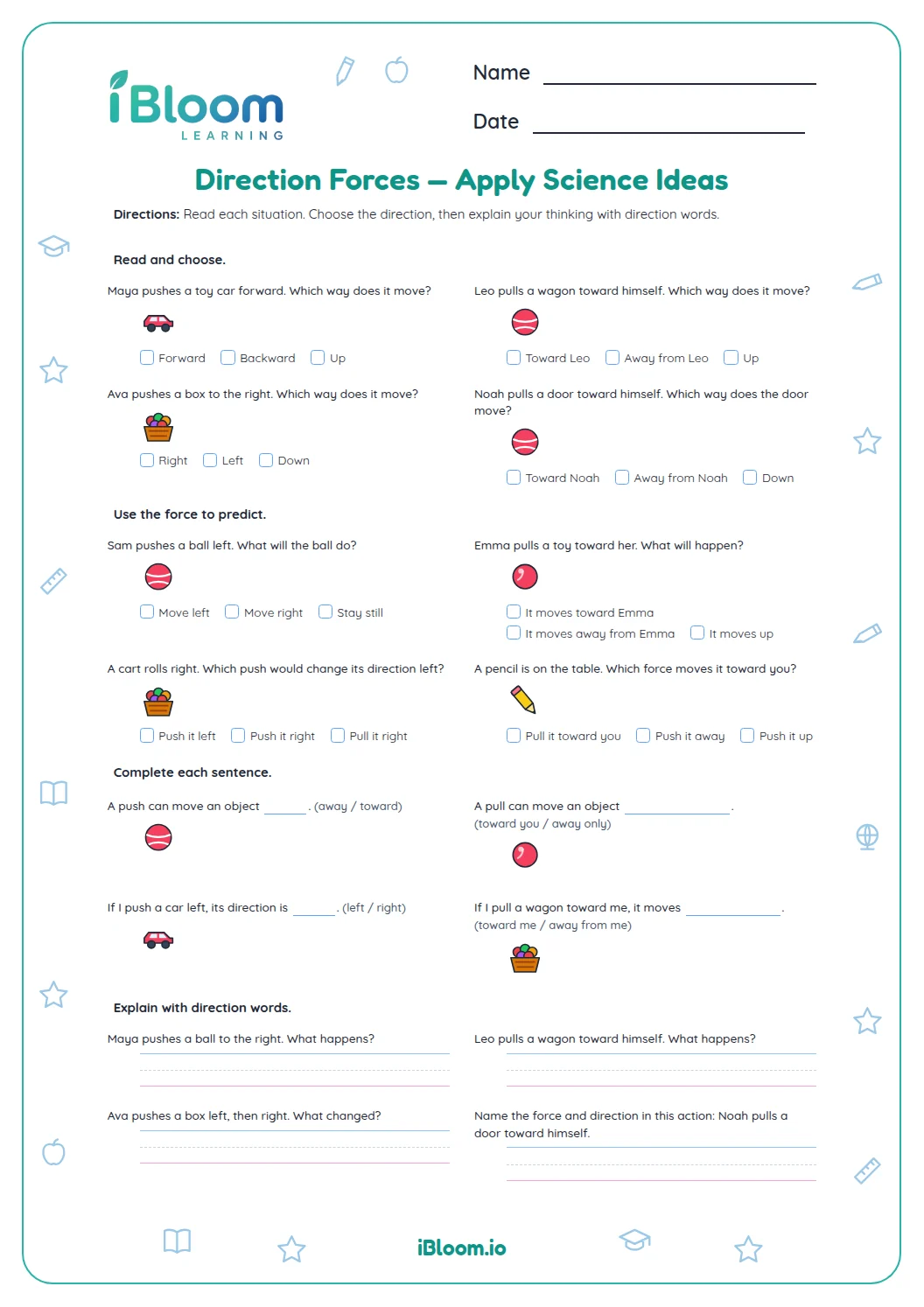
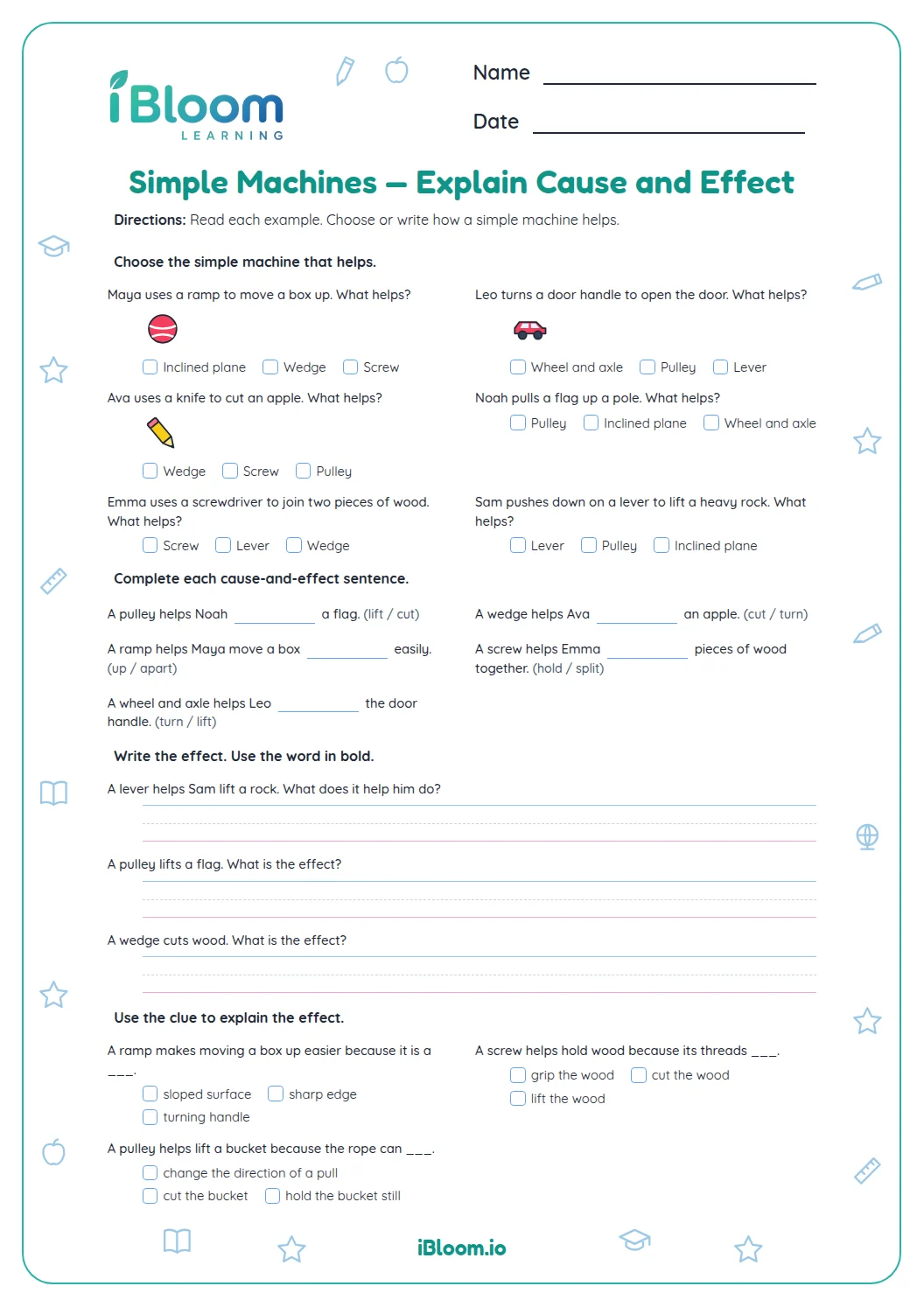
About this worksheet
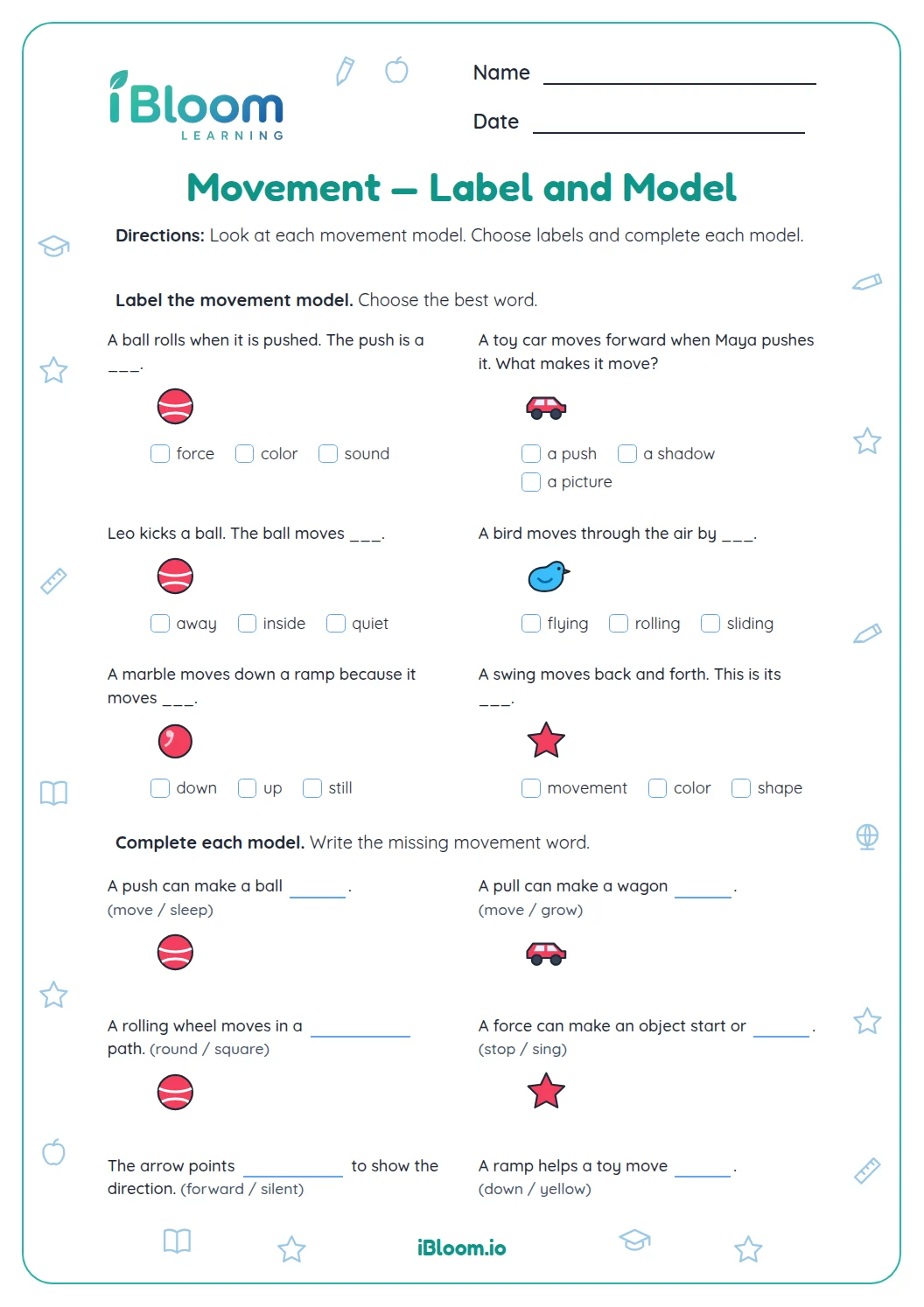
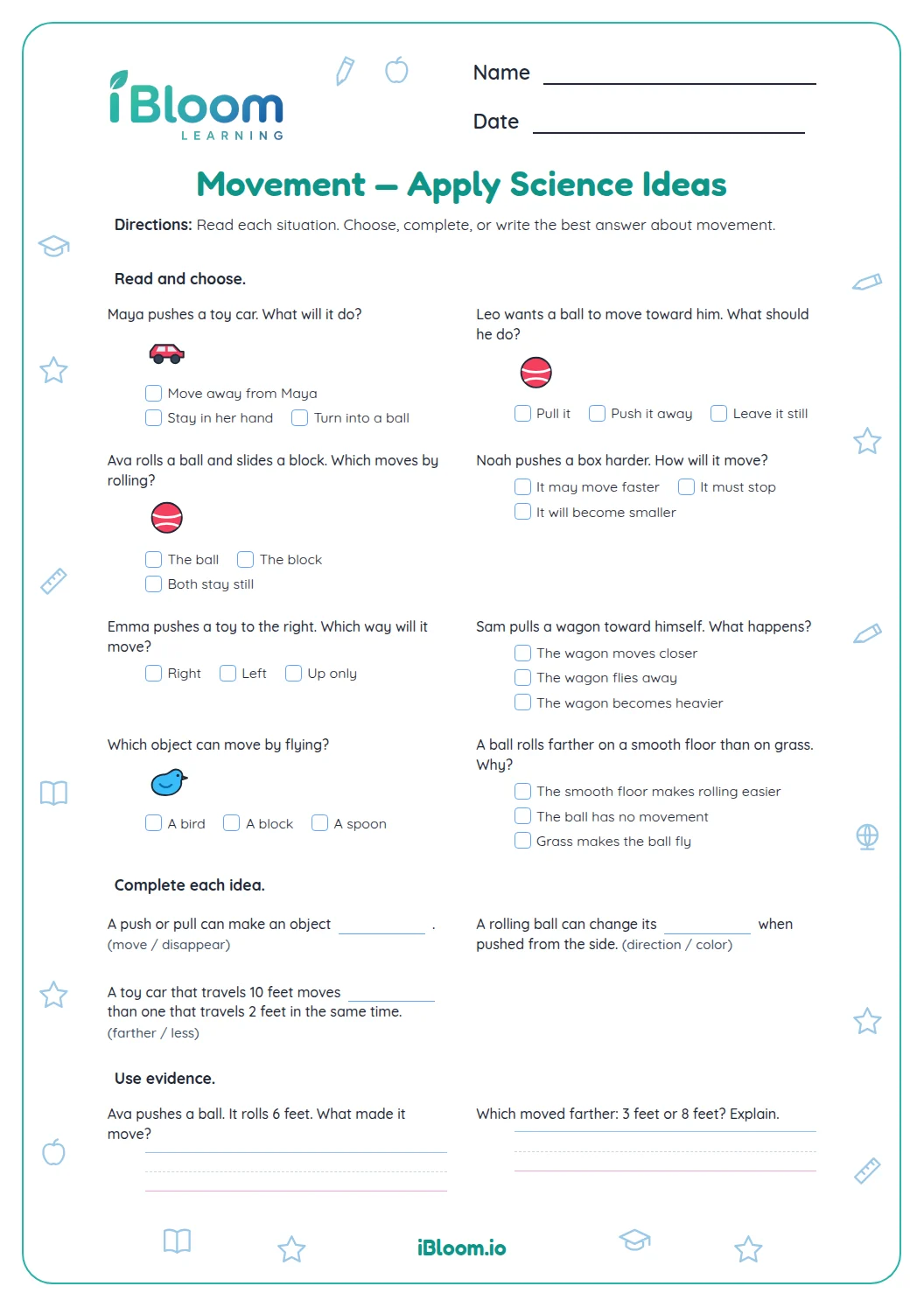
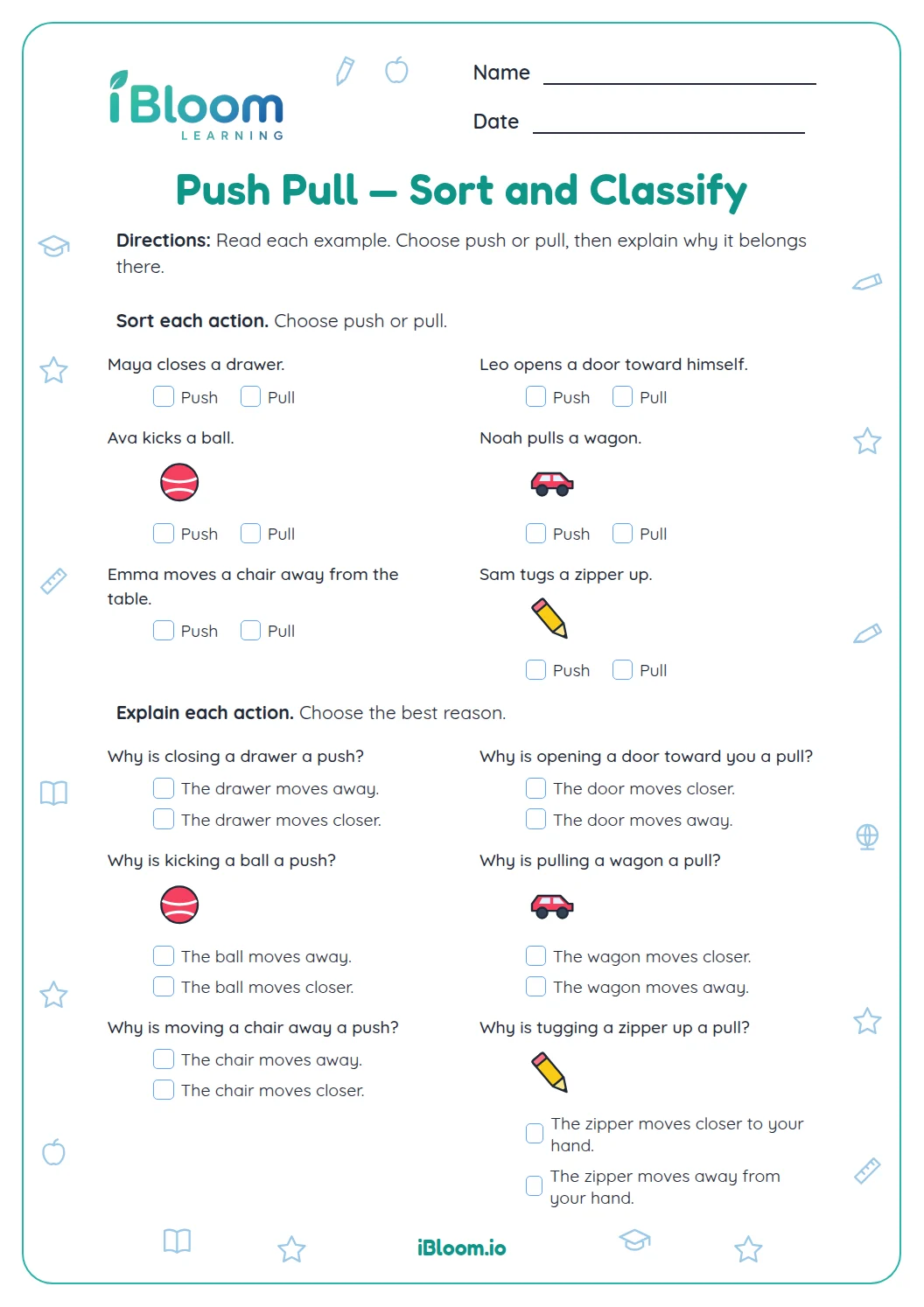
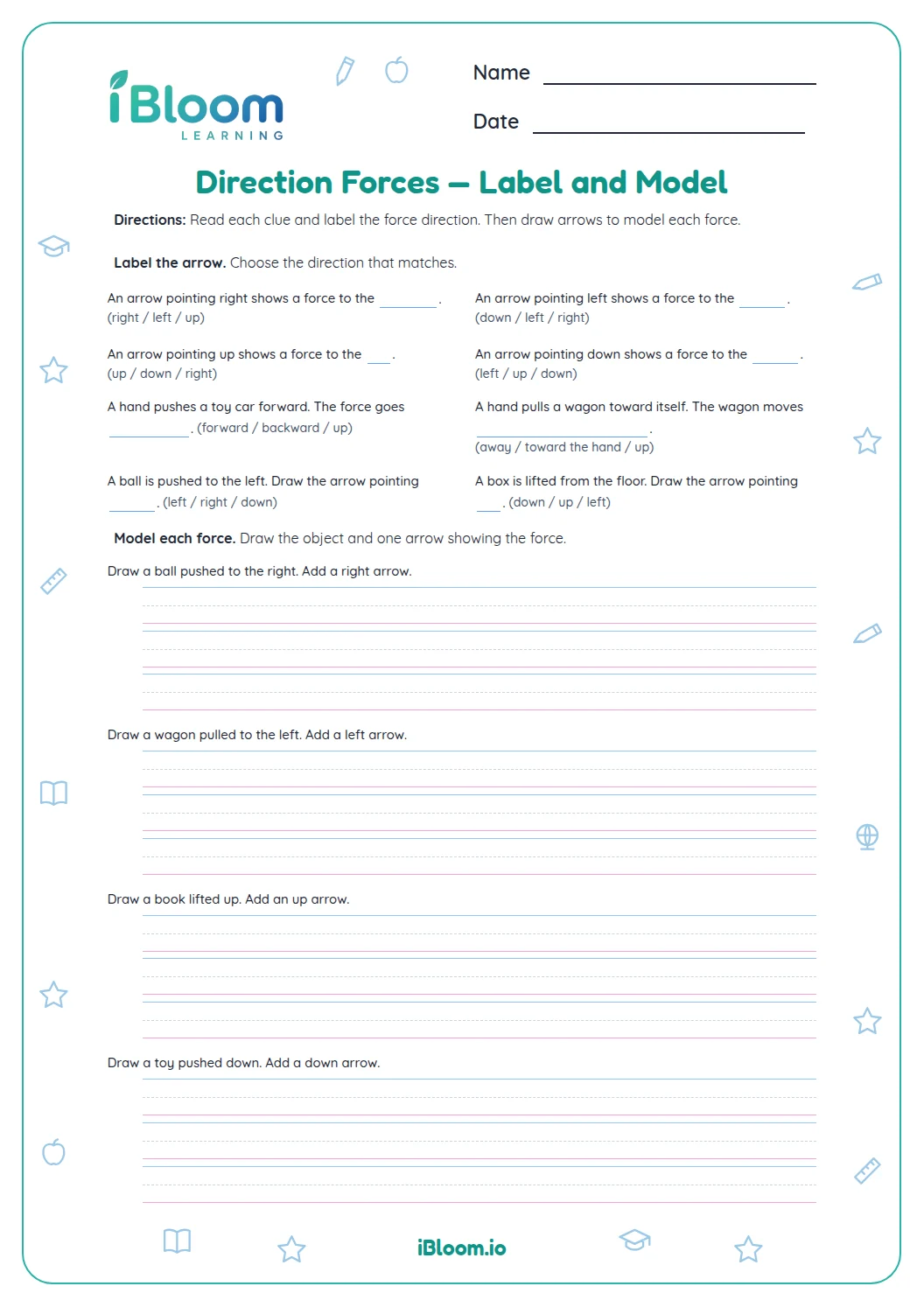
This free printable Grade 1 science worksheet asks children to connect a push, pull, slope, or surface with an object’s movement. It has 14 prompts: five multiple-choice questions, eight sentence completions, and one short explanation. Children identify causes and effects in familiar situations with a car, ball, kite, wagon, and marble. The separate key gives answers and a sample explanation.
How do children connect a cause to movement?
A cause is an action or condition that helps something happen. An effect is what happens next. A push can start a toy car moving, while a rug can slow a rolling marble.
The first questions use familiar objects so children can name the event and its result before explaining more open situations.
- 1Ava pushes a door, so the door ___.
- 2Cause: Ava pushes.
- 3Effect: the door opens.
What will children practice on the page?
Five questions ask children to select a cause or effect. Eight sentence completions apply movement words to pushes, pulls, friction, and surfaces; the final prompt asks for a brief explanation about a ball on hills.
How can the answer key help?
The key gives the choice and fill-in answers, plus a sample explanation for the final question. Accept another clear answer that links the steeper slope with faster movement.
How to use this worksheet
- 1Read the whole event before choosing an answer.
- 2Name what acted on the object: a push, pull, slope, or surface.
- 3Ask what changed: did it start, stop, slow, or change direction?
- 4For a blank, reread the full sentence to check that the result makes sense.
- 5For an explanation, say the cause and the likely effect.
- 6Use the key to discuss answers that describe another reasonable result.
Common mistakes and quick fixes
The mistake
Naming an object detail as a cause, such as “the ball is blue.”
The fix
Ask whether that detail could make the ball move; look for a push, pull, slope, or contact.
The mistake
Mixing up the event and the result.
The fix
Retell it with “because” or “so”: a push happened, so the car moved.
The mistake
Assuming every surface affects motion the same way.
The fix
Compare the surfaces in the question; rough carpet tends to slow a rolling object more than smooth tile.
What to practice next
Make more practice
Questions parents and teachers ask
What does cause and effect mean here?
A cause is an action or condition that helps something happen; an effect is the result. On this page, a push can make a toy car move, and a rough rug can slow a marble. Children read each situation and connect the event with a sensible movement result.
How many questions are on the worksheet?
There are 14 prompts in three parts: five multiple-choice items, eight sentence completions, and one short explanation. The first questions identify a cause or effect, the next group applies movement words, and the last asks children to explain how a slope can affect a rolling ball.
Does the sheet include picture clues?
The new worksheet uses written situations rather than picture clues. It names familiar objects such as a car, ball, kite, wagon, and marble, so children can focus on the cause-and-effect relationship described in each sentence without needing to interpret an illustration.
What is a possible answer to the hill question?
A sample answer is that a ball may roll faster down a steeper hill. The key accepts a short explanation connecting the slope with the ball’s movement. Children can use their own clear wording as long as they describe how the hill can affect the ball.
How should I check the written response?
The last item has more than one reasonable wording, so the answer key provides a sample. Look for a clear connection between the steeper slope and the ball’s movement. The other questions have a selected answer or a short word that completes the sentence.
Is an answer key included?
Yes. A separate answer key lists the choices and completed words, along with a sample response for the final explanation. Use it after the child has tried the questions, then ask them to point out the cause and effect in any item they want to review.