Free printable practice
Simple Machines Practice Activities
Grade 1 science worksheets for recognizing simple machines and explaining how they help people move, lift, cut, turn, or hold objects.
Free printable worksheet PDFs
Preview every available page, then download the free worksheet PDF for home, homeschool, tutoring, or classroom practice.
Preview the exact activity before downloading it.
 Simple Machines — Sort and ClassifyGrade 1 science worksheets for recognizing simple machines and explaining how they help people move, lift, cut, turn, or hold objects. This sort and classify worksheet provides a distinct, age-appropriate way to practise the same lesson.Grade 1Free PDF preview4 pages
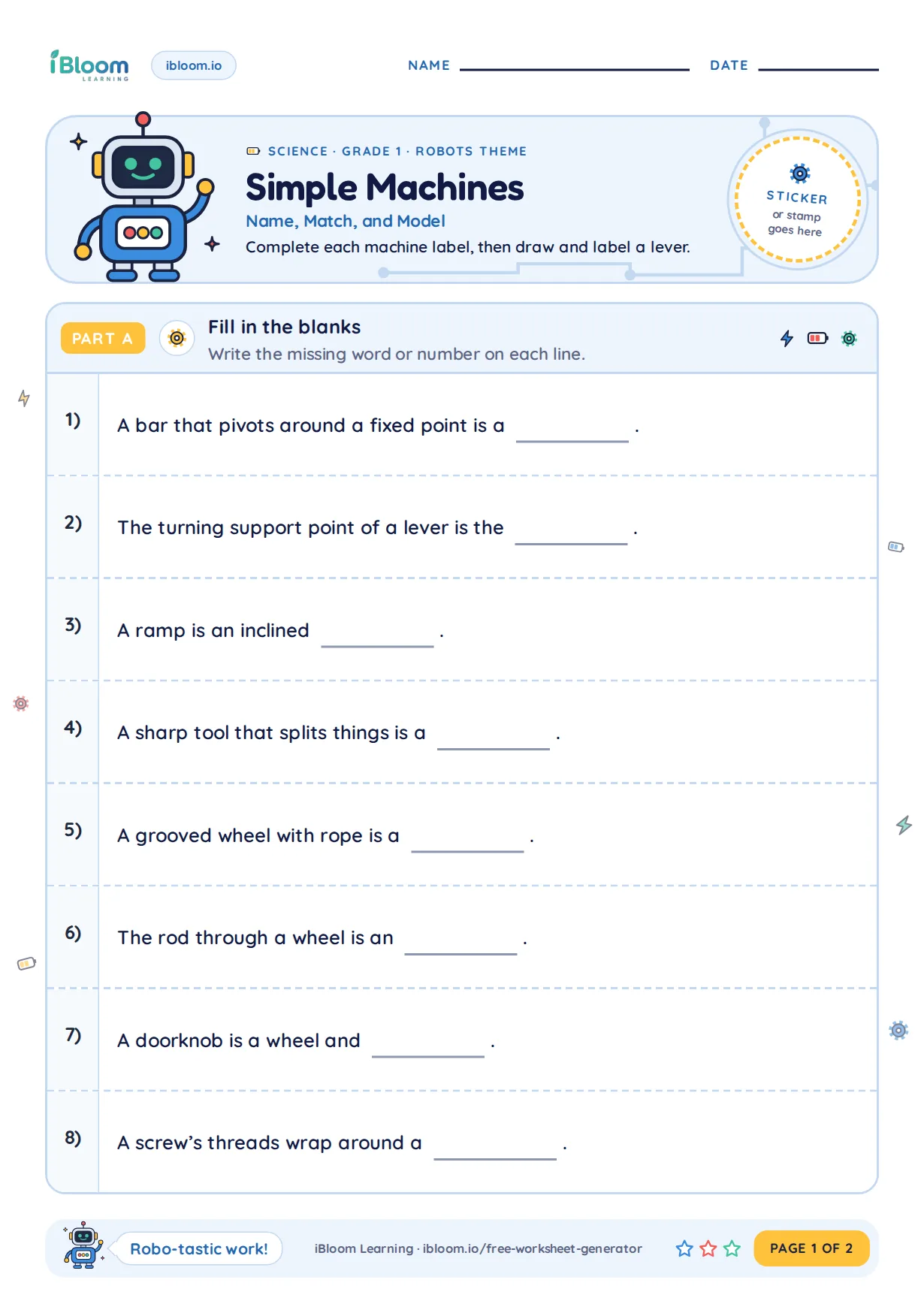 Simple Machines — Label and ModelGrade 1 science worksheets for recognizing simple machines and explaining how they help people move, lift, cut, turn, or hold objects. This label and model worksheet provides a distinct, age-appropriate way to practise the same lesson.Grade 1Free PDF preview
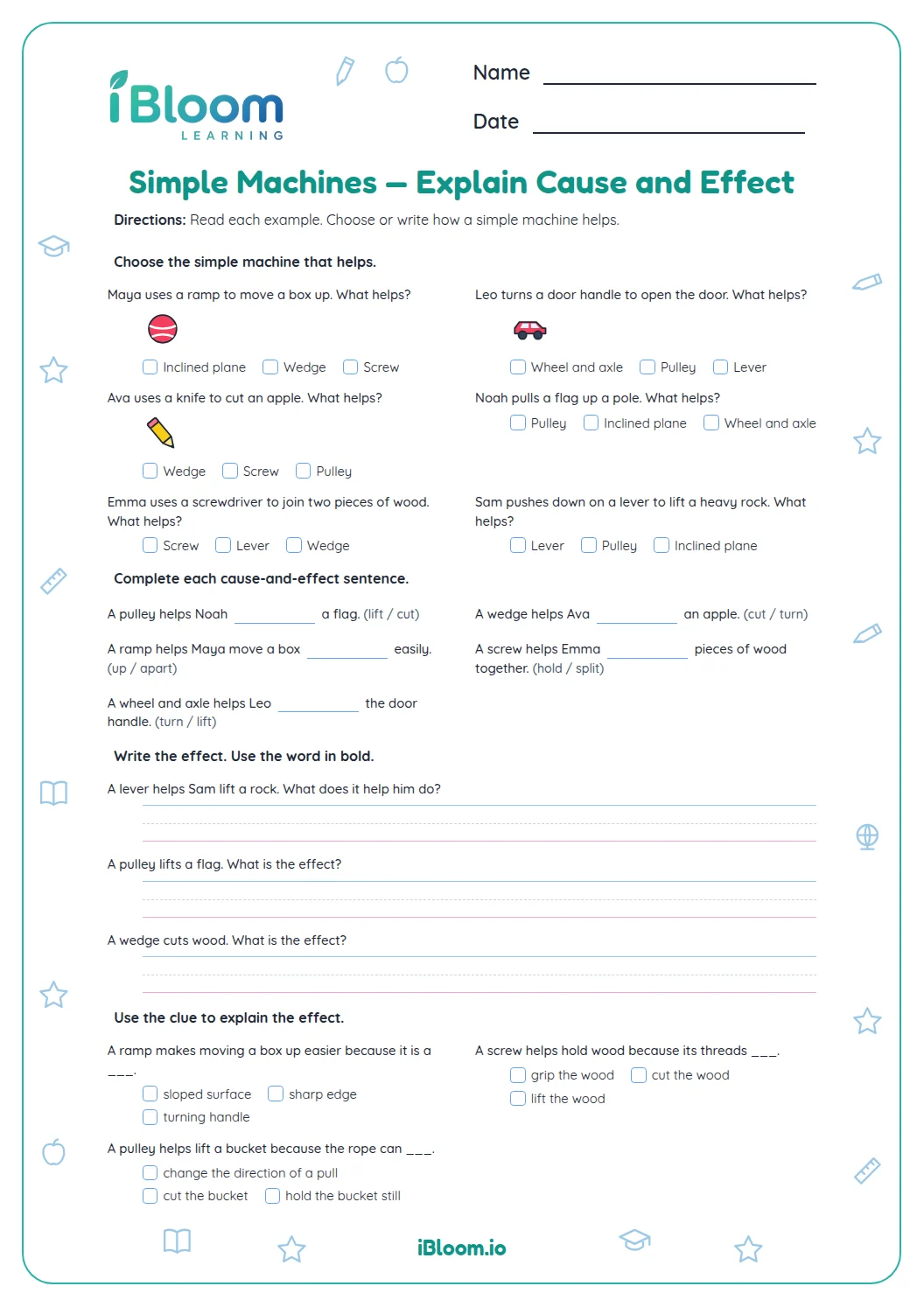 Simple Machines — Explain Cause and EffectGrade 1 science worksheets for recognizing simple machines and explaining how they help people move, lift, cut, turn, or hold objects. This explain cause and effect worksheet provides a distinct, age-appropriate way to practise the same lesson.Grade 1Free PDF preview4 pages
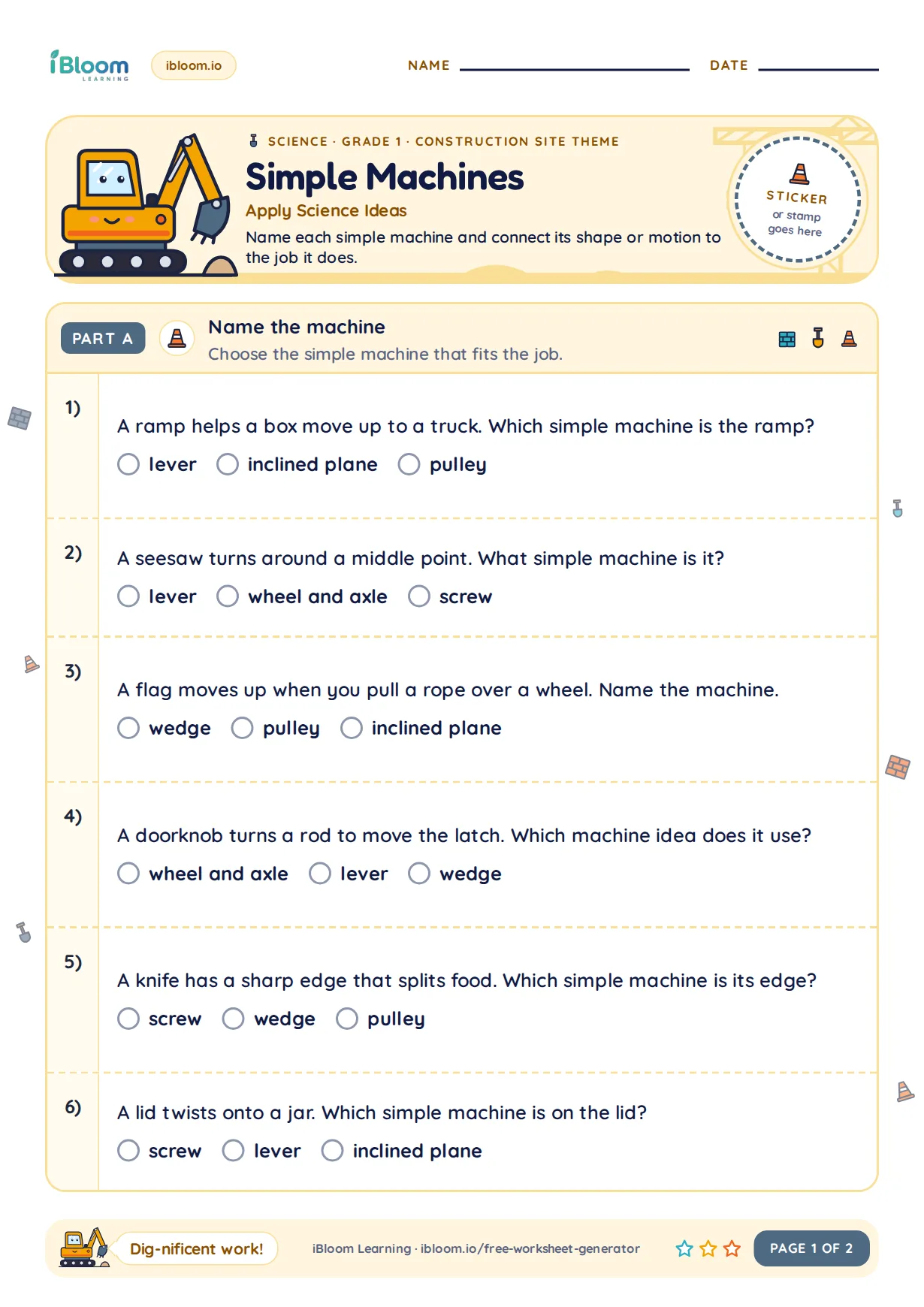 Simple Machines — Apply Science IdeasGrade 1 science worksheets for recognizing simple machines and explaining how they help people move, lift, cut, turn, or hold objects. This apply science ideas worksheet provides a distinct, age-appropriate way to practise the same lesson.Grade 1Free PDF preview
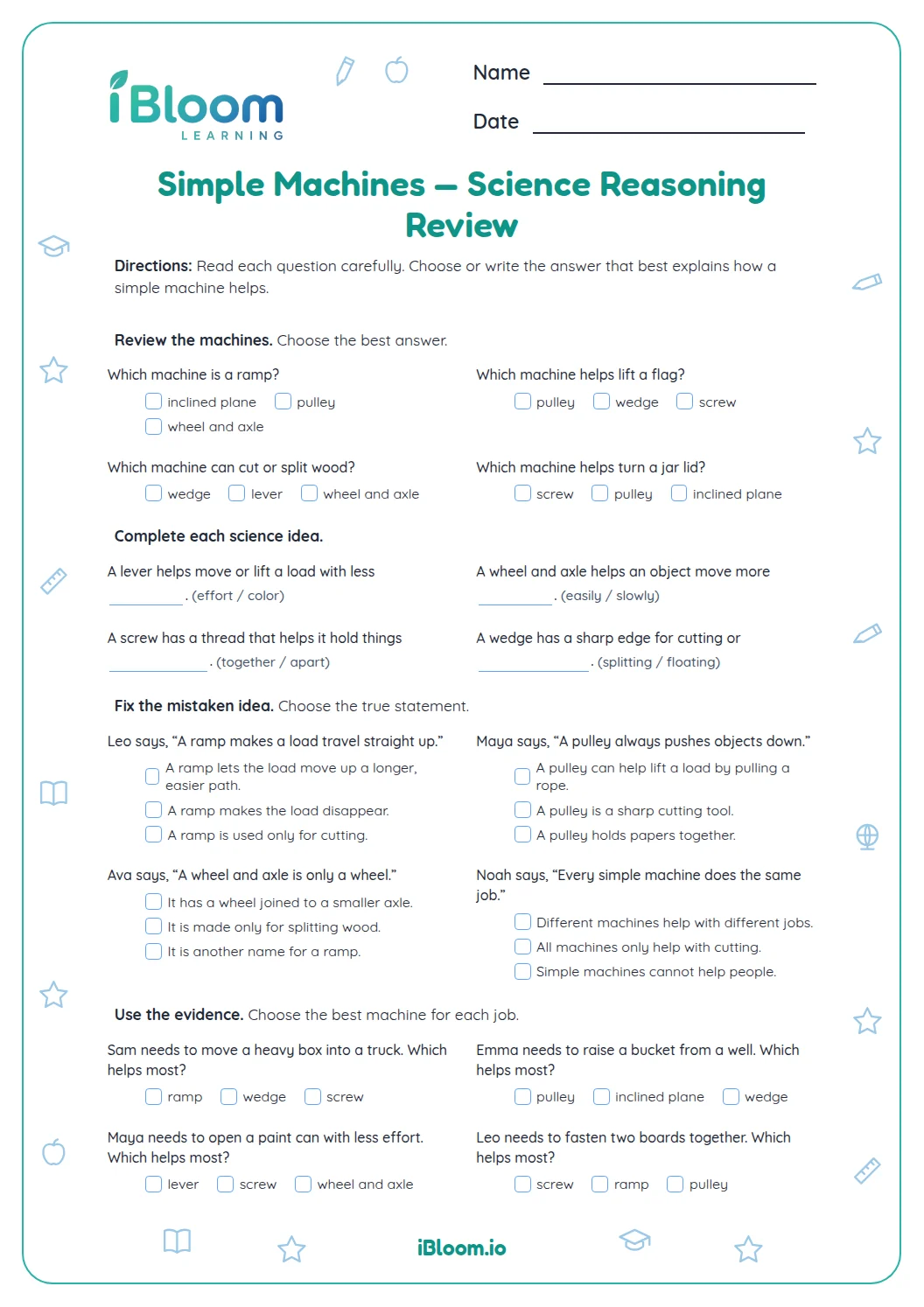 Simple Machines — Science Reasoning ReviewGrade 1 science worksheets for recognizing simple machines and explaining how they help people move, lift, cut, turn, or hold objects. This science reasoning review worksheet provides a distinct, age-appropriate way to practise the same lesson.Grade 1Free PDF preview
Practice that builds confidence
What children learn
These Grade 1 science worksheets help children explore simple machines as everyday tools that make work easier. Students practise identifying levers, pulleys, wheels and axles, inclined planes, wedges, and screws in familiar objects.
The printable activities include picture sorting, matching, labeling, and short observation tasks connected to forces and machines. Children build vocabulary while noticing how a push, pull, turn, lift, or slide can help an object move or change direction.
Simple machines are a first step toward understanding how forces are used in real life. In these activities, Grade 1 learners connect each machine to a job: a ramp helps move something up, a wedge can split or cut, a screw holds or raises, a pulley lifts, a lever helps lift or move, and a wheel and axle helps things roll or turn. The focus is recognition, function, and clear science language rather than memorizing definitions alone.

Skill progression in the worksheets
Children begin by naming machines from clear pictures, then compare pairs of objects and explain what each one helps people do. They may sort examples such as seesaws, scissors, doorknobs, ramps, bottle caps, flagpoles, knives, and wagons by the simple machine they show. Later tasks ask students to complete simple sentences using words such as push, pull, lift, roll, turn, slide, ramp, wheel, axle, lever, wedge, screw, and pulley.
A simple parent routine
At home, choose one room and ask your child to find “machines hiding in plain sight.” A door handle can show a wheel and axle, a jar lid can show a screw, and a butter knife can show a wedge. Ask three questions: What part moves? Do you push, pull, or turn it? How does it make the job easier? Then have your child draw one object and label the simple machine it uses.

Classroom uses for teachers
Teachers can use these printables after a short demonstration with classroom objects, during science centers, or as a follow-up to a forces and motion lesson. Picture-based pages support early readers, while sorting and sentence tasks encourage discussion. They also work well for partner talk: one child names the object, and the other explains the job the machine does.

Common mix-ups to watch for
Young learners often think a “machine” must have a motor or electricity. Reinforce that a spoon, ramp, screw, or wheel can be a machine too. Some children confuse wedges and inclined planes because both have slanted surfaces; the key idea is that a ramp helps things move up or down, while a wedge is often used to split, cut, or hold something in place.
Free printable PDF download
Use this grade 1 simple machines worksheet page to preview the activity, print it, or download it as a PDF for quick practice. It works well for homework, homeschool lessons, tutoring, morning work, revision, and classroom centers.
Answers and answer key support
After the child completes the worksheet independently, parents and teachers can use the answer support or answer key information to check the work, review mistakes, and choose the next practice step.
Why iBloom worksheets help
The pages keep the science concrete and age-appropriate, using everyday examples before asking for explanations. A child-friendly strategy is: look at the shape, notice the motion, and name the job. If children can say “I turn it,” “it rolls,” or “it lifts,” they are ready to connect the object to the simple machine.
Helpful answers
Frequently asked questions
Which simple machines are covered in these Grade 1 worksheets?
The worksheets introduce the six common simple machines: lever, pulley, wheel and axle, inclined plane, wedge, and screw, using familiar everyday examples.
Are these worksheets suitable for children who are still developing reading skills?
Yes. Many activities use pictures, matching, sorting, and short labels so early readers can practise the science concept without being held back by long text.
How can I explain a simple machine to a first grader?
Tell your child that a simple machine is a tool that helps make a job easier. It may help us lift, roll, cut, turn, pull, or move something.
What everyday objects can I use with these worksheets?
Useful examples include a ramp, spoon, seesaw, scissors, doorknob, wagon, jar lid, screw, knife, flagpole, and slide.
What mistake do children commonly make with simple machines?
Many children think only powered objects are machines. These worksheets help them see that non-electric tools, such as ramps, screws, and wheels, are machines too.
Is this grade 1 simple machines worksheet free?
Yes. You can preview it for free and use the printable worksheet for home or classroom practice.
Can I download this grade 1 simple machines worksheet as a PDF?
Yes. Use the worksheet download option to save a printable PDF, or print the worksheet directly from the page.
Does this grade 1 simple machines worksheet include answers or an answer key?
When the activity has fixed answers, iBloom includes answer support so parents and teachers can check the completed worksheet.