

About this worksheet
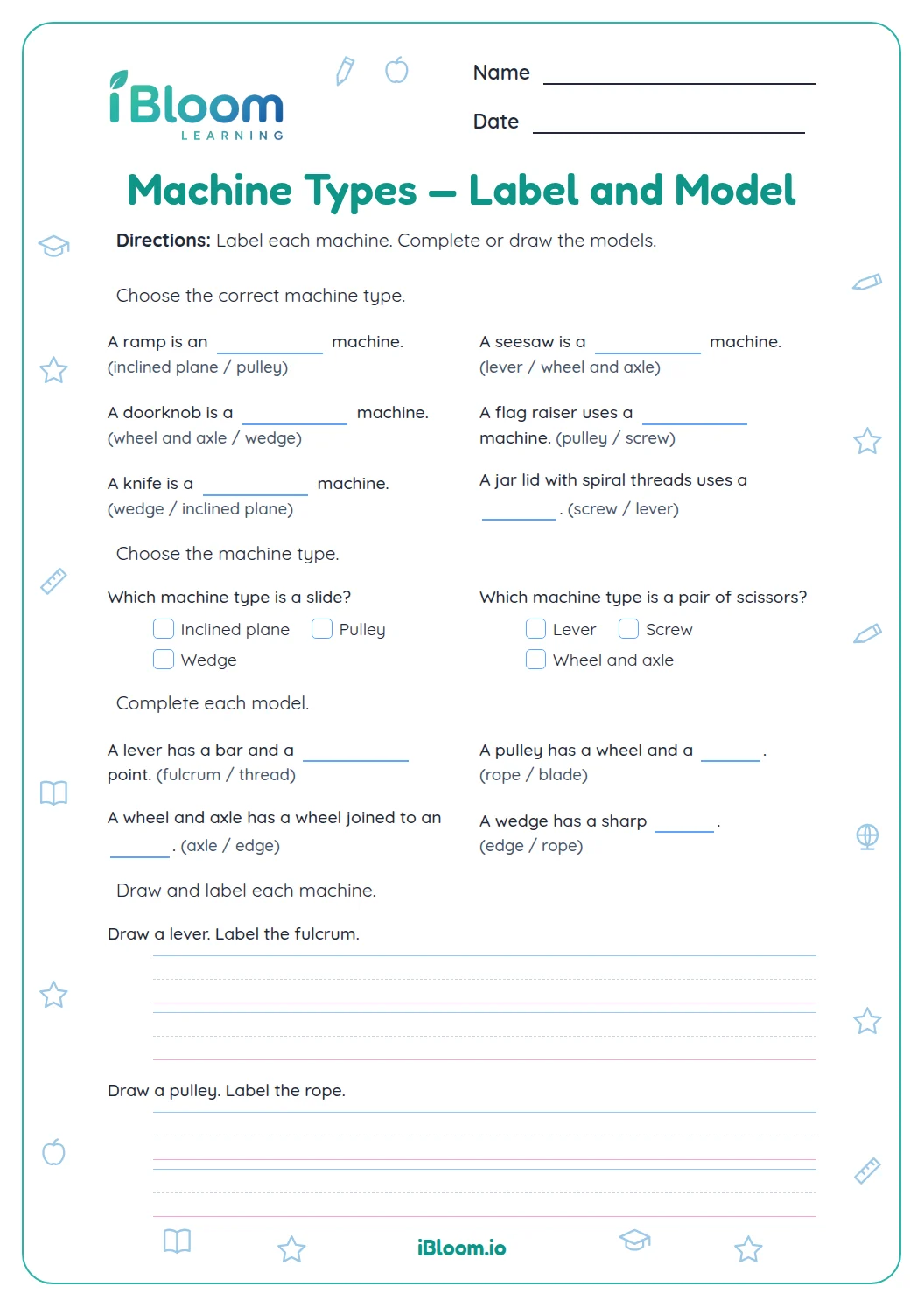
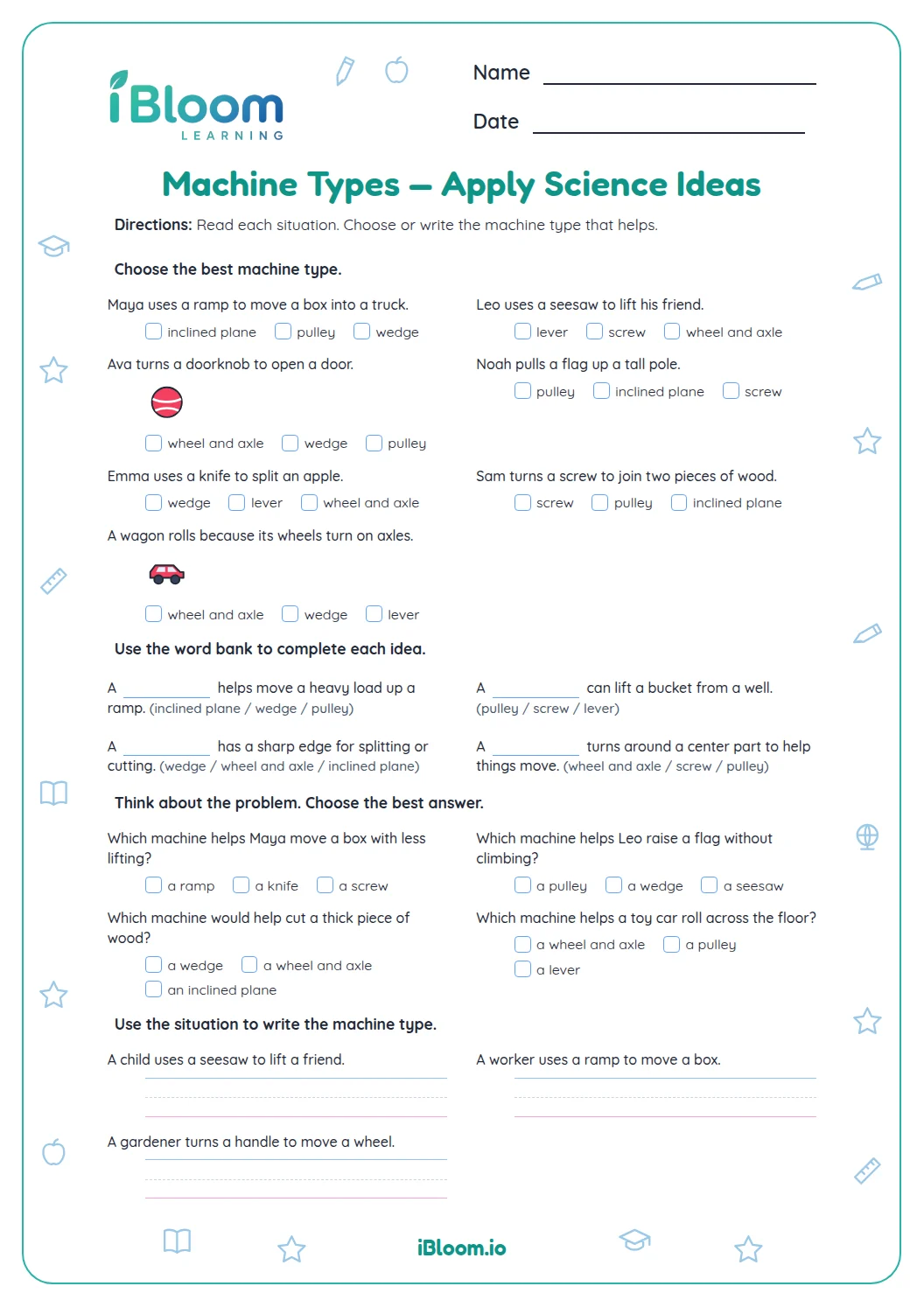
This free printable introduces six simple machines through familiar jobs and objects. Grade 1 students complete 13 short labels about ramps, wedges, wheel-and-axles, pulleys, levers, screws, and useful parts, then draw a lever that can lift a small box. The model asks children to label the bar and fulcrum, connecting the lever’s shape to its job. The worksheet connects to NGSS K-2-ETS1-2, which includes using a sketch, drawing, or model to show how shape helps an object function.
Aligned to K-2-ETS1-2
What machines appear on the worksheet?
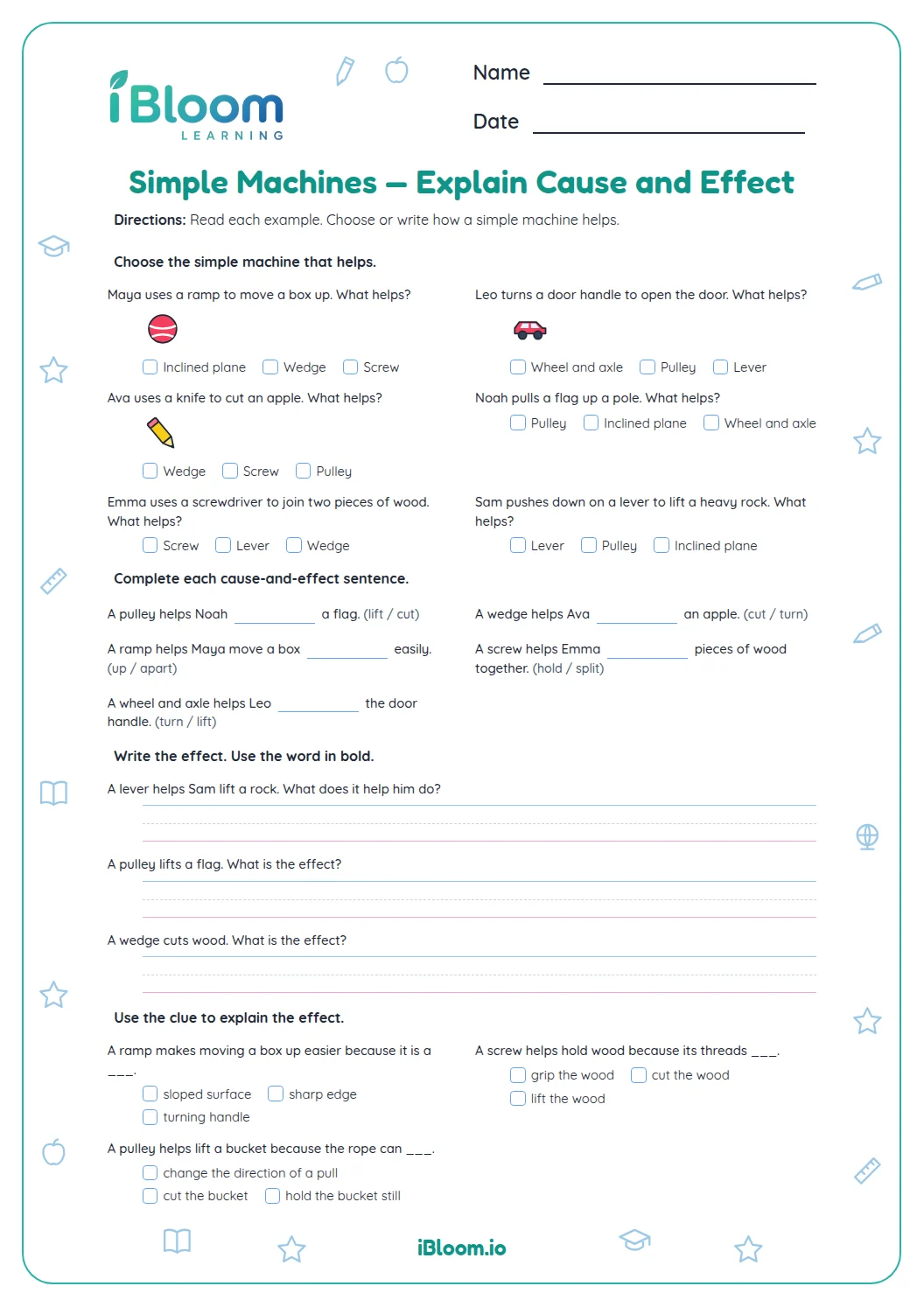
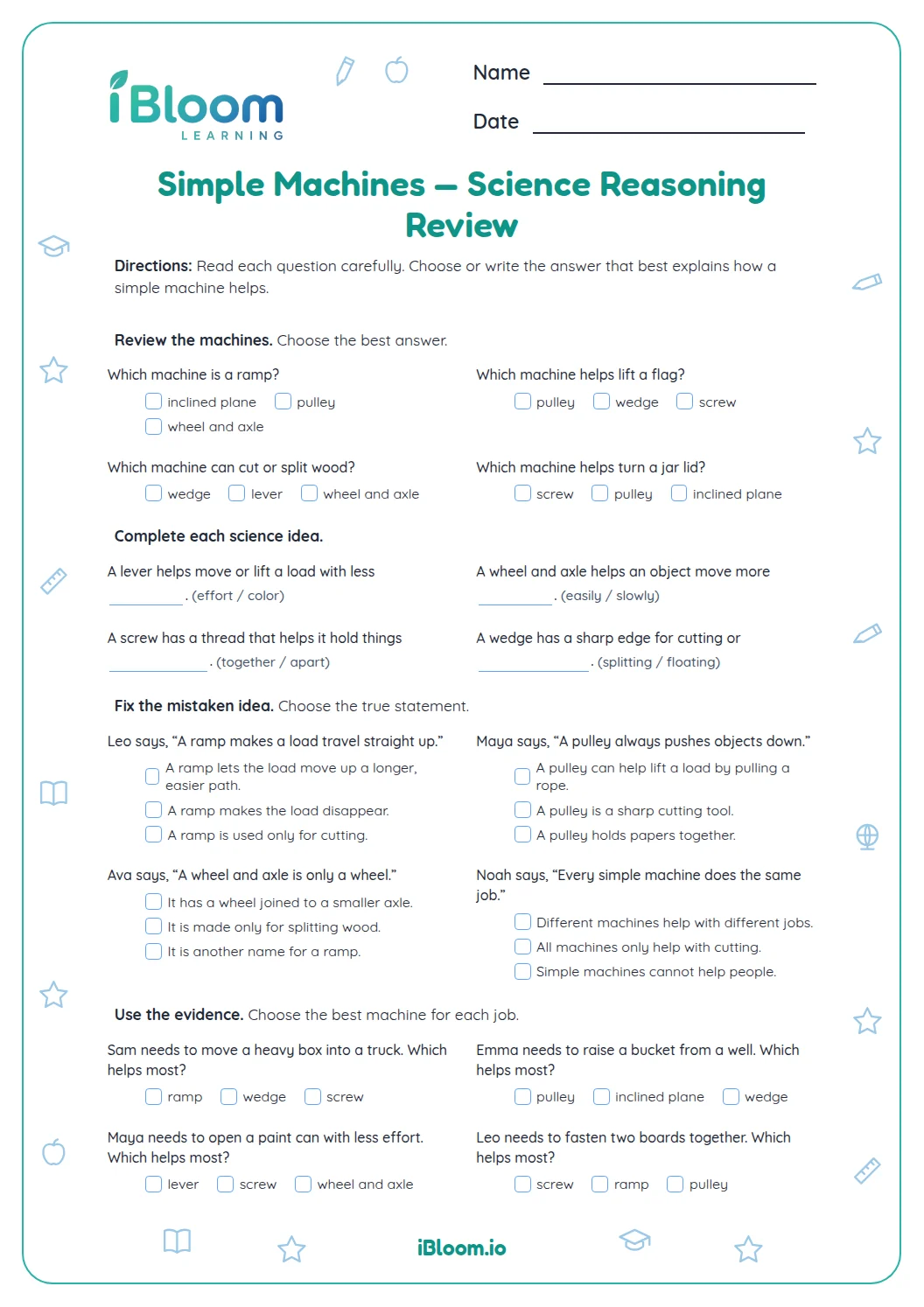
The 13 fill-in questions name six simple machines: inclined plane, wedge, wheel and axle, pulley, lever, and screw. Short clues connect each name or part to a familiar shape or job.
- 1A lever turns around its support point.
- 2That support point is the fulcrum.
How does an object clue reveal the machine?
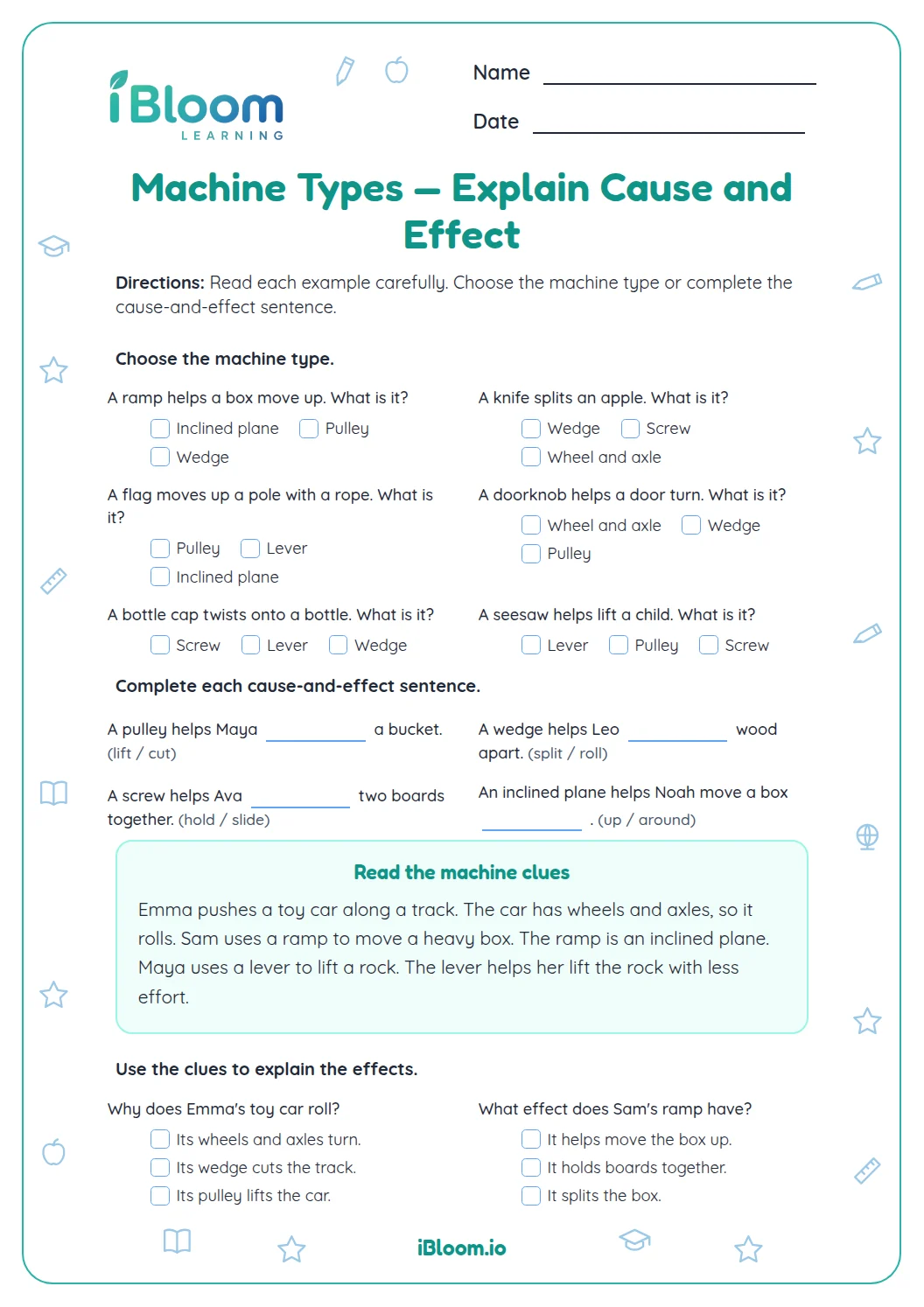
Think about the shape and movement in the clue. A sloping surface is an inclined plane. A wheel that turns around a rod uses a wheel and axle. A rope moving over a grooved wheel points to a pulley.
What should the lever model show?
Draw a long bar resting on a support point, or fulcrum, with a small box at one end. Label the bar and fulcrum. The drawing should make the lever’s shape and lifting job easy to see.
How can children explain a machine’s job?
Ask what moves, what stays in place, and how the shape helps. A pulley changes the direction of a pull on a rope; an inclined plane gives a sloped path; a lever turns around a fulcrum. The drawing can show how the lever helps lift.
How to use this science page
- 1Read each object or job clue carefully.
- 2Picture how the object is shaped or moves.
- 3Choose the simple machine that matches the clue.
- 4For the missing-part item, use the words wheel and axle together.
- 5Draw the ramp and lever with the key parts easy to see.
- 6Explain one job a simple machine can make easier.
Common simple-machine mix-ups
The mistake
Calling every sloping object a wedge.
The fix
A ramp is an inclined plane that provides a sloped path; a wedge has a sharp edge used to split or cut.
The mistake
Saying a doorknob is only a wheel.
The fix
The turning knob works with a rod through its center, so the pair is a wheel and axle.
The mistake
Drawing a lever as a bar without a support point.
The fix
Add the fulcrum beneath the bar. The fulcrum is the point the lever turns around.
Next Generation Science Standards alignment
The drawing prompts connect a simple machine’s shape with the job it is designed to do.
Sketch and model a ramp and lever to show how their shapes help with a task.
On this sheet: Students draw a ramp and a lever whose shapes help move a toy car or lift a box.
Show the official wordingHide the official wording
Develop a simple sketch, drawing, or physical model to illustrate how the shape of an object helps it function as needed to solve a given problem.
What to practice next
Make more practice
Further reading
Questions parents and teachers ask
Which six simple machines are included?
The worksheet names inclined planes, wedges, wheel-and-axles, pulleys, levers, and screws. Children complete short machine labels and identify parts from their jobs, then draw a lever with its bar and fulcrum labeled. The answer key supplies the terms and a sample model.
What should the ramp drawing include?
A useful lever drawing shows a bar resting on a support point, or fulcrum, with a small box at one end. The child labels the bar and fulcrum. This model connects the lever’s shape to lifting the box, and the answer key gives one sample arrangement.
What is the fulcrum in a lever?
The fulcrum is the support point a lever turns around. In the drawing, show a bar resting on that point. A box at one end makes the lifting job clear, and the label identifies the fulcrum. The answer key gives one sample arrangement.
Is a ramp the same as a wedge?
Both have sloping surfaces, but they are used differently. A ramp is an inclined plane that helps move a load along a slope. A wedge has a sharp edge that can split or cut, as a knife blade does. The clue about the job helps distinguish them.
How can I help a child explain how a machine works?
Ask the child to point to its shape and describe the job it helps with. For example, a lever turns on a fulcrum, while a pulley uses a rope over a wheel to lift a load. Connecting a part to an action makes the explanation concrete.