Free printable practice
Magnets Practice Activities
Printable Grade 1 science activities for exploring how magnets attract, repel, and interact with everyday materials.
Free printable worksheet PDFs
Preview every available page, then download the free worksheet PDF for home, homeschool, tutoring, or classroom practice.
Preview the exact activity before downloading it.
 Magnets — Sort and ClassifyPrintable Grade 1 science activities for exploring how magnets attract, repel, and interact with everyday materials. This sort and classify worksheet provides a distinct, age-appropriate way to practise the same lesson.Grade 1Free PDF preview6 pages
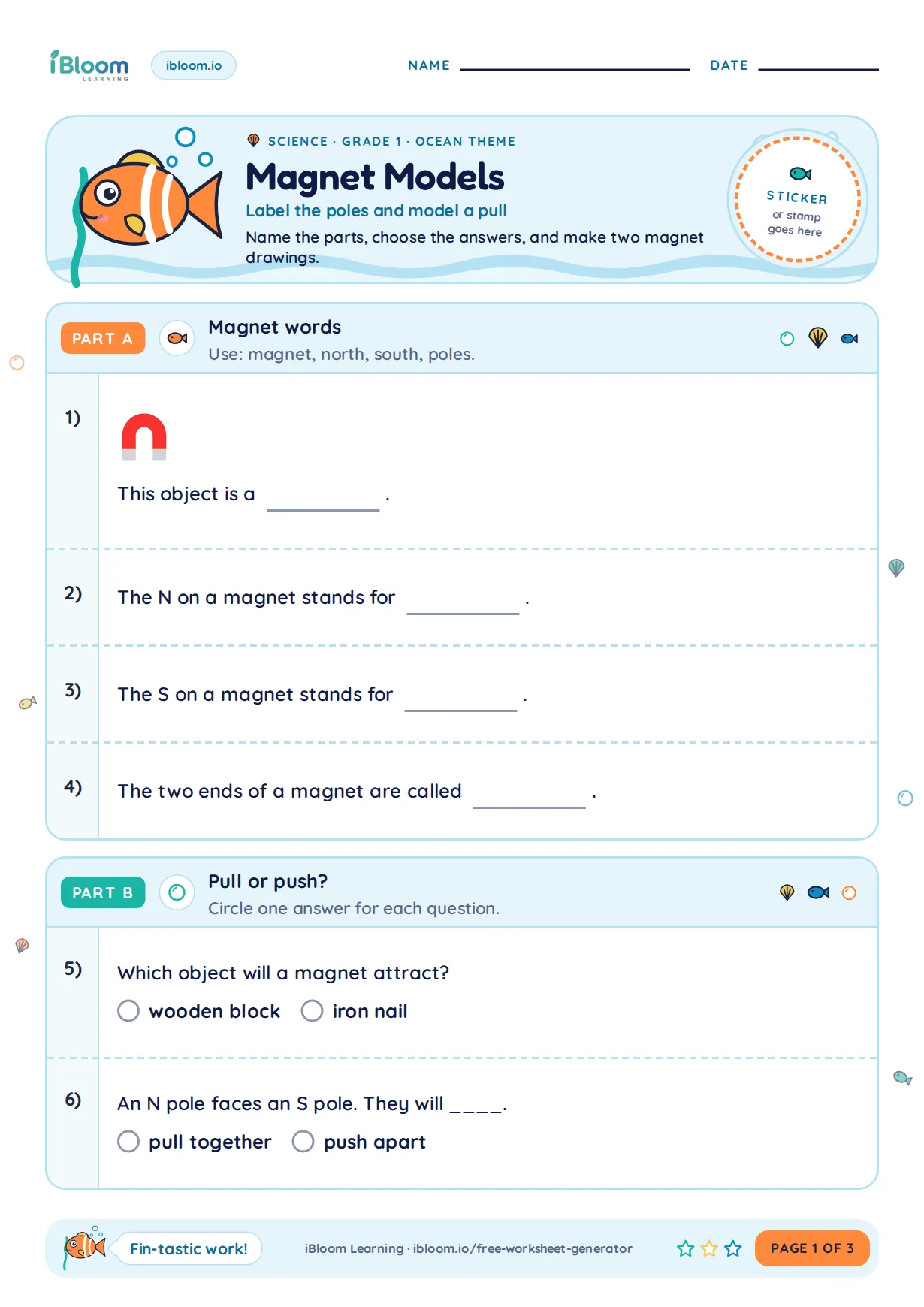 Magnets — Label and ModelPrintable Grade 1 science activities for exploring how magnets attract, repel, and interact with everyday materials. This label and model worksheet provides a distinct, age-appropriate way to practise the same lesson.Grade 1Free PDF preview
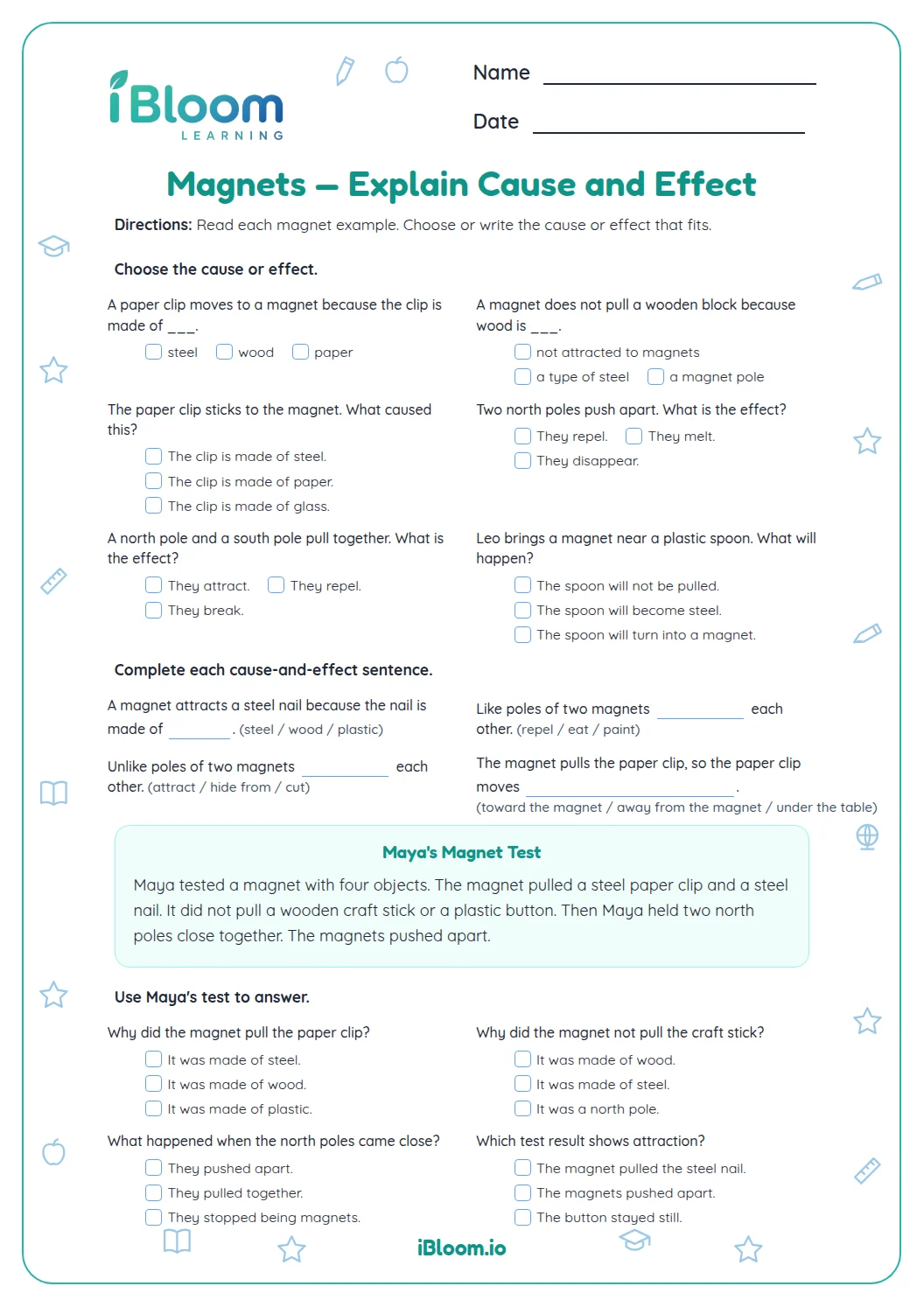 Magnets — Explain Cause and EffectPrintable Grade 1 science activities for exploring how magnets attract, repel, and interact with everyday materials. This explain cause and effect worksheet provides a distinct, age-appropriate way to practise the same lesson.Grade 1Free PDF preview
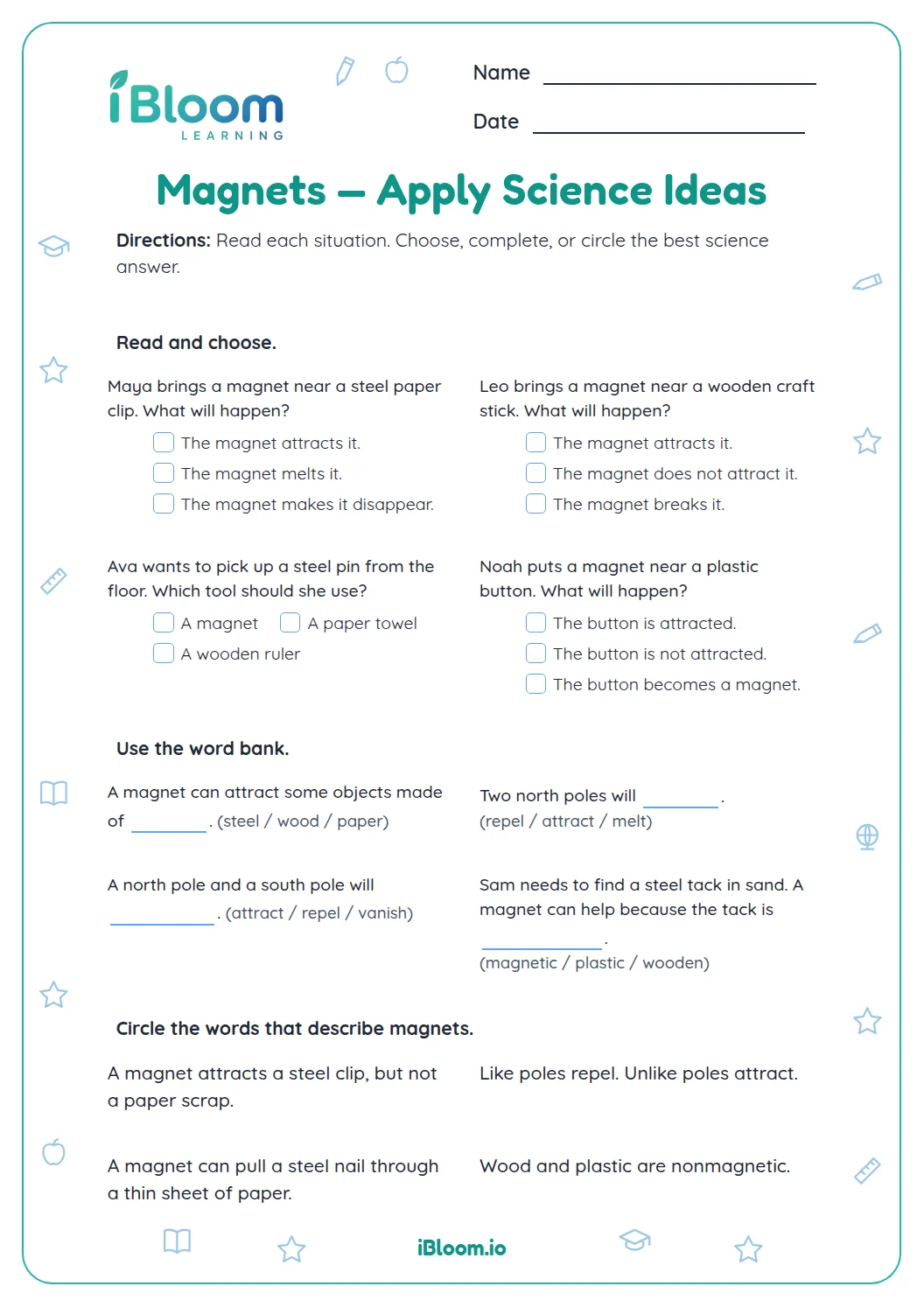 Magnets — Apply Science IdeasPrintable Grade 1 science activities for exploring how magnets attract, repel, and interact with everyday materials. This apply science ideas worksheet provides a distinct, age-appropriate way to practise the same lesson.Grade 1Free PDF preview
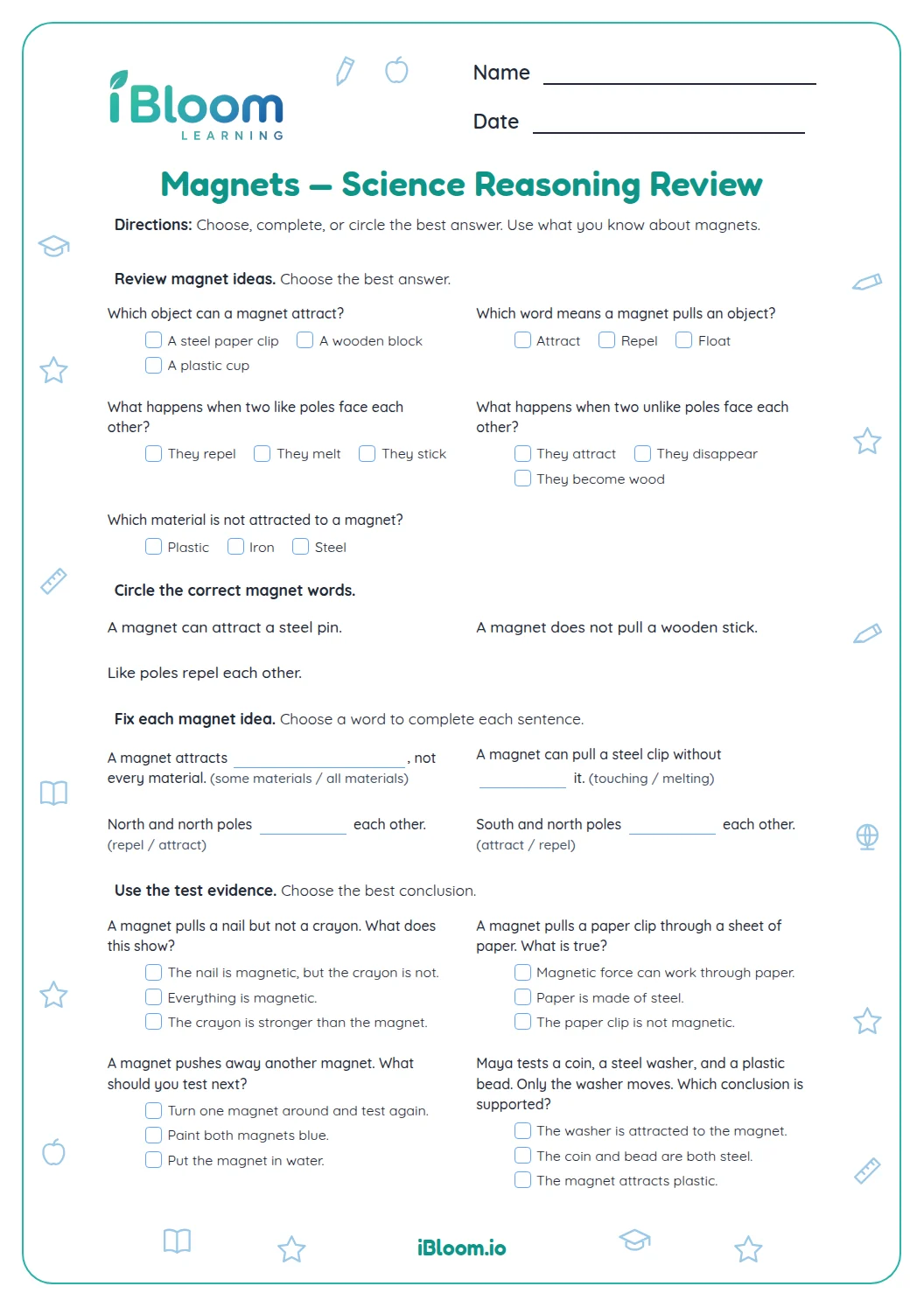 Magnets — Science Reasoning ReviewPrintable Grade 1 science activities for exploring how magnets attract, repel, and interact with everyday materials. This science reasoning review worksheet provides a distinct, age-appropriate way to practise the same lesson.Grade 1Free PDF preview
Practice that builds confidence
What children learn about magnets
These Grade 1 magnet worksheets help children observe how magnets pull on some objects, do not pull on others, and can push or pull another magnet. Children practise using early science words such as attract, repel, pole, metal, and magnetic.
The printable activities include sorting, prediction, observation, matching, labeling, and simple investigation prompts. They fit the Science > Grade 1 > Material Properties > Magnets path by connecting magnet behaviour to the properties of common classroom and home materials.
Children build the idea that a magnet can exert a force without needing to touch every object directly. They compare paper clips, coins, buttons, plastic toys, pencils, foil, keys, and other familiar items, then decide which are attracted to a magnet. A key Grade 1 understanding is that magnets attract some metals, especially iron and steel, but not every metal or every shiny object.

From sorting to simple investigations
The worksheets move from picture sorting and yes/no predictions to recording what actually happens. Children may circle objects a magnet will attract, match a magnet action to the words attract or repel, or look at two magnets and decide whether they will push apart or pull together. Some tasks introduce the idea that magnetic force can work through thin materials such as paper or card.
Parent routine for home practice
Give your child a safe magnet and five to eight small household objects. Ask, “What do you predict will happen?” before testing each one. Make two piles: attracted and not attracted. After testing, have your child explain one surprise using a sentence frame: “The magnet attracted the ___ because it is made of ___.” Keep the focus on careful noticing rather than getting every prediction right.

Classroom uses for teachers
Teachers can use these pages for science centers, small-group investigation records, or follow-up after a magnet demonstration. They also work well with a class chart where students add evidence from their tests. The mix of drawing, circling, labeling, and short response tasks supports young learners who are still developing writing stamina.

Common errors to watch for
Children often think all metals are magnetic, all silver-colored objects are magnetic, or larger magnets are always stronger. They may also confuse attract and repel. Encourage them to say what they observed: “It pulled,” “It did not move,” or “The magnets pushed apart.” This keeps explanations tied to evidence.
Free printable PDF download
Use this grade 1 magnets worksheet page to preview the activity, print it, or download it as a PDF for quick practice. It works well for homework, homeschool lessons, tutoring, morning work, revision, and classroom centers.
Answers and answer key support
After the child completes the worksheet independently, parents and teachers can use the answer support or answer key information to check the work, review mistakes, and choose the next practice step.
Why iBloom worksheets help
The activities are built for first graders: simple visuals, clear choices, and repeated use of magnet vocabulary in meaningful contexts. A helpful child-friendly strategy is “predict, test, tell”: guess first, try the magnet, then tell what happened using the words attract, repel, or not magnetic.
Helpful answers
Frequently asked questions
What magnet skills do these Grade 1 worksheets cover?
They cover identifying objects that magnets attract, sorting magnetic and nonmagnetic materials, recognizing attract and repel, and using simple observation evidence.
Do first graders need to know north and south poles?
These worksheets introduce poles through push and pull behavior, but they keep the focus age-appropriate: same poles repel, opposite poles attract, and magnets can act without direct contact.
What objects are good for a magnet activity at home?
Safe choices include paper clips, steel keys, pencils, erasers, plastic lids, cardboard, coins, foil, and buttons. Adult supervision is important, especially with small magnets or small objects.
How can I help if my child thinks all metals are magnetic?
Let your child test several metal-looking objects and compare results. Then explain that magnets attract some metals, such as iron and steel, but not all metals or shiny objects.
Can these worksheets be used in science centers?
Yes. They are suited for centers because children can predict, test with real objects, record results, and discuss magnet vocabulary with a partner or teacher.
Is this grade 1 magnets worksheet free?
Yes. You can preview it for free and use the printable worksheet for home or classroom practice.
Can I download this grade 1 magnets worksheet as a PDF?
Yes. Use the worksheet download option to save a printable PDF, or print the worksheet directly from the page.
Does this grade 1 magnets worksheet include answers or an answer key?
When the activity has fixed answers, iBloom includes answer support so parents and teachers can check the completed worksheet.