






About this worksheet
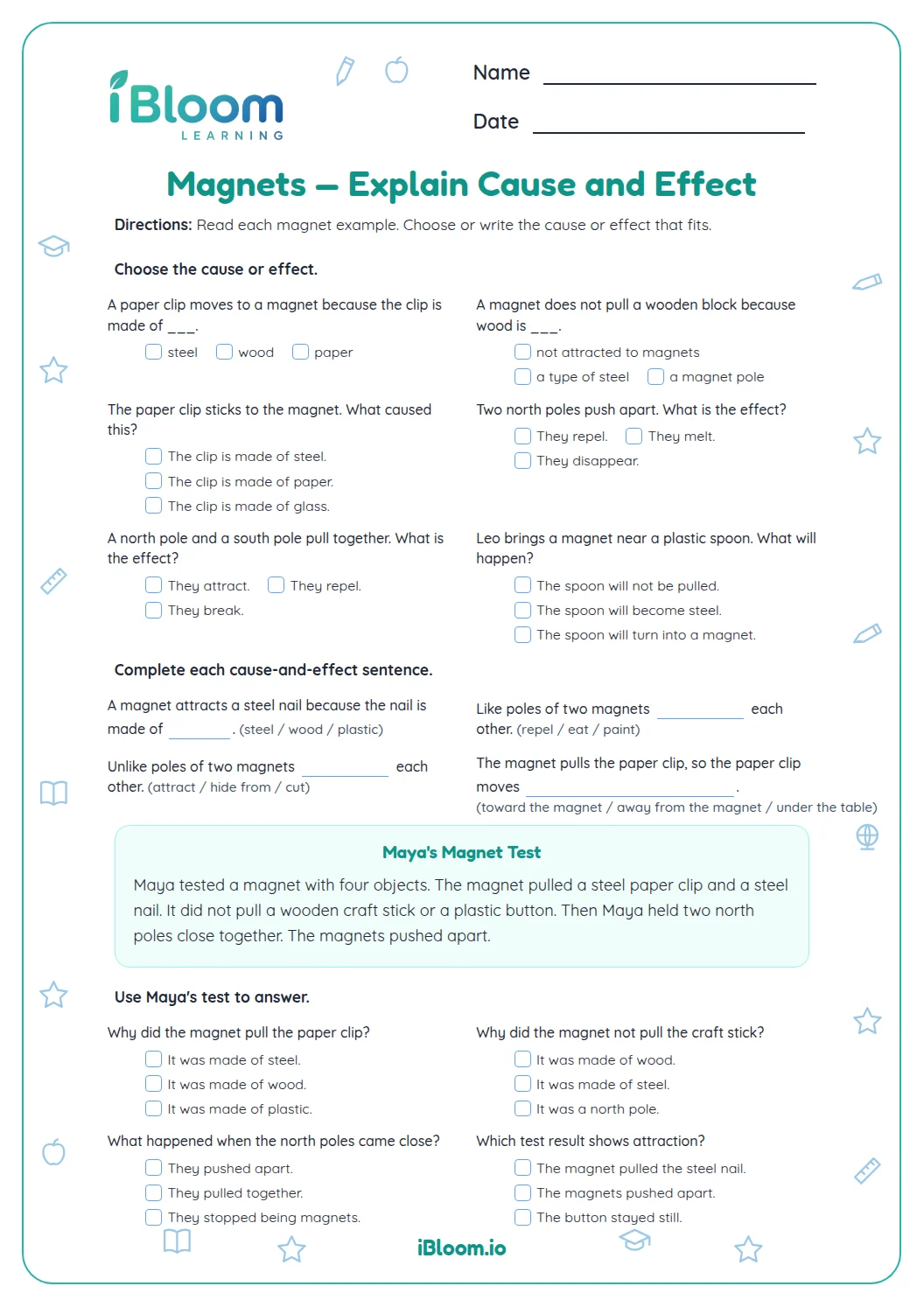
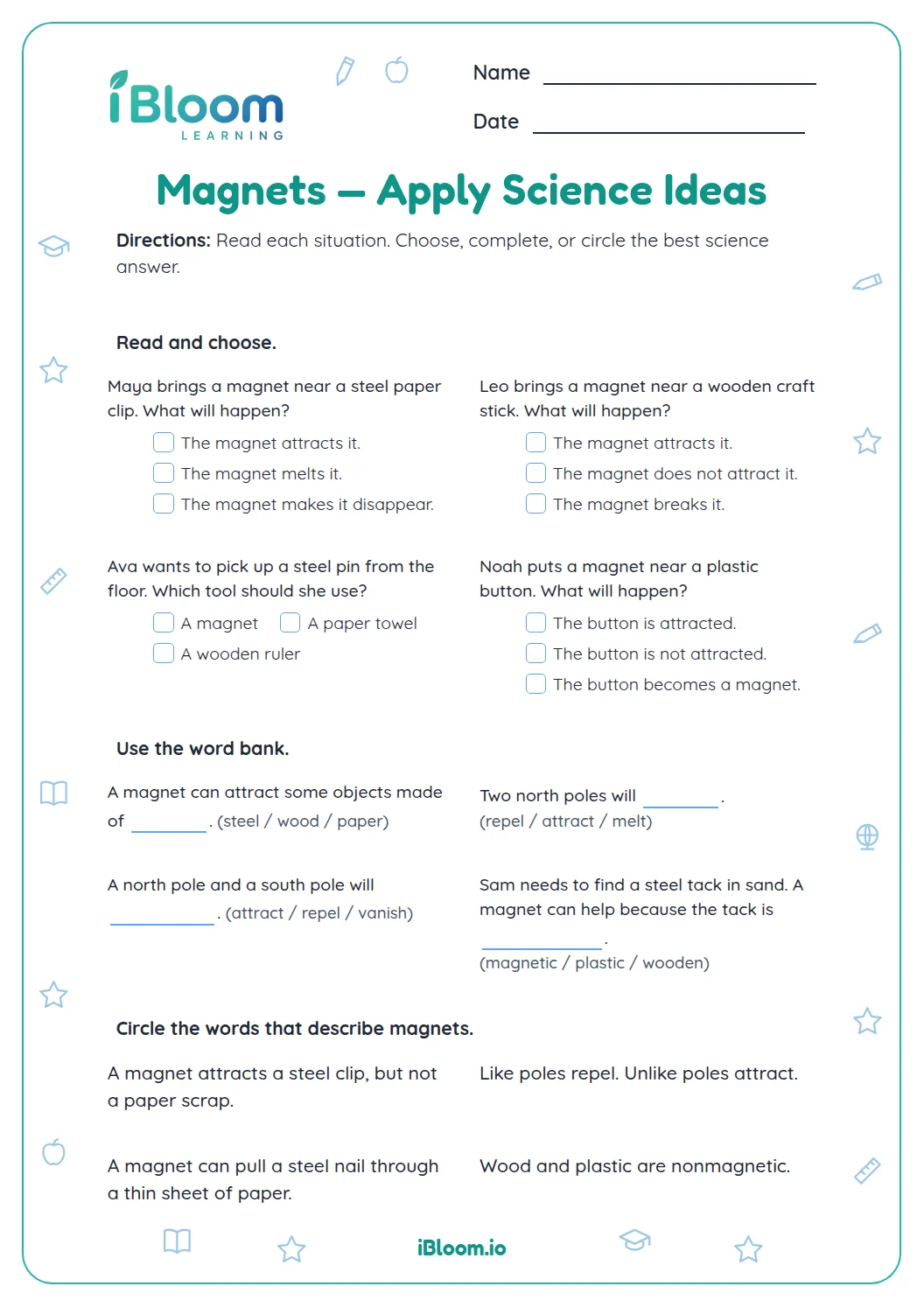
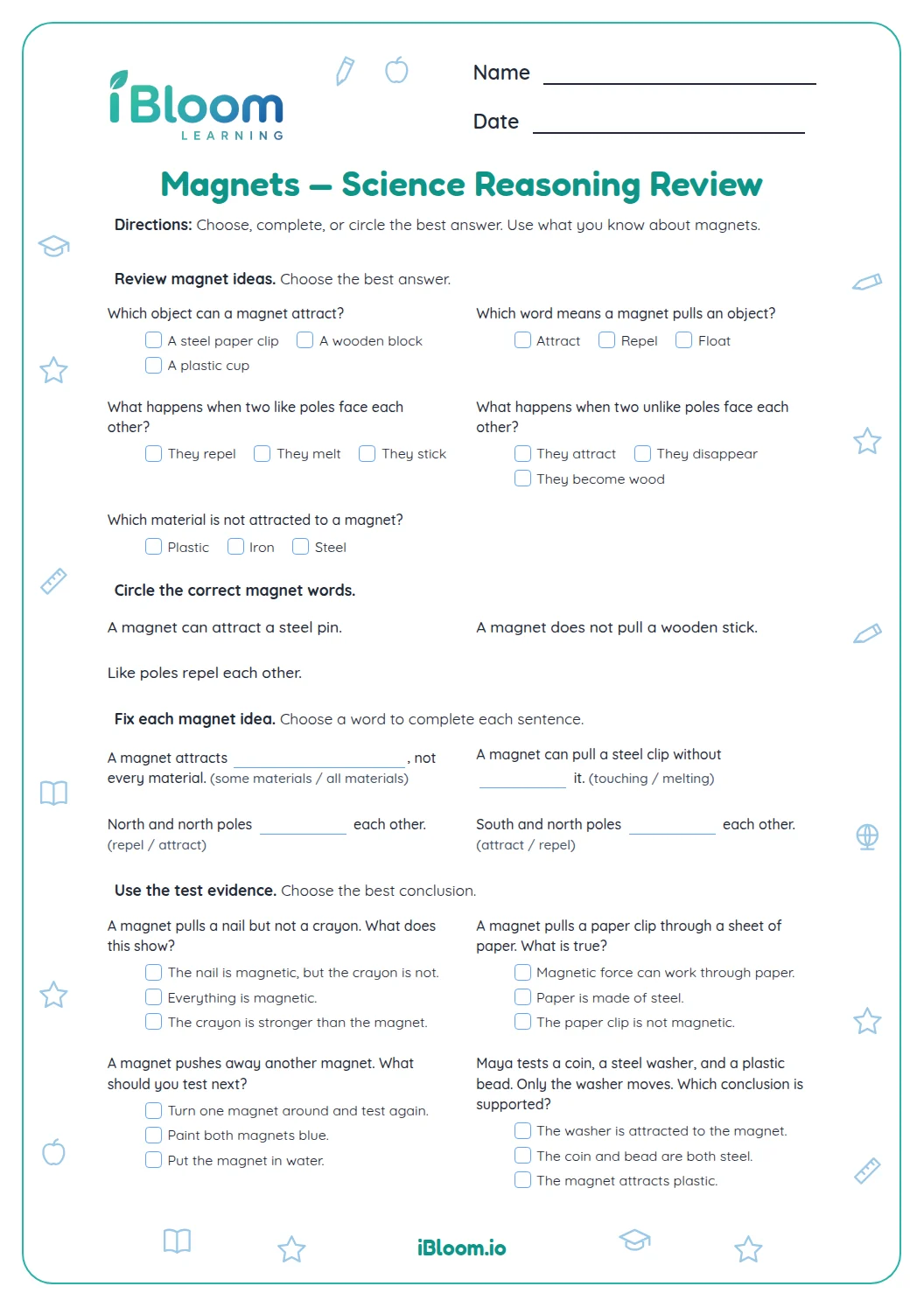
This free printable Grade 1 worksheet connects magnet words with simple models children can draw. Part A names a magnet and its poles. Part B asks which materials magnets attract and how facing poles interact, including a compass example. Part C adds material and pole-pair choices. Part D has three drawing boxes for a labeled bar magnet, an attracting pair, and a repelling pair. The 16 tasks move from labels to predictions and models. An adult can read directions aloud; the answer key gives short answers and drawing features to check.
What do N and S mean on a magnet?
N names the north pole and S names the south pole. A bar magnet has one of each, at opposite ends. The horseshoe magnet in question 1 has a different shape, but it also has two poles.
Part A gives four short labels. Children name the pictured object, expand N and S, and name the two ends together.
How do the pole labels help children predict a pull?
Look at the two ends facing each other. Opposite poles, N and S, attract: they pull together. Like poles, such as N and N, repel: they push apart.
In question 15, both magnets need both labels. Opposite poles face across the gap and arrows point toward it. Question 16 reverses the facing poles; like poles push apart, so the arrows point away.
- 1An N pole faces an S pole.
- 2These are opposite poles.
- 3Choose “pull together.”
Which material should children choose in question 5?
Choose the iron nail when comparing it with wood and plastic. Iron is attracted to a magnet; wood and ordinary plastic are not. The compass question connects a magnet with the direction north.
Check the drawings for scientific meaning, rather than artistic detail. A plain rectangle is enough for a bar magnet when the labels and motion arrows are clear.
How to use this worksheet
- 1Read the four Part A words aloud and identify the horseshoe magnet.
- 2Have the child fill the four blanks and say what N and S mean.
- 3In Part B, point out the material words iron, wooden, and plastic.
- 4Before question 10, place a finger on each facing pole and read the pair aloud.
- 5Use the key to check labels and arrows, then ask the child to explain the pull.
Mistakes to notice and fix
The mistake
Labeling both ends of one magnet N.
The fix
Put N and S at opposite ends of each bar; each magnet has both poles.
The mistake
Choosing the wooden block because it is a solid object.
The fix
Focus on material: the iron nail is attracted, while wood is not.
The mistake
Drawing arrows apart when N faces S.
The fix
Say “opposites pull together” and redraw both arrows toward the gap.
What to practice next
Make more practice
Questions parents and teachers ask
Do we need real magnets to complete this worksheet?
No. The 16 tasks can be completed with a pencil using the word prompts, choices, and drawing boxes. Real classroom magnets can help an adult demonstrate a pull and a push first. The printed answers depend on the stated materials and pole labels.
What should the bar magnet drawing look like?
Draw a simple rectangle with N at one end and S at the other for question 14. The child can add color, but the labels carry the important information. Check that the letters sit at opposite ends so the two poles are easy to identify.
Why does the worksheet say iron nail instead of metal nail?
Iron names a material that a magnet attracts. The word metal includes materials with different magnetic behavior, so it would make the question less precise. Read iron aloud if needed, then contrast the nail with the wooden block and the plain plastic spoon elsewhere on the sheet.
Which way should the arrows point in question 10?
For question 15, both arrows point toward the gap because N faces S. For question 16, N faces N, so arrows point away from the gap. Each bar also needs its other pole labeled. The key describes these features so you can check different clear drawings.
Can I read the magnet questions aloud?
Yes. Reading the prompts aloud lets a first grader focus on magnetic ideas and labels. Pause at north, south, attract, and poles to connect each term to its meaning. Let the child choose the answers and make all three drawings, then explain one choice.