






About this worksheet
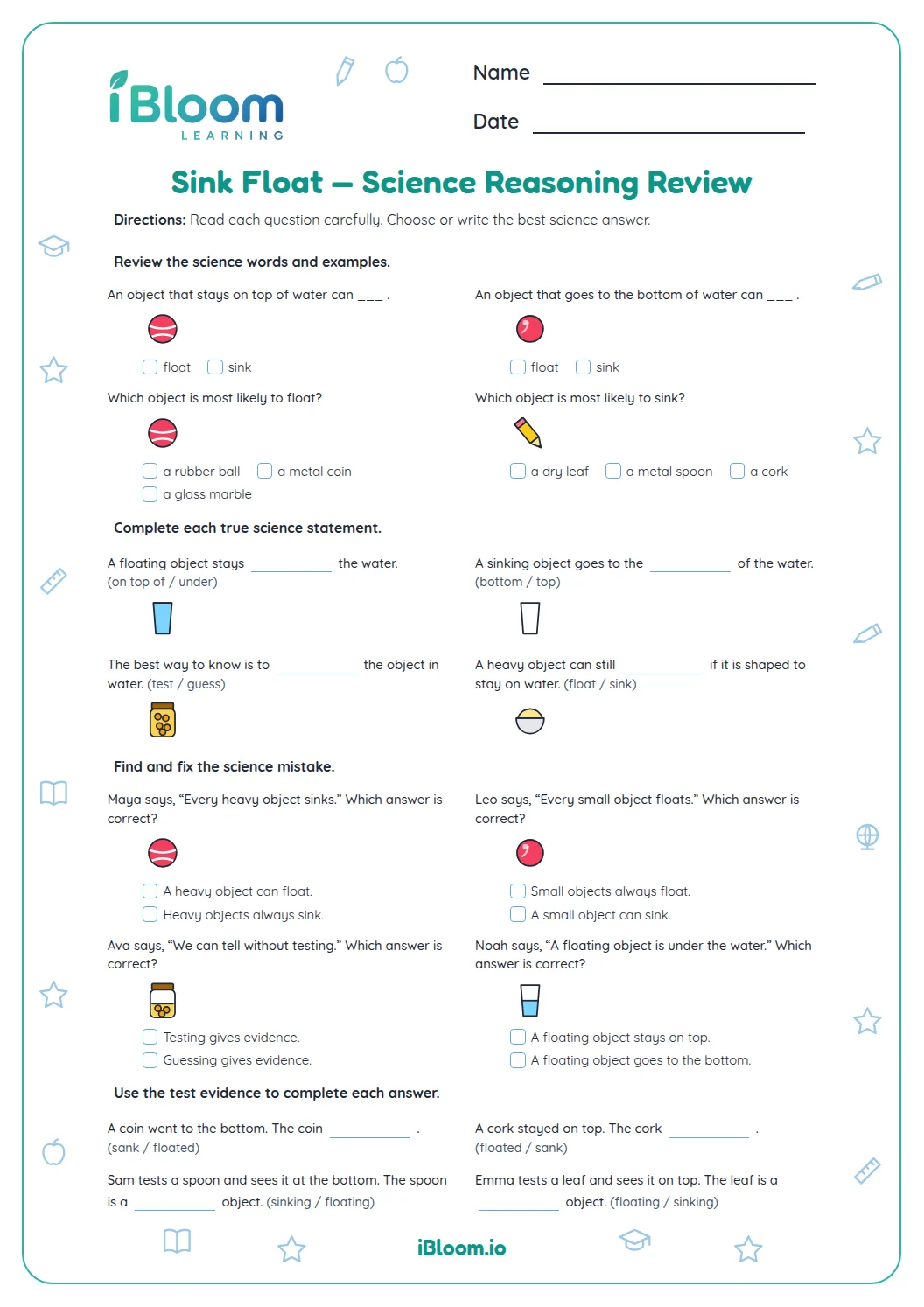
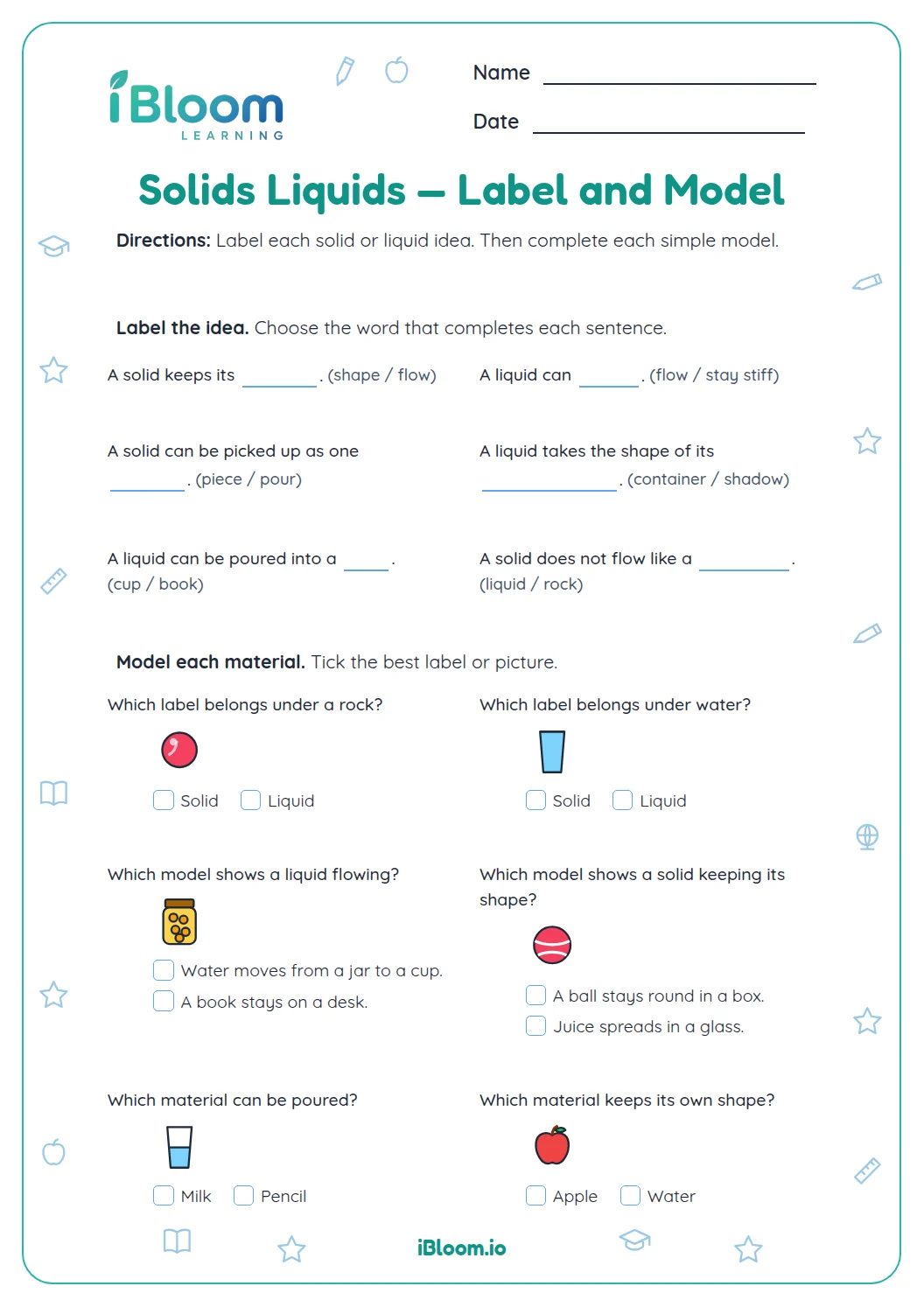
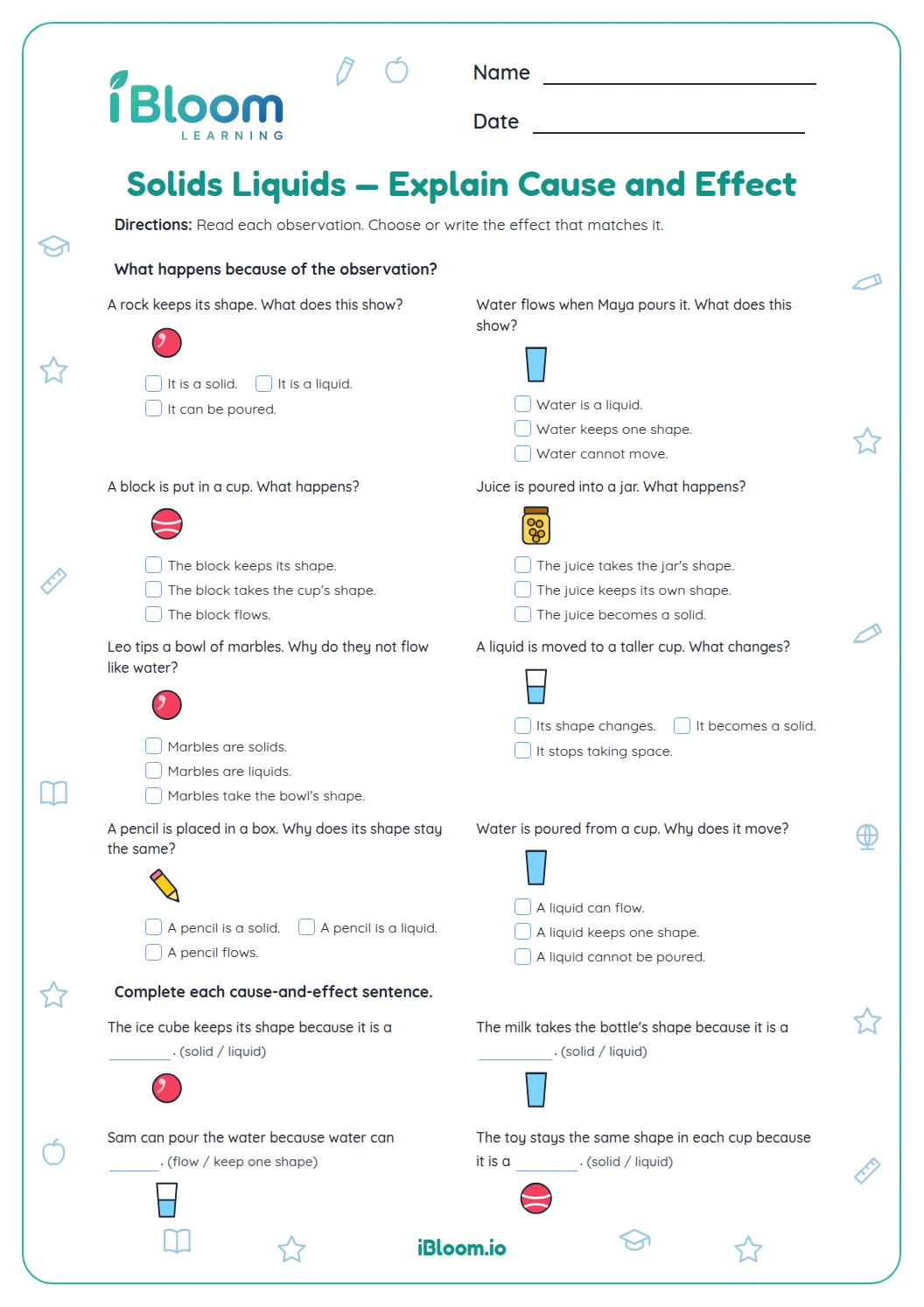
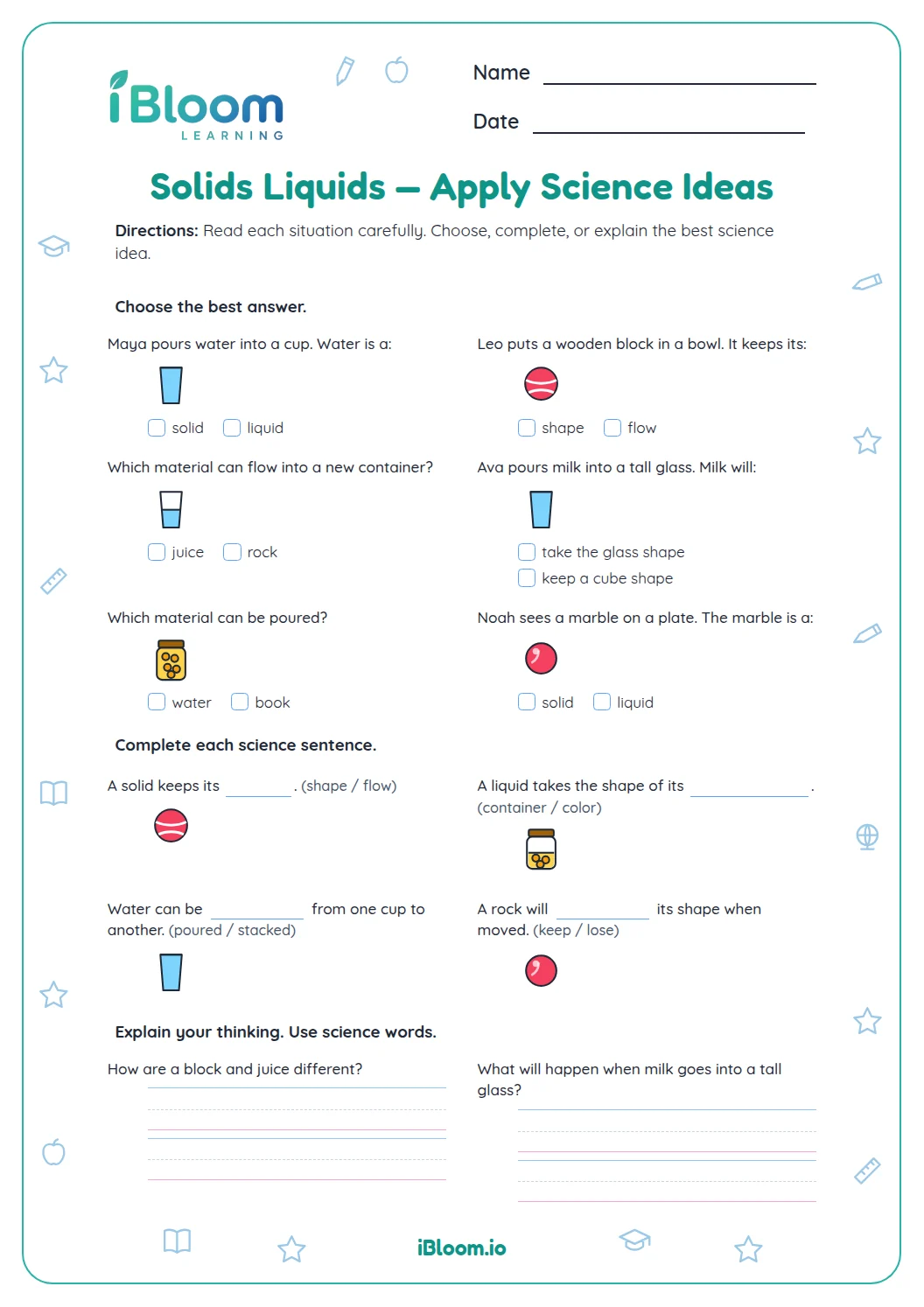
This free printable Grade 1 science worksheet practices predicting whether familiar objects sink or float. Children compare material clues, choose a fair way to test objects, and interpret simple observations. Sixteen questions move from single-object predictions to test choices. A separate answer key supports review at home or in class.
How do I predict whether an object will sink or float?
Think about the object, then make a prediction you can check. A prediction is an idea to test, not a guaranteed answer. Cork, leaves, rocks, and metal objects provide useful comparisons.
Questions 1–6 ask children to predict one object at a time. For example, a small rock is expected to sink, while a cork is expected to float.
- 1Object: cork
- 2Prediction: float
- 3Test: place it gently in water
- 4Observation: record whether it stays at the surface
What material clues can I compare?
Objects can be made from different materials, such as wood, metal, plastic, or rock. The material is one clue to discuss, but an observation from the test is the evidence for the result. The sheet asks children to compare pairs and name what they can observe.
How can I make a fair sink-or-float test?
Use the same water setup for each object and change only the object being tested. Lower each item carefully, watch what happens, and record the result. The clay questions invite children to change its shape and test a new idea.
What is on this worksheet?
The 16 questions progress from predictions to comparisons, a simple model, and plans for gathering evidence. The old page’s general plant prompt has been replaced with activities that directly practice the sink-or-float skill.
- Part A: predict outcomes for familiar objects
- Part B: compare material clues and complete a model
- Part C: plan a fair test and record observations
- Separate answer key
How can I use this worksheet?
- 1Ask the child to predict before reading the choices.
- 2Have them explain what observation would support the prediction.
- 3Compare two objects using the same water setup.
- 4For the clay item, ask what one change they will test.
- 5Check written responses for a clear test or observation.
Common mistakes and quick fixes
The mistake
Treating a prediction as proof.
The fix
Test the object and record what actually happens.
The mistake
Changing several things in one test.
The fix
Keep the container and water setup the same; change only the object.
The mistake
Calling any wet object a floater.
The fix
Watch whether it stays at the surface or goes under the water.
What to practice next
Make more practice
Further reading
Questions parents and teachers ask
What does “float” mean?
An object floats when it stays at the surface of the water instead of sinking beneath it. Children can watch the object after placing it gently in the water. A careful observation helps them record the result, even if it differs from their first prediction.
Does this worksheet ask children to test the objects?
It asks children to predict, choose a careful comparison, and interpret an observation. An adult can extend the page by testing safe objects in a clear container of water. Keep small items away from young children who may put them in their mouths.
Why compare different materials?
Comparing a cork, leaf, rock, key, and other objects gives children examples to discuss. They can name what each is made from, predict what may happen, and check the prediction with an observation. The test result is the evidence they use in their explanation.
What makes a test fair?
A fair comparison uses the same container and water setup for each object. Change the object being tested while keeping the other conditions steady. Then watch carefully and record whether the object remains at the surface or moves below it.
How does the clay question connect to floating?
A piece of clay may sink when shaped as a compact ball. Children are asked to imagine a different shape, such as a wide hollow bowl, then describe how they could test it. This links a prediction to a specific change and an observable result.
Is an answer key included?
Yes. The separate key gives the expected predictions and sample responses for questions with more than one reasonable explanation. Use the prediction answers as a starting point, then let a real water test provide evidence for the result.