




About this worksheet
This free printable Grade 1 science worksheet helps children place each month in its season and see the year as a cycle that repeats. Children label months with winter, spring, summer or fall, finish the month lists for each season, and complete short year models such as March, April, then May. A last part asks which month, or which season, has long days or short days. The practice supports NGSS 1-ESS1-2, relating the amount of daylight to the time of year. Seventeen questions are printed on two pages, with a separate answer key.
Aligned to 1-ESS1-2
What is on this worksheet?
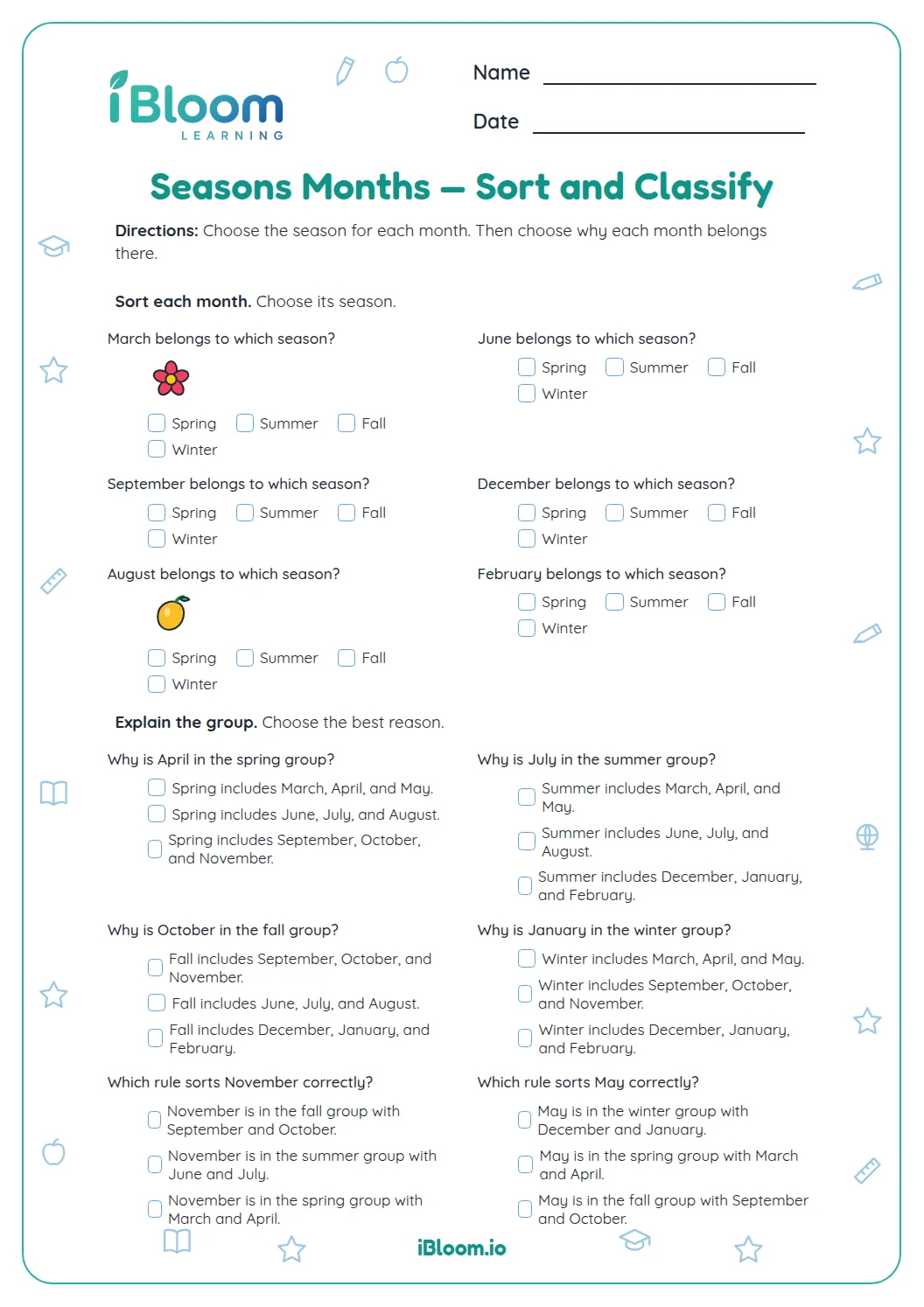
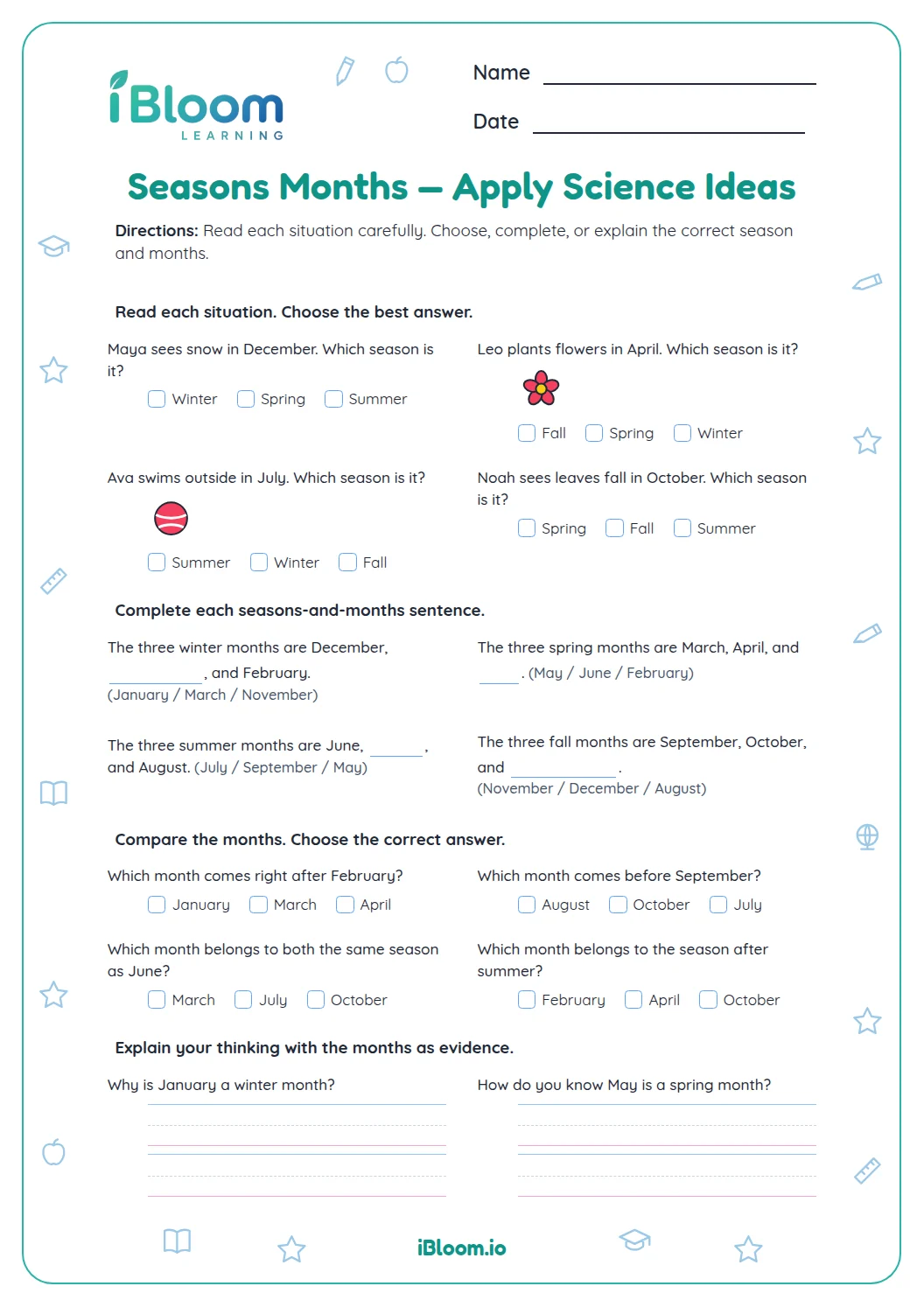
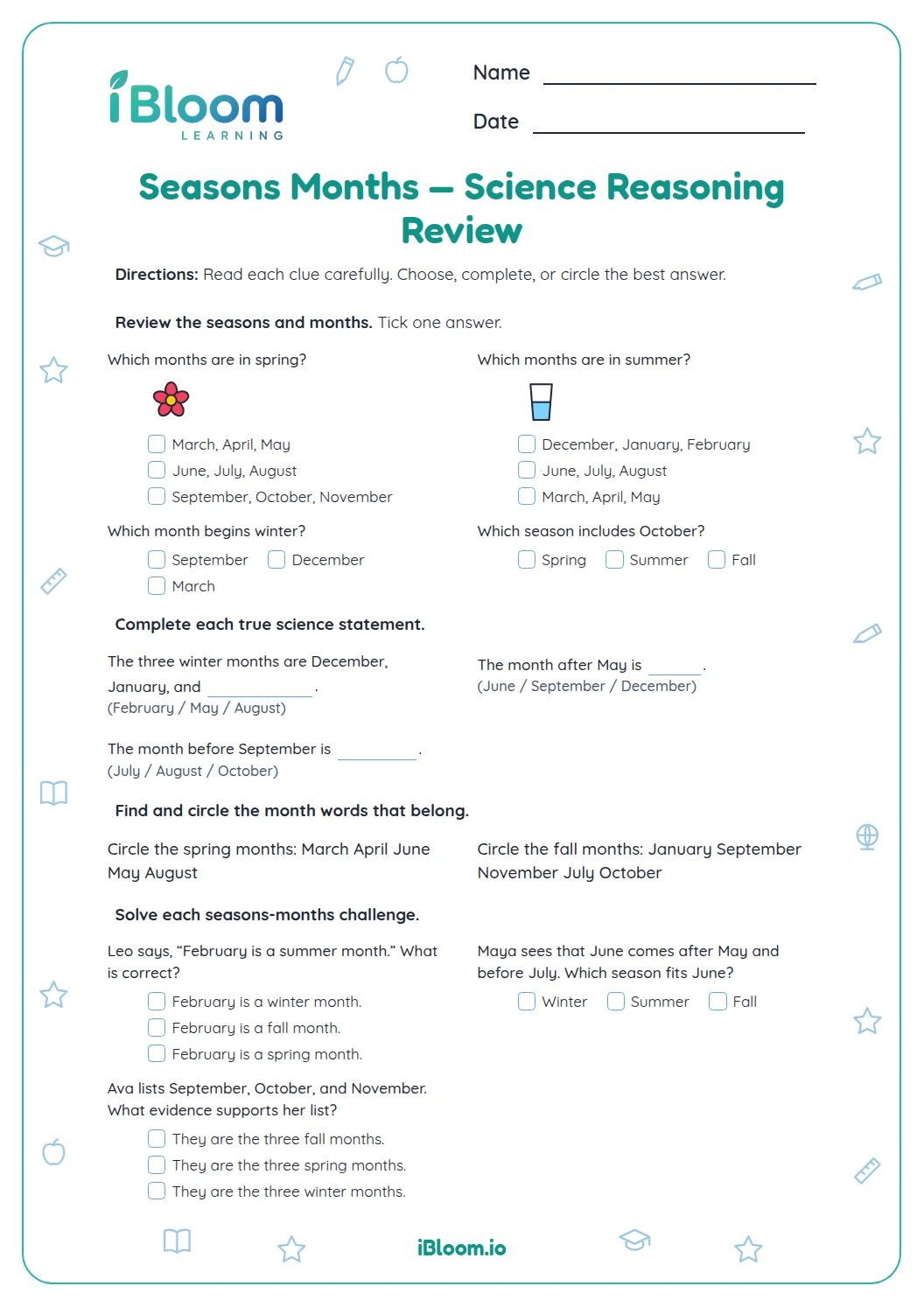
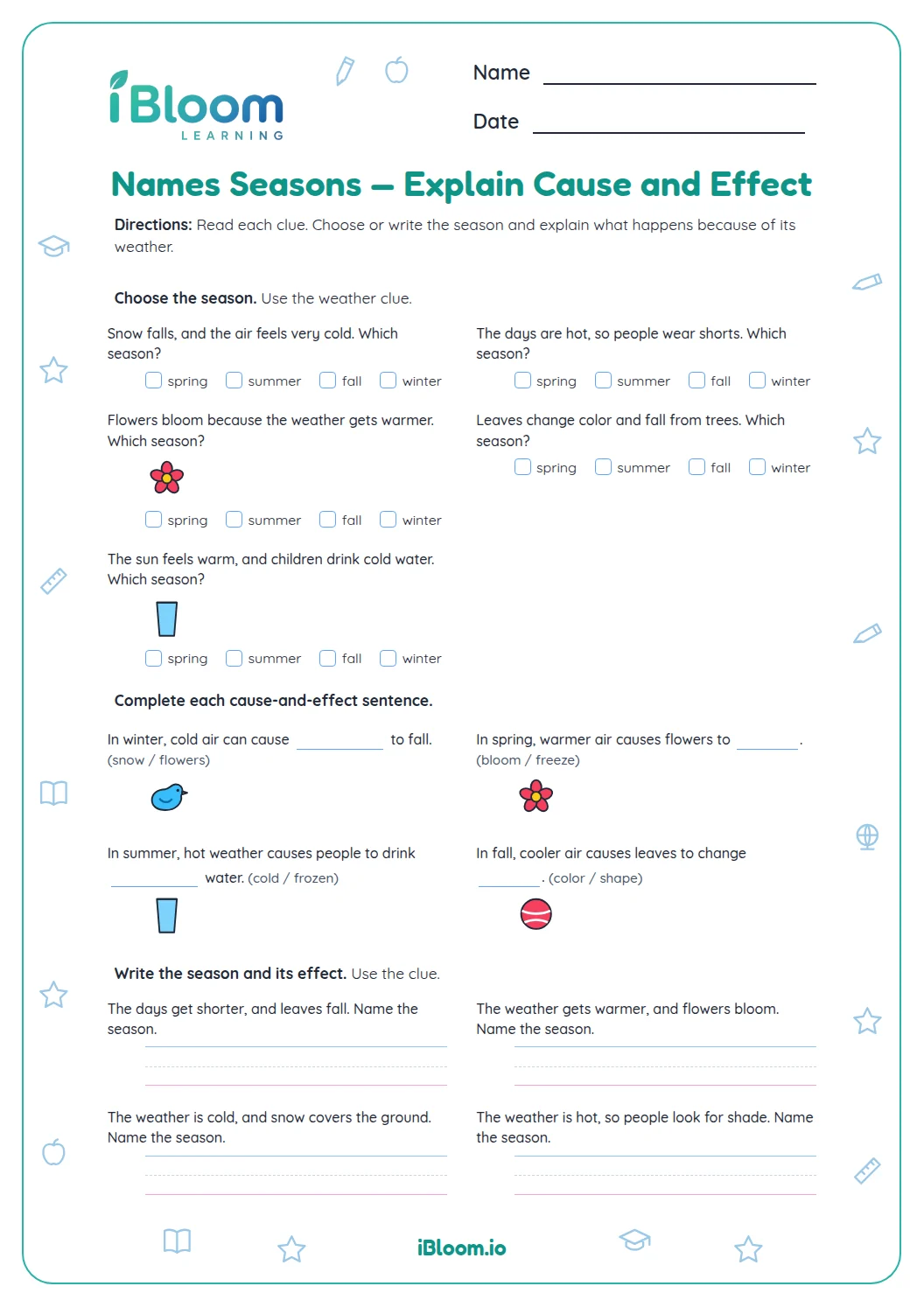
Seventeen questions in four parts. The first two parts are about labels: which season a month belongs to and which month finishes each season. The third part is a model of the year, with a name missing from each short chain. The last part connects the seasons to how much daylight we get.
Every month name is printed on the page, so children do not need to spell them. They can choose, point or write one word.
- Part A, Name the season: six months, four seasons to choose from (questions 1 to 6)
- Part B, Fill in the months: finish each season's list of months (7 to 10)
- Part C, Follow the year: write the missing season or month in a chain (11 to 14)
- Part D, Daylight and seasons: three questions about long and short days (15 to 17)
- A two-page answer key
Which months go with which season?
This sheet groups the months the way many US classrooms do: winter is December, January and February; spring is March, April and May; summer is June, July and August; and fall is September, October and November. Each month belongs to exactly one season, so a child can learn them as four short lists of three.
Part B prints each list with one month missing. Reading a list aloud, such as “Summer includes June, July, and ___,” helps children hear which month finishes it.
- 1Winter includes December, January and ___. → February
- 2Spring includes March, April and ___. → May
- 3Fall includes September, October and ___. → November
Why does the year repeat in the same order?
After fall comes winter again, so the seasons form a circle, and the months do too: after December comes January. Part C asks children to build that model one step at a time.
In question 14, “June → July → ___ → September,” the missing month sits between two that are named. Children use what they know about order: August follows July and comes before September.
- 1Winter → Spring → Summer → ___ → Fall
- 2December → January → ___ → February
- 3June → July → ___ → September → August
How does daylight change through the year?
In the United States the sun is up longest in June and shortest in December. Summer days are long, with light well into the evening, and winter days are short, with the sun going down by late afternoon in many places.
Part D turns that pattern into three questions. Question 15 asks which month has more daylight, and questions 16 and 17 ask which season matches a short day and which matches a long day. A good follow-up is to notice what time the sun sets this week and again in a different season.
How to use this worksheet at home or in class
- 1Say the four season names in order with your child, then say the twelve months in order.
- 2Keep a calendar nearby and find the current month. Ask which season it is in.
- 3Let your child finish Part A, and then read each list in Part B aloud, such as “December, January, February.”
- 4In Part C, say each chain out loud like a song before writing the missing word.
- 5For Part D, talk about when it gets dark in summer and in winter, and ask what your child has noticed.
- 6Check with the answer key, and revisit any chain that was missed on another day.
Common mistakes and quick fixes
The mistake
Choosing June for spring in question 8, because spring is warm and June feels warm too.
The fix
Say the spring list aloud: March, April, May. June is the first month of summer, so it belongs in the next list.
The mistake
Skipping fall in a chain, such as writing Winter after Summer in question 11.
The fix
Count the four seasons on four fingers: winter, spring, summer, fall. After fall the circle starts again with winter.
The mistake
Mixing up long and short days, such as choosing winter when it stays light late (question 17).
The fix
Remember playing outside after dinner. In summer it is still light then, so summer has the long days.
Science standards alignment
Relate the amount of daylight to the time of year.
On this sheet: Part D links long days to June and summer and short days to December and winter, and Parts A to C place every month in its season.
Show the official wordingHide the official wording
Make observations at different times of year to relate the amount of daylight to the time of year.
What to practice next
Make more practice
Further reading
Questions parents and teachers ask
Which months does this worksheet put in each season?
Winter is December, January and February, spring is March, April and May, summer is June, July and August, and fall is September, October and November. Many US classrooms use this grouping because every month belongs to one season. The answer key and Part B both follow it.
Why does winter start on December 1 here, not December 21?
The calendar marks the first day of each season around the 21st, partway through a month. For young children it is easier to learn whole months, so this worksheet uses groups of three. Your child can learn the exact start dates later, once the season order and the month lists feel familiar.
Are the seasons the same everywhere in the world?
No. This worksheet follows the pattern in the United States, in the Northern Hemisphere. South of the equator the seasons are the other way around, so July is a winter month in Australia and Argentina, and December brings summer. The month order stays the same everywhere; only the season each month falls in changes.
Why are there daylight questions on a seasons worksheet?
The amount of daylight is one of the clearest ways to tell seasons apart. In summer the sun stays up late, and in winter it sets early. Part D asks children to connect that pattern to June, December and the seasons, which supports the science standard on the sheet.
My child cannot read the months yet. Can they still do it?
Yes, with a grown-up reading the questions aloud. Every month and season is printed on the page, and children choose from the printed words, so no spelling is needed for Parts A, B and D. Part C has a short word to write, which a grown-up can spell aloud or write alongside.
How can we practice seasons outside of the worksheet?
Name the month and season at breakfast for a week, then keep a simple chart of when the sun sets. Noticing that sunset comes earlier in the fall and later in the spring makes the daylight pattern real. A wall calendar with each season in its own color also helps.