










About this worksheet
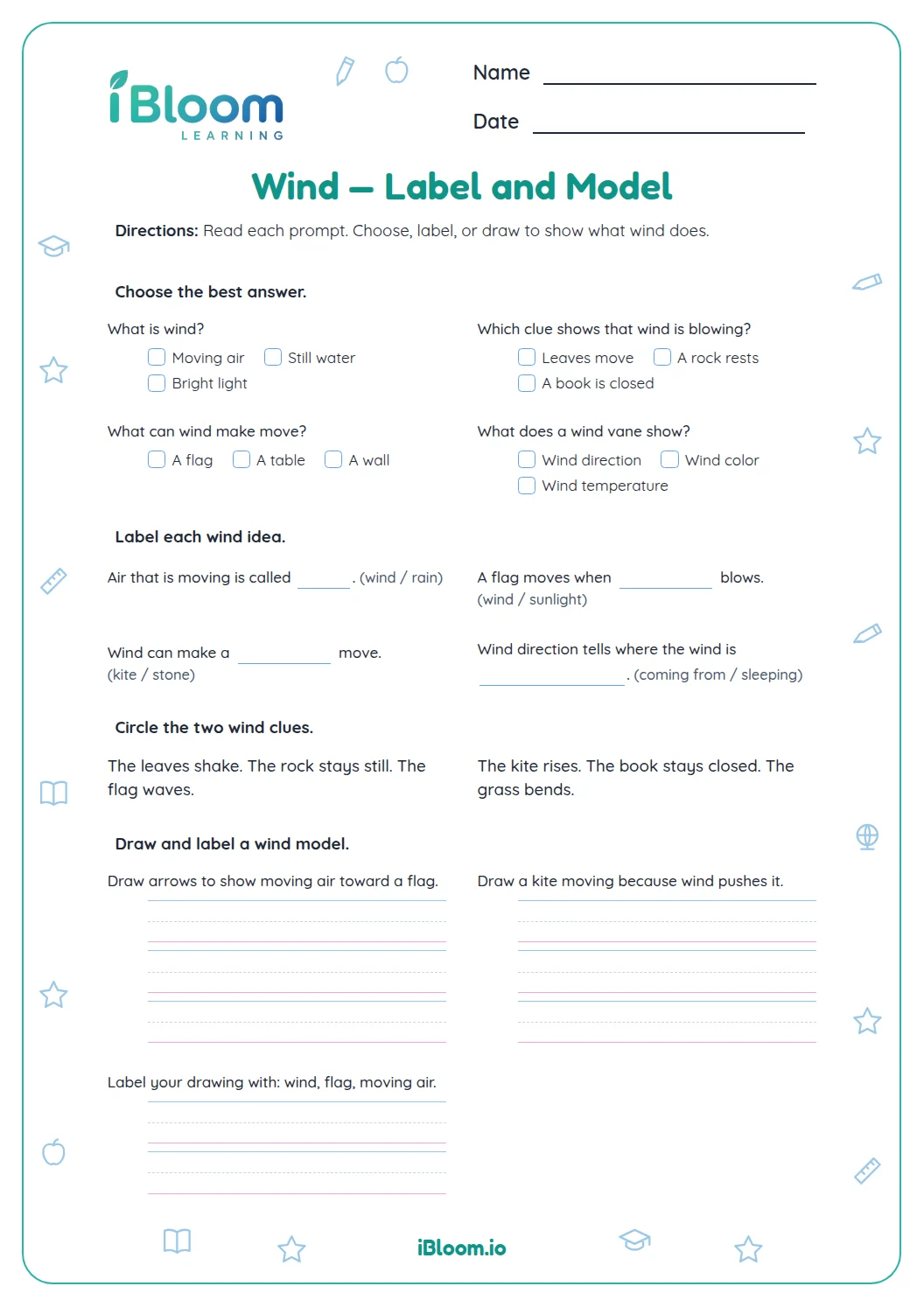
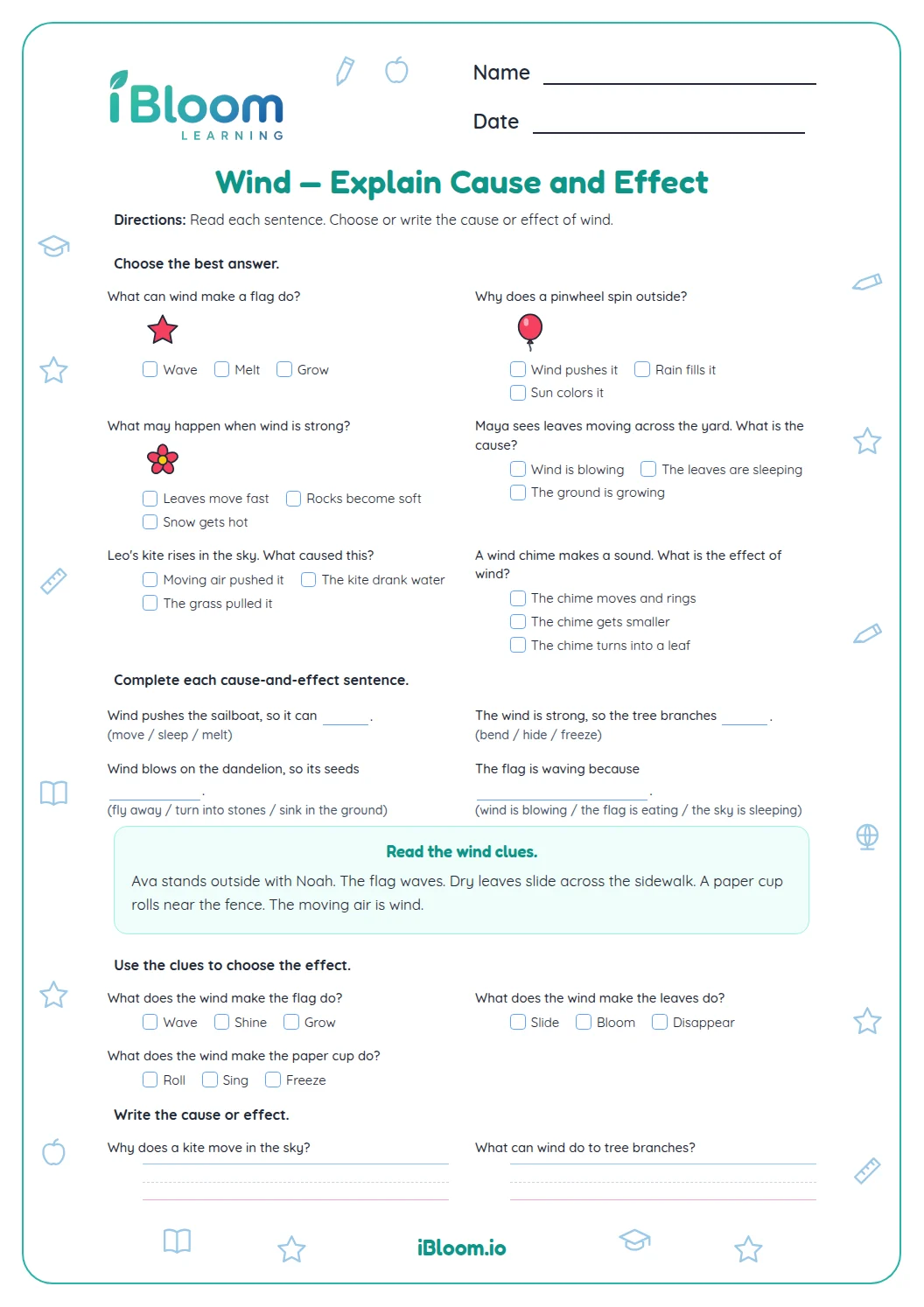
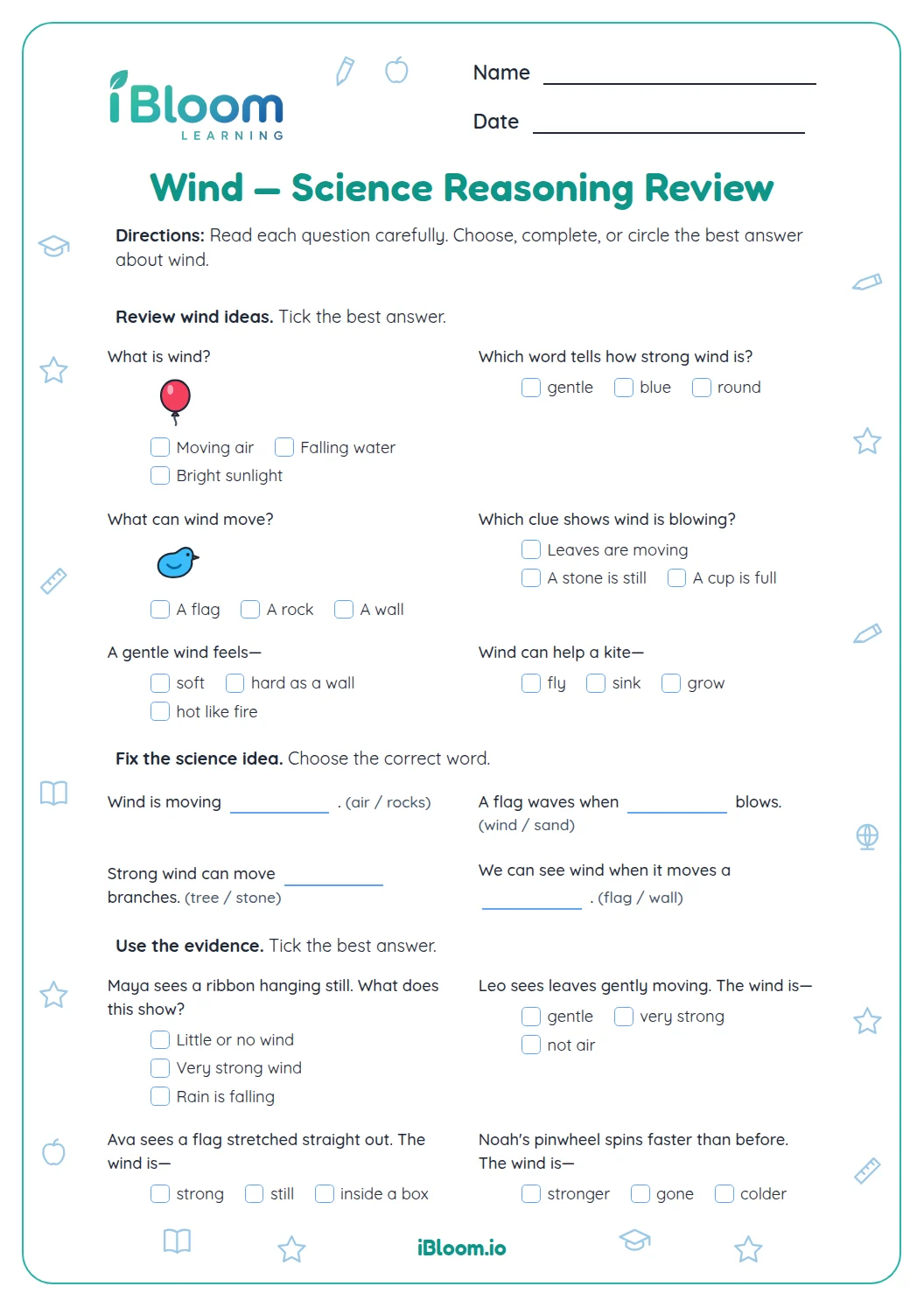
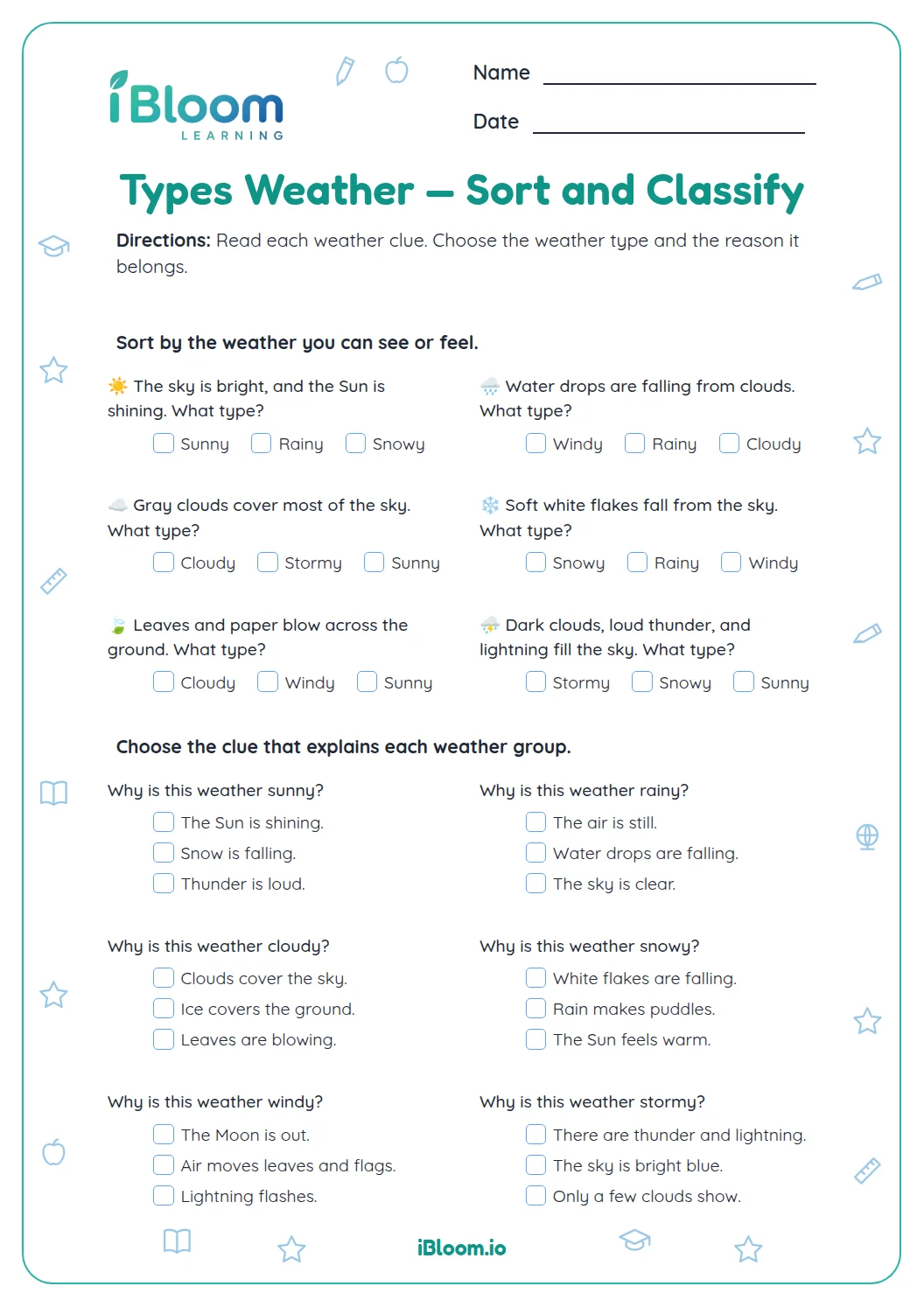
This free printable science worksheet helps Grade 1 children sort and classify what they notice about wind. Wind is air that is moving, and we cannot see it, but we can see what it does. Children decide whether wind is moving five things, such as a kite or a rock, sort three weather clues as calm, breeze or strong wind, and finish with two picture questions about what wind can move. A two-page answer key is included.
What is on this worksheet?
The sheet has three short parts that go from sorting to matching. Every question uses things children may have seen at a park or from a window: kites, flags, leaves, balls and umbrellas.
Each question has one right answer, and a grown-up can read the sentences aloud for children who are still building reading stamina.
- Part A, Wind or not wind: 5 sentences to sort, each with a picture (kite, rock, soccer ball, leaf and toy car)
- Part B, How strong is the wind?: 3 sentences to sort as calm, breeze or strong wind
- Part C, What can wind move?: 2 questions with picture answers (a leaf for a light breeze and a hat for a strong wind)
- A two-page answer key
How can you tell if something moves because of wind?
Ask what is pushing it. A kite rises because moving air pushes against it. A ball that a child kicks is moved by the kick, and a toy car is moved by a hand, so those are not wind. A rock that sits still is not being moved at all.
If the thing is light and open to the air, and no person or animal is pushing it, wind is a likely reason. Leaves swirling across a yard are a good example.
- 1A ball rolls because a child kicks it.
- 2What is pushing the ball? The child's kick.
- 3That is not moving air.
- 4So the answer is Not wind.
How do children tell calm, breeze and strong wind apart?
The signs get bigger as the wind gets stronger. On a calm day a flag hangs straight down and a feather falls straight down. In a breeze, leaves rustle and a kite lifts slowly. In a strong wind, branches bend and an umbrella can flip inside out.
Talking about how big the movement is gives children a simple way to describe wind without a tool.
Why do light things move and heavy things stay still?
A light breeze can push a leaf or a feather but not a rock, because the rock is much heavier and the air pushes with only a small force. A strong wind can blow away a hat.
Part C asks children to match the strength of the wind to what it can move.
How to use this worksheet at home or in class
- 1Go outside or look out a window first. Ask what is moving, and what might be making it move.
- 2Read the Part A sentences aloud with your child and ask “What is pushing it?” for each one.
- 3Do question 1 together, then let your child finish Part A alone and talk about the two kicked or pushed items.
- 4For Part B, act it out: stand still for calm, wave your hands gently for a breeze and sway your whole body for a strong wind.
- 5In Part C, talk about why a leaf moves in a breeze and a rock does not.
- 6Check with the answer key and ask your child to point out one sign of wind on the way home.
Common mistakes and quick fixes
The mistake
Choosing wind for the kicked ball because the ball is moving.
The fix
Moving things are not always moved by wind. Ask what pushes the thing. A kick or a hand is not moving air.
The mistake
Choosing breeze for the flag that hangs straight down in question 6, because flags usually wave.
The fix
Look at what the flag is doing. Hanging straight down means nothing is pushing it, so the air is calm. In a breeze it would lift and flutter.
The mistake
Picking the rock as something a light breeze can move.
The fix
Hold a rock and a leaf and ask which is heavier. A breeze moves light things, like leaves, but a rock stays still.
What to practice next
Make more practice
Questions parents and teachers ask
What is wind?
Wind is air that is moving. We cannot see air, but we can see what wind does: it flaps flags, swirls leaves and lifts kites. This worksheet helps children notice those signs and decide when wind is the reason something moves, and when something else, like a kick, is.
What grade is this wind worksheet for?
It is written for Grade 1 science and weather lessons. The sentences are short, so most Grade 1 readers can work alone, and a grown-up can read aloud for children who need it. The picture questions in Part C also work for Kindergartners who are learning about weather.
What do calm, breeze and strong wind mean?
Calm means the air is hardly moving, a breeze is a light wind, and strong wind is a wind that moves big things. Children tell them apart by the signs: a hanging flag is calm, rustling leaves are a breeze, and bending branches are strong wind.
Why is a rolling ball not an example of wind?
Wind is moving air, and the ball in question 3 is moved by a kick, not by air. It is easy to think wind whenever something moves outdoors. Ask what pushes the thing: a kick, a hand or a person means not wind, while moving air means wind.
How long does the worksheet take, and is there an answer key?
Most Grade 1 children finish in about 15 minutes. The two-page answer key matches the worksheet page for page and shows each correct choice, including the picture answers in Part C, so you can print the worksheet alone and check the answers together afterward.
How can my child explore wind at home?
Go outside on a breezy day and look for signs of wind: flags, leaves, tree branches and clothes on a line. Try dropping a feather and a pebble together, or blowing on both to see which moves. Ask your child to say whether the wind is calm, a breeze or strong.