






About this worksheet
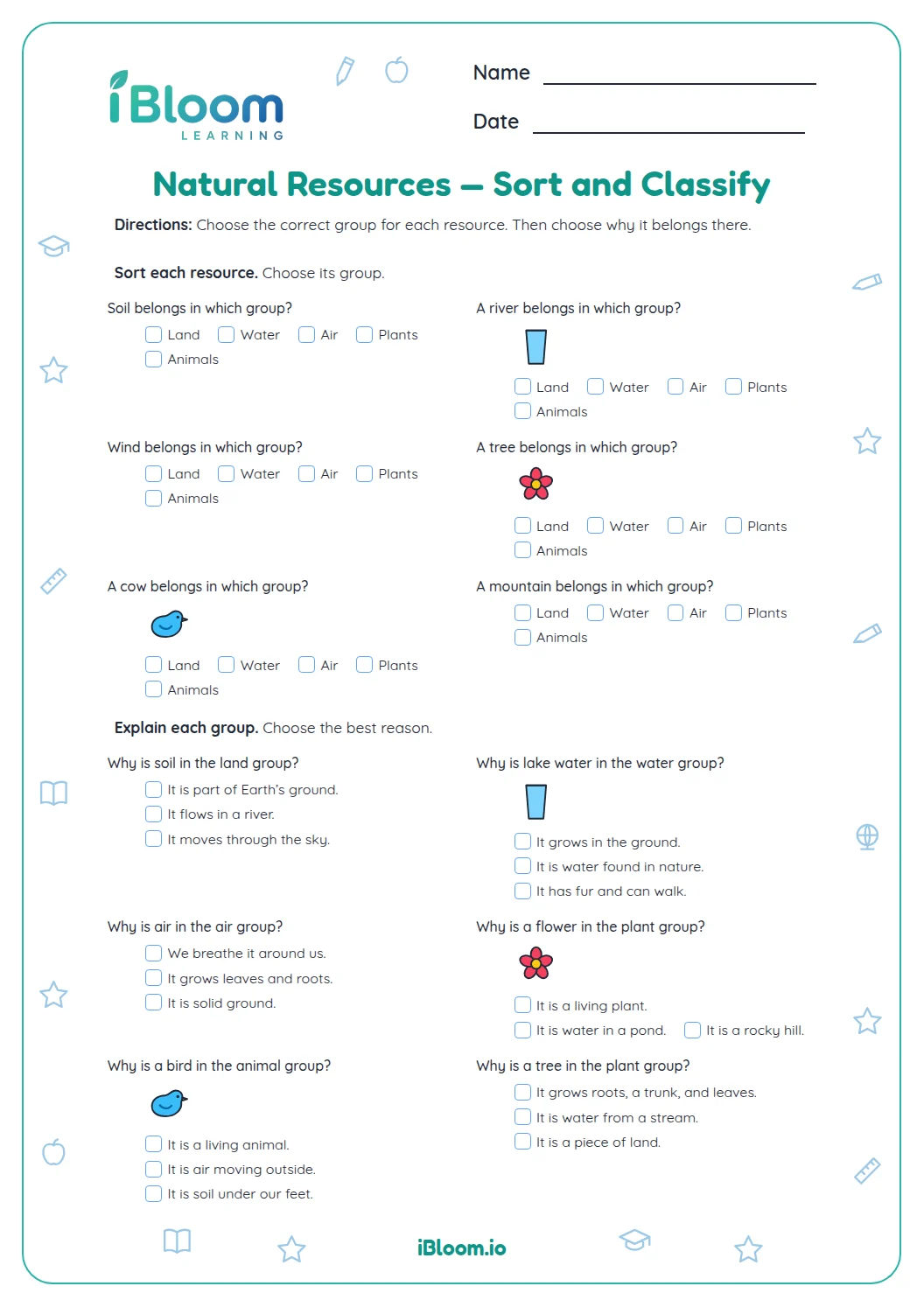
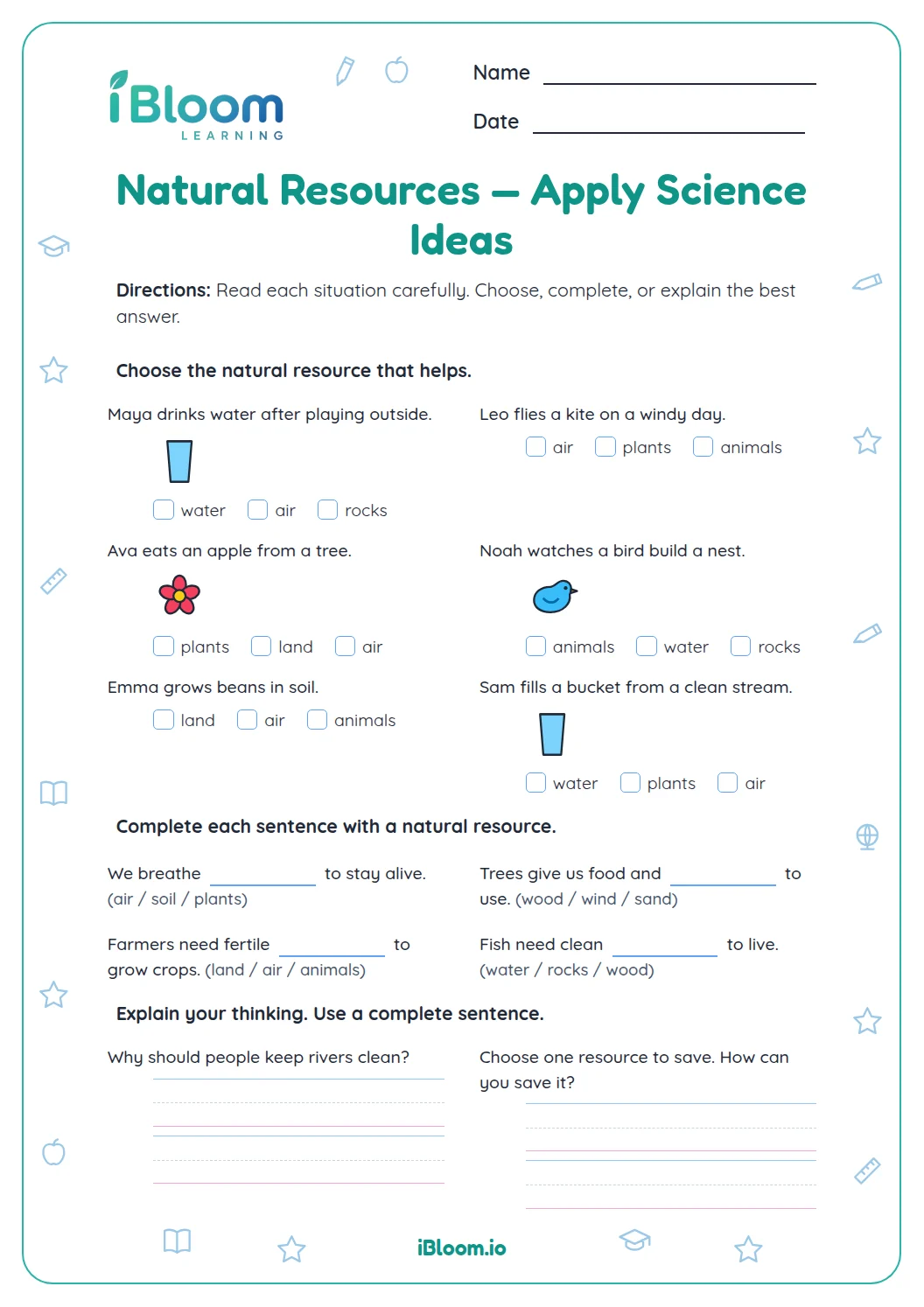
This free printable worksheet introduces Grade 2 students to natural resources, the things people and animals use that come from nature. In Part A, children label a resource from a clue: water, animals and rocks. In Part B, they pick the natural resource in two sets of pictures. In Part C, they finish four arrow models that show a resource becoming something we use, such as Tree → wood → a chair. In Part D, they write one sentence about a resource they used today. A two-page answer key is included.
What is on this natural resources worksheet?
Ten questions in four parts. Each part asks children to do something a little different with the same idea, so they meet natural resources as words, pictures and short cause-and-effect models.
Part A gives a clue and asks for the resource. Part B uses pictures, with one natural resource and two things made by people in each set. Part C finishes arrow models such as “Sunlight → plants → food to eat.” Part D asks for one sentence in the child's own words.
- Part A: label water, animals and rocks from a clue (questions 1 to 3)
- Part B: pick the natural resource in two picture sets (questions 4 and 5)
- Part C: complete four arrow models about rain, sunlight, trees and cows (questions 6 to 9)
- Part D: write about a resource you used today (question 10)
How can a child tell a natural resource from something made by people?
Ask: “Did this come from nature, or did a person make it?” A tree, the sun and a cow come from nature. A car, a chair and a radio are made by people, even though the materials in them began in nature.
Part B uses this question twice. In question 4, the car and bicycle are made by people, and the tree is the natural resource. In question 5, the sun is natural, while the chair and radio are made.
How do children read an arrow model?
Each model is a short chain. The arrow means “gives us” or “turns into,” so Rain → river → ___ reads “rain fills a river, and the river gives us…” Children pick what comes at the end, which shows how a resource from nature becomes something people use.
Read each chain aloud with every choice and ask, “Does that come next?” A river gives water to drink, not air or rocks.
- 1Tree → wood → ___
- 2A tree gives us wood.
- 3What can people make from wood? A chair.
- 4A rock and a cloud are not made from wood.
- 5Answer: a chair
Why teach natural resources in Grade 2?
Second graders already use air, water, soil, plants and animals every day without naming them. Giving each one a name and a job helps children see where everyday things come from.
These names also give children words for later lessons on energy, renewable resources and saving resources.
How to use this worksheet at home or in class
- 1Start with a quick talk: “What did you use today that came from nature?” Water, air and wood are easy examples.
- 2Read the Part A clues aloud and let your child say the answer before marking it.
- 3For Part B, ask the question “Did a person make it?” for each picture before choosing.
- 4In Part C, read each arrow chain aloud with each choice, and listen for the one that comes next.
- 5For question 10, let your child say the sentence first, then write it with a capital letter and a period.
- 6Check with the answer key, then go outside and find three natural resources together.
Common mistakes and quick fixes
The mistake
Choosing the car in question 4 because it is made of metal, and metal comes from the ground.
The fix
Separate the material from the thing. Metal began in nature, but the car is made by people, so the tree is the natural resource.
The mistake
Choosing air to breathe for question 6, Rain → river → ___, because air and water are both all around us.
The fix
Follow the arrows one at a time: rain fills a river, and a river holds water. Ask, “What do we get from a river?” Water to drink.
The mistake
Choosing soil for question 2 because animals live on the land.
The fix
Read the clue again: milk, eggs and wool. Ask which of the three things gives them. Cows, hens and sheep are animals, so the answer is animals.
What to practice next
Make more practice
Questions parents and teachers ask
What counts as a natural resource on this worksheet?
Air, water, soil, rocks, plants, animals and sunlight all count. They come from nature, and people use them every day. Part A names water, animals and rocks, Part B includes a tree and the sun, and the Part C models follow rain, sunlight, a tree and a cow to something people use.
Why is a car not a natural resource in question 4?
A car is made by people, even though its metal began in the ground. A natural resource is the material in nature itself, such as the tree, the sun or the water. That difference between the thing and its materials is the main idea of Part B.
Is the sun a natural resource?
Yes. Sunlight comes from nature, and people and plants use it. Plants need it to grow, and solar panels turn it into electricity. In question 5, the sun is the natural resource, while the chair and radio are things people made.
What if my child's sentence in question 10 is different from the sample?
That is fine, because the key shows only one sample, such as “I drank water to stay healthy.” Any real resource and use is correct. Check that the sentence names a natural resource, such as water, air or wood, and tells how your child used it.
How can I make natural resources real at home?
Take a short walk and ask your child to point out natural resources: the air they breathe, a tree, a rock, a puddle. Then ask which things nearby were made by people. Sorting what you see into natural and made is the same thinking as Part B.
What should we practice after this worksheet?
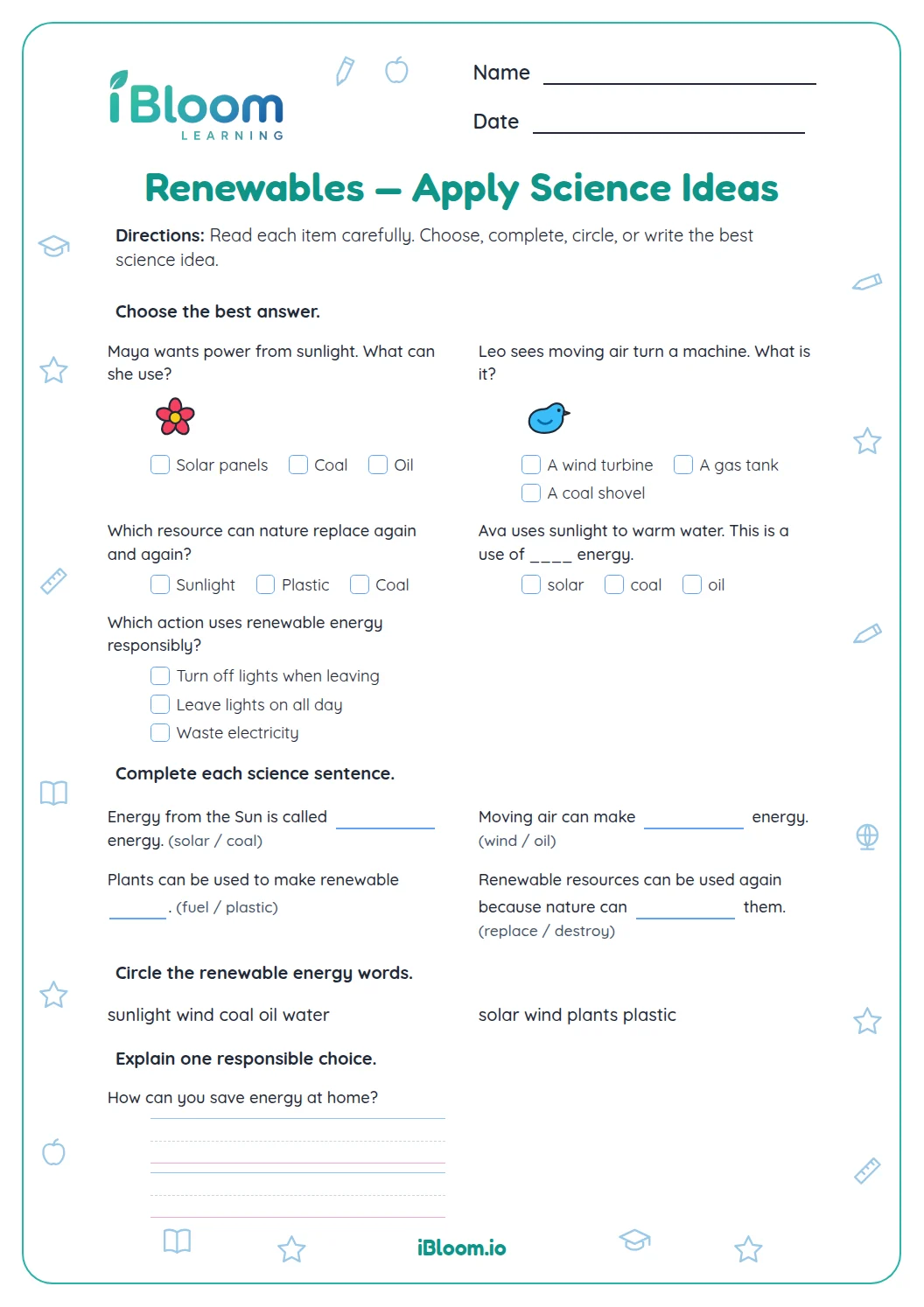
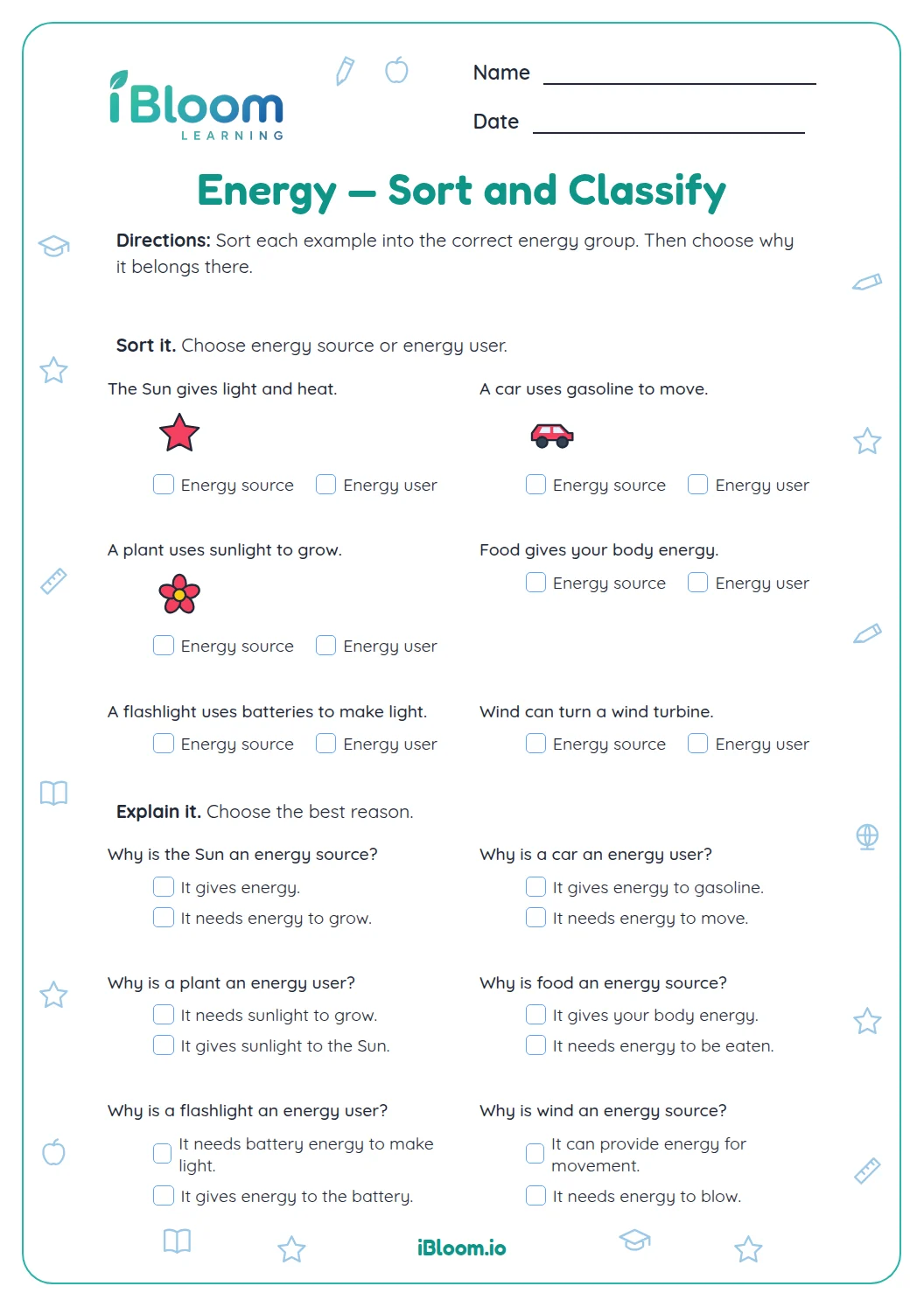
Renewables is a natural next step, since it looks at resources such as sunlight and wind that do not run out. Energy and resource conservation follow. Each builds on the idea that natural resources are useful and that people can choose how to use them.