





About this worksheet
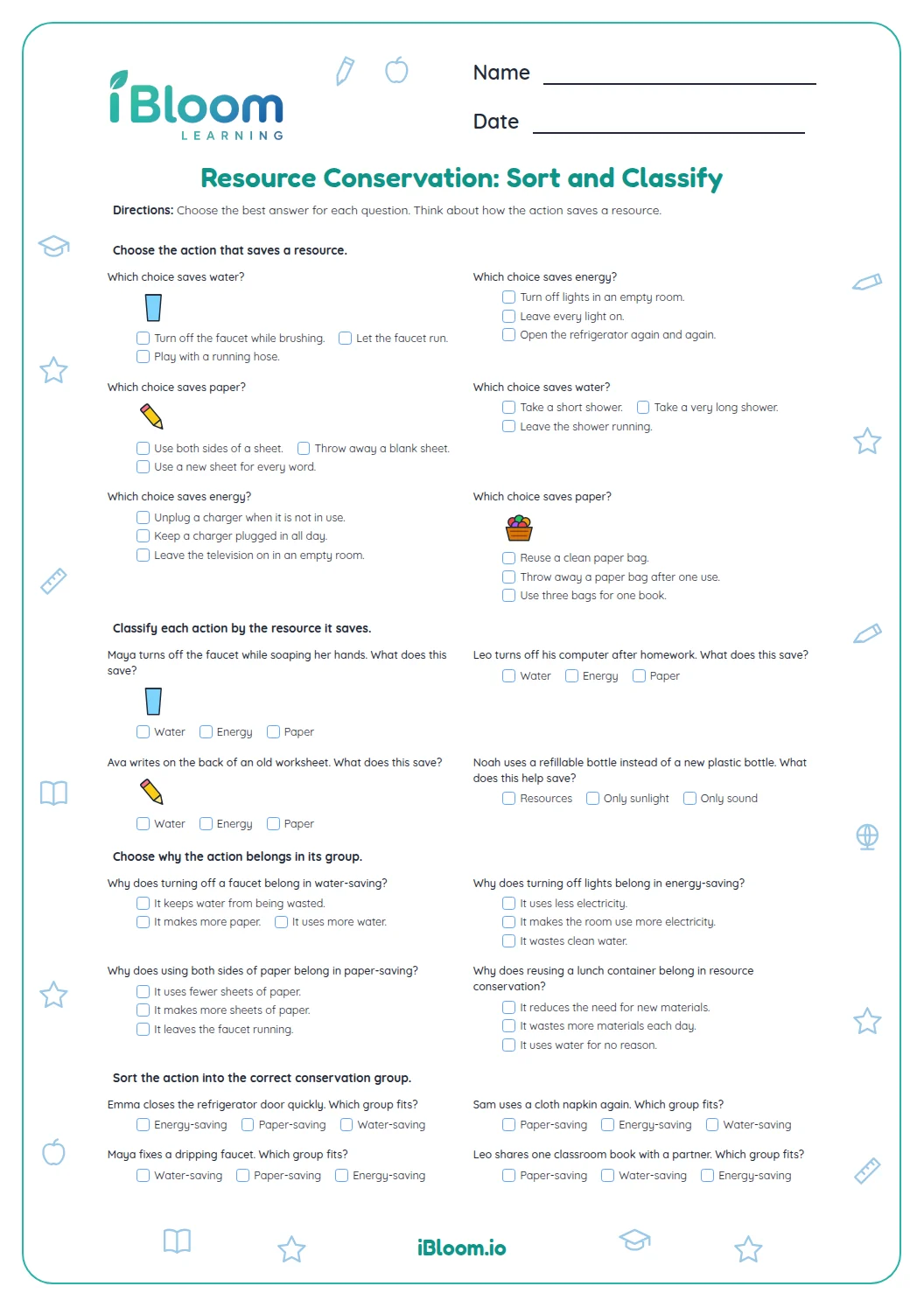
This Grade 2 resource conservation worksheet turns familiar routines into science decisions. Students choose ways to save water while brushing teeth, reuse paper and containers, reduce trash, and save electricity. Later questions ask them to name what an action conserves and explain why a helpful choice matters. The answer key gives the expected resource and sample explanations, while allowing equivalent sensible wording.
Which everyday choices save resources?
Part A presents home and classroom situations. Students choose practical ways to use less water, paper, packaging, or electricity.
- 1While brushing, the tap can keep running or be turned off.
- 2Turning off the tap uses less water.
- 3Choose “Turn off the tap.”
How can students name what an action saves?
Part B asks students to connect actions with the resources they affect. For instance, using both sides of a worksheet reduces paper waste.
How can a student explain a conservation choice?
Part C invites students to explain why a reusable container helps and suggest another use for clean paper with a blank side.
How to use this worksheet
- 1Read each situation and identify the resource involved.
- 2Compare both choices before marking an answer in Part A.
- 3In Part B, choose what the action saves or which next step helps.
- 4In Part C, write a short explanation or one practical reuse idea.
- 5Use the key to discuss other practical answers that make sense.
Helpful reminders
The mistake
Choosing any “green” action without matching it to the situation.
The fix
Name the resource first, then choose the action that saves or reuses it.
The mistake
Saying recycling fixes every kind of waste.
The fix
Check whether the example is about using less, reusing an item, or recycling suitable material.
The mistake
Writing only “good” as an explanation.
The fix
Add what is saved and how, such as “It saves electricity because the light is off.”
What to practice next
Make more practice
Questions parents and teachers ask
What resources appear on the worksheet?
The situations focus on water, paper and other materials, and electricity. Students consider actions such as turning off a faucet, using both sides of paper, choosing reusable containers, and switching off a light in an empty room. Each example asks learners to connect a routine with a resource.
Is this worksheet appropriate for Grade 2?
Yes. The questions use familiar home and classroom routines and ask children to recognize a helpful choice, name a resource, or give a short reason. The explanations can be a clear phrase or a sentence, depending on the learner and how much writing practice is appropriate.
Do students need special science materials?
No materials are needed. The page uses printed situations about everyday choices, so students can work independently or talk through each example with a teacher or caregiver before writing. They may also point out similar resource-saving actions they notice in their classroom or home.
What counts as a correct written explanation?
The answer key gives a sample reason, but other accurate explanations are acceptable. For example, a washable container can be used again and can replace a disposable one. Look for an answer that explains how reuse reduces the need for new materials or packaging.
How can we extend the activity at home?
Invite the child to notice one resource-saving action during the day, such as turning off a faucet or reusing a container. Ask which resource it affects and how the action reduces waste or use. Naming both the action and its effect helps connect the worksheet to daily routines.