






About this worksheet
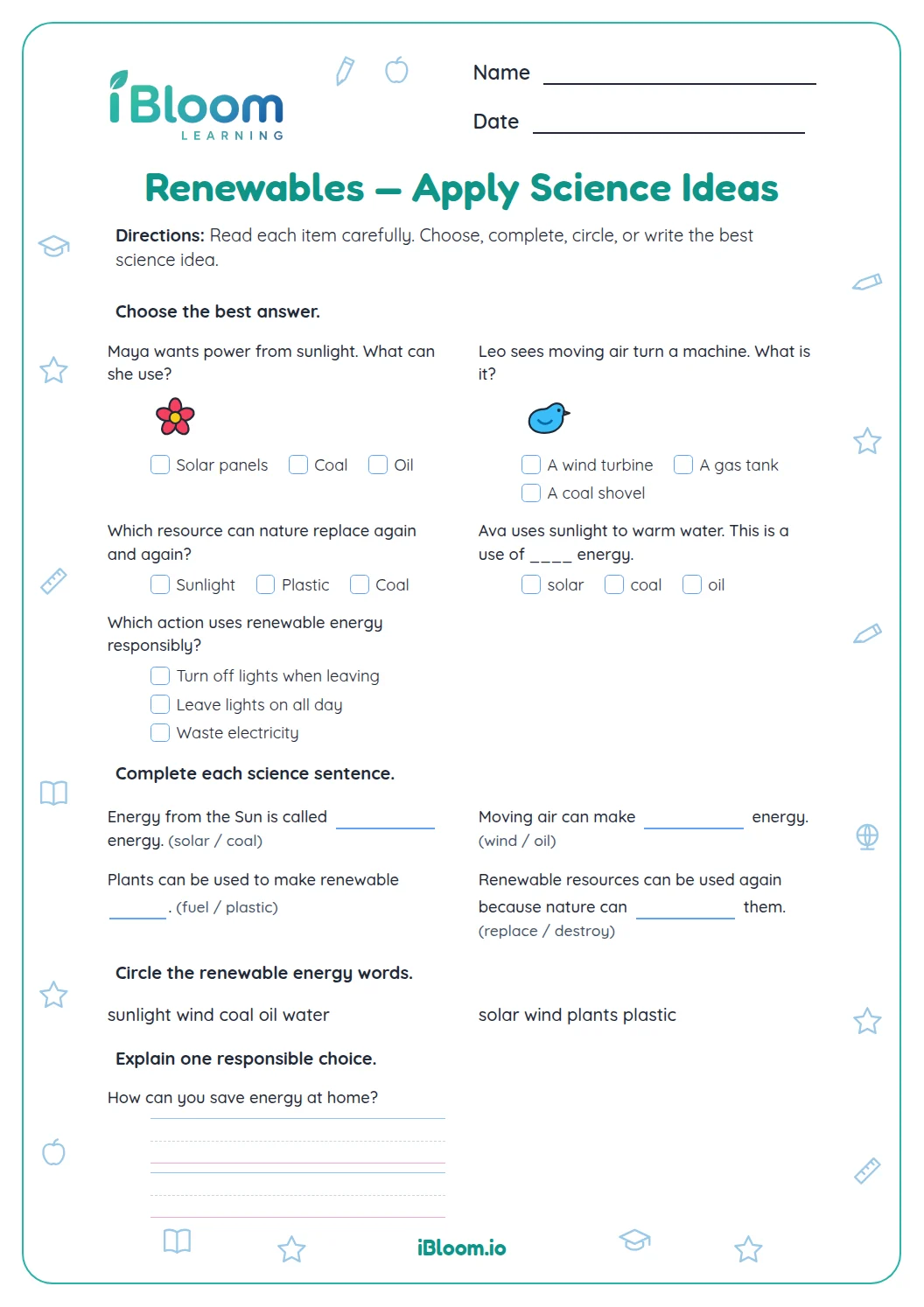
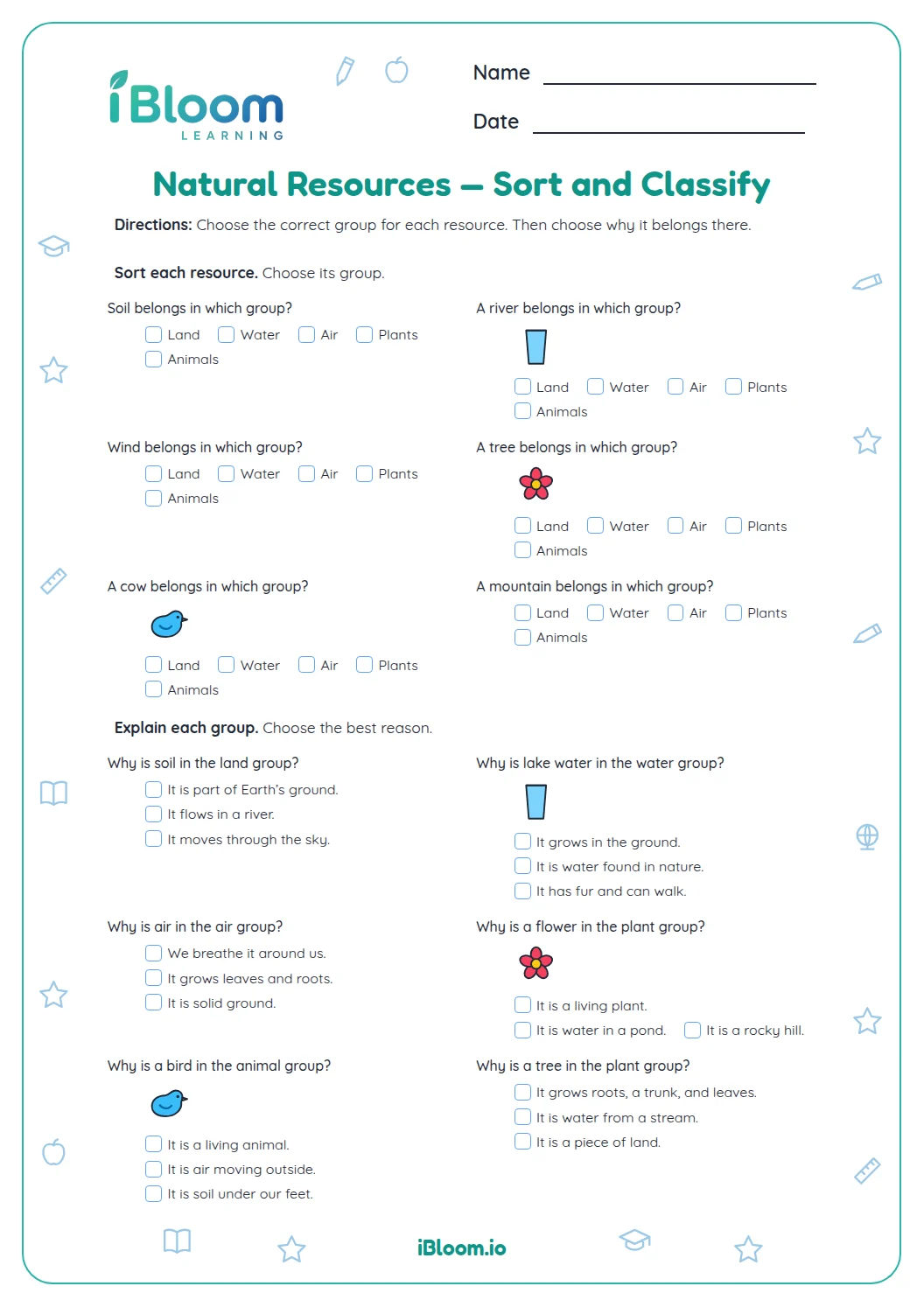
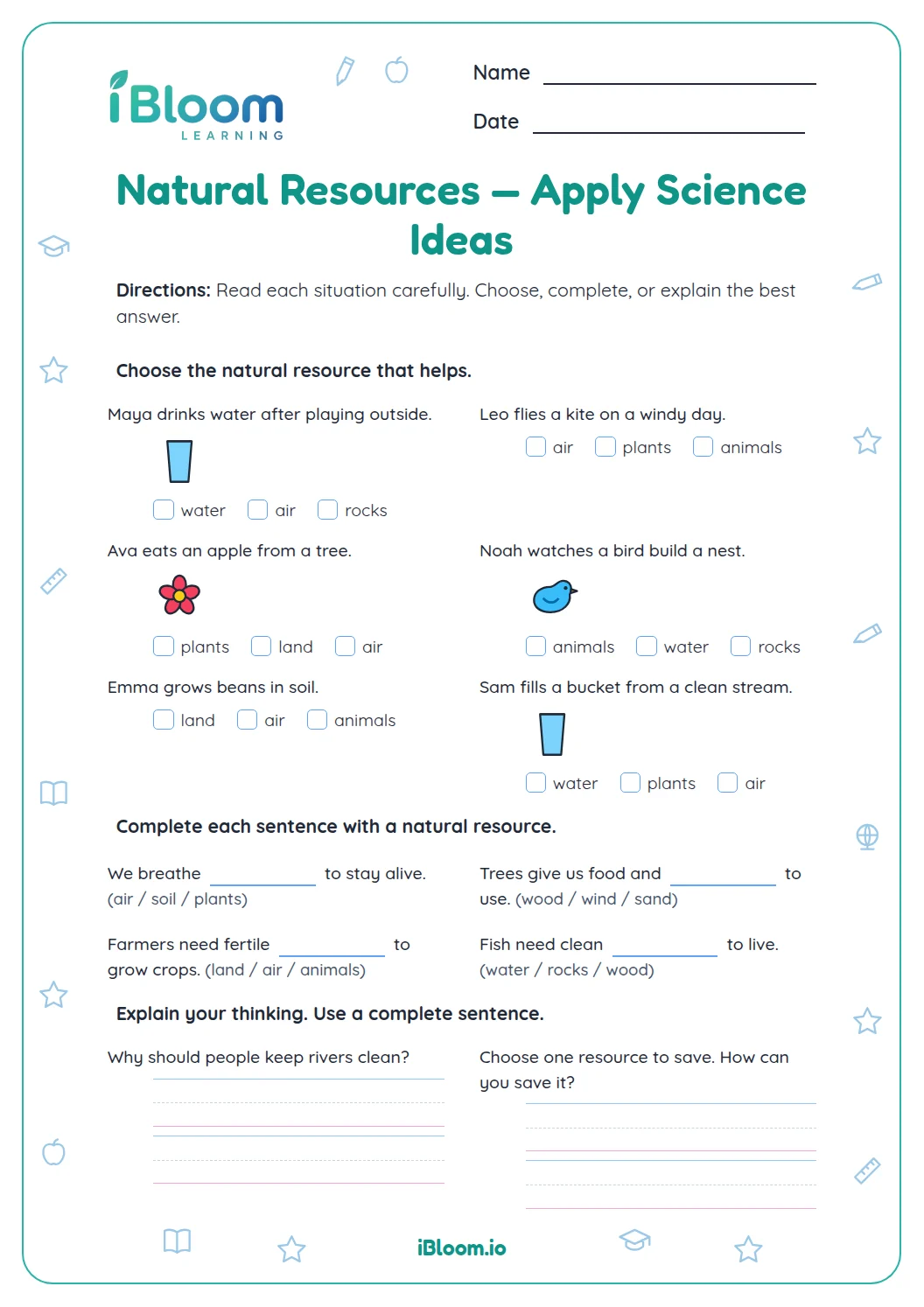
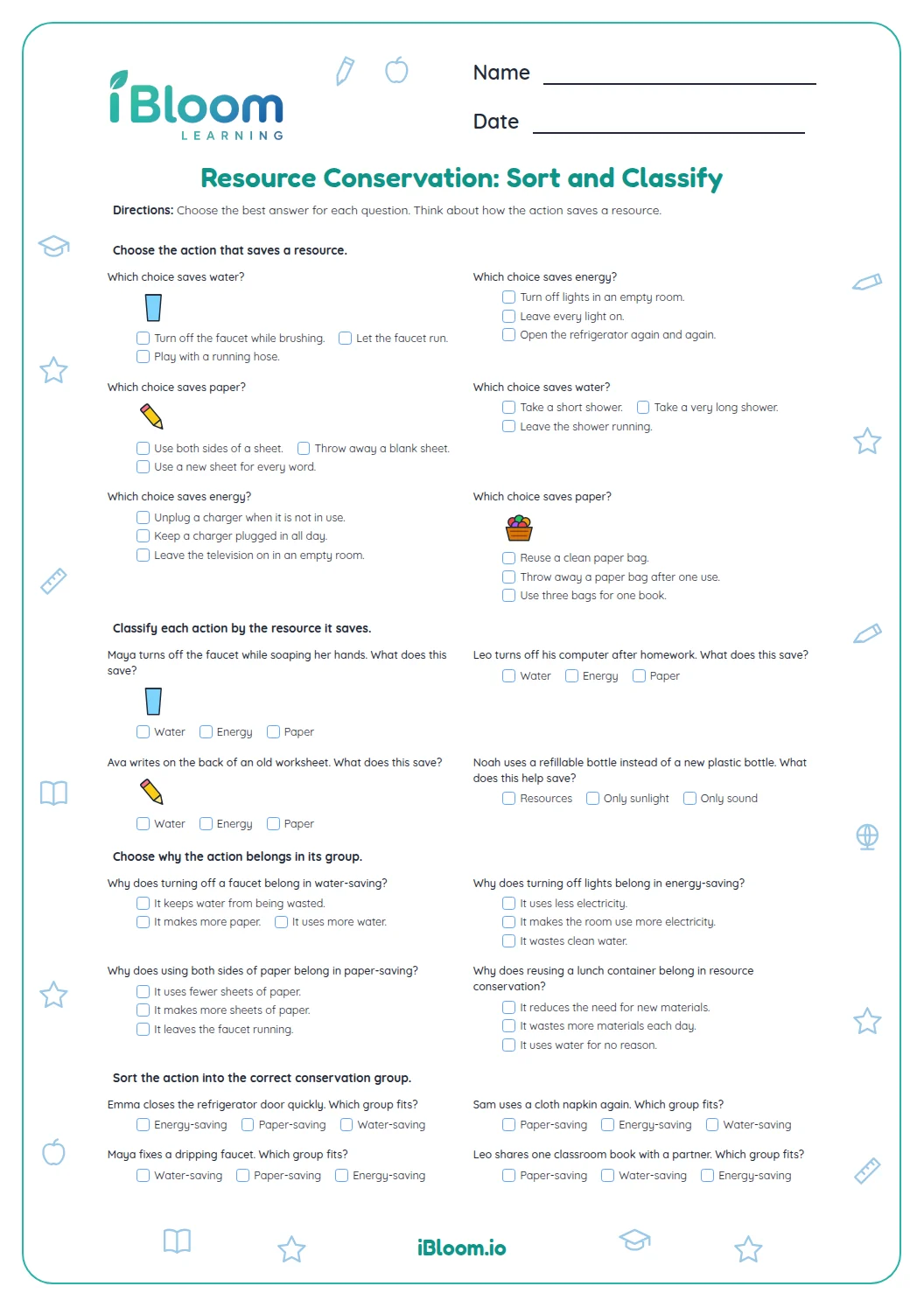
Children sort familiar resources such as sunlight, wind, trees, coal, oil, and natural gas. The first two parts build a clear renewable/nonrenewable distinction; the final questions ask learners to apply it to responsible resource use and explain their choices.
What does this worksheet practice?
Part A asks students to recognize resources that can be replenished and identify examples. Part B is a quick classification sort. Part C applies the idea to using forests and choosing energy sources.
- Part A: 5 multiple-choice classification questions
- Part B: 6 renewable or nonrenewable choices
- Part C: 6 short explanations and applications
What does renewable mean?
A renewable resource is replaced naturally on a time scale that allows people to use it again. Sunlight and wind are continually available. Trees can be renewable when forests are managed and new trees replace those harvested. Coal, oil, and natural gas form so slowly that people use them far faster than they are made.
- 1A forest supplies wood.
- 2If new trees are planted as trees are harvested, the resource can grow again.
- 3The careful replacement matters.
How can I classify a resource?
Ask how the resource is replaced. If it is naturally replenished in a useful time, it is renewable. If it takes an extremely long time to form, it is nonrenewable. Part C asks for a reason as well as a label.
How to use this worksheet
- 1Read each resource name and decide how nature replaces it.
- 2For Part B, circle one category: renewable or nonrenewable.
- 3For Part C, include a reason, not just the category.
- 4Remember that a renewable resource can still be used carelessly; replacement and responsible use both matter.
- 5Check the answer key and discuss any different examples that are scientifically sound.
Common mistakes and quick fixes
The mistake
Thinking every natural material is renewable.
The fix
Ask how long it takes nature to replace it. Oil is natural but forms over a very long time.
The mistake
Assuming any use of trees is automatically renewable.
The fix
Explain that replacing trees and managing the forest help the supply grow again.
The mistake
Calling sunlight nonrenewable because it can be cloudy.
The fix
Clouds can block sunlight temporarily; they do not use up the sun’s energy.
What to practice next
Make more practice
Questions parents and teachers ask
What is a renewable resource?
A renewable resource is one that nature replaces in a useful time. Sunlight and wind are renewable; trees can be renewable when forests are replanted and cared for over time. A renewable resource is replaced by nature in a useful time. Sunlight and wind are renewable; trees can be renewable when forests are replanted and cared for.
Are coal and oil renewable?
No. Coal and oil take an extremely long time to form, so people use them far faster than nature replaces them. They are classified as nonrenewable resources. Coal and oil take an extremely long time to form, so people use them far faster than nature replaces them. They are nonrenewable resources.
Can a renewable resource be used carelessly?
Yes. A resource may be renewable but still become scarce in a place if people use it faster than it is replaced. Responsible use helps keep a supply available. A renewable resource can still become scarce in one place if people use it faster than it is replaced. Responsible use helps keep supplies available.
What grade is this worksheet for?
This worksheet is designed for Grade 2 science practice with familiar natural resources and simple categories. Children compare how sunlight, wind, trees, coal, oil, and natural gas are replaced. The final part asks them to explain why a resource belongs in a category and how people can care for a supply.
Why are trees treated differently from coal?
Trees can grow again within a human lifetime when forests are replanted and managed. Coal forms over an extremely long time, so people cannot replace it quickly. Trees can grow again within a human lifetime when forests are replanted and managed. Coal forms over an extremely long time and cannot be quickly replaced.
How many questions are included?
There are 17 questions in three parts and a separate answer key. Learners classify resources, choose examples, and explain their choices. The questions move from selecting a resource, to sorting examples, to applying the idea of replacement to forests and energy use.