




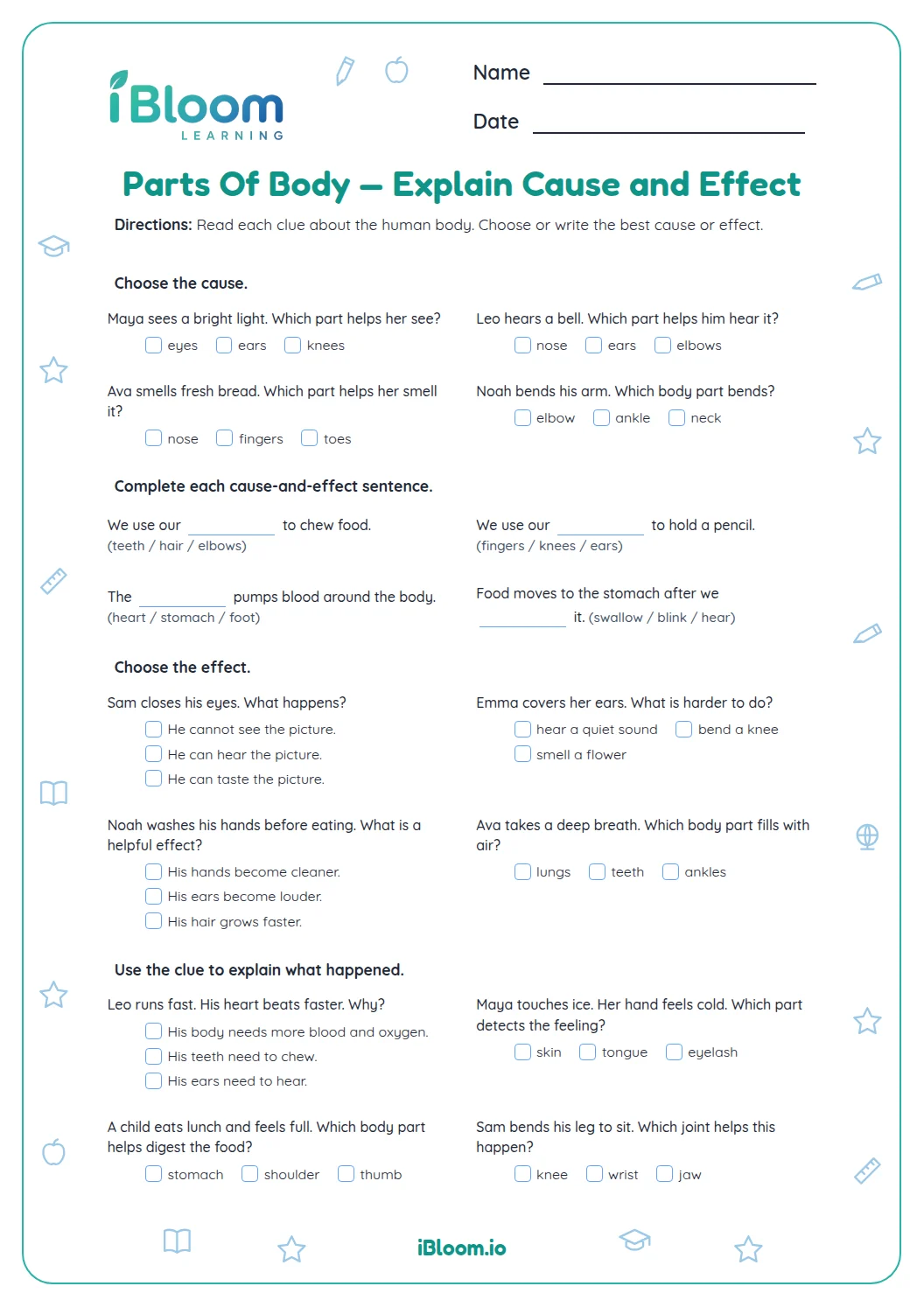
About this worksheet
This free Grade 2 health worksheet gives children practice explaining cause and effect in familiar body and wellness situations. It includes choices, short explanations, and a short informational passage about exercise and breathing. Children identify what happened first, then connect it to a likely effect. The passage questions practice CCSS RI.2.3 by asking students to connect scientific ideas in a text. A separate answer key includes sample responses for open-ended questions.
Aligned to RI.2.3
How do you find a cause and its effect?
A cause is what makes something happen. An effect is what happens because of it. Ask, “What happened first?” and “What happened next because of that?”
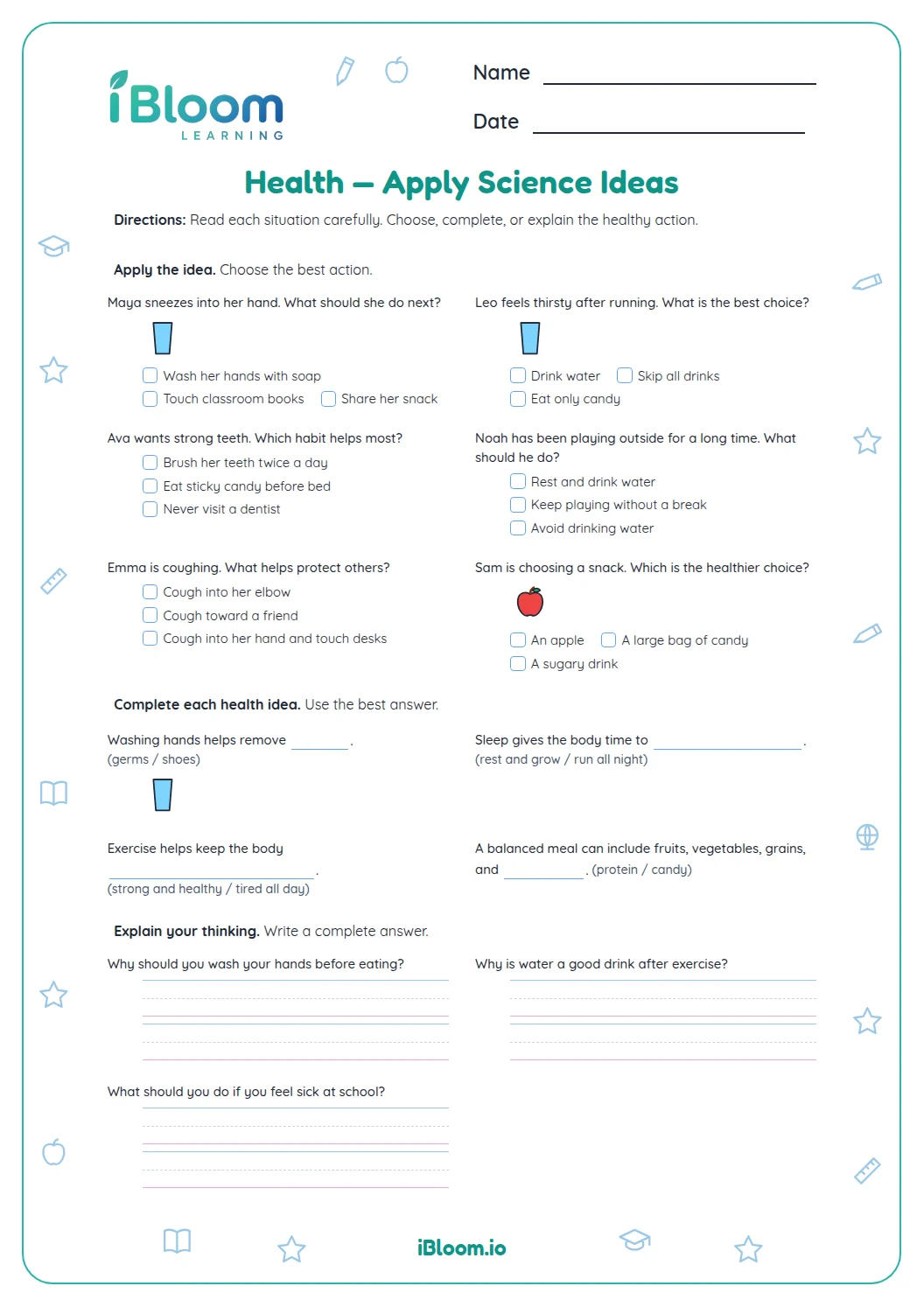
For question 3, Sam skips handwashing before lunch. The skipped washing is the cause; germs may then spread to food. The answer describes a possible effect, not a guaranteed illness.
- 1Cause: Sam does not wash his hands.
- 2Possible effect: Germs may spread to his food.
What can a passage tell us about the body?
In “Lee Goes for a Run,” running makes his muscles use more energy. His heart pumps faster and he breathes faster. Resting after the game is followed by slower breathing and heartbeat. The passage lets children use details to connect actions with body responses.
How can you explain an effect clearly?
Name the action or event, then say what may happen. For example, a coat on a cold day helps a person stay warm. Use “may” or “can” when more than one outcome is possible.
How to use this worksheet
- 1Read the whole situation before choosing an answer.
- 2Ask what happened first; that is often the cause.
- 3Ask what happened because of it; that is the effect.
- 4For passage questions, point to the sentence that gives the link.
- 5Use a complete sentence for the explain questions.
- 6Check that your explanation answers the “why” or “what happened next” question.
Common mistakes and quick fixes
The mistake
Naming the effect as the cause, such as calling “feeling thirsty” the cause of a sunny walk.
The fix
Put the events in order: the walk happens first; thirst follows.
The mistake
Writing only “water” when asked how drinking water may affect the body.
The fix
Tell the result: drinking water helps replace water lost during activity.
The mistake
Treating a possible effect as something that always happens.
The fix
Use may or can for likely outcomes, such as “A child may feel rested after sleep.”
Curriculum alignment
This worksheet practices the following standard.
Connect events and ideas in an informational text.
On this sheet: Children connect health actions or body events with their effects.
Show the official wordingHide the official wording
Describe the connection between a series of historical events, scientific ideas or concepts, or steps in technical procedures in a text.
What to practice next
Make more practice
Further reading
Questions parents and teachers ask
What does cause and effect mean?
A cause makes something happen; an effect is what happens as a result. In this sheet, running is a cause of faster breathing, while resting is followed by slower breathing. Children identify these links in everyday health situations and in Lee’s passage.
What happens in Lee’s passage?
Lee runs, and his muscles use more energy. His heart pumps faster and he breathes faster. After he rests, both begin to slow. The three passage questions ask children to name the cause, describe the effect, and use a detail from the text.
How should my child answer the explanation questions?
A clear sentence that names the cause and connects it to the result is enough. Words such as “because,” “so,” “may,” and “can” help explain the link. The answer key gives sample responses; accept other answers that fit the situation and passage.
Does this worksheet give medical advice?
No. It uses familiar examples such as exercise, sleep, handwashing, and brushing teeth to practice reading and explaining cause and effect. It does not diagnose a health problem or promise that one outcome will always happen. Children can use “may” when an effect is possible.
How many questions and pages are included?
There are 14 questions across three pages total, including a separate answer key page. Children answer five choice questions, three questions about a short passage, and six written explanations. The answer key includes sample wording for questions with more than one reasonable response.