





About this worksheet
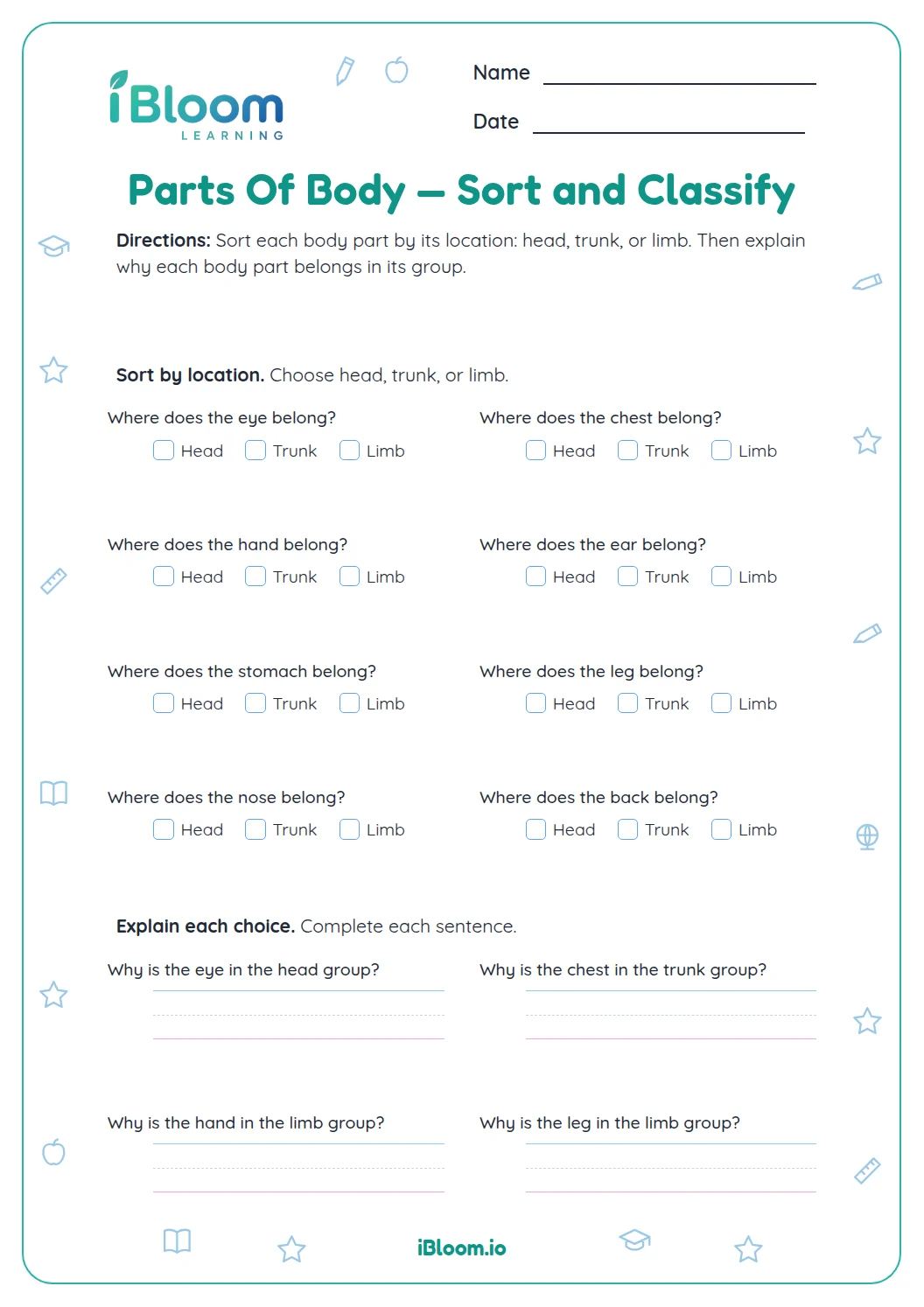
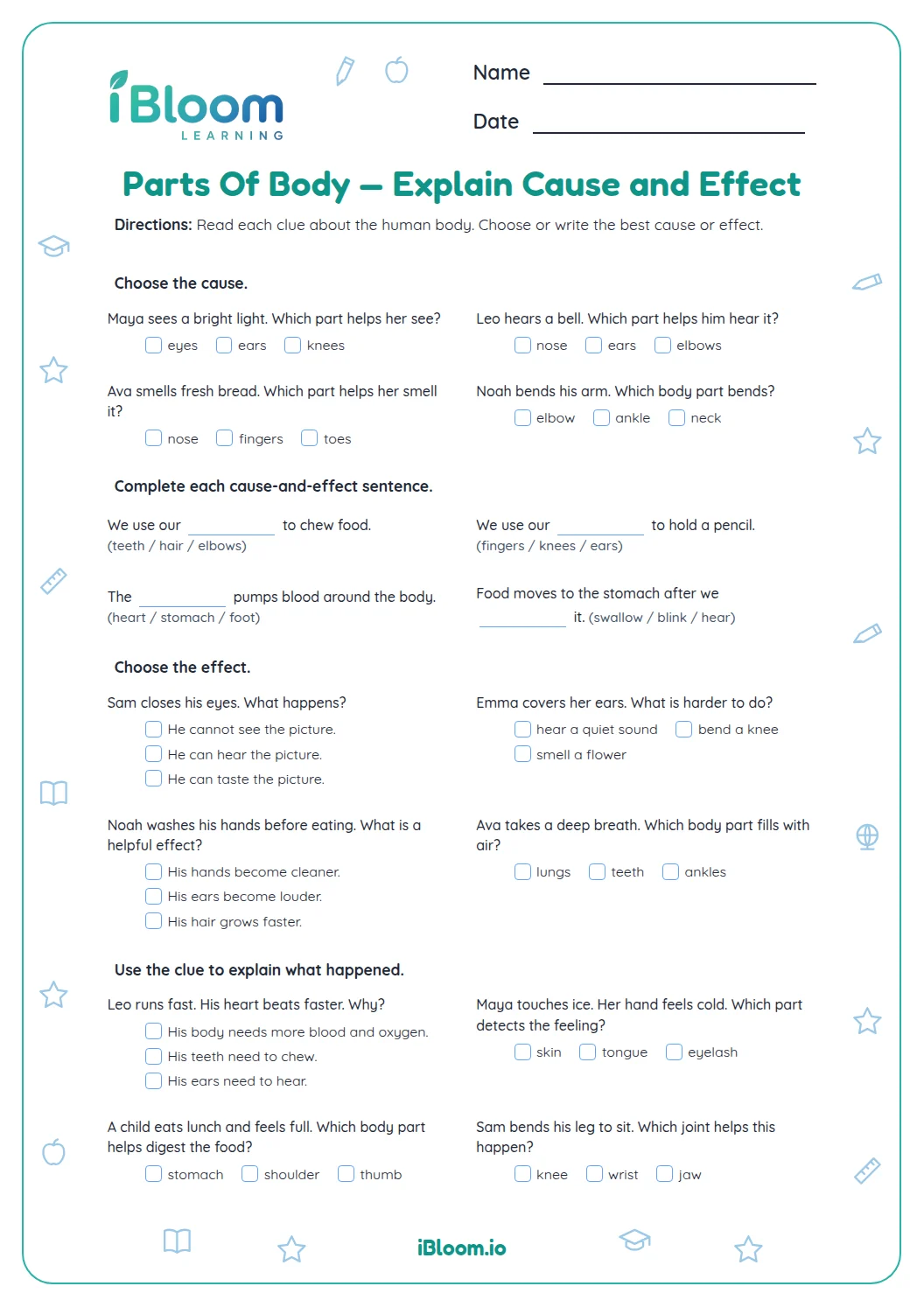
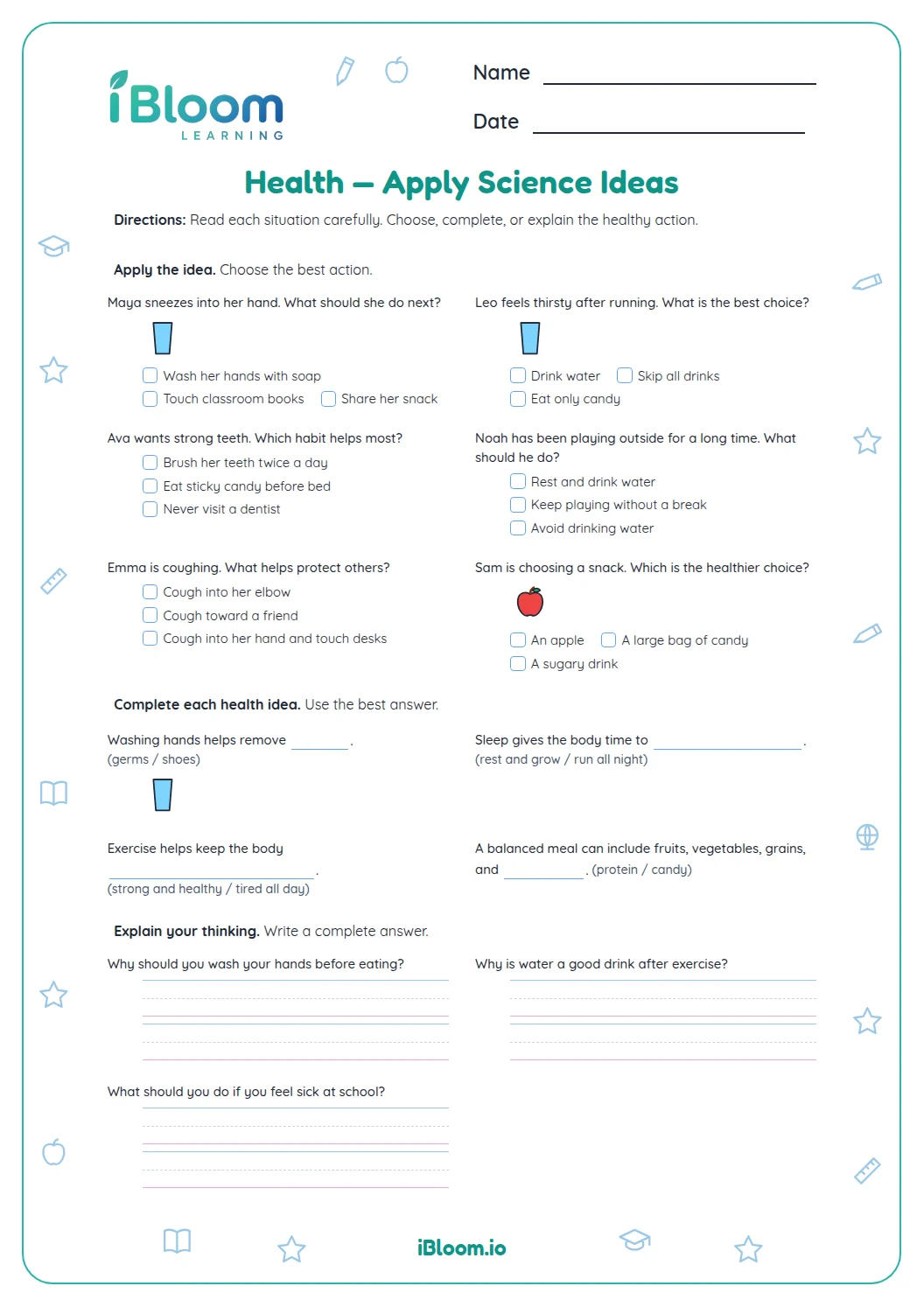
This Grade 2 human-body worksheet asks students to apply ideas about body parts and their functions. In 15 everyday situations, learners write the part that helps someone see, hear, smell, taste, move, hold, or sense texture. The questions replace the unrelated plant-growth prompt on the old sheet with focused human-body practice. A separate answer key is included.
How do body parts help us?
Different body parts help with different actions. Eyes help us see, ears help us hear, and skin can sense touch. Arms, hands, legs, and feet help us move or hold things.
Thinking about the action in a situation can help identify the body part involved. Some actions use more than one part, but each question asks for one best choice.
How do students apply these ideas?
Read what is happening, decide whether the person is sensing or moving, and choose the body part that does that job. For a texture question, focus on touch; for a walking question, think about the parts that bend and step.
- 1You want to see a small picture clearly.
- 2Ask which body part helps with seeing.
- 3Eyes help us see.
- 4Answer: eyes
What situations appear on the sheet?
The 15 questions describe ordinary actions such as smelling a flower, chewing an apple, walking, holding a spoon, and kicking a ball. The answer key lists the body part selected for each situation.
How to use this worksheet
- 1Read the complete situation first.
- 2Identify the action or sense involved.
- 3Think of the body part that helps with that job.
- 4Write the body part that best matches the action or sense.
- 5Check the answer key and discuss any choices that were confusing.
Common mistakes and quick fixes
The mistake
Choosing a part that is nearby in the story.
The fix
Focus on the action, such as hearing or holding, and match its function.
The mistake
Mixing up smell and taste.
The fix
Think about the sense: the nose detects smells and the tongue helps with taste.
The mistake
Assuming every action uses only one body part.
The fix
Many actions use several parts; choose the one the question specifically asks about.
What to practice next
Make more practice
Questions parents and teachers ask
What body parts does this worksheet cover?
The questions include eyes, ears, nose, hands, teeth, knees, skin, tongue, arms, eyelids, and feet. Students connect each part with a job in a familiar situation, such as seeing a picture or holding a pencil. Every item names an action, such as smelling a flower or kicking a ball, and asks for the body part most directly connected to it.
How many questions are on the worksheet?
There are 15 short-answer situations. Each asks students to write the body part that helps with the described action or sense, and the separate answer key lists a response for every item. Most answers are a familiar body-part word such as eyes, nose, or skin.
Can one action use more than one body part?
Yes. Everyday actions often involve several body parts working together. Each question gives a specific clue about the job it asks about, so students should select the part that best matches that clue. The questions focus on a single clue in each situation, such as what senses texture or what closes to shield the eyes.
How can I support a child who is unsure?
Ask the child to name the action first: seeing, hearing, smelling, tasting, moving, holding, or feeling a texture. Then ask which body part helps with that action. Relating the question to a familiar experience can help. For instance, smelling points to the nose, while tasting points to the tongue; the sense described helps guide the choice.
Is there an answer key?
Yes. The separate answer key lists a response for all 15 questions and appears on two pages. Adults can use it to review each body-part function and discuss how that part helps in the described situation. The key also makes it easy to check answers after students complete both worksheet pages.