





About this worksheet
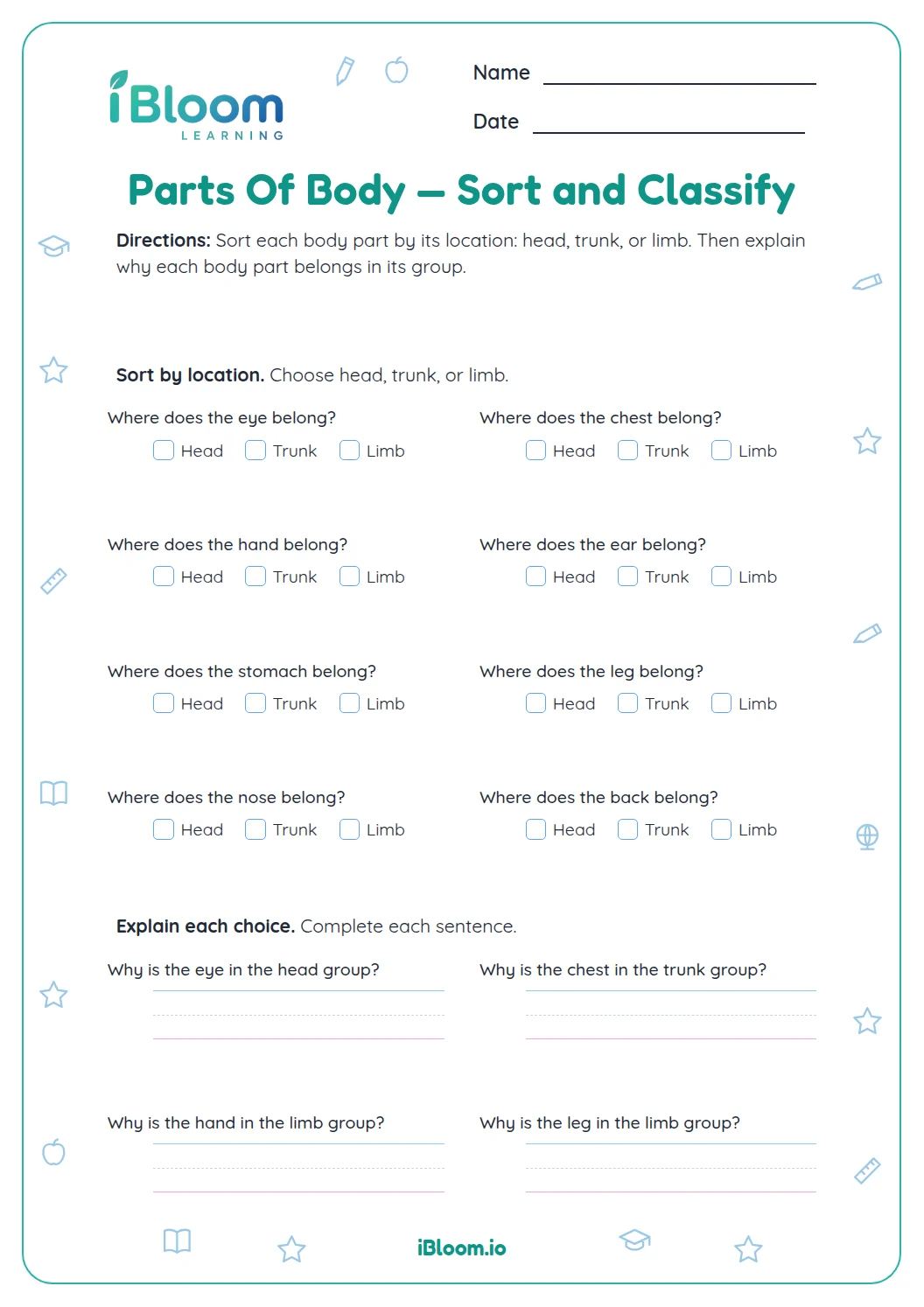
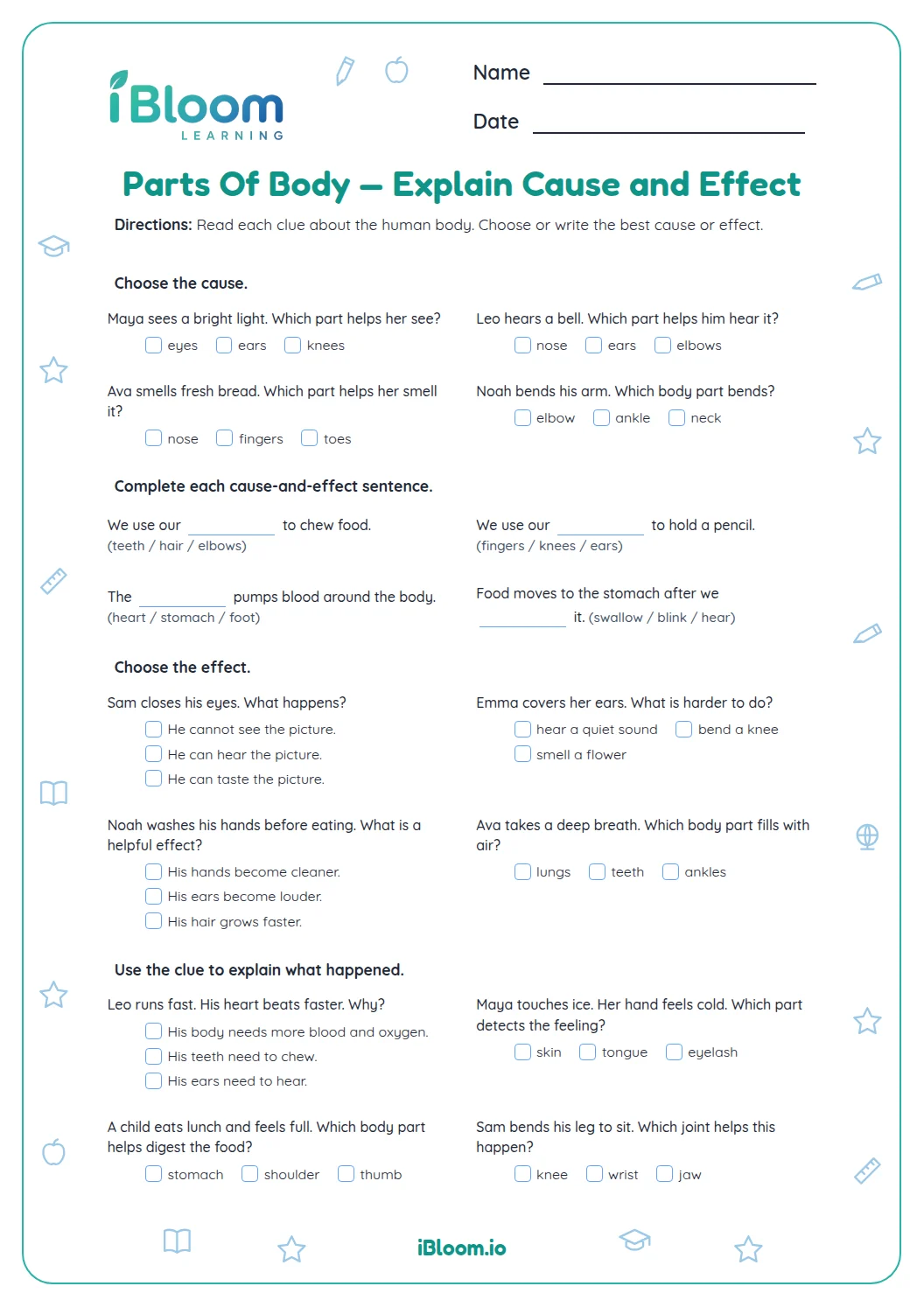
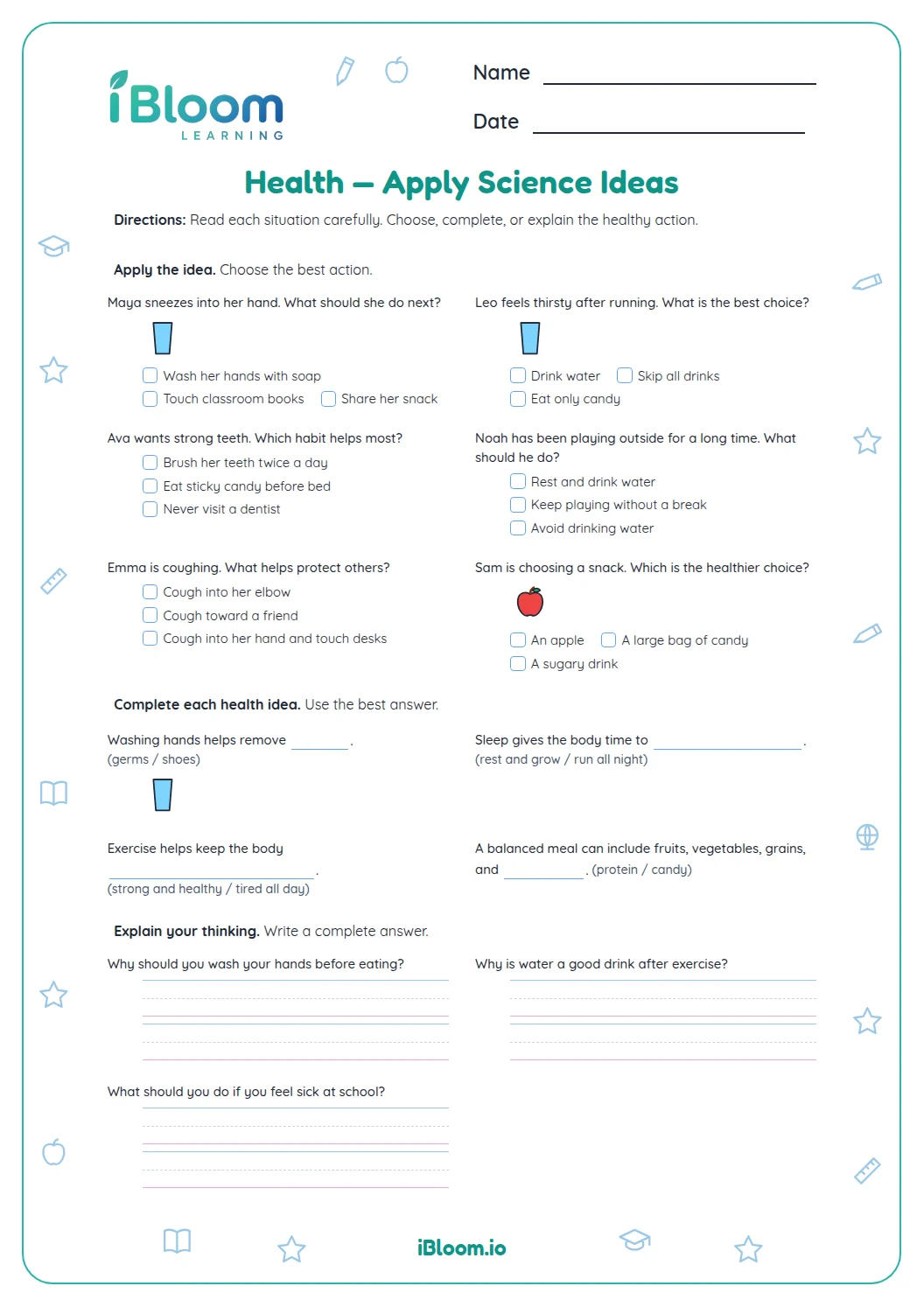
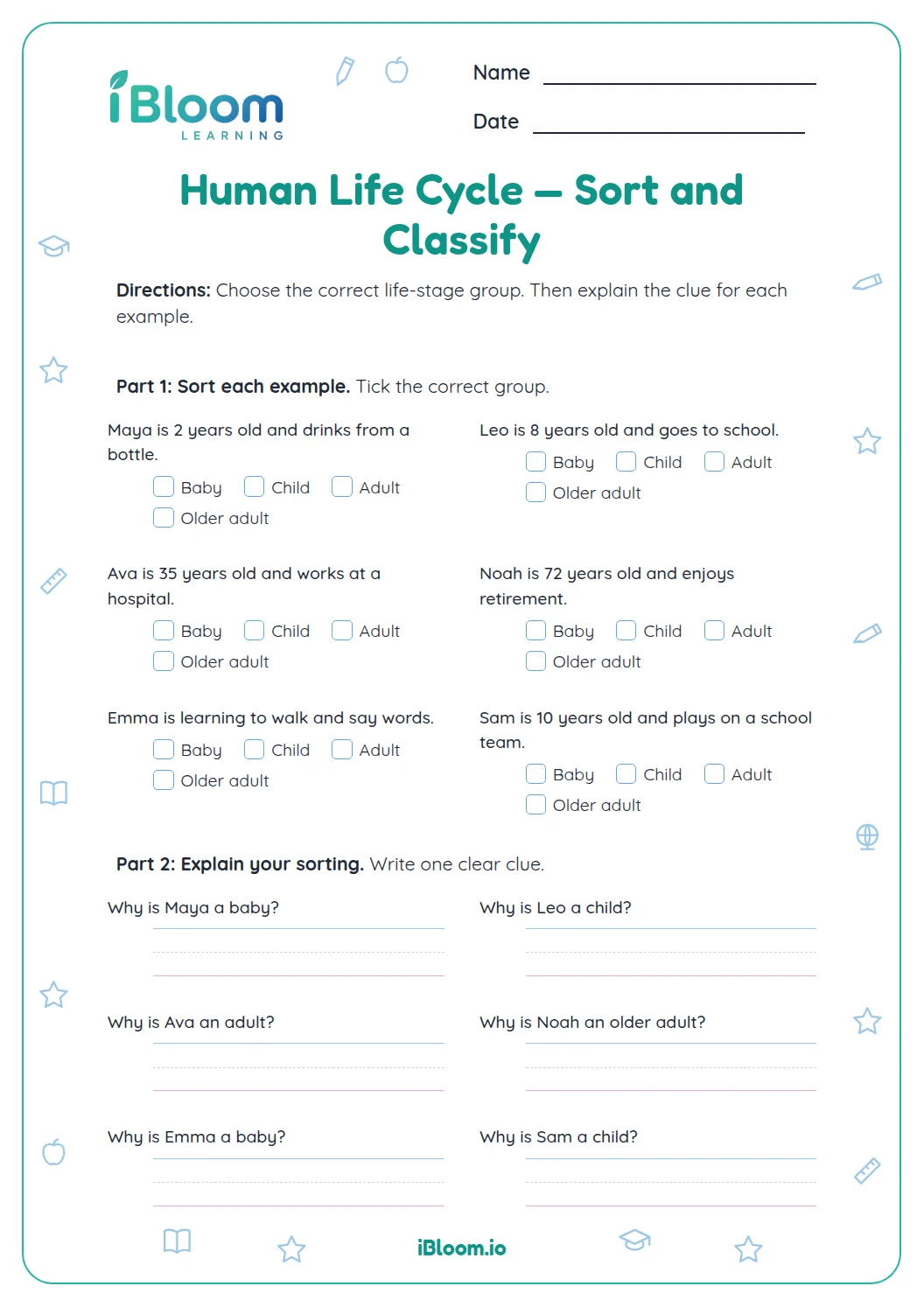
This Grade 2 science review connects familiar body parts with the jobs they do. Part A uses small picture clues for eight multiple-choice questions. Part B asks learners to apply those ideas to everyday situations, such as hearing a whistle or feeling a pebble underfoot. The key gives concise answers and examples.
Which body part helps with each job?
Part A presents an everyday situation and a matching picture clue. Children choose the body part that helps most directly.
- Eyes help us see; ears help us hear
- The nose helps with smell; the tongue helps with taste
- Hands and feet help with different kinds of movement
How can you use a body part’s job to reason?
Part B changes the situation but keeps the same idea: name the body part and connect it to what it does. Some questions ask for a brief explanation.
- Use the action in the situation as a clue
- For an explanation, state the part and its job
How to use this worksheet
- 1Read the action or situation in the prompt.
- 2Name the body part that directly helps with that action.
- 3For Part B, use what you know about the part’s job to explain your thinking.
- 4Check the short answers with the key; accept clear equivalent wording for sample responses.
Common mistakes and quick fixes
The mistake
Choosing a body part that is nearby in the picture instead of the one doing the job.
The fix
Focus on the action word, such as hear, smell, hold or kick.
The mistake
Saying that a closed eye can see because the sun is still there.
The fix
Connect sight to the eyes being open and able to receive what is seen.
The mistake
Giving only a body-part name when the question asks why.
The fix
Add the job: “Hands grip the cup, while ears help us hear.”
What to practice next
Make more practice
Questions parents and teachers ask
Which body parts appear in the picture questions?
Part A asks about the nose, ears, eyes, hands, teeth, feet, tongue, and knee. Each question pairs a small picture clue with three answer choices, such as choosing the body part used to smell a flower. Learners can name the body part before choosing.
What happens in Part B?
Part B gives short situations and asks learners to connect evidence to a body part. Examples include hearing a whistle without seeing its source and feeling a rough pebble under a bare foot. The questions use familiar experiences to make each connection clear.
Do children need to write full explanations?
Several Part B questions ask for a short explanation, while others ask for a body part. A clear phrase or sentence is enough. For the explanation about holding a cup, the answer should connect hands with gripping and ears with hearing.
Why does the worksheet ask about more than one sense?
The questions help learners distinguish what different body parts do. Seeing, hearing, smelling, tasting, and feeling are represented alongside movements such as holding, kicking, bending, and tapping. Each item asks about a particular job or situation using a familiar example.
Is an answer key included?
Yes. The separate key shows the expected body part for each question and gives sample wording for open responses. A child’s wording can differ if it still identifies the body part and explains the job described. Review the reasoning together after the first attempt, and ask which clue helped most.
How can we continue the discussion?
Ask the learner to notice which body part helps during a routine activity, such as listening for a timer or picking up a spoon. The related body-part worksheets can add more practice identifying parts and their functions through additional examples.