Free printable practice
Weather Words Practice Activities
Printable Grade 2 science worksheets that help children read, use, and explain weather words such as sunny, cloudy, windy, rainy, temperature, and forecast.
Free printable worksheet PDFs
Preview every available page, then download the free worksheet PDF for home, homeschool, tutoring, or classroom practice.
Preview the exact activity before downloading it.
 Weather Words — Sort and ClassifyPrintable Grade 2 science worksheets that help children read, use, and explain weather words such as sunny, cloudy, windy, rainy, temperature, and forecast. This sort and classify worksheet provides a distinct, age-appropriate way to practise the same lesson.Grade 2Free PDF preview
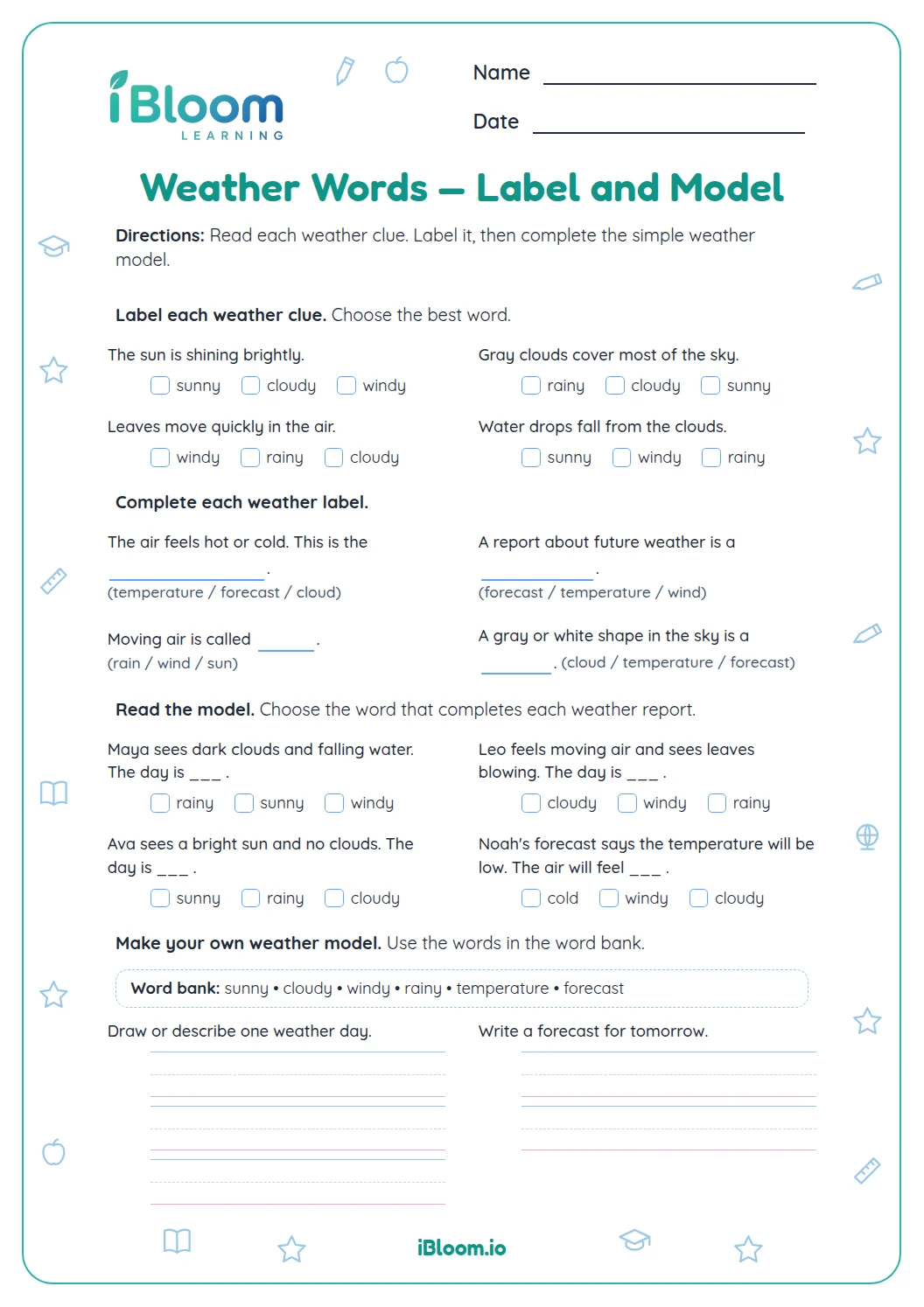 Weather Words — Label and ModelPrintable Grade 2 science worksheets that help children read, use, and explain weather words such as sunny, cloudy, windy, rainy, temperature, and forecast. This label and model worksheet provides a distinct, age-appropriate way to practise the same lesson.Grade 2Free PDF preview
 Weather Words — Explain Cause and EffectPrintable Grade 2 science worksheets that help children read, use, and explain weather words such as sunny, cloudy, windy, rainy, temperature, and forecast. This explain cause and effect worksheet provides a distinct, age-appropriate way to practise the same lesson.Grade 2Free PDF preview6 pages
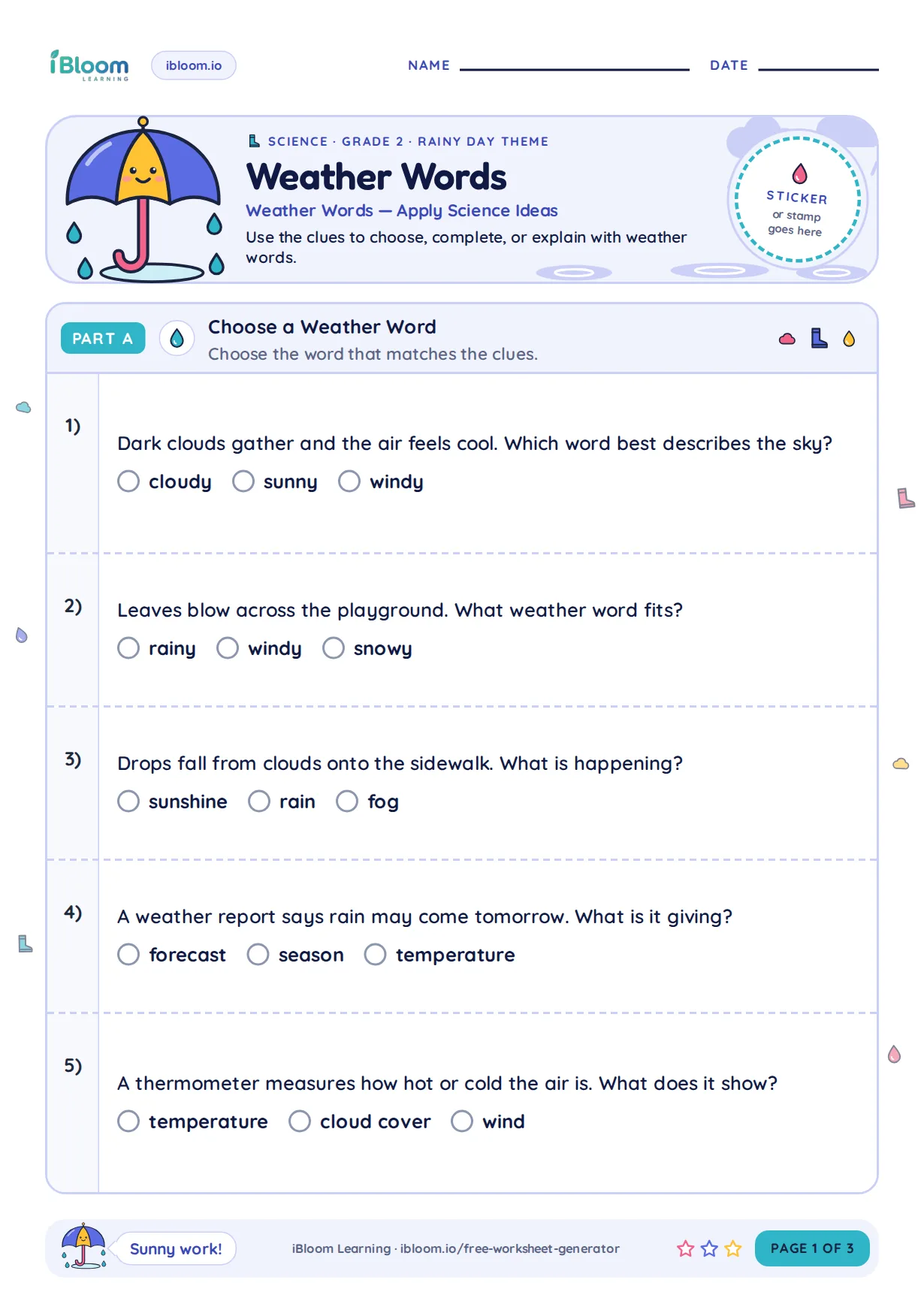 Weather Words — Apply Science IdeasPrintable Grade 2 science worksheets that help children read, use, and explain weather words such as sunny, cloudy, windy, rainy, temperature, and forecast. This apply science ideas worksheet provides a distinct, age-appropriate way to practise the same lesson.Grade 2Free PDF preview4 pages
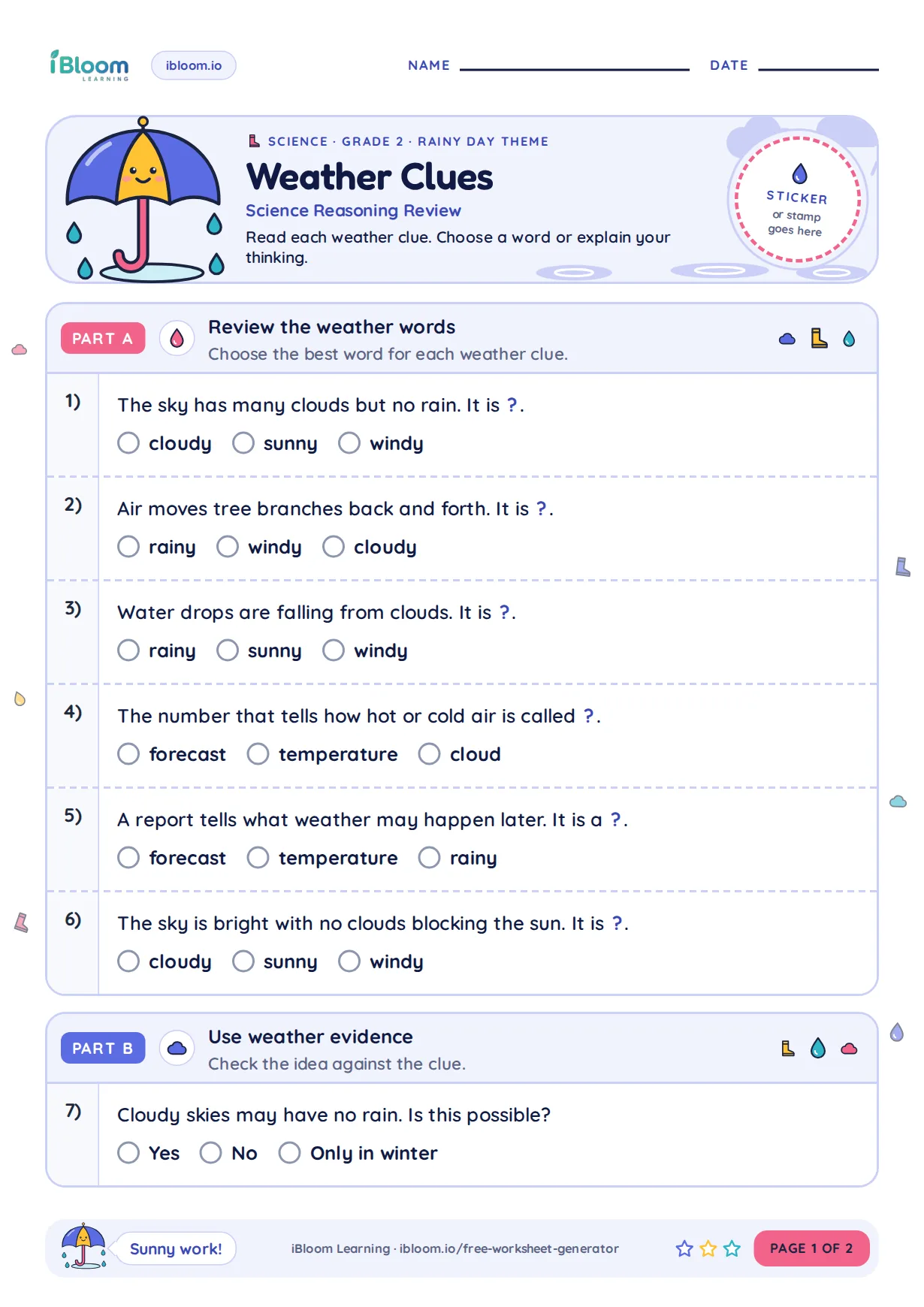 Weather Words — Science Reasoning ReviewPrintable Grade 2 science worksheets that help children read, use, and explain weather words such as sunny, cloudy, windy, rainy, temperature, and forecast. This science reasoning review worksheet provides a distinct, age-appropriate way to practise the same lesson.Grade 2Free PDF preview
Practice that builds confidence
Weather vocabulary in context
These Grade 2 weather words worksheets help children build the vocabulary they need to describe daily weather clearly. Students practise reading, matching, sorting, and using words connected to sky conditions, wind, rain, snow, temperature, and forecasts.
The printable activities include picture-supported word practice, short science sentences, labeling tasks, and simple observation prompts. Children learn that weather words are not just labels—they help explain what is happening outside and what people might wear, do, or expect next.
Grade 2 children are ready to move beyond saying “nice” or “bad” weather. These worksheets guide them toward precise words such as sunny, cloudy, rainy, windy, snowy, foggy, stormy, hot, cold, warm, cool, temperature, thermometer, precipitation, and forecast. Picture clues and short sentences help students connect each word to something they can observe.

From noticing to explaining
The practice builds from recognizing a weather word to using it in a meaningful sentence. A child may first match “windy” to a picture of bending trees, then complete a sentence such as, “It is windy, so the kite moves.” This progression supports science thinking: observe the sky, name the condition, and explain how it affects people, plants, animals, or activities.
A simple home routine
Parents can make the worksheets stronger with a quick daily weather talk. Look out a window or step outside, ask “What do you notice?”, then choose one worksheet word to describe it. Encourage your child to give proof: “I think it is cloudy because I cannot see much blue sky.” After the page is finished, let your child draw today’s weather and write one matching sentence.

Classroom uses for teachers
Teachers can use these printables in science centers, morning work, vocabulary review, or as a companion to a class weather chart. They also work well before a weather journal activity because students practise the words they will need for observation. Pair work is useful: one student reads a weather word, and the other explains which clue in the picture or sentence supports it.

Common errors to watch for
Some children mix up weather and seasons, such as thinking “snowy” means “winter” instead of a weather condition. Others confuse cloudy and foggy, or use temperature words without evidence. Remind students that weather can change from day to day, while seasons last longer. A child-friendly strategy is “Look, name, prove”: look carefully, name the weather word, then prove it with one clue.
Free printable PDF download
Use this grade 2 weather words worksheet page to preview the activity, print it, or download it as a PDF for quick practice. It works well for homework, homeschool lessons, tutoring, morning work, revision, and classroom centers.
Answers and answer key support
After the child completes the worksheet independently, parents and teachers can use the answer support or answer key information to check the work, review mistakes, and choose the next practice step.
Why iBloom worksheets help
The pages are designed for clear Grade 2 practice, with familiar examples and enough repetition to make new science words stick. Children read, choose, label, and write, so vocabulary is practised in more than one way. This helps them speak and write about weather with confidence during lessons, discussions, and simple observations.
Helpful answers
Frequently asked questions
What weather words do Grade 2 students practise on these worksheets?
Children practise common weather vocabulary such as sunny, cloudy, rainy, windy, snowy, foggy, stormy, hot, cold, warm, cool, temperature, thermometer, precipitation, and forecast.
How do these worksheets support science learning, not just spelling?
The activities connect each word to pictures, observations, and short sentences, so students learn to describe real weather conditions and explain their clues.
Can I use these pages with a daily weather chart?
Yes. They work well before or after a weather chart routine because children practise the vocabulary they need to record and discuss the day’s weather.
What is a common mistake children make with weather words?
Many children confuse weather with seasons, such as treating snowy as the same as winter. The worksheets help them focus on weather as a condition that can change from day to day.
How can parents extend the worksheet practice at home?
Ask your child to look outside, choose one weather word, and give a reason for it. For example, “It is windy because the tree branches are moving.”
Is this grade 2 weather words worksheet free?
Yes. You can preview it for free and use the printable worksheet for home or classroom practice.
Can I download this grade 2 weather words worksheet as a PDF?
Yes. Use the worksheet download option to save a printable PDF, or print the worksheet directly from the page.
Does this grade 2 weather words worksheet include answers or an answer key?
When the activity has fixed answers, iBloom includes answer support so parents and teachers can check the completed worksheet.