





About this worksheet
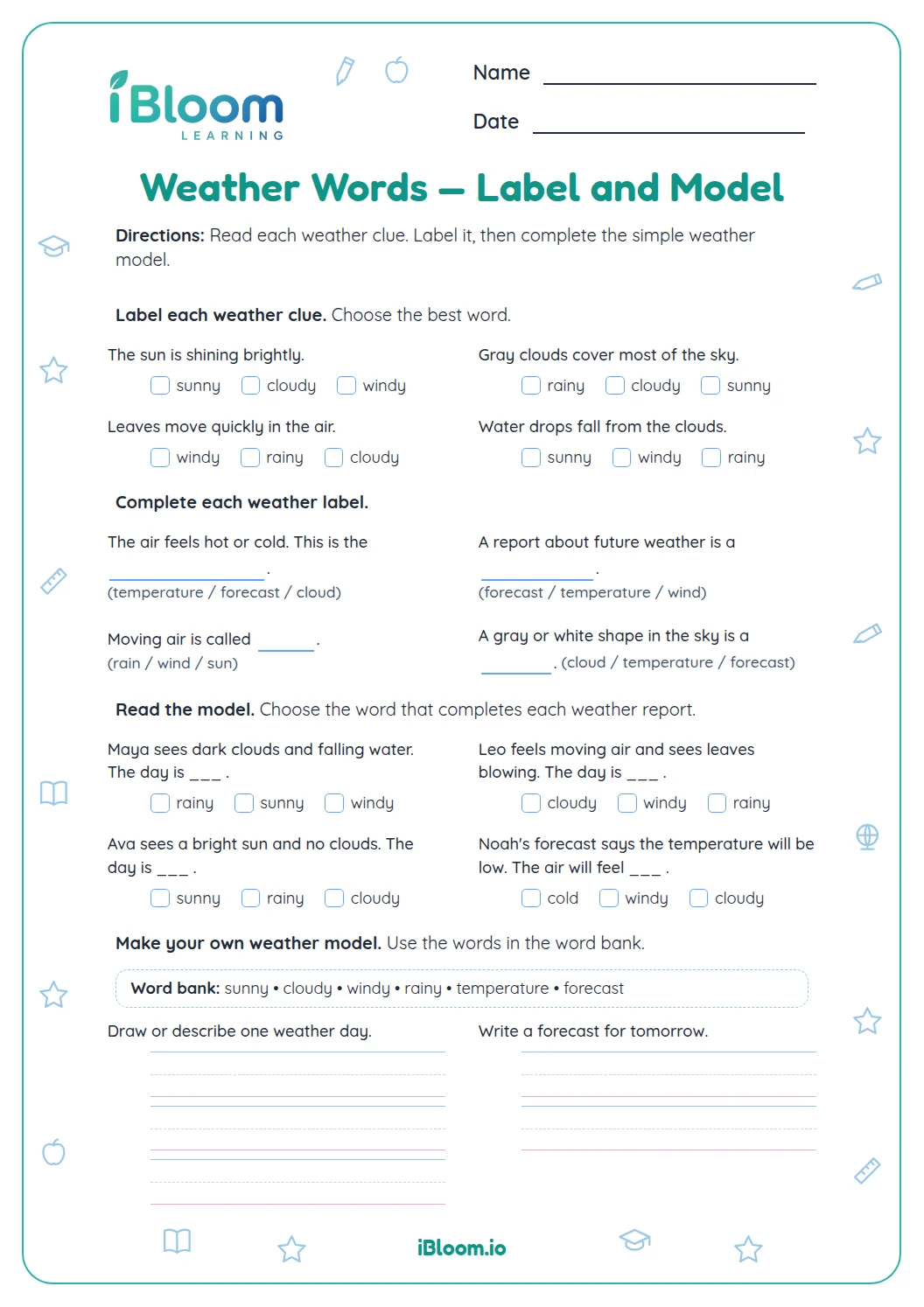
This free Grade 2 science worksheet reviews weather words through 14 short clues and reasoning questions. Children distinguish clouds, wind, rain, snow, temperature, and forecasts, then use details in a situation to select a fitting conclusion. The two-page printable includes a separate answer key for checking vocabulary and discussing the evidence.
Which weather words appear?
The first part practices cloudy, windy, rainy, sunny, temperature, and forecast. Each prompt gives a plain-language clue, such as moving branches for wind or a report about later conditions for a forecast.
How do the later questions use evidence?
Later questions ask children to check a statement against an observation. For example, a forecast can describe possible weather, while a temperature tells how hot or cold the air is.
How can you discuss a weather clue?
Ask which detail supports the chosen word. “Water drops are falling from clouds” supports rainy; “a flag blows straight out” supports windy.
How to use this worksheet
- 1Read the whole clue before choosing a word.
- 2For an explanation, point to the detail that supports your idea.
- 3Accept different sensible examples for the open responses.
- 4Use the answer key to discuss evidence, not just the final word.
Common mix-ups and quick fixes
The mistake
Treating cloudy and rainy as the same condition.
The fix
Clouds may appear without rain; look for falling drops before choosing rainy.
The mistake
Calling a forecast a measurement.
The fix
A forecast describes weather that may happen; temperature measures how hot or cold the air is.
The mistake
Assuming wind always means cold weather.
The fix
Wind describes moving air. Check temperature separately to decide whether it is cold.
What to practice next
Make more practice
Questions parents and teachers ask
What weather words does this worksheet cover?
The 14 questions use cloudy, windy, rainy, sunny, snowy, temperature, and forecast. Children match each word to a short clue, then check statements and use observations such as falling drops, a blowing flag, or a clear sky. Ask the child to point to the clue that supports each choice.
Is a cloudy day always rainy?
No. Clouds can cover the sky without rain falling. The worksheet asks children to notice the specific evidence in a clue: clouds describe the sky, while raindrops indicate rain. A cloudy day can be dry, so the word cloudy alone does not prove that it is raining.
What is the difference between temperature and a forecast?
Temperature tells how hot or cold the air is. A forecast is a report about weather that may happen later. The worksheet uses both terms so children can distinguish a measurement from a prediction. For example, a forecast may call for rain tomorrow.
How many pages are in the printable?
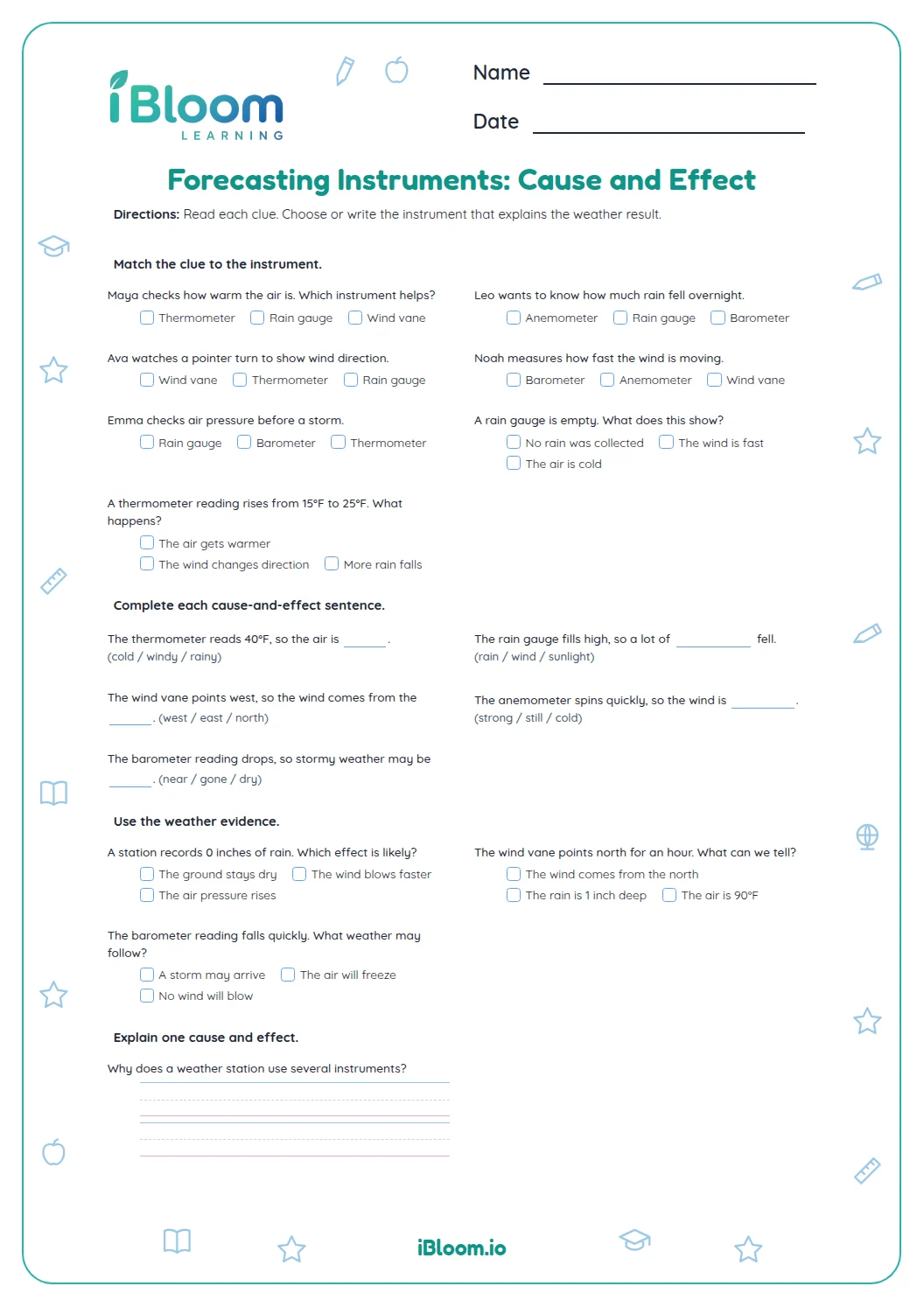
The worksheet has 14 questions arranged across two pages. A separate two-page answer key lists the expected answers, so an adult can check the work and ask the child to point to the clue that helped. It is useful to discuss why the answer fits.
Can wind happen when the weather is warm?
Yes. Wind means that air is moving; it does not by itself tell whether the air is cold or warm. Use a separate temperature clue to decide how hot or cold the air is. A blowing flag can show wind on a warm day too.