






About this worksheet
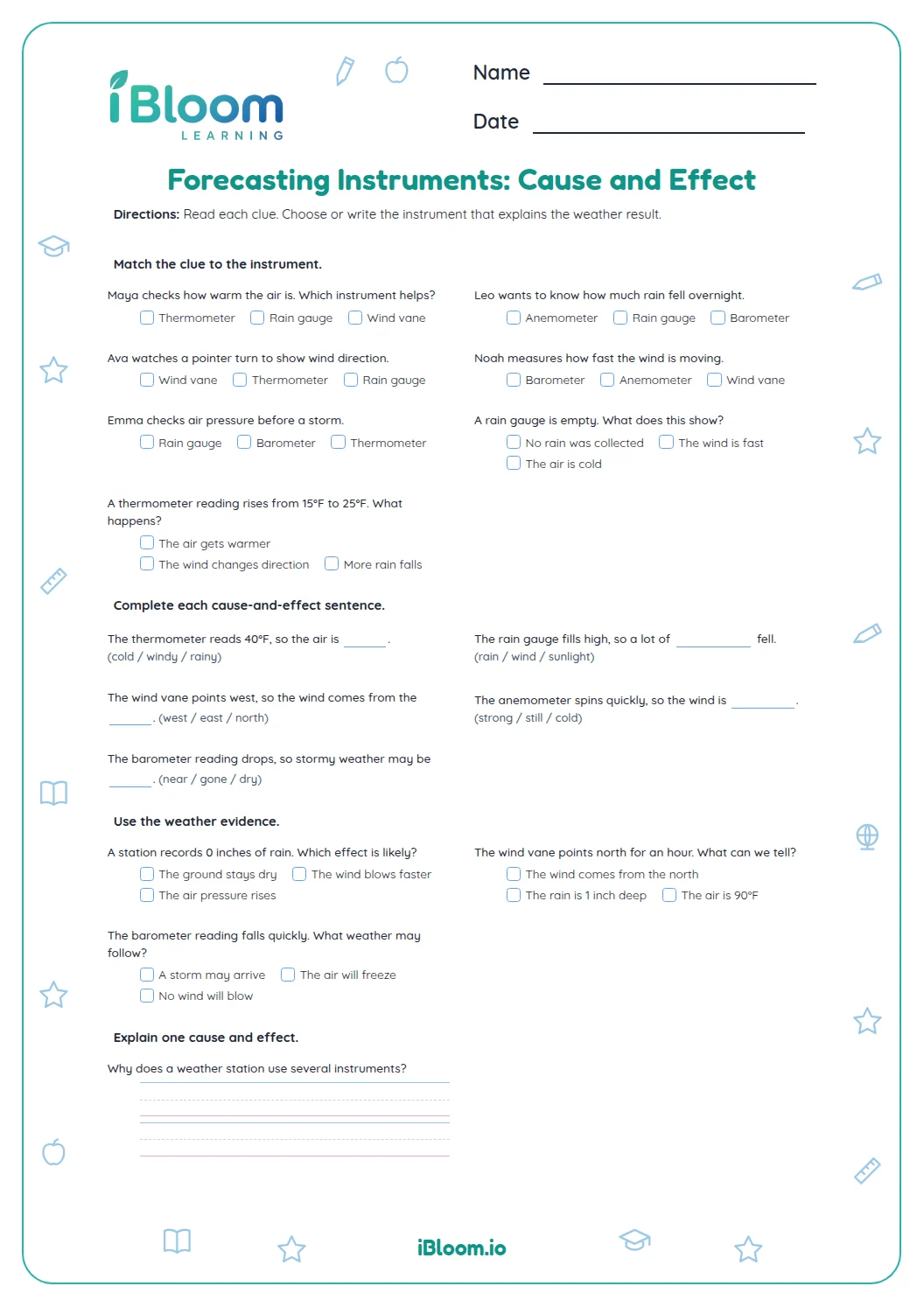
This free Grade 2 science worksheet connects five forecasting instruments with the information they collect. Part A has five tool questions, a forecast question and a comparison of the wind tools. Part B gives five weather observations and asks for the instrument that could collect each one. Part C compares the two wind instruments and has two drawing tasks that build a simple weather station: a thermometer and rain gauge in one box, then a wind vane in the other. Children label all three instruments. The separate answer key gives the choices and tool names, with descriptions of the features to check in the drawings.
What do the five instruments measure?
A thermometer measures air temperature. A rain gauge measures rainfall, a wind vane shows the direction wind comes from, and an anemometer measures wind speed. A barometer measures air pressure. Say “direction” and “speed” separately when comparing the two wind tools.
Weather observations help forecasters understand conditions and make predictions. On this sheet, the measurements are examples of observations children can connect to a tool.
How do children match a reading to an instrument?
Look at what the observation describes. Degrees Fahrenheit describe temperature; inches can describe rain amount; north describes direction; and miles per hour describe speed. A rising air-pressure reading comes from a barometer. Children connect each clue to a tool in Part B.
- 1Air temperature: 72°F. Instrument: ___.
- 2The reading tells how warm the air is.
- 3Answer: thermometer.
What belongs in the weather-station model?
Question 12 asks children to draw a thermometer with a tube and scale, plus a rain gauge with an open top and measurement marks. They label each instrument with its name. Question 13 adds a wind vane: an arrow on a pole, with N, E, S and W around it and the arrow pointing north. Question 14 pairs the wind vane for direction with the anemometer for speed.
Judge whether the requested parts and names are clear. The key gives a written checklist of features. Different reasonable shapes and sizes are fine; children are making simple models of the instruments.
How to use this worksheet
- 1Say the five instrument names and connect each one with its job.
- 2Complete Part A, including the question about predicting future weather.
- 3Read the five Part B observations aloud and identify what each one describes.
- 4Use the first drawing box for a thermometer and rain gauge; label both.
- 5Draw and label a wind vane in the second box, with N above, E right, S below and W left.
Mistakes to notice and fix
The mistake
Using an anemometer for the direction north.
The fix
Pair wind vane with direction and anemometer with speed; reread questions 9 and 10.
The mistake
Naming a thermometer for an inch of rain.
The fix
Connect degrees to temperature and collected water depth to a rain gauge.
The mistake
Using a thermometer to measure air pressure.
The fix
A thermometer measures temperature; a barometer measures air pressure. Compare questions 7 and 11.
What to practice next
Make more practice
Questions parents and teachers ask
Which weather instruments are included?
The five instruments are a thermometer, rain gauge, wind vane, anemometer and barometer. Children choose tools for their jobs in Part A, name them from observations in Part B, compare the wind tools, and draw a weather station with a thermometer, rain gauge and wind vane.
What is the difference between a wind vane and an anemometer?
A wind vane shows the direction the wind comes from, while an anemometer measures wind speed. The sheet uses north for a direction reading and 8 miles per hour for a speed reading. Ask the child whether each reading tells where the wind comes from or how fast it moves.
Does my child need real weather instruments?
No, children can use the tool names, observation clues and drawing directions to complete the sheet with a pencil. An adult can explain unfamiliar words first. If real classroom instruments are available, compare them afterward with the thermometer, rain gauge and wind vane in the drawings.
What should I check in the first drawing box?
Look for two named instruments: a thermometer with a tube and scale, and an open rain gauge with measurement marks. The child should label each instrument with its name. The key describes these features, so accept clear simple drawings without requiring an exact artistic style.
What should the wind-vane model show?
It should show an arrow on a pole, with N, E, S and W around it and the arrow pointing toward N. The child labels the instrument wind vane. Explain that the arrow represents wind coming from the north, then check the direction letters together.