







About this worksheet
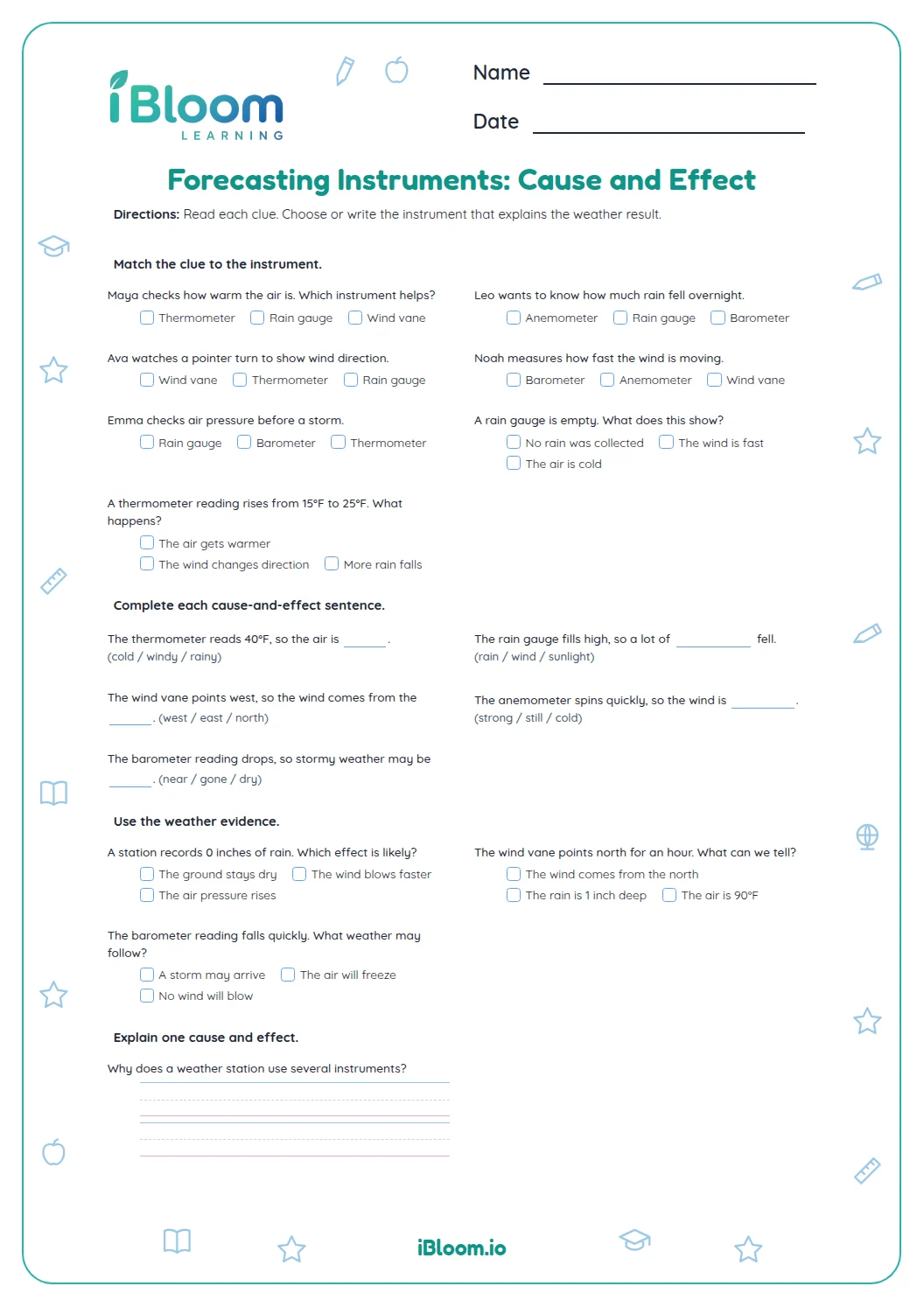
This Grade 2 science printable reviews instruments used to observe weather and the evidence they provide. Fourteen questions cover thermometers, rain gauges, wind vanes, and anemometers, then ask learners to interpret readings and connect observations with a forecast. The answer key follows the worksheet order.
Which weather instrument answers each question?
Part A matches each instrument to its job: a thermometer measures air temperature, a rain gauge collects rain, a wind vane shows direction, and an anemometer measures wind speed. Later questions use readings and observations as evidence for a simple forecast.
The 14 questions begin with instrument jobs, then use readings and observations as evidence for simple weather conclusions.
- 16 questions practice the skill in steps
- The answer key follows the worksheet questions
- Open responses include sample answers
How does a weather tool provide useful evidence?
Question 1 asks which tool measures air temperature. The thermometer is the match; a rain gauge measures collected precipitation, while a wind vane shows direction.
How can the answer key support practice?
Check one response at a time. Match each instrument or observation to the answer in the key, then revisit any item that needs another look.
- Point to one clue that supports the answer
- Return to the passage or situation when needed
A simple practice routine
- 1Read what the question asks to measure or observe.
- 2Match the job to the correct instrument.
- 3Use the reading and conditions as evidence.
- 4Complete the instrument and weather statements.
- 5Check each answer against the key and name its evidence.
Common mistakes and quick fixes
The mistake
Using a wind vane to measure wind speed.
The fix
A wind vane shows wind direction; an anemometer measures speed.
The mistake
Calling an empty rain gauge a thermometer reading.
The fix
A rain gauge collects precipitation; a thermometer measures temperature.
The mistake
Making a forecast from a single clue.
The fix
Use repeated observations and more than one useful measurement when possible.
What to practice next
Make more practice
Questions parents and teachers ask
Which weather tools are on this worksheet?
Learners review the thermometer, rain gauge, wind vane, and anemometer. They match each tool to temperature, rainfall, wind direction, or wind speed, then use readings and observations as evidence for simple weather conclusions. Invite the learner to explain one choice and point to its evidence before checking.
How many questions are included?
There are 14 questions: eight multiple-choice items followed by six fill-in responses about instruments, readings, and weather evidence. The printable includes the worksheet and a separate answer key. The key follows the same question order, making it easy to check each response.
What does a wind vane measure?
A wind vane shows the direction from which wind comes. An anemometer measures wind speed. The worksheet asks learners to match these tools to their jobs and to read a vane direction using a simple compass rose clue.
How do the questions connect instruments to forecasts?
Learners first identify each instrument’s job, then interpret readings and observations. A later question asks what evidence supports a rainy forecast, linking weather clues with a prediction. The answer key gives the intended instrument or observation for every item.
Can a single observation show a weather pattern?
One reading gives information about one moment. Repeated observations, such as thermometer readings across several days, can reveal a pattern. The worksheet asks why readings should be checked over time and uses that idea in its forecast reasoning. Invite the learner to explain one choice and point to its evidence before checking.