



About this worksheet
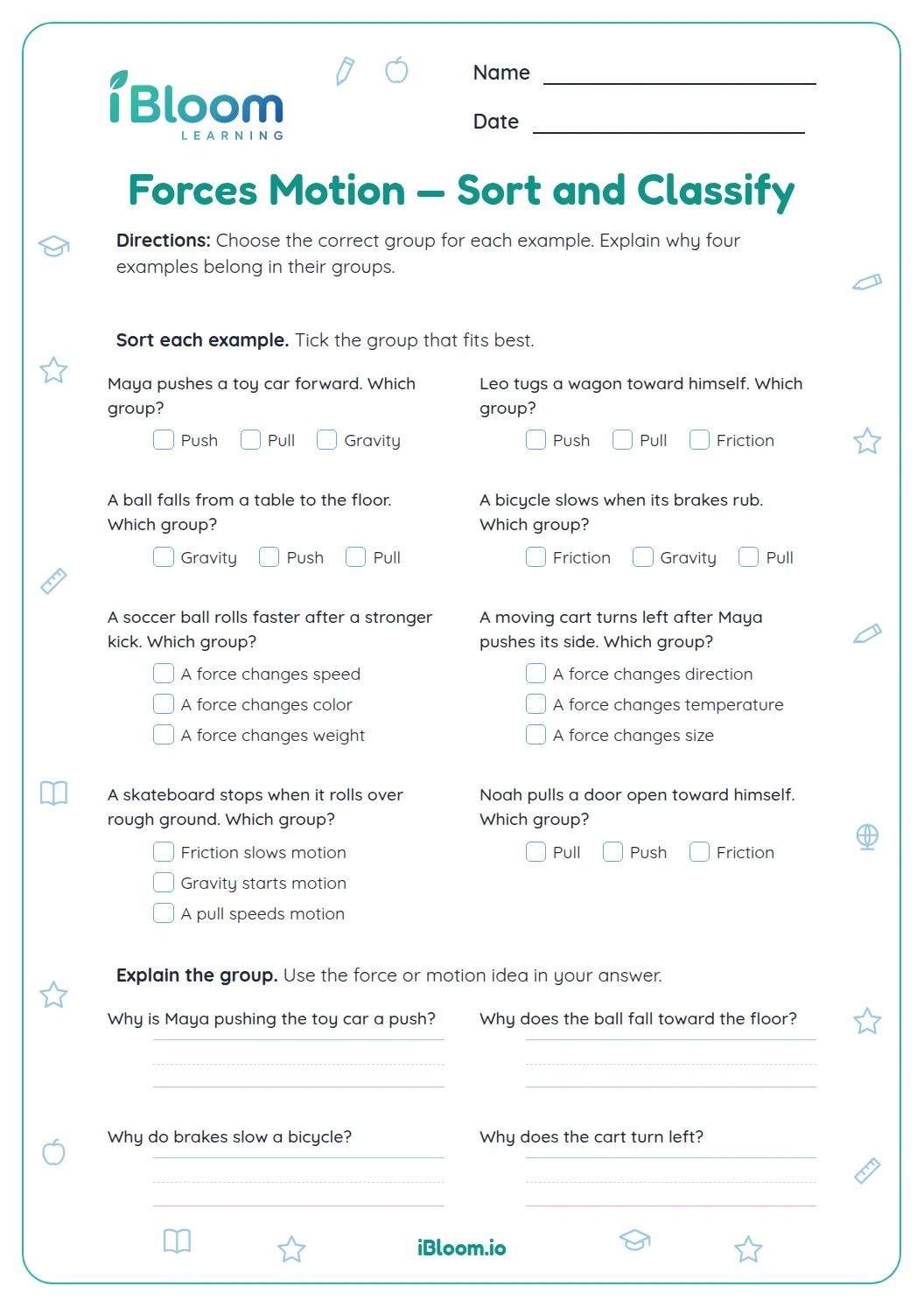
This Grade 3 science worksheet helps students tell gravity and friction apart in everyday examples. Students write G or F beside 16 situations, including falling objects, a bicycle brake, a sled on snow and a shoe gripping the floor. The page gives a focused sorting activity and a separate answer key. Students can explain each choice by naming the clue in the sentence.
What does Part A ask students to classify?
Sixteen short situations ask students to mark gravity with G or friction with F. The examples show falling objects, surfaces slowing motion, and surfaces helping an object grip.
Part A focuses on familiar events; Part B adds statements about force effects and properties.
- 1A book slides more slowly on a rough table.
- 2The book and table touch, so friction slows the slide.
- Write G for gravity
- Write F for friction
- Use the example clue to classify each item
What does gravity do?
Gravity pulls objects toward Earth. A dropped object falls even when no hand or surface is pushing it downward. Gravity also pulls a toy car down a ramp.
- 1A toy car rolls down a ramp. Which force pulls it downhill?
- 2Gravity pulls the car toward Earth along the ramp.
When does friction act?
Friction acts between surfaces that touch. It can slow sliding or rolling, and it can also help surfaces grip. A brake pad pressing a bicycle tire is one example.
How can students compare the two forces?
Ask whether the example depends on an object being pulled toward Earth or on two surfaces touching. That question helps distinguish gravity from friction in the situations on this page.
How to use this worksheet
- 1Read the whole situation before choosing a force.
- 2Ask whether the object is being pulled toward Earth.
- 3If surfaces touch and resist sliding or rolling, consider friction.
- 4Notice that friction may slow motion or help a surface grip.
- 5Review each choice with the answer key and explain the clue.
Common mistakes and quick fixes
The mistake
Choosing gravity whenever something is moving downward.
The fix
Look for the cause: gravity pulls downward, while friction comes from touching surfaces.
The mistake
Thinking friction only slows things down.
The fix
Friction can also help a shoe grip a floor or a tire grip a road.
The mistake
Calling any touching force friction.
The fix
Check whether surfaces rub or resist motion; simple contact alone does not describe friction.
What to practice next
Make more practice
Further reading
Questions parents and teachers ask
What is gravity?
Gravity is a force that pulls objects toward Earth. It explains why a dropped pencil or ball falls. On this worksheet, students recognize gravity in falling objects and an object moving down a ramp. The examples use familiar objects such as a ball, book, bicycle and sled. Students look for the force named by the situation.
What is friction?
Friction is a force between surfaces that touch. It can resist sliding or rolling, as when a box slows on carpet, and it can help a shoe or tire grip a surface. The worksheet contrasts a downward pull with contact between surfaces. Ask students to point out which clue fits each force.
Can friction help an object instead of slowing it?
Yes. Friction can help a shoe grip the floor or a tire grip the road. It resists slipping between surfaces, which can make controlled movement possible. A shoe gripping a floor is a useful counterexample to the idea that friction only slows motion. Grip comes from friction between surfaces.
How many examples do students classify?
There are 16 short-answer items. Students write G or F beside each situation, and the answer key gives a letter for every prompt. The examples include both falling objects and surfaces that rub or grip. It is a quick way to check the letter beside each example.
Why is gravity different from friction?
Gravity pulls objects toward Earth and can act without surfaces touching. Friction happens between surfaces in contact. Looking for contact and rubbing helps students identify friction in the examples. The page uses everyday situations to connect force words with motion. Students can explain their choice by naming the clue in each item.