




About this worksheet
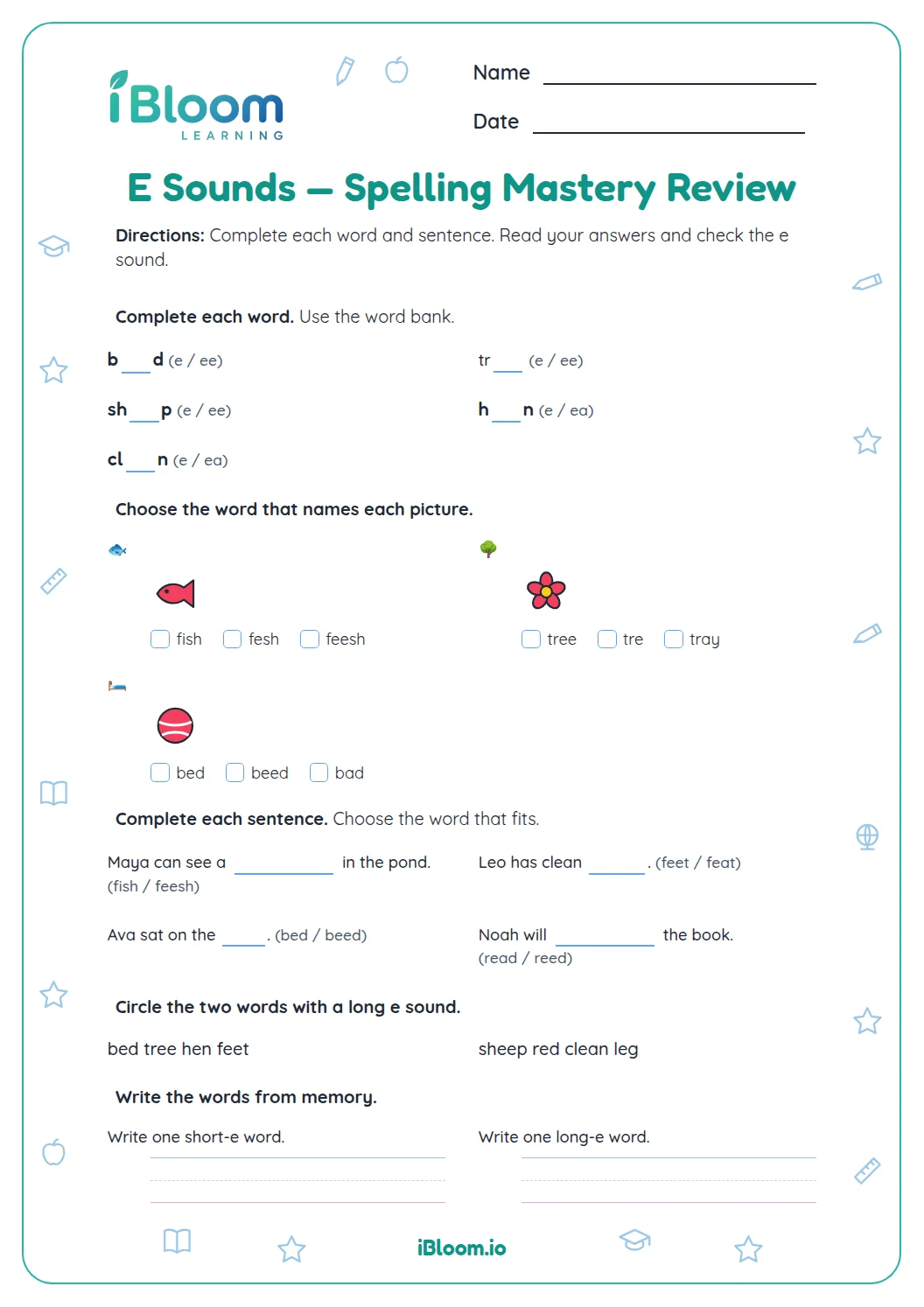
This Grade 1 spelling page gives students 16 short sentences with a missing word. Each item offers three choices, and students use the sentence meaning and the e sound to choose a spelling. The words include short-e examples such as bed, hen, and red, along with long-e spellings such as bee, see, and feet. A separate answer key lists the correct words.
Aligned to L.1.2.e
How do the sentences help with spelling?
Each sentence gives a meaning clue for the missing word. “The ___ laid three eggs” points to hen, while “Brush your ___ before bed” points to teeth. After choosing, students can say the word and notice how its vowel sound is spelled.
Which e sounds appear on the page?
The worksheet includes short-e words such as bed, hen, red, and feet, as well as long-e words such as bee, see, and tree. The long-e sound appears in more than one spelling pattern, so students use both sound and context to choose the word.
How can students check their choices?
Read the completed sentence from beginning to end. The chosen word should make sense and match the spoken word in the student’s mind. Then compare the spelling with the key and look closely at the vowel letters in any missed word.
How to use this worksheet
- 1Read the whole sentence before looking at the choices.
- 2Say each choice and listen for the e sound.
- 3Use the sentence to decide which word makes sense.
- 4Choose the spelling that matches the word you mean.
- 5Reread the sentence with the word filled in.
- 6Check the key and notice the vowel pattern in any correction.
Common mistakes and quick fixes
The mistake
Choosing a similar-sounding word without checking meaning.
The fix
Read the whole sentence and ask whether the word fits.
The mistake
Mixing up short-e and long-e sounds.
The fix
Say the word slowly and listen to the vowel sound.
The mistake
Choosing the right word but overlooking its spelling.
The fix
Look at the vowel letters and compare them with the key.
Use knowledge of the e sound to choose a correctly spelled word in context.
On this sheet:
Show the official wordingHide the official wording
Spell untaught words phonetically, drawing on phonemic awareness and spelling conventions.
What to practice next
Make more practice
Further reading
Questions parents and teachers ask
What words are practiced on the page?
The 16 choices include bed, hen, bee, set, leap, hear, seal, wool, see, deer, teeth, tree, red, cheese, and feet. Students use a sentence clue to choose the word that fits, then can review its spelling in the separate key.
Does the worksheet practice short and long e?
Yes. Words such as bed, hen, and red have a short-e sound, while bee, see, and tree have a long-e sound. Students choose each word from context, which gives them a reason to listen carefully to the vowel and check its spelling.
How can an adult help without giving the answer?
Read the sentence aloud and ask the student to say each choice. Then ask which word makes sense and what vowel sound they hear. The adult can point to the vowel letters after the student chooses and compare them with the key afterward.
Why use sentence clues for spelling?
A sentence gives a word a clear meaning, which helps a student decide which spelling belongs in the blank. For example, a sheep has a coat of wool. Saying the completed sentence also gives the student a chance to hear the word in context.
Is this a handwriting worksheet?
No. Students select a word from three choices for each sentence. The practice focuses on recognizing a correctly spelled e-sound word in context; it does not ask students to copy words, write their own sentences, or practice handwriting on ruled lines.
What should students do after checking?
For any missed item, reread the sentence, say the target word, and look closely at its vowel spelling. Students can then practice that word aloud or write it once in a notebook. The linked vowel-sound pages offer related spelling practice.