






About this worksheet
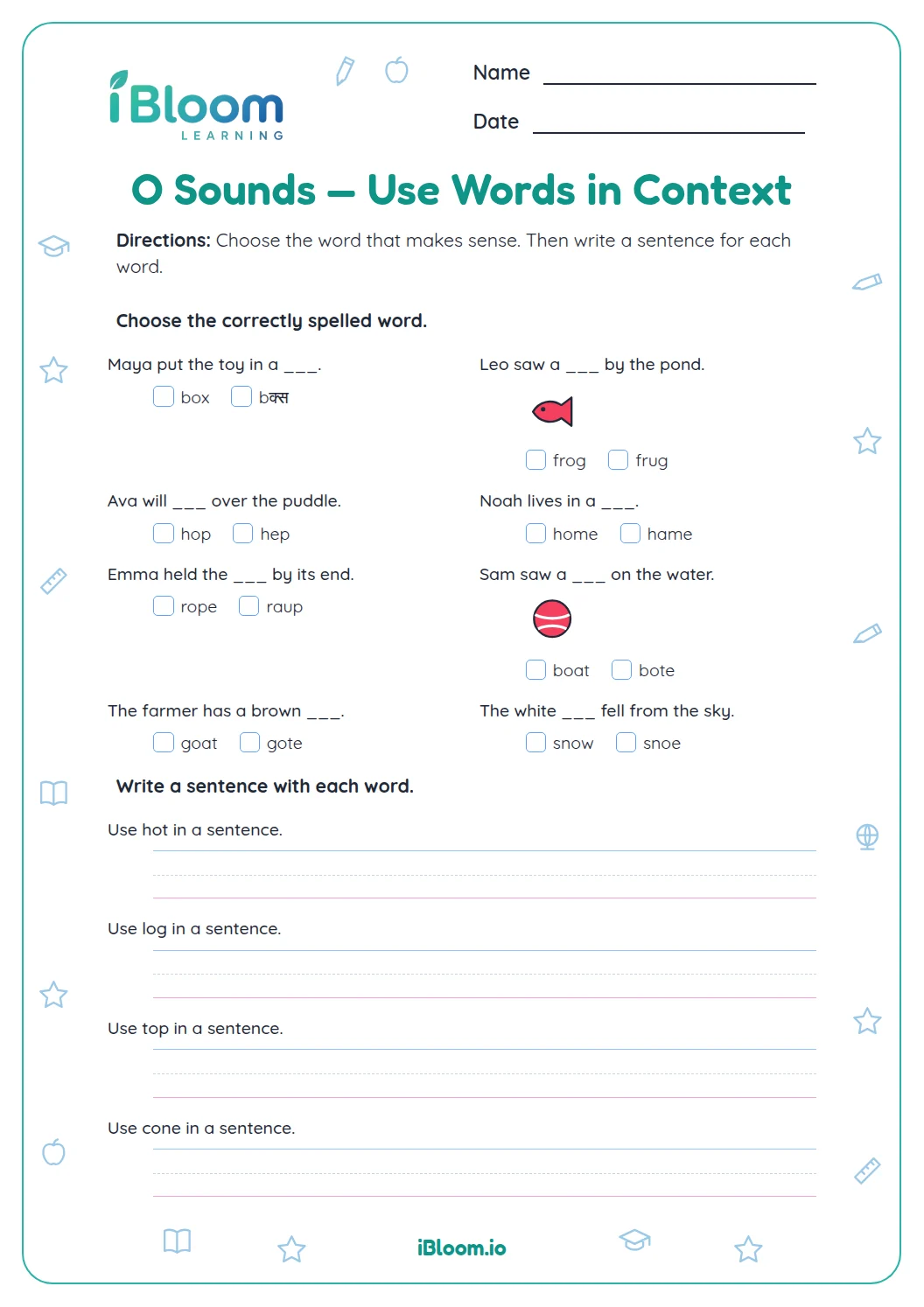
This free printable Grade 1 spelling worksheet asks children to finish words that have an o sound. Short o words such as dog, fox and clock come first, then long o words spelled oa (boat, goat, coat), o with a silent e (nose, bone) and ow (snowman). Each of the first twelve questions has a picture, so a child knows the word before writing the missing letters. The last two parts pick out short and long o words and finish four sentences. It practices Common Core RF.1.3c and L.1.2d, and a separate answer key is included.
Aligned to RF.1.3c and L.1.2d
What is the difference between short o and long o?
A short o is the sound in dog, fox and clock. It is a quick sound, and in these words it is written with a single o. A long o says its own name, as in boat, nose and snow.
The long o can be written several ways, which is what makes it harder to spell. This sheet uses three common ones: oa as in boat, o with a silent e at the end as in bone, and ow as in snow.
How does this worksheet teach the spelling?
The sheet moves from easy to hard in four parts. Every picture word shows the letters before and after the gap, so children only decide what goes in the middle.
- Part A, Short o words: dog, fox, frog, box, clock and rocket, each with a picture and one missing o
- Part B, Long o words: boat, nose, goat, snowman, bone and coat, where the missing letters are oa, o or ow
- Part C, Short or long o?: four questions that ask which word has the sound named
- Part D, Finish the sentence: toad, close, pot and snow, with no picture and a sentence for a clue
- Answer key on a separate page
How do children know whether to write oa, o or ow?
Hearing the word tells a child that the vowel is long, not which spelling to use, so the printed letters around the gap matter. In n___se and b___ne a silent e already sits at the end, so the gap needs only o. In b___t, g___t and c___t there is no e, and the long o is written oa. In sn___man and snow, the long o is written ow.
These are patterns to notice, not rules that always work, so let your child compare a few words side by side.
- 1Picture: a nose
- 2n___se
- 3Say it slowly: n - oh - z
- 4The vowel says its name, and the word already ends in a silent e
- 5Write o: n o se = nose
How to use this worksheet at home or in class
- 1Warm up by saying dog, fox and clock and then boat, nose and snow. Ask your child which words have the short o and which have the long o.
- 2Do question 1 together. Name the picture, say it slowly (d-o-g), and write the missing o.
- 3Let your child finish Part A alone, saying each word aloud after the gap is filled.
- 4In Part B, point out the letters before and after the gap. Ask: "Does the word end in a silent e, or does the vowel need two letters?"
- 5Read each Part C word out loud before your child fills in a bubble. Parts C and D need no pictures, so they show whether the sound carries over.
- 6Check with the answer key, and have your child read every finished word one more time.
Common mistakes and quick fixes
The mistake
Writing bot for boat, or got for goat, by leaving out the a.
The fix
Say the word slowly and stretch the vowel: b-oh-t. A long o often needs two letters, so try oa and read it back.
The mistake
Writing oa or ow in a word that already ends in a silent e, such as noase or nowse for nose.
The fix
Look at the letters after the gap first. If the word ends in e, that e makes the o long, so the gap needs just one o: n-o-se, b-o-ne.
The mistake
Picking hop or hot as the long o word in Part C because all three choices start with ho.
The fix
Read each choice out loud instead of looking at the letters. Hope says the letter name, oh, while hop and hot have the quick short o.
Common Core alignment
Most US states use the Common Core standards or a close state version. The two Grade 1 standards below match what this sheet practices.
Know that a final e and vowel teams like oa spell long vowel sounds, as in bone and boat.
On this sheet: Part B writes long o as oa, as o with a silent e, and as ow.
Show the official wordingHide the official wording
Know final -e and common vowel team conventions for representing long vowel sounds.
Spell words with common patterns, here short o and long o words, correctly.
On this sheet: Every question asks children to write the missing letters of a word and spell it correctly.
Show the official wordingHide the official wording
Use conventional spelling for words with common spelling patterns and for frequently occurring irregular words.
What to practice next
Make more practice
Further reading
Questions parents and teachers ask
What should my child know before this worksheet?
Your child should know the letter sounds and be able to say a word slowly, sound by sound. Knowing the five vowels helps, and so does having heard the difference between a short vowel and a long vowel. If not, say the words dog and boat together first and listen for the o.
Why does the sheet use pictures for the first twelve questions?
A picture tells the child which word to spell, so the child can focus on the vowel instead of guessing the word. Parts C and D take the pictures away. There the child works from the written word and a sentence clue, which shows whether the spelling is really learned.
Is the long o only spelled oa, o with a silent e, and ow?
No. English has other long o spellings, such as oe in toe and a plain o in go. This worksheet sticks to three common ones: oa in boat, o with a silent e in nose and bone, and ow in snow and snowman. More spellings can be added as your child reads more words.
Can my child fill in this sheet without writing whole words?
Yes. Each gap needs only one to three letters, because the letters around the gap are already printed. This keeps the focus on the vowel and avoids slow handwriting. Once the gap is filled, ask your child to read the whole word out loud to check it makes sense.
What is the answer to question 10?
The answer is ow. The picture shows a snowman, and the word is written sn___man. Saying the word slowly gives sn-oh-man, with a long o, and in this word the long o is written ow, so the finished word is snowman. The answer key shows each missing letter in green.
Is there an answer key for this worksheet?
Yes. A separate answer key shows the missing letters for all sixteen gaps and the correct word in each of the four multiple choice questions. Print the worksheet pages on their own and keep the key for checking, then have your child read every finished word aloud once more.