



About this worksheet
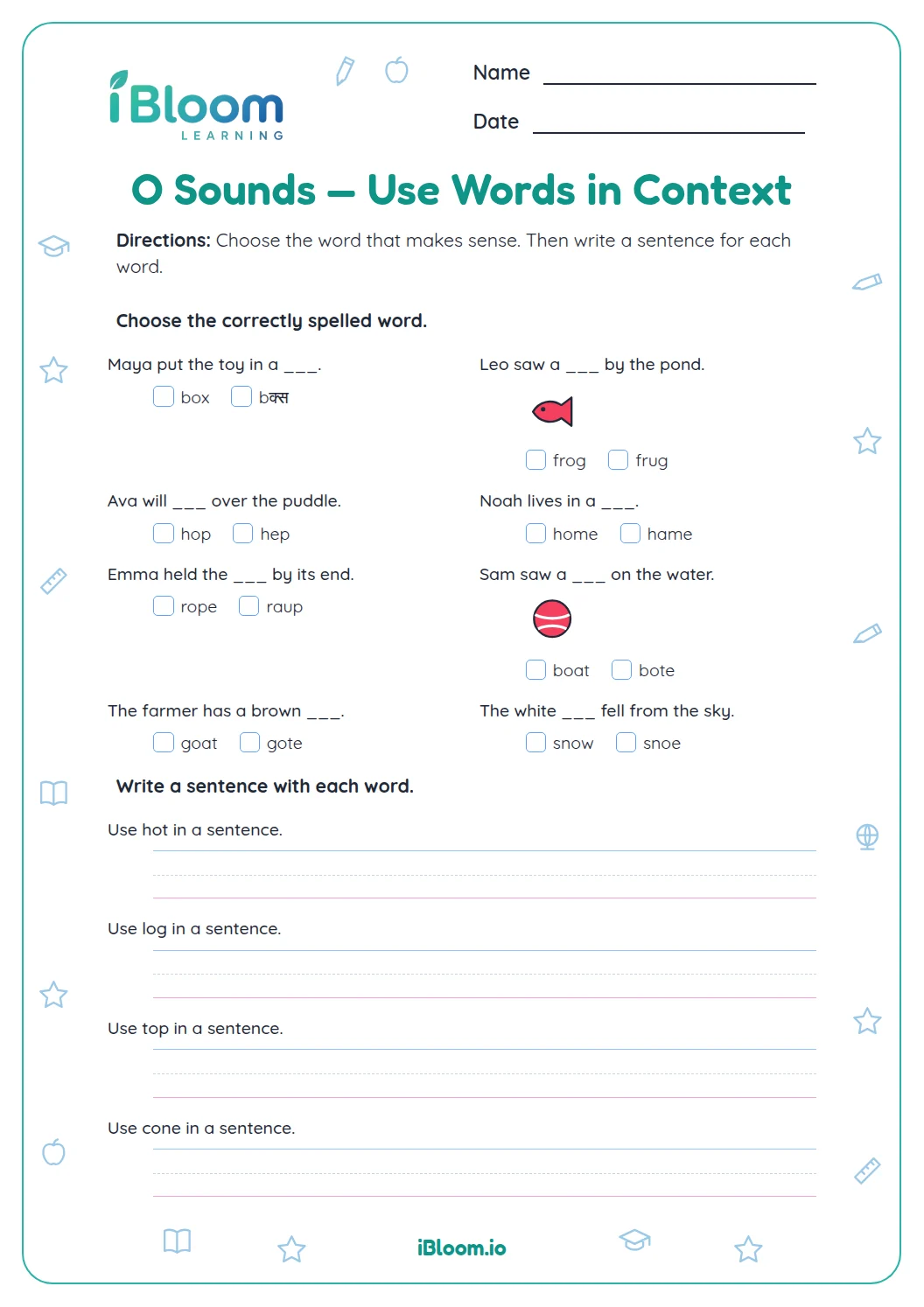
This free printable Grade 1 worksheet gives children 14 chances to check short-o and long-o spellings. Part A offers spelling choices in four sentences. Part B asks children to repair five short-o words, and Part C asks them to repair five long-o words. The sentences make the intended words clear: a boat floats, a rope is for jumping, and a sock goes on a foot. This practices Common Core L.1.2d through conventional spelling patterns. A separate answer key supplies each correct word, so an adult can check the spelling without requiring a whole sentence to be copied.
Aligned to L.1.2d
Which O sounds will children practice?
Short o appears in pot, hop, box, sock and fox. Long o appears in roll, boat, rope, nose and coat. Say pot and rope side by side so your child hears the difference before looking closely at the letters.
The sheet includes several long-o spellings. Final e helps mark the vowel in rope and nose; oa appears in boat and coat. Roll gives practice with a familiar word that has o followed by ll.
How do you help a child repair a word?
Read the sentence before editing. It gives the intended meaning, which matters when both choices are real words, as in hop and hope. Then write just the corrected word on the answer line.
- 1Question 9: We jump over the ROP.
- 2The intended word is rope, with a long-o sound.
- 3Keep r, o and p; add a final e.
- 4Answer: rope
How do the three parts build independence?
Part A lets children compare two spellings. Part B removes the choices and focuses on short-o words. Part C keeps the same correction task but changes to long-o patterns.
Check a correction letter by letter. For box and fox, x represents the final /ks/ sounds. In sock, ck follows the short vowel. Return to one pattern at a time when reviewing an error.
A short spelling routine
- 1Say pot and rope aloud and compare their vowel sounds.
- 2Read each Part A sentence before choosing a spelling.
- 3In Part B, say the CAPITAL word as it should sound.
- 4Write only the corrected word for each item in Parts B and C.
- 5Use the key to check the letters, then read the corrected sentence.
Spelling slips to discuss
The mistake
Choosing hope in the sentence about moving on one foot.
The fix
Act out hop and say its short-o sound before choosing.
The mistake
Leaving rope as rop.
The fix
Compare the written word with rope and notice the final e.
The mistake
Writing bote for the floating boat.
The fix
Practice the oa in boat and coat together, then check the sentence again.
Common Core alignment
Correct short-o and long-o words using familiar spelling patterns.
On this sheet: Children choose and write correct spellings in short sentences.
Show the official wordingHide the official wording
Use conventional spelling for words with common spelling patterns and for frequently occurring irregular words.
What to practice next
Make more practice
Further reading
Questions parents and teachers ask
Does this sheet include both short and long O?
Yes, the sheet includes both sounds in familiar words. Part B focuses on short o in box, sock, fox and pot. Part C focuses on long o in rope, nose, boat and coat. Part A mixes sounds so children also use the sentence to choose.
Should my child rewrite the whole sentence?
No, children write only the corrected word in Parts B and C. That keeps the writing task focused on spelling. Read the complete sentence aloud after correcting the word so the child can hear how the meaning and the chosen spelling fit together.
Can I read the sentences aloud?
Yes, an adult can read each sentence and say the intended word naturally. Keep the printed choices visible in Part A, and let the child decide which spelling fits. In the correction parts, ask the child to examine the letters before offering a spelling hint.
Why are boat and coat spelled with oa?
Boat and coat share the oa spelling for the long-o sound. Pairing these words gives children a pattern to remember while correcting bote and cote. After checking the answer key, have your child underline oa in both corrected words and read the two words aloud.
What does the answer key show?
The separate answer key marks the correct choices and supplies all ten corrected words. Use it after your child finishes each part, or check all 14 items together. For a missed answer, compare the child’s spelling with the key and identify the exact letters to change.