


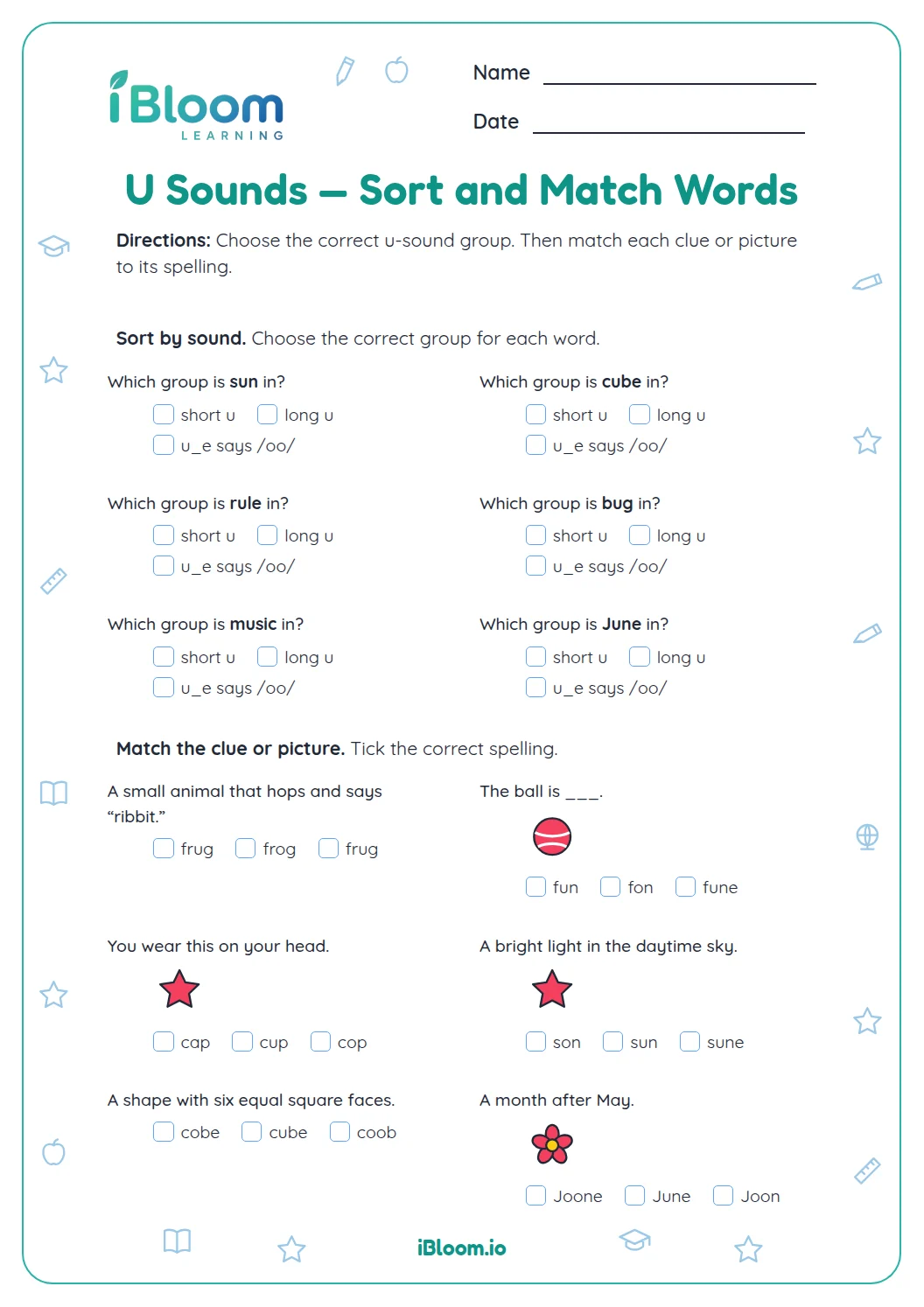
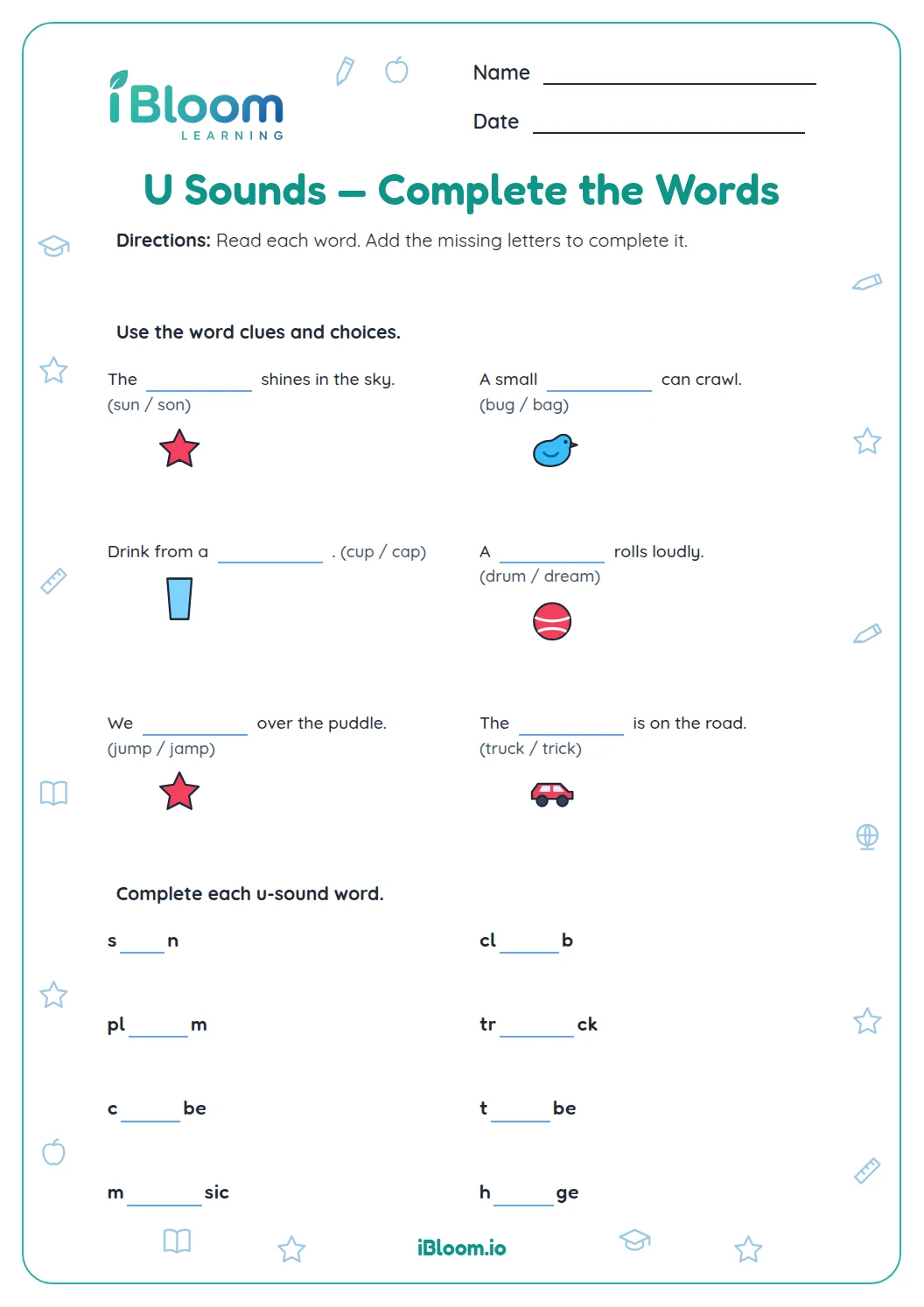

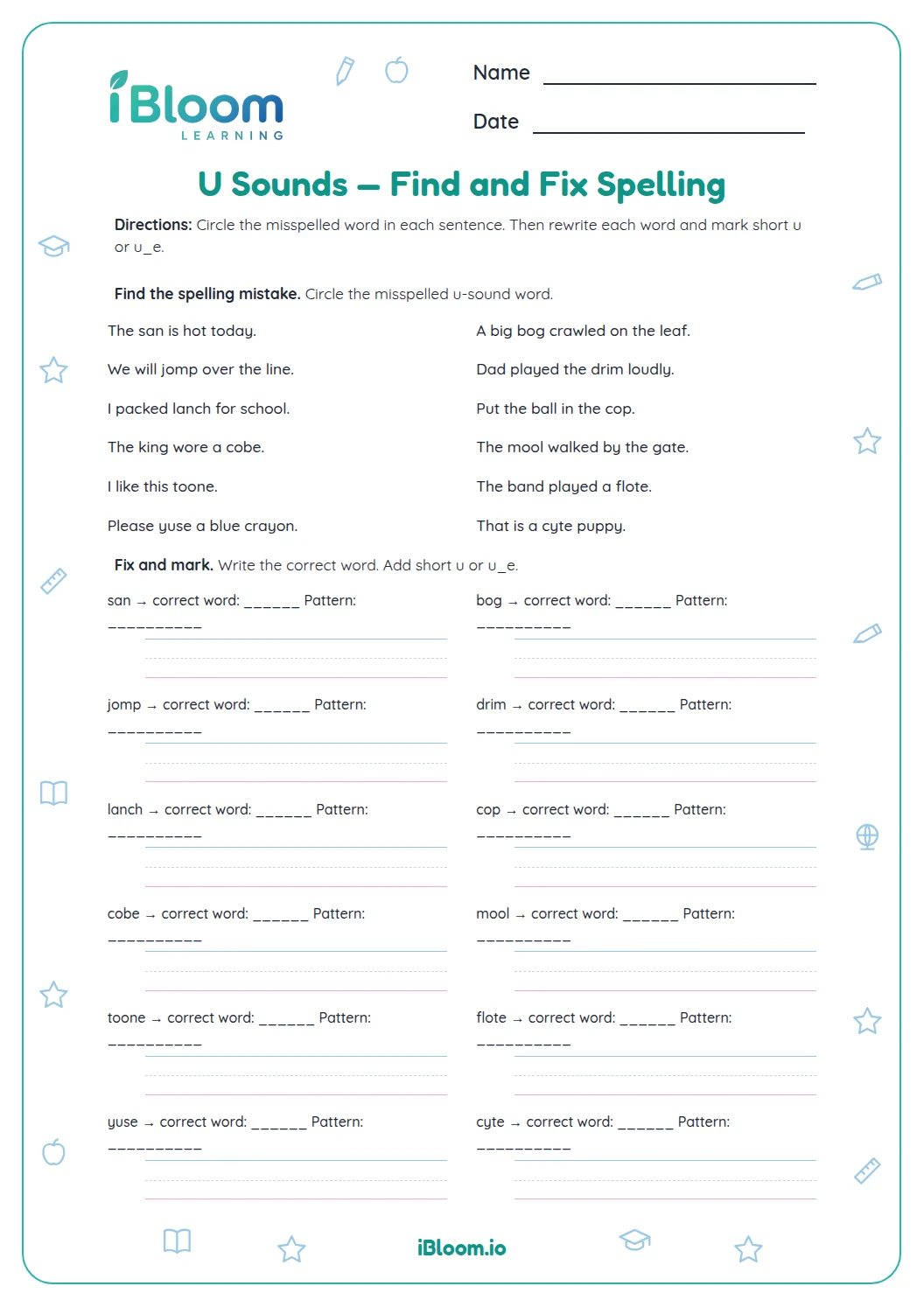
About this worksheet
This free Grade 1 worksheet practices split digraphs, also called silent-e patterns, in two steps. Children first find and circle six words missing their final e, then write eight corrected words and mark the vowel-consonant-e pattern. The examples include cake, bike, home, bone, dance and like, covering a–e, i–e, o–e and u–e. The page practices Common Core RF.1.3c by reading final-e words and L.1.2d by spelling familiar words with common patterns. A separate answer key shows the intended corrections and patterns.
Aligned to RF.1.3c and L.1.2d
How can a child spot a missing final e?
Read each sentence and look for the word that does not fit its spelling pattern. A word such as cak is missing the final e in cake; the e helps the a stand for its long sound.
Part A asks children to circle one misspelled word in each of six short sentences. Every target is a split-digraph word with its final e missing.
How does the final e change each word?
In Part B, write the complete word and mark the vowel-consonant-e pattern. The first and last letters are the vowels, with one consonant between them; the final e is not pronounced.
The first answer is cake; a_e. The same routine works for bike; i_e and home; o_e.
- 1Fix cak. Write the word and mark its pattern.
- 2Correct word: cake
- 3Pattern: a_e
What words and patterns are included?
The 14 questions cover six words to find and eight corrections. The target words use a–e, i–e, o–e and u–e patterns; cake, bike, home, bone, dance and like provide examples.
A quick way to find and fix each word
- 1Read the Part A sentence and circle its one word missing a final e.
- 2Say the word aloud and listen for the long vowel sound.
- 3For Part B, write the corrected word and its vowel-consonant-e pattern.
- 4Check that the consonant stays between the two vowels, as in cake: a_e.
- 5Use the key to check the word and pattern, then reread the sentence.
Silent-e slips to check
The mistake
Leaving out the final e in a word such as bik.
The fix
Say bike and notice the long i; write the final e after the consonant.
The mistake
Putting e between the vowel and consonant, as in caek.
The fix
Keep the order vowel, consonant, final e: cake.
The mistake
Reading danc as a finished word.
The fix
Use the sentence meaning and add final e to make dance.
Common Core alignment
Read words with final e representing a long vowel sound.
On this sheet: Children read silent-e words in sentence choices and spelling repairs.
Show the official wordingHide the official wording
Know final -e and common vowel team conventions for representing long vowel sounds.
Correct familiar words that follow silent-e spelling patterns.
On this sheet: Children write eight corrected silent-e words.
Show the official wordingHide the official wording
Use conventional spelling for words with common spelling patterns and for frequently occurring irregular words.
What to practice next
Make more practice
Further reading
Questions parents and teachers ask
Which silent-e patterns are on this sheet?
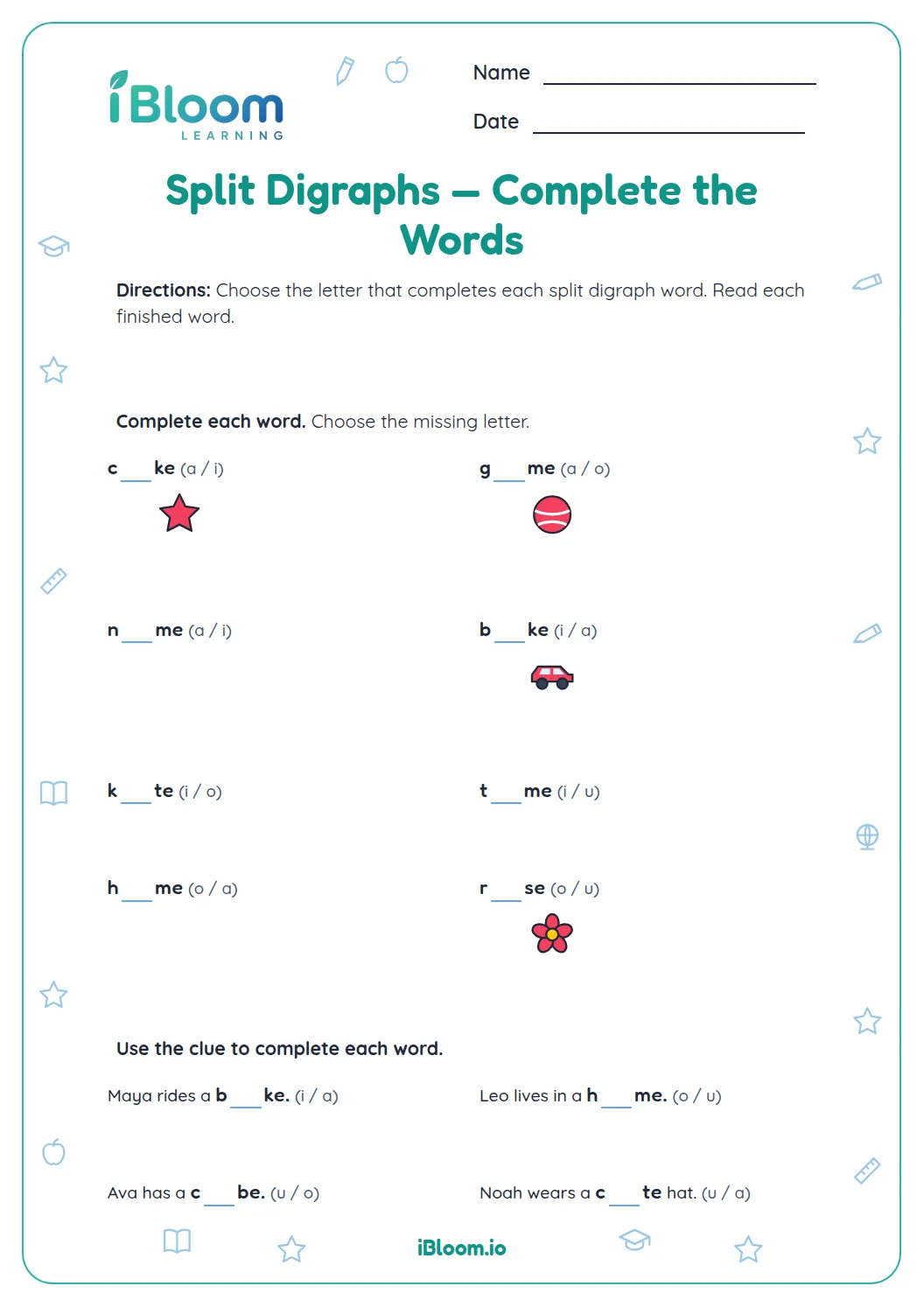
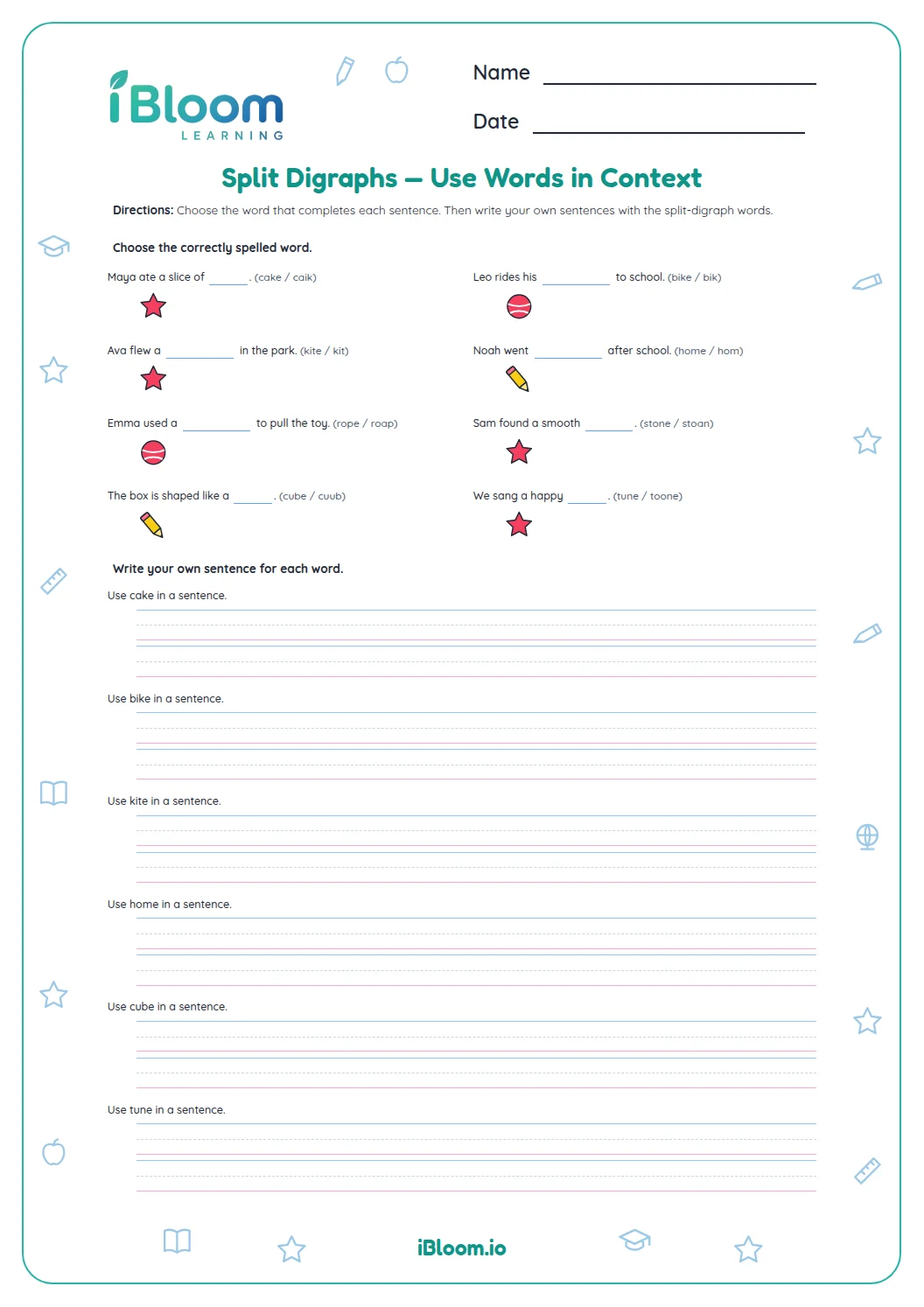
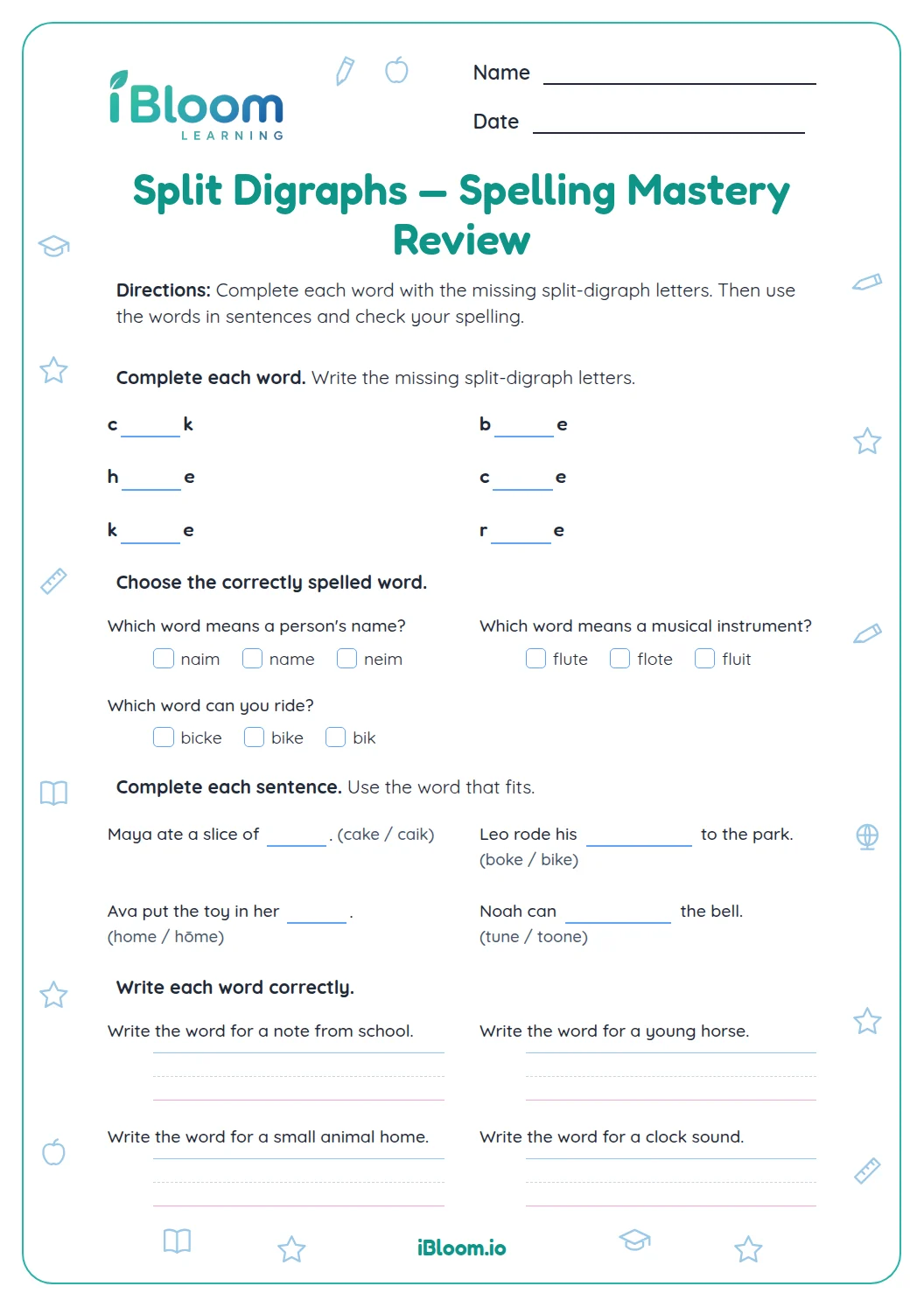
The worksheet practices a–e, i–e, o–e and u–e. Children find words such as cak, bik, hom and bon with the final e missing, then write cake, bike, home, bone, dance and like and mark each word’s pattern in Part B.
Does my child copy the whole sentence when fixing a spelling?
No. Part B asks for the corrected word and its split-digraph pattern. For example, the key gives “cake; a_e” for question 7, so the child can focus on the spelling change and pattern instead of copying the whole sentence.
Can I read the sentences aloud?
Yes. Read each short sentence naturally and let your child look for the word whose spelling is incomplete. If needed, say the target word clearly, then ask which letter is missing at the end. This keeps attention on the spelling pattern.
Why does question 1 use cak?
Cak is the misspelled target in “Maya ate a cak at the party.” Adding final e gives cake, a word with the a–consonant–e pattern. The other Part A targets follow the same missing-final-e idea and each sentence has one intended target.
How should I use the answer key?
Use the key after your child finishes both parts. It identifies the six words to circle and gives each of the eight corrected words with its pattern, such as “bike; i_e.” If a pattern is marked differently, compare the letters rather than the handwriting.