



About this worksheet
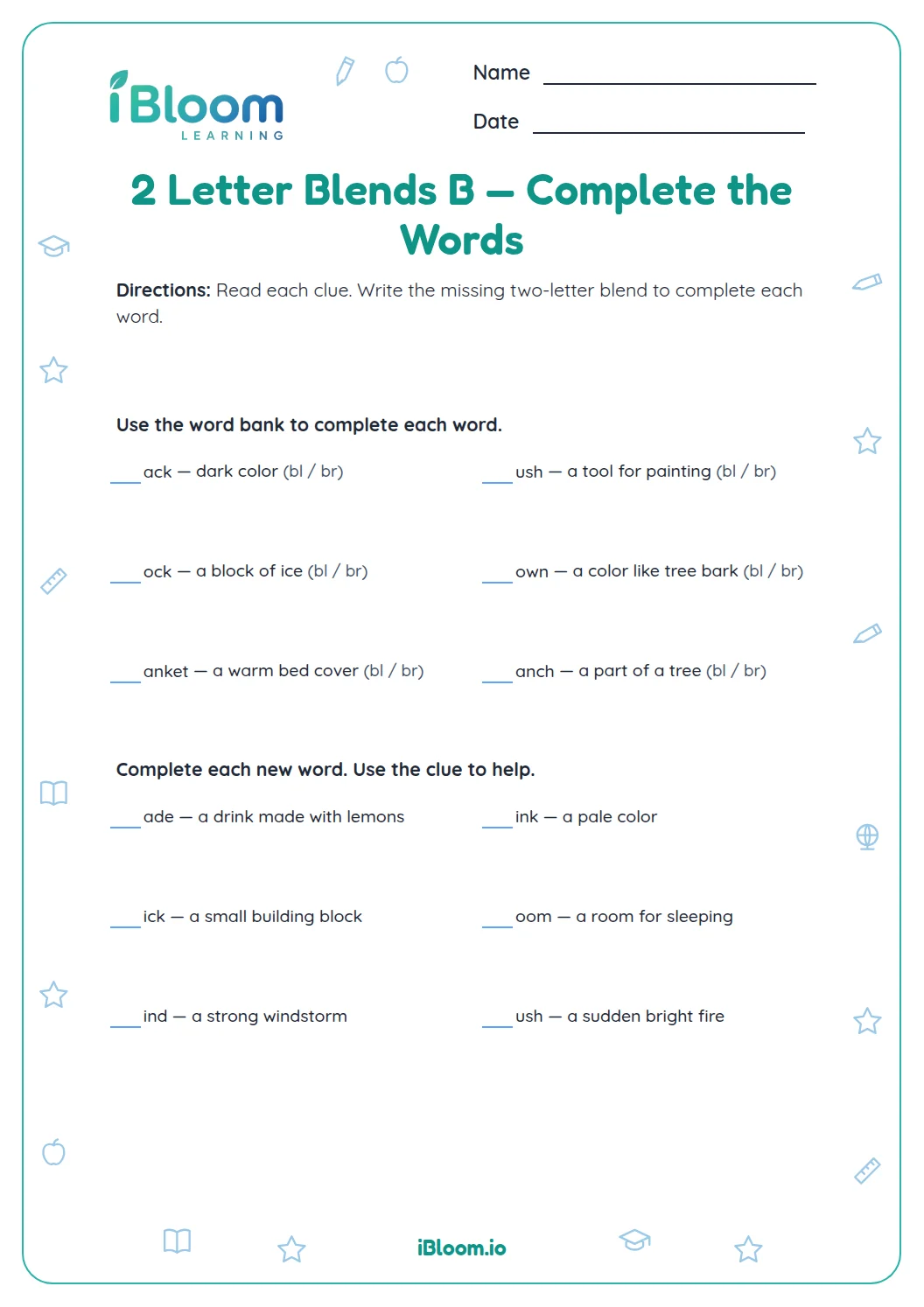
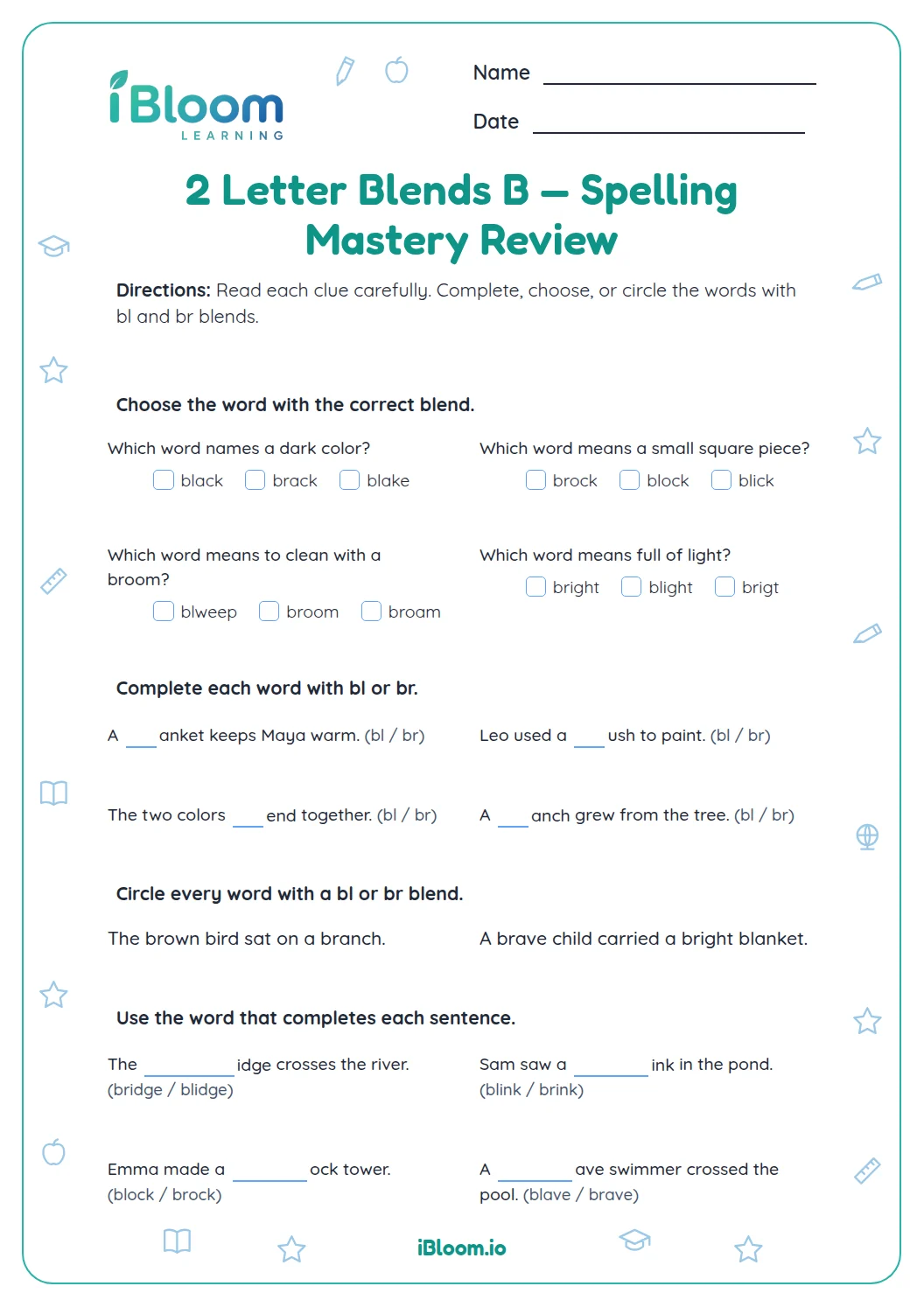
This free Grade 3 spelling worksheet pairs a beginning-blend sort with a meaning match. Children work with six words: black, brush, bloom, brick, blank and brave. In Part A, they label each word bl or br. In Part B, they choose from the same six words and write each one beside its definition. The repeated word set lets children check the two consonants while connecting spelling to meaning. These 12 questions practice spelling patterns under Common Core L.3.2f. A separate answer key gives every blend and word.
Aligned to L.3.2f
What do bl and br have in common?
Both blends begin with b, and both consonant sounds can be heard. In black, the second sound is /l/; in brush, it is /r/. Saying the whole word first helps children hear the blend without adding an extra vowel between the consonants.
The B in the list name identifies this worksheet set. This page focuses on the two beginnings bl and br, with four words for each group.
How does the meaning match support spelling?
Part B asks children to select and write a whole word, so they revisit the beginning blend and the rest of its spelling. Each definition has one match in the bank, and each word is used once.
For question 10, a block used to build walls is a brick. Children can check its br beginning against their answer to question 4.
- 1Clue: a small block used to build walls
- 2Choose brick from the word bank.
- 3Check the beginning: b + r = br.
- 4Write brick on the line.
How can I check understanding after the sheet?
Ask your child to read the three bl words together, then the three br words. Next, cover the bank and ask for the word that means willing to act even when afraid. Have your child explain why brave belongs with brush and brick.
Use a missed answer to decide what to revisit: the second consonant for an incorrect blend, or the definition for an incorrect word match.
How to use this worksheet
- 1Read the six words aloud together before writing.
- 2Model black by saying its beginning sounds and writing bl.
- 3Let the child sort the remaining five words in Part A.
- 4Read the Part B bank and write one word for each meaning.
- 5Check the key, then say and spell any word that needed a correction.
Mistakes to check together
The mistake
Writing b for the beginning blend.
The fix
Ask for both beginning consonants: bl in bloom or br in brush.
The mistake
Putting brick in the bl group.
The fix
Say brick and black slowly and listen for the different second sounds.
The mistake
Matching blank to the dark-color clue.
The fix
Compare blank with black letter by letter, then reread both definitions.
Common Core alignment
Use beginning blend patterns to sort and spell six words.
On this sheet: Children group bl and br words, then write each complete word beside its meaning.
Show the official wordingHide the official wording
Use spelling patterns and generalizations (e.g., word families, position-based spellings, syllable patterns, ending rules, meaningful word parts) in writing words.
What to practice next
Make more practice
Further reading
Questions parents and teachers ask
Which words are on this blend worksheet?
The eight words are black, brush, bloom, brick, blank, brave, blush and branch. Each appears once in the sorting part and once as an answer in the matching part. Children first hear whether the second consonant is l or r, then use the definition to retrieve the whole spelling.
Does the B in the title mean every blend starts with b?
This page uses bl and br, both of which begin with b. The B in the library title names the list set. Children sort by the complete two-letter blend, so the important distinction on this sheet is the second consonant: l in black or r in brush.
Should children draw lines to match the meanings?
Children write the matching word beside each definition. The eight-word bank appears in the Part B directions, and each word is used once. Writing the word gives an extra spelling check: compare the two beginning consonants and then check the remaining letters against the bank.
Can I help with the definitions?
Yes, read a definition aloud and discuss a familiar example before the child writes. A brick wall or a branch on a tree can make a clue clearer. Keep the eight-word bank visible, then let the child select the matching word and check its beginning blend.
What does the answer key include?
The key supplies bl or br for all eight sorting questions and the complete word for each of the eight meaning clues. Use it after the child finishes, then revisit one missed item aloud. Ask whether the correction came from listening to the blend or understanding the definition.