



About this worksheet
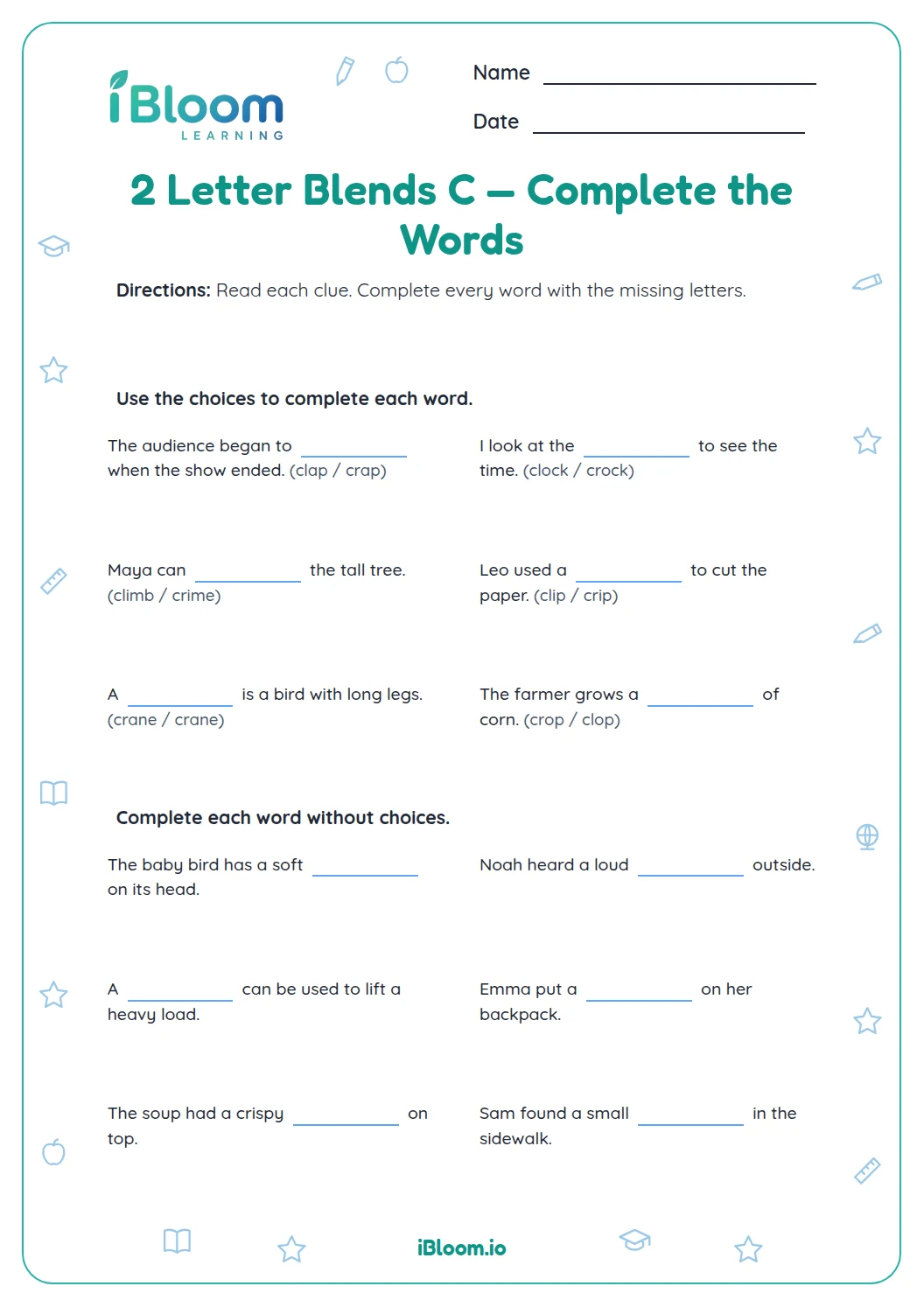
This free Grade 3 List C worksheet practices cl, cr, and ch words in context. Part A checks clap, clean, crab, and crack. Part B asks children to write two original sentences using chalk, cloud, child, and crown. Part C checks eight more spellings, including chair, cherry, climb, and cheese. The cl and cr pairs are blends with two sounds; ch represents one sound in these words. The writing practices Common Core L.3.2f. A separate key gives all twelve spelling choices and sample sentences.
Aligned to L.3.2f
How are cl, cr, and ch different?
In clap and crab, the two starting consonants make two sounds. These pairs are blends: cl and cr. In chair, the letters ch work together to represent one sound. That pair is called a digraph.
This List C set includes both kinds of letter pairs. Say clap, crab, and chair, then point to the letters that make their starting sounds. Keep both letters when spelling each word.
How do children choose a correct spelling?
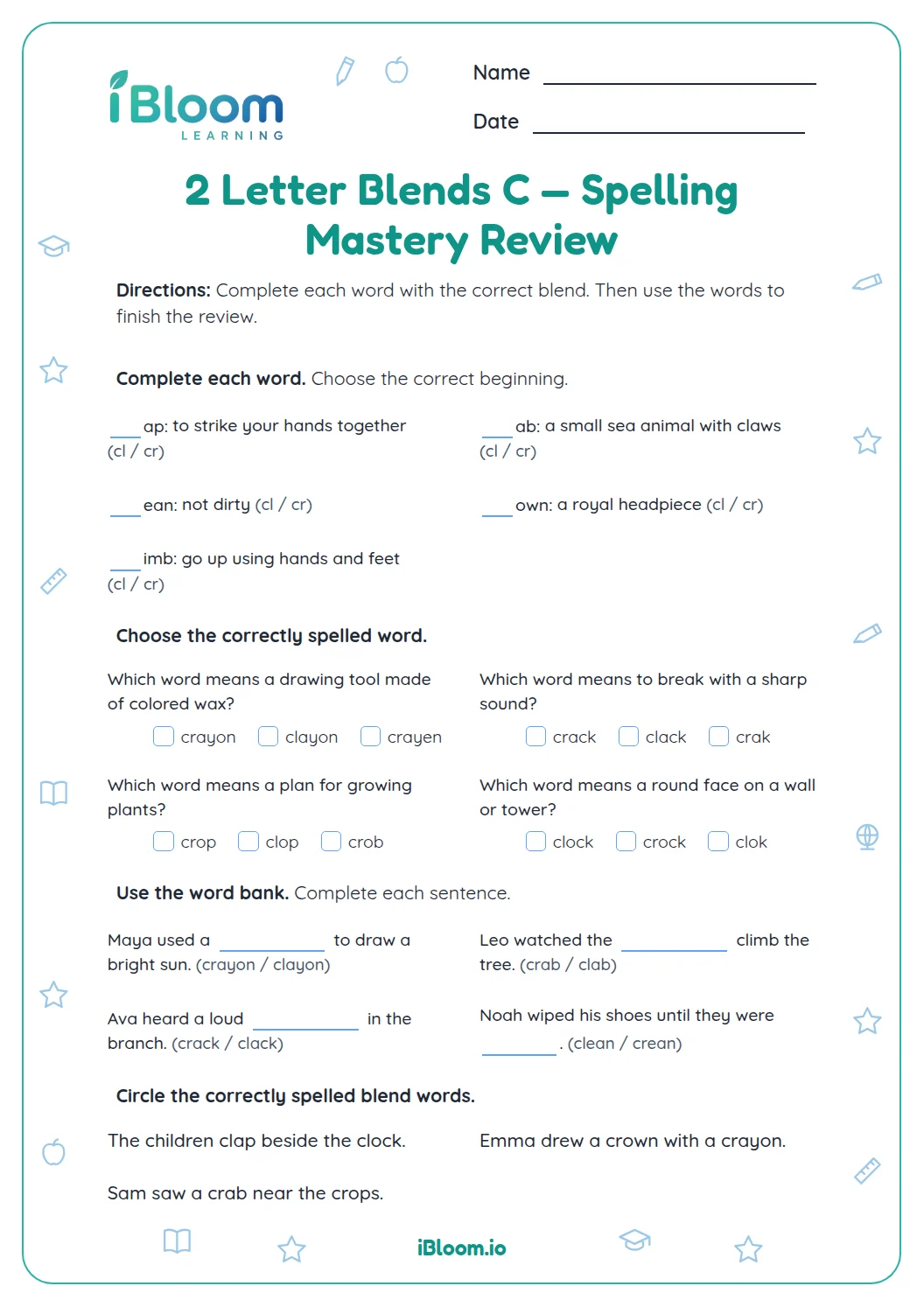
Read the sentence for meaning, then compare the two spellings. Some choices may sound alike when read aloud, so children must also look at the letters. For clean, the vowel team ea belongs in the middle; clap and crab each use a single final consonant.
- 1Please ___ the table after dinner.
- 2Choices: clean, cleen
- 3Answer: clean. The word is spelled c-l-e-a-n.
How do the two sentences use List C words?
Part B combines related words in two complete sentences: chalk and cloud in a drawing sentence, then child and crown in one idea. Part C checks additional spellings in short contexts, including climb, cheese, and the ch words.
Check each target word’s spelling and the whole sentence. “A child used chalk to draw a cloud” includes both given words and expresses a complete idea.
How to use this worksheet
- 1Say clap, crab, and chair and compare their starting sounds.
- 2Read the four Part A sentences and choose the correctly spelled word.
- 3Write one complete sentence using chalk and cloud, then one using child and crown.
- 4Read the eight Part C sentences and check each spelling against the context.
- 5Check spellings and meaning with the key; accept other complete, accurate sentences.
Mistakes to notice and fix
The mistake
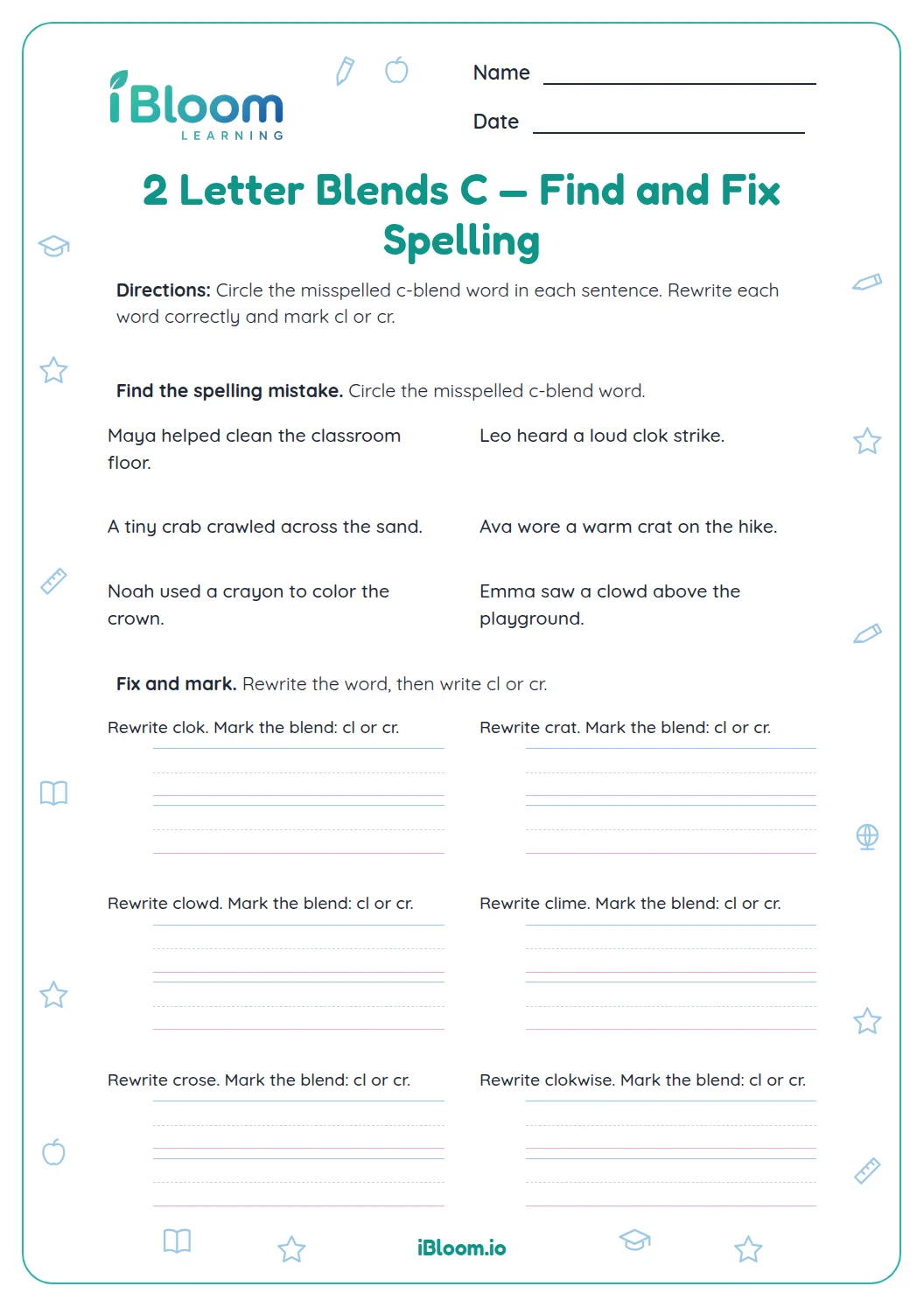
Writing cap when the sentence needs clap.
The fix
Listen for both starting sounds and keep c and l.
The mistake
Choosing cleen because it sounds like clean.
The fix
Look at the spelling: clean uses the vowel team ea.
The mistake
Calling ch two separate sounds in chair.
The fix
Say chair slowly. The letters ch work together to represent one sound.
Common Core alignment
Use cl, cr, and ch spelling patterns when writing words in sentences.
On this sheet: Children choose correct spellings and write six sentences using List C words.
Show the official wordingHide the official wording
Use spelling patterns and generalizations (e.g., word families, position-based spellings, syllable patterns, ending rules, meaningful word parts) in writing words.
What to practice next
Make more practice
Further reading
Questions parents and teachers ask
Which words are in List C on this worksheet?
The worksheet checks all twelve List C words: clap, clean, crab, crack, chair, cherry, climb, cloud, crown, child, chalk, and cheese. Part B asks for two sentences using chalk with cloud and child with crown. Part A and Part C check spelling in short contexts.
Is ch a consonant blend?
In the words on this sheet, ch is a digraph: two letters that represent one sound. The cl in clap and cr in crab are blends because both consonant sounds can be heard. List C includes both patterns, so compare their sounds while keeping both letters in writing.
Why do the choices include spellings such as cleen?
The incorrect spellings let children compare letter patterns while using a sentence for meaning. Clean fits the sentence about the table, but its vowel team must be ea. Clap and crab also appear in a second context so children can check the ending consonant before reading the sentence aloud.
How should I check the six original sentences?
Check that both target words are spelled correctly, the sentence expresses a complete idea, and it matches the prompt. Part B uses chalk and cloud together, then child and crown together. The key gives sample sentences, but other accurate sentences that include both words count.
Can children say their sentences before writing?
Yes, saying each sentence aloud helps children plan a complete thought. Ask them to include the given word and the situation named in the prompt. After writing, reread the sentence together and check the target spelling, the capital at the beginning, and the punctuation at the end.