






About this worksheet
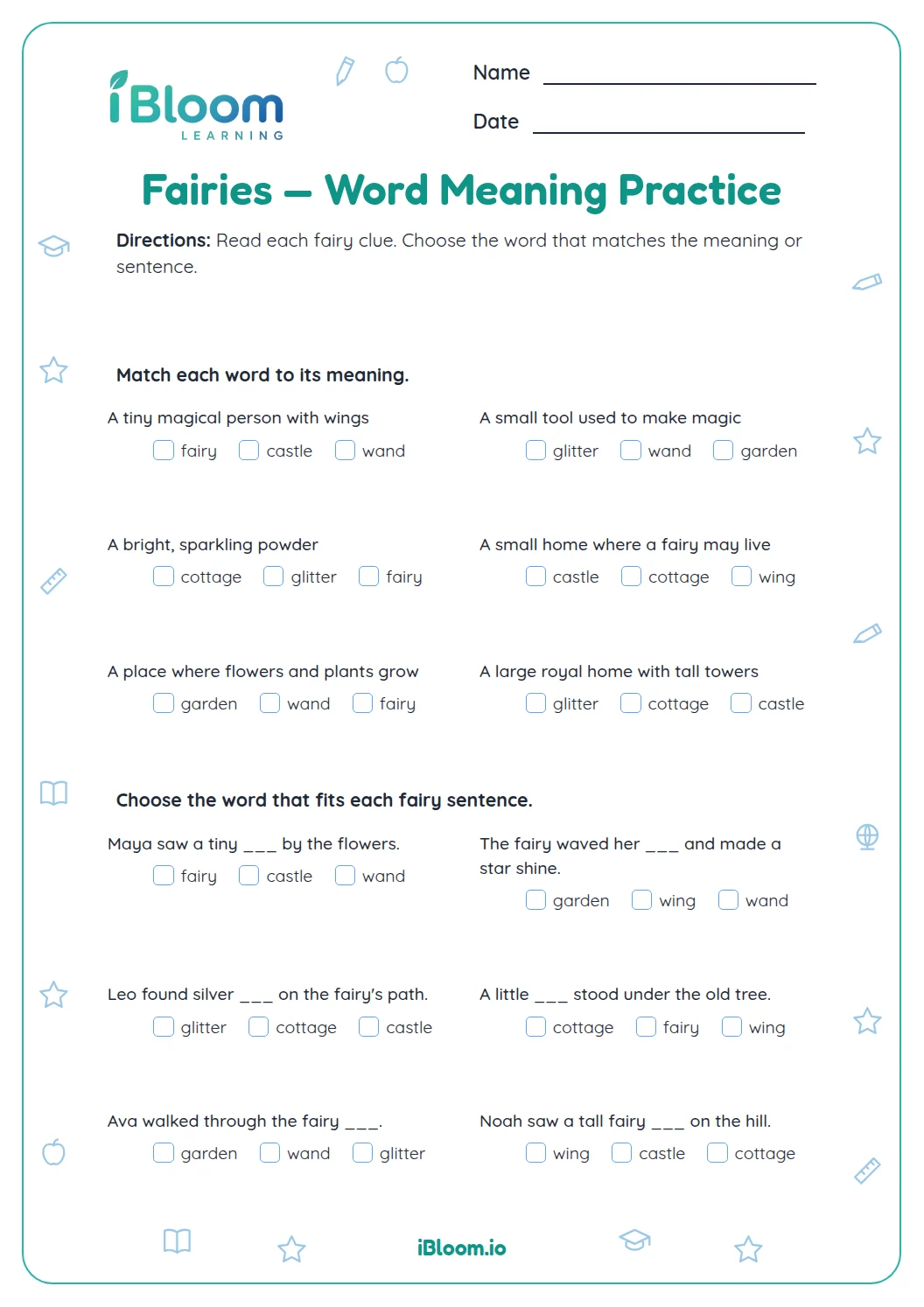
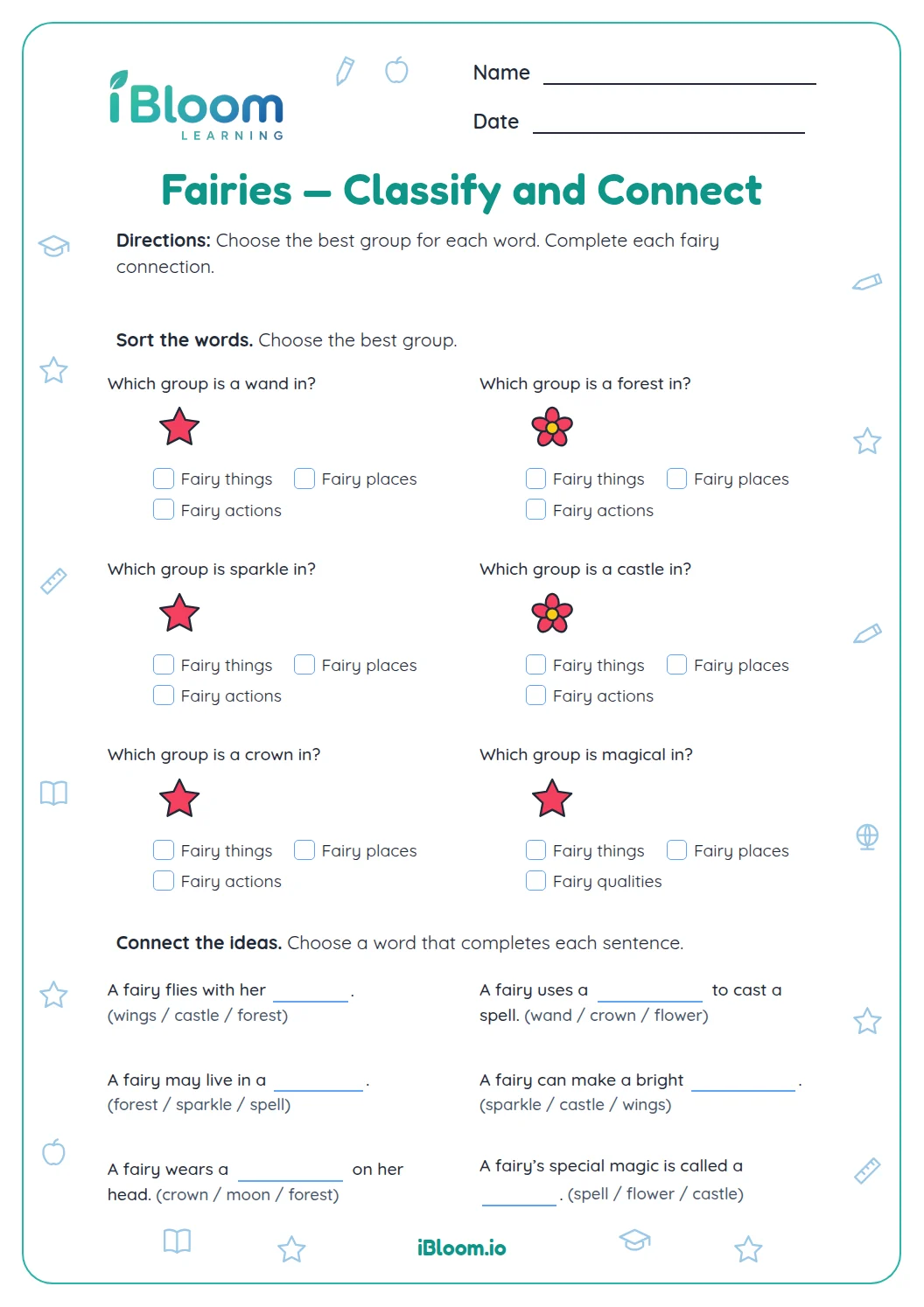
This free Grade 1 fairy vocabulary page pairs an eight-word search with meaning, category, and sentence clues. Students find fairy, wings, wand, magic, flower, petal, tiny, and glow, then use sentence clues and word attributes to explain what the words mean and how they connect. The questions practice CCSS L.1.4.a and L.1.5.b. A separate answer key supports review.
Aligned to L.1.4.a and L.1.5.b
How can a child search for each fairy word?
Start with the word list and look for its first letter in the grid. Track one row at a time and circle the letters in order. All eight words run across a row, which lets beginning readers focus on matching letters and reading each word.
- 1Find FAIRY in the first row.
- 2Circle F-A-I-R-Y from left to right.
How do context clues help with word meaning?
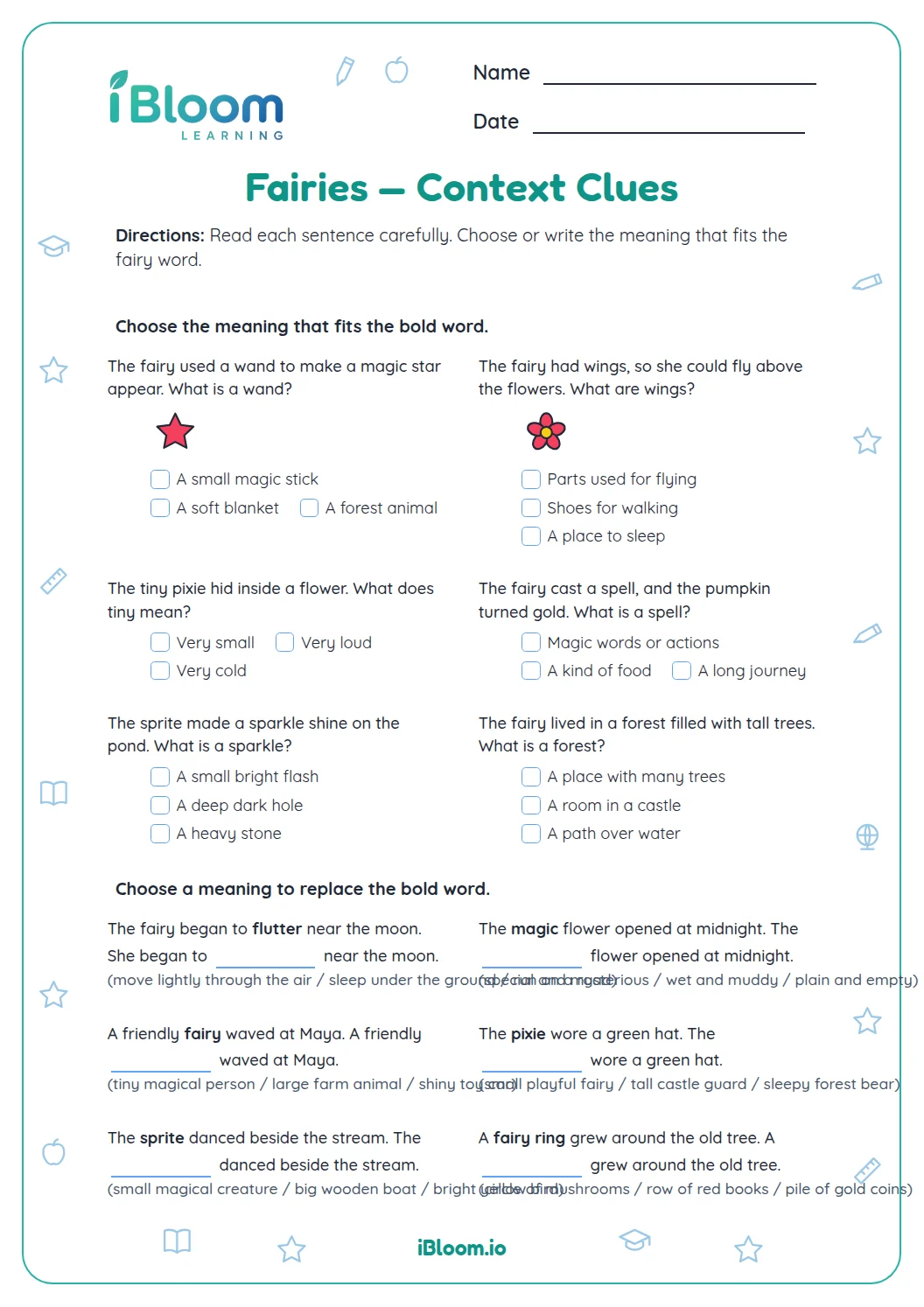
A sentence gives a small clue about a word. In “The tiny fairy sat on a petal,” the word tiny describes the fairy’s size. Part B asks students to choose meanings that fit the sentence, such as glow meaning to give off light.
How are the vocabulary words related?
Some words name parts or objects, while others describe an attribute or action. A petal belongs to a flower; tiny tells size; glow describes what light does. Parts C and D use categories and sentence clues to reinforce those relationships.
- Part A: locate 8 words in the grid
- Part B: use sentence clues
- Part C: connect words to meanings and categories
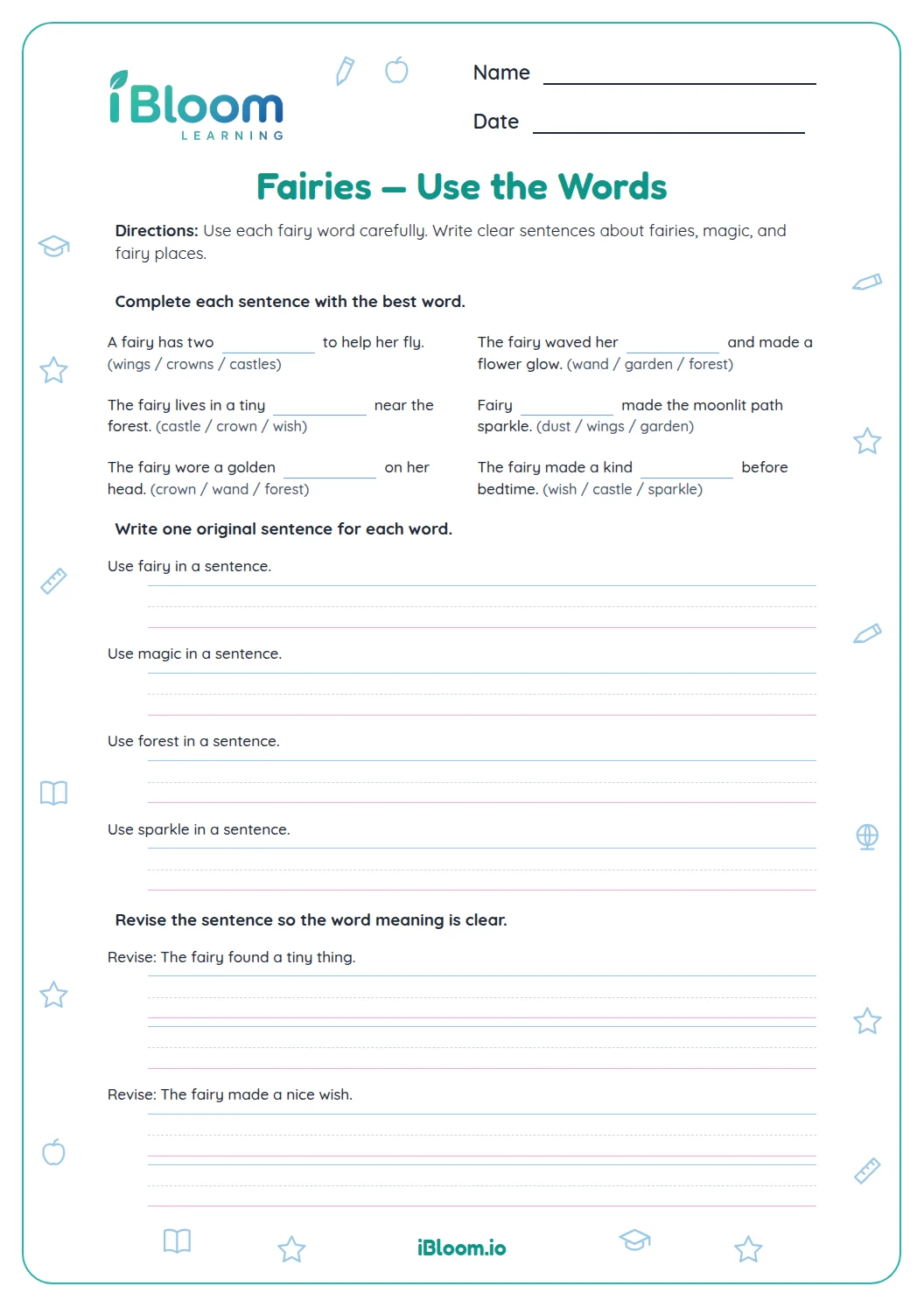
- Part D: complete simple vocabulary sentences
How to use this worksheet
- 1Read each word in the list and say it aloud.
- 2Scan the grid for the first letter, then check each next letter.
- 3Use the whole sentence to choose a word meaning.
- 4Name the category or attribute in short-answer questions.
- 5Reread each completed sentence to see if it makes sense.
Common mistakes and quick fixes
The mistake
Guessing a word meaning from its first letter alone.
The fix
Read the whole sentence for a clue about what the word does or describes.
The mistake
Mixing up a petal and a flower.
The fix
A petal is one part of a flower; the flower is the whole plant part named.
The mistake
Reading “tiny” as a feeling word.
The fix
Ask whether the word tells size, action, or a thing; tiny tells size.
Common Core alignment
Students use sentence clues and word categories to explain fairy vocabulary.
Use sentence clues to determine what glow and tiny mean.
On this sheet: Students use the sentences about the wand and fairy to identify the meanings of glow and tiny.
Show the official wordingHide the official wording
Use sentence-level context as a clue to the meaning of a word or phrase.
Define fairy words by their category or a key attribute.
On this sheet: Students identify wings as parts used for flying, a petal as part of a flower, and tiny as a size attribute.
Show the official wordingHide the official wording
Define words by category and by one or more key attributes (e.g., a duck is a bird that swims; a tiger is a large cat with stripes).
What to practice next
Make more practice
Further reading
Questions parents and teachers ask
Which words are hidden in the grid?
The grid contains FAIRY, WINGS, WAND, MAGIC, FLOWER, PETAL, TINY, and GLOW. FAIRY, WINGS, WAND, MAGIC, FLOWER, and PETAL run left to right; TINY and GLOW run down. The answer key confirms each location. The words appear in a compact six-row grid.
How many questions are on this worksheet?
There are 14 questions in four parts: one word search, five multiple-choice clues, three short-answer connections, and five sentence completions. The worksheet has two pages and a separate answer key. Students find the words first, then use the clues to connect meaning and category.
How can a child tell what “tiny” means?
Look at how the word is used in the sentence. In “The tiny fairy sat on a petal,” tiny describes the fairy’s size. The worksheet asks students to use that clue and distinguish a size word from a name or action.
What is the difference between a petal and a flower?
A petal is one part of a flower. The sentence “A petal is part of a ___” points to flower as the whole. Connecting the smaller part to its whole helps students sort words by category and remember what each vocabulary word names.
Do all the word-search answers go in the same direction?
No. FAIRY, WINGS, WAND, MAGIC, FLOWER, and PETAL run left to right, while TINY and GLOW run downward. Following the printed word list in more than one direction gives students a small search challenge. The key lists all eight words.
What can we do after the word search?
Ask the student to use one word in a new sentence or describe a fairy using two words from the list. The linked vocabulary review games offer another way to revisit meanings. Related word-search pages provide a fresh vocabulary set for continued practice.