





About this worksheet
This free Grade 1 vocabulary worksheet helps children move from recognizing feeling words to using them. Part A gives four word-meaning choices, and Part B has four sentences to complete using the same meanings. Part C asks children to write six sentences with glad, sad, calm, and scared, including a sentence with because. The practice supports Common Core L.1.6 through the use of words learned in reading and conversation. The answer key gives fixed answers for Parts A and B and sample sentences for Part C. Children may invent characters and situations for their writing.
Aligned to L.1.6
Which feeling words are on the sheet?
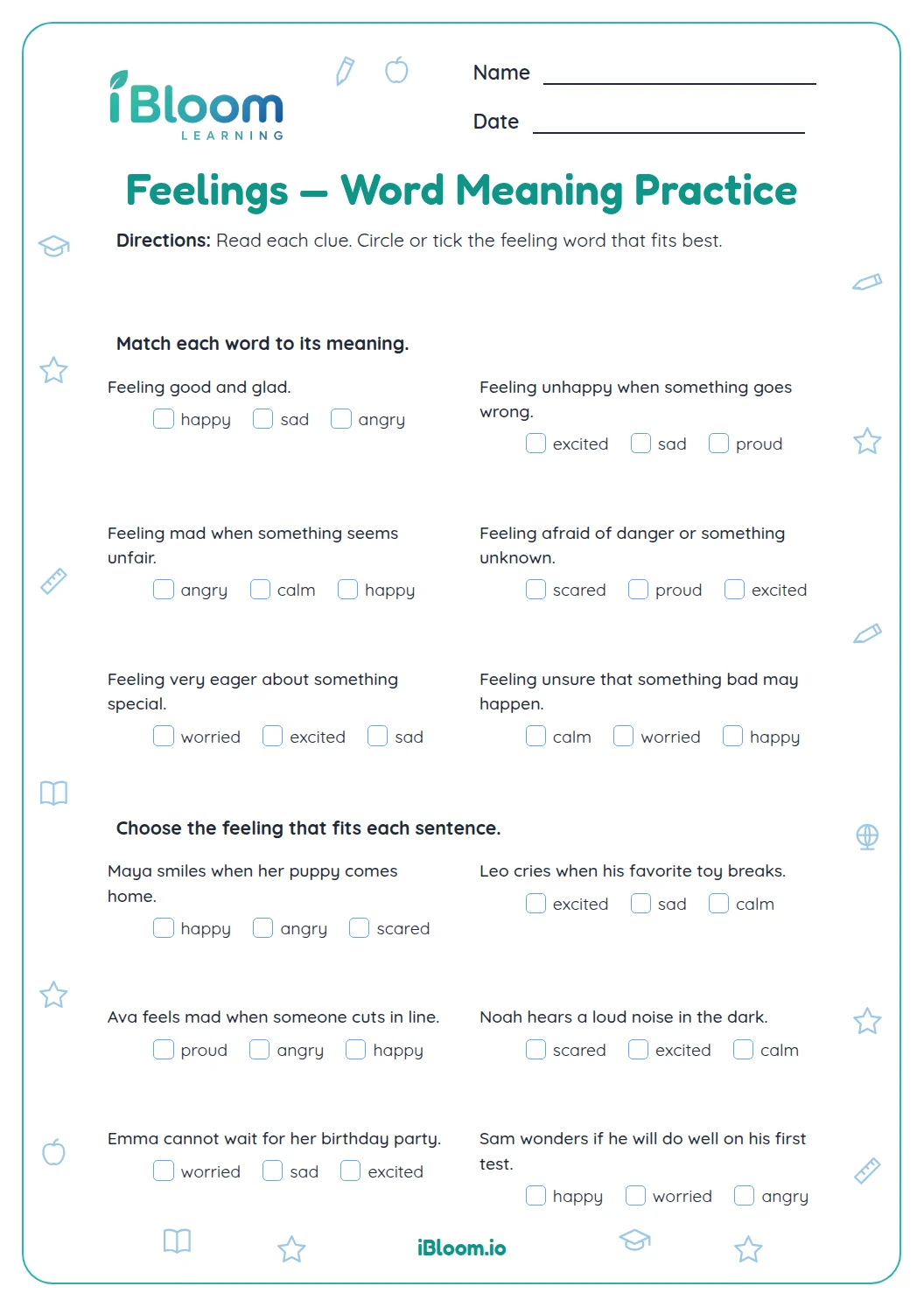
Children work with glad, sad, mad, scared, and calm. The first two parts connect glad with happy, scared with afraid, mad with angry, and calm with peaceful. Part C gives six chances to write a feeling word in a sentence.
Read the words aloud if decoding would interrupt the vocabulary work. A child can explain a meaning orally before writing it.
How do the sentence clues guide the answers?
The fill-ins use meaning clues rather than asking adults to decide how a child should feel. For example, the word happy points directly to glad. Personal writing then leaves room for the child’s own or invented response.
- 1I feel happy and ___. (glad / sad)
- 2Happy and glad have similar meanings.
- 3Completed sentence: I feel happy and glad.
How do the final prompts encourage word use?
The first two prompts ask about a made-up child, so the writer can invent a situation. The calm sentence can describe a real or imagined moment. The scared sentence gives a story character a reason with because.
Check that the word fits the meaning and that the sentence makes sense. A child’s sentence need not match the sample situation on the key. Help with spelling as needed, then reread the sentence together.
How to use this worksheet
- 1Read glad, sad, mad, scared, and calm aloud together.
- 2Ask the child to choose the meanings in Part A.
- 3Have the child read the meaning clue before writing each Part B answer.
- 4Let the child say each Part C sentence aloud before writing.
- 5For the last sentence, ask what reason will follow because.
- 6Check the fixed answers, then discuss the meaning of each original sentence.
Mistakes to notice and how to help
The mistake
Choosing sad for a sentence that already says happy.
The fix
Compare the meanings of happy and sad, then try glad in the blank.
The mistake
Using calm to mean afraid.
The fix
Connect calm with peaceful and scared with afraid; reread both choices.
The mistake
Stopping the final sentence immediately after because.
The fix
Add a reason, such as a loud horn blows, to finish the thought.
Common Core alignment
Use feeling words in sentences and connect a feeling to a reason with because.
On this sheet: Children read feeling words, use them in sentences, and finish a sentence that gives a reason with because.
Show the official wordingHide the official wording
Use words and phrases acquired through conversations, reading and being read to, and responding to texts, including using frequently occurring conjunctions to signal simple relationships (e.g., because).
What to practice next
Make more practice
Further reading
Questions parents and teachers ask
Which words will my child practice?
Your child will read and use glad, sad, mad, scared, and calm. The first two parts teach clear meaning pairs such as happy and glad or afraid and scared. In Part C, the child writes sentences about feelings, with sample responses on the key to guide checking.
Does my child have to write about personal feelings?
No; children can invent characters and situations for their answers. Two prompts specifically ask about a made-up child, and the last asks about a story character. The calm sentence can also describe an imagined situation. The aim is to use the vocabulary clearly in a sentence.
Can I read the questions aloud?
Yes; an adult can read the prompts and choices aloud while the child thinks about the meanings. Ask the child to say the answer first, then write it. For Part C, rehearse a complete sentence together and let the child choose the situation and feeling details.
Are there different correct answers in the writing part?
Yes; the four writing prompts allow many sensible sentences. The key gives samples, while Parts A and B have fixed answers. For writing, check that the required feeling word is used meaningfully and that the final because sentence includes a reason that completes the thought.
Why does the last prompt include because?
Because connects the character’s feeling to a reason. In A story character feels scared because a loud horn blows, the ending explains why the character feels that way. This gives children a concrete way to practice the word-use and simple relationship work described in Common Core L.1.6.