





About this worksheet
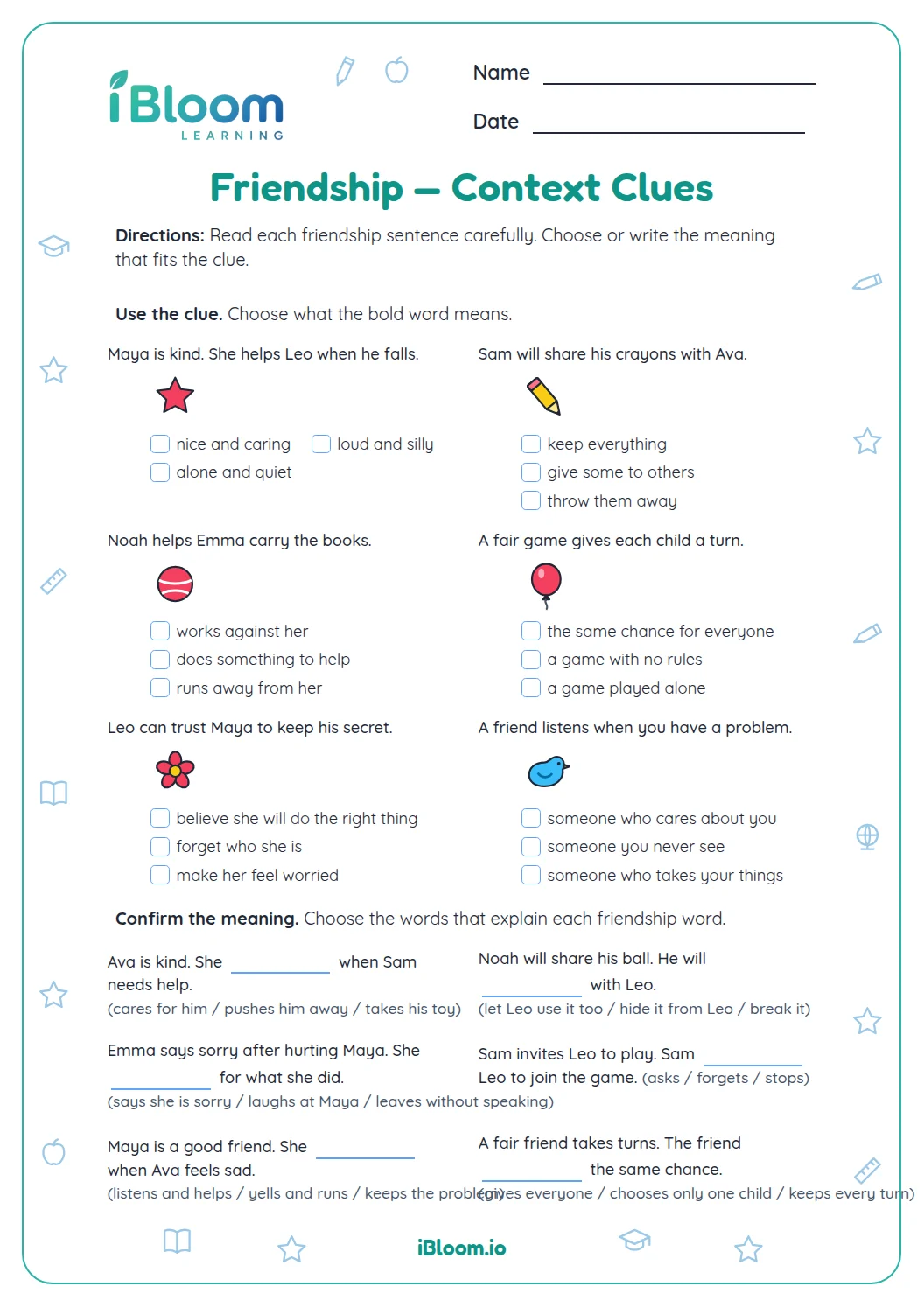
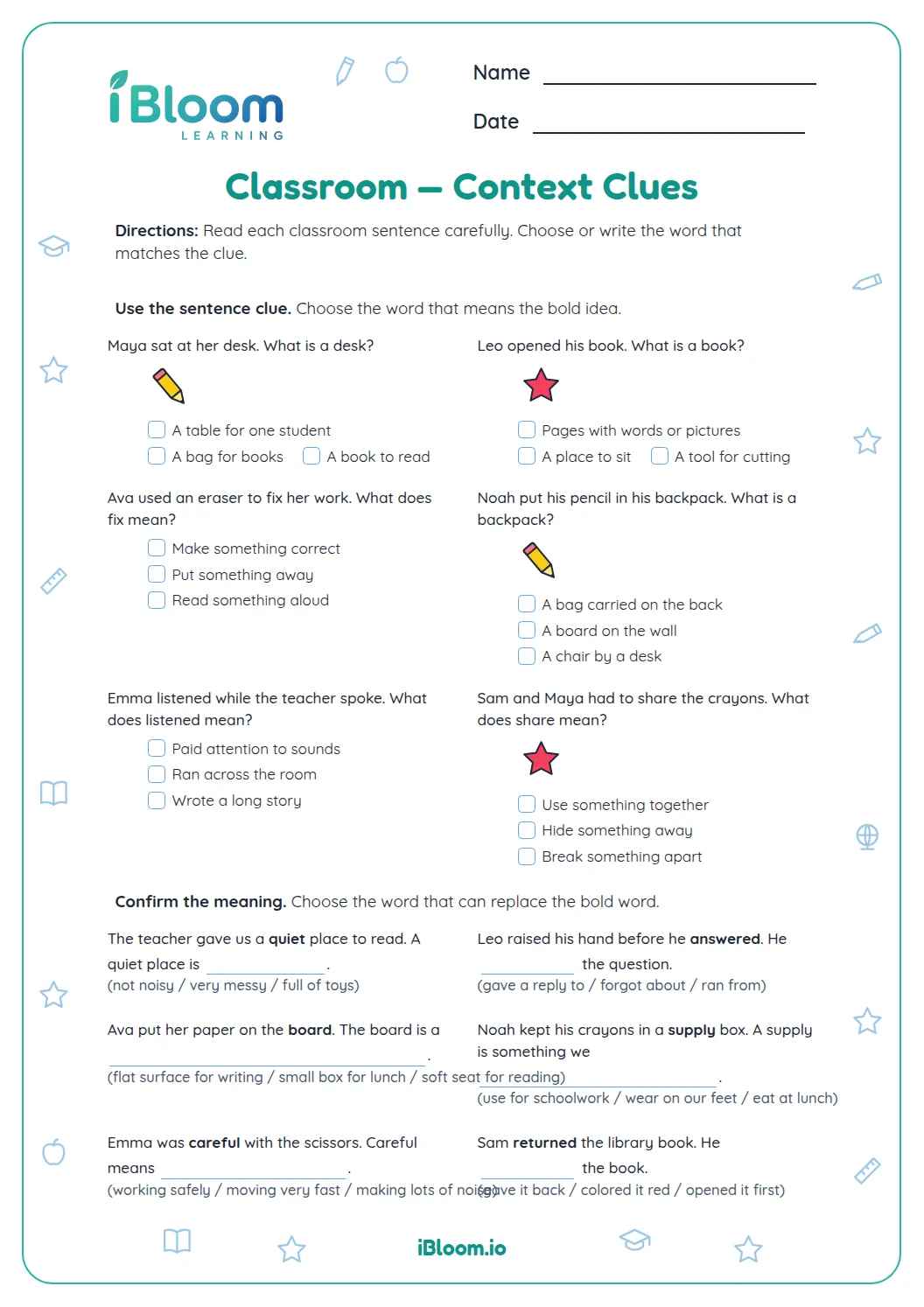
This Grade 1 printable pairs a small feelings word search with 13 short context-clue questions. In Part A, children find glad, sad, mad, shy, and calm in a letter grid. Part B gives one clear sentence clue for each feeling choice, such as smiling after a team wins or hiding when meeting new people. The sheet practices using sentence-level context to understand a word, aligned to Common Core L.1.4a. A separate answer key is included.
Aligned to L.1.4a
What is a context clue?
A context clue is a detail near a word that helps a reader understand it. Actions, facial expressions, and events can show how a person feels.
How do you pick a feeling that fits?
Read the full sentence and picture what is happening. Then test each choice against the clue. In “Mia smiled when her team won,” both smiled and won point to glad.
- 1Mia smiled when her team won. She felt ___.
- 2Clue: she smiled after her team won.
- 3The feeling that fits is glad.
What does the word search add?
The word search gives children a first look at five feeling words before they use sentence clues. In the remaining questions, one sentence detail points to the best fitting feeling.
How to use this worksheet
- 1Find the five words in Part A.
- 2Read each sentence in Part B all the way through.
- 3Notice the action or event that hints at the feeling.
- 4Try each answer choice in the sentence.
- 5Use the answer key to discuss which clue helped most.
Common mistakes and quick fixes
The mistake
Choosing a feeling from only one familiar word.
The fix
Read the action and event together before choosing.
The mistake
Mixing up mad and sad.
The fix
Ask whether the sentence shows anger or a loss that brings tears.
The mistake
Picking a feeling that could fit in general but not this clue.
The fix
Check that the exact detail in the sentence supports the choice.
Common Core alignment
This sheet connects the practice to a specific Common Core skill.
Use a sentence clue to work out a feeling word.
On this sheet: Each item uses details in a short sentence to identify a feeling word.
Show the official wordingHide the official wording
Use sentence-level context as a clue to the meaning of a word or phrase.
What to practice next
Make more practice
Further reading
Questions parents and teachers ask
What is a context clue?
A context clue is a detail in a sentence that hints at what a word means. In “Mia smiled when her team won,” the smile and the win help show that Mia feels glad. The separate answer key lists the response, and a quick reread helps children connect each answer to its clue.
Can an adult read the worksheet aloud?
Yes. An adult can read a sentence and its choices aloud, then ask the child which detail helped. This keeps the focus on using sentence context to identify the feeling. The separate answer key lists the response, and a quick reread helps children connect each answer to its clue.
Which feeling words appear in the word search?
The grid contains glad, sad, mad, shy, and calm. Children look across and down, then see the words again in the sentence questions. The separate answer key lists the response, and a quick reread helps children connect each answer to its clue.
How many questions are included?
The printable has 14 activities: one word search and 13 sentence questions. It spans two worksheet pages and includes a separate answer key with the words and feeling choices. Children can complete the search before reading the clue sentences.
Why can the same feeling word appear more than once?
Readers need to use the clue in each new sentence rather than memorize a single match. The repeated calm and proud examples connect those words to different actions and situations. The separate answer key lists the response, and a quick reread helps children connect each answer to its clue.