






About this worksheet
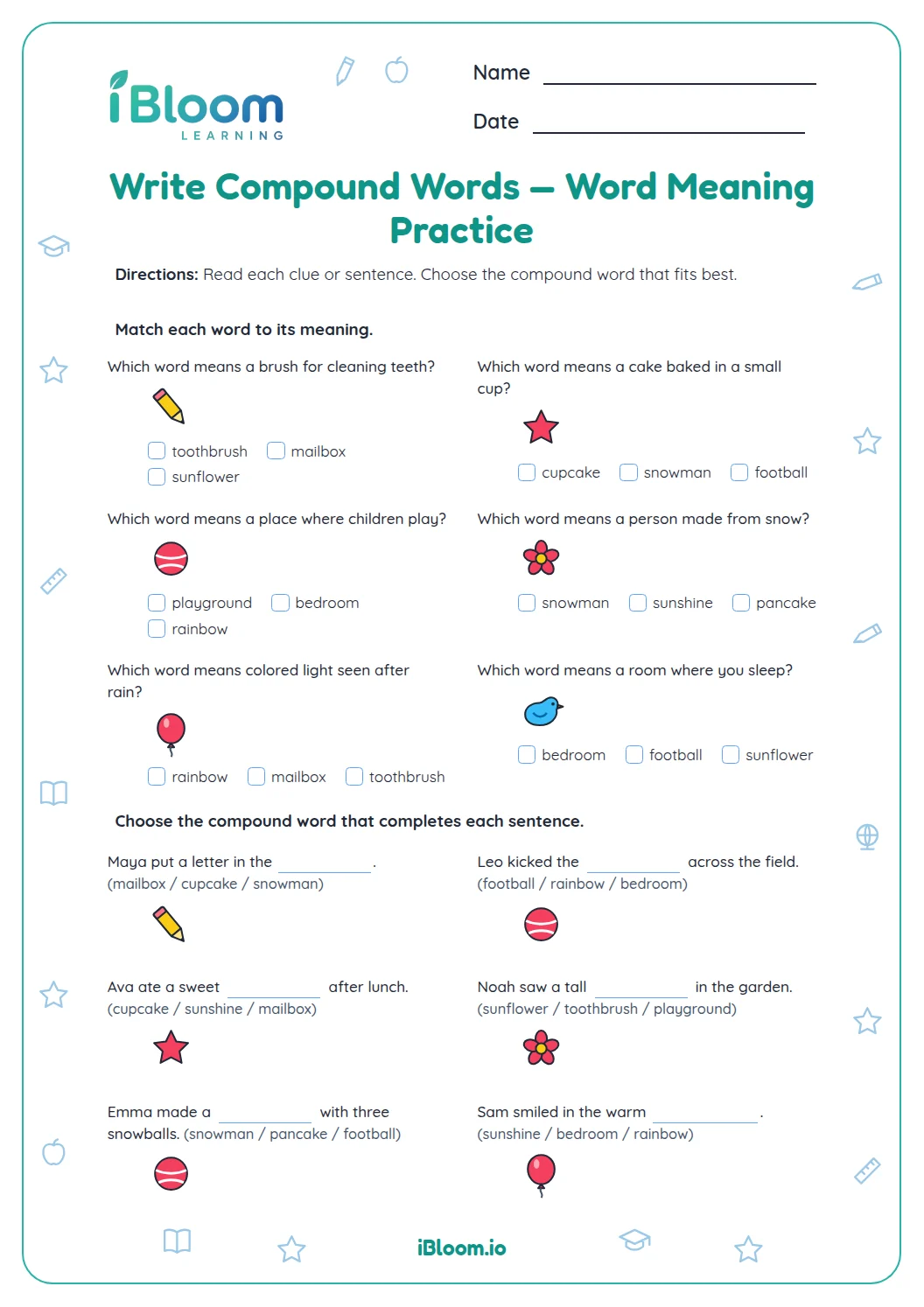
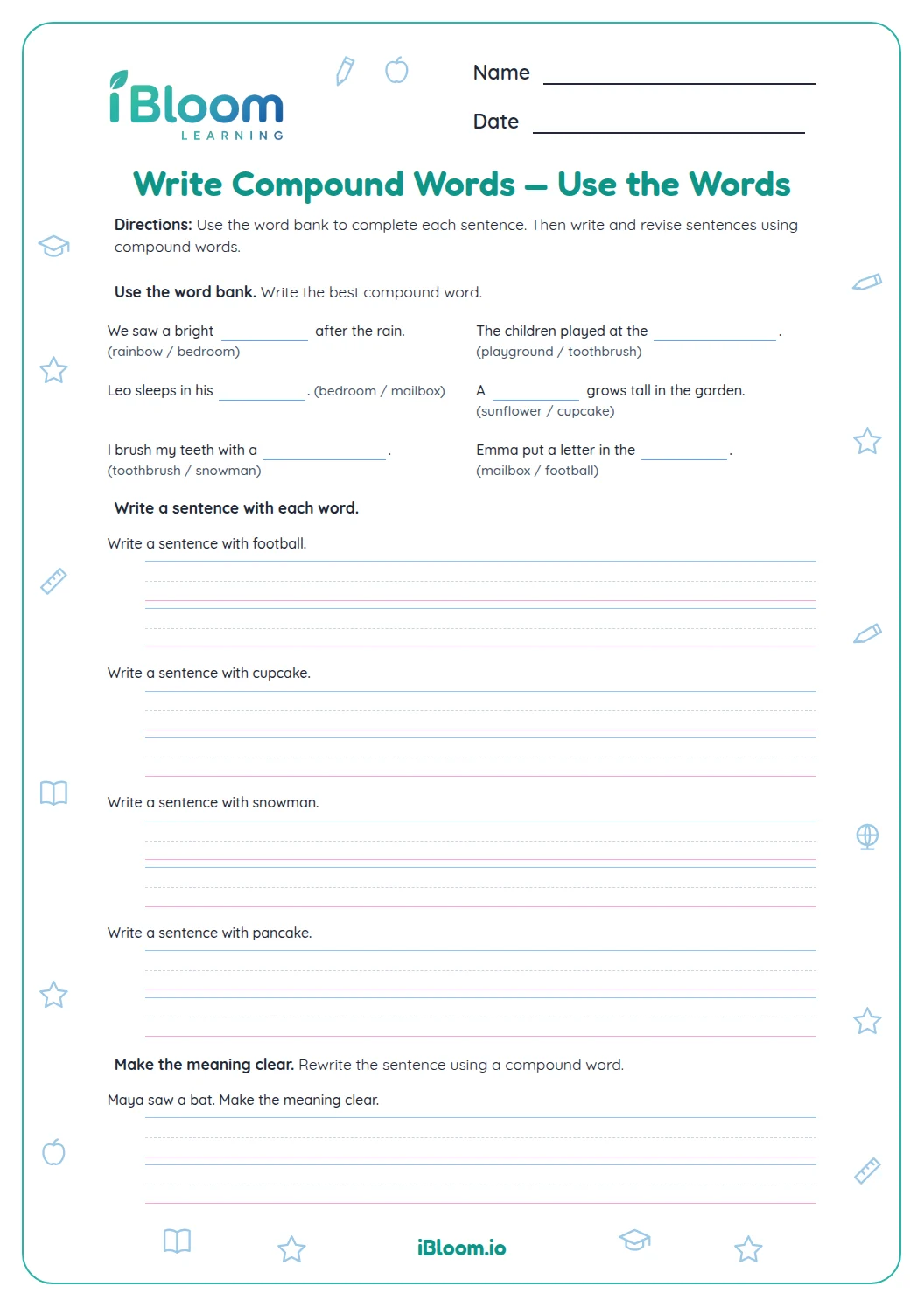
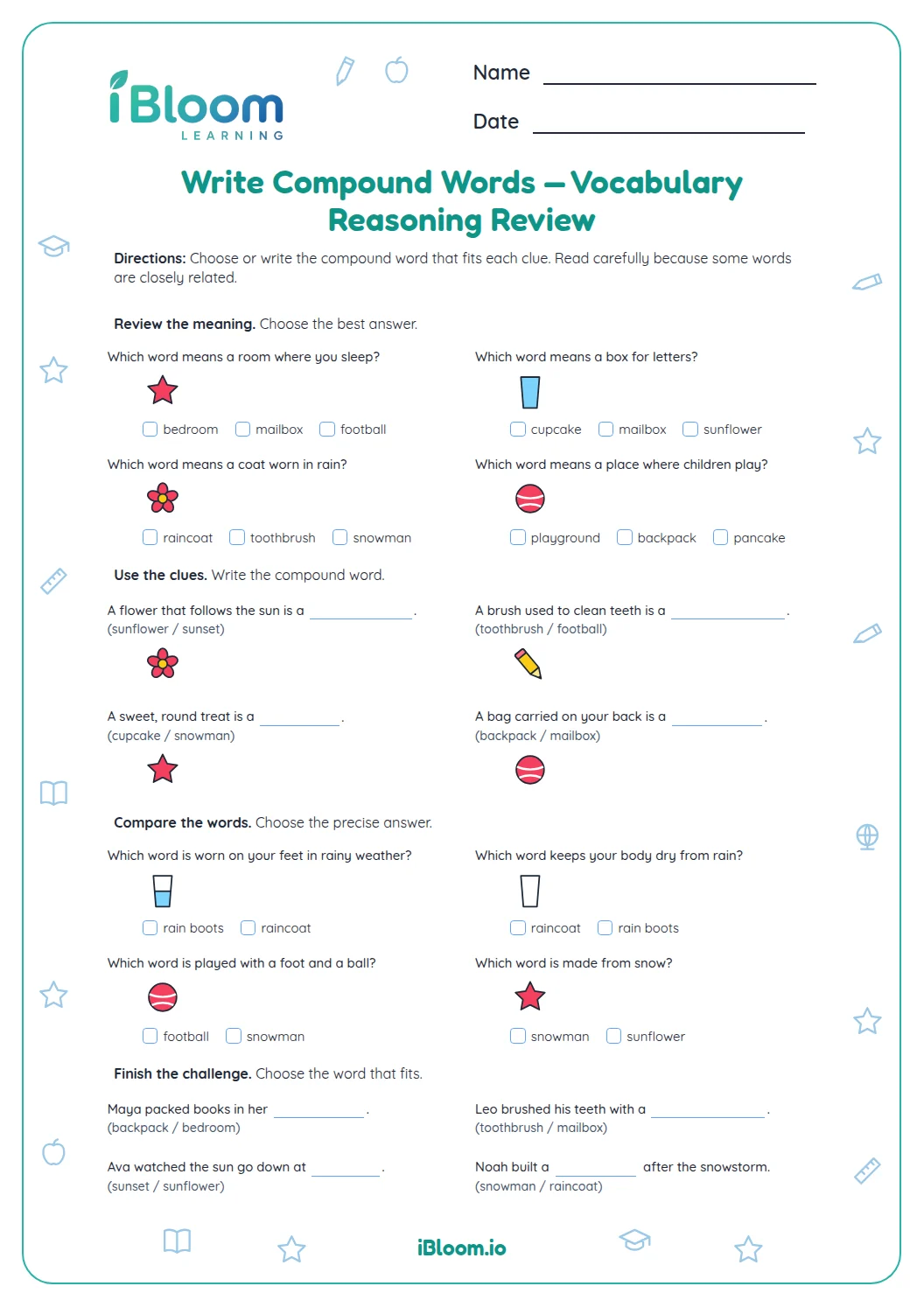
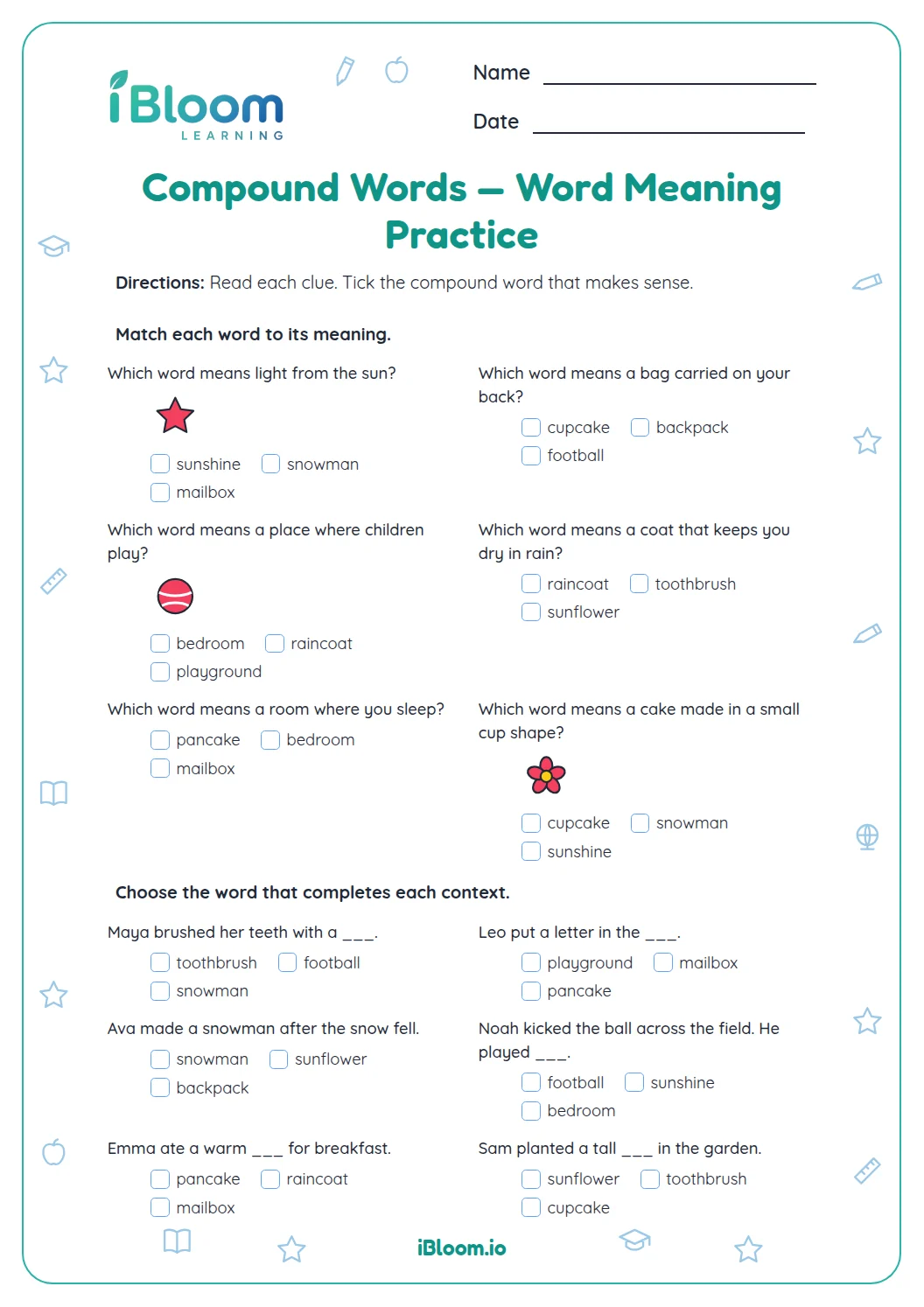
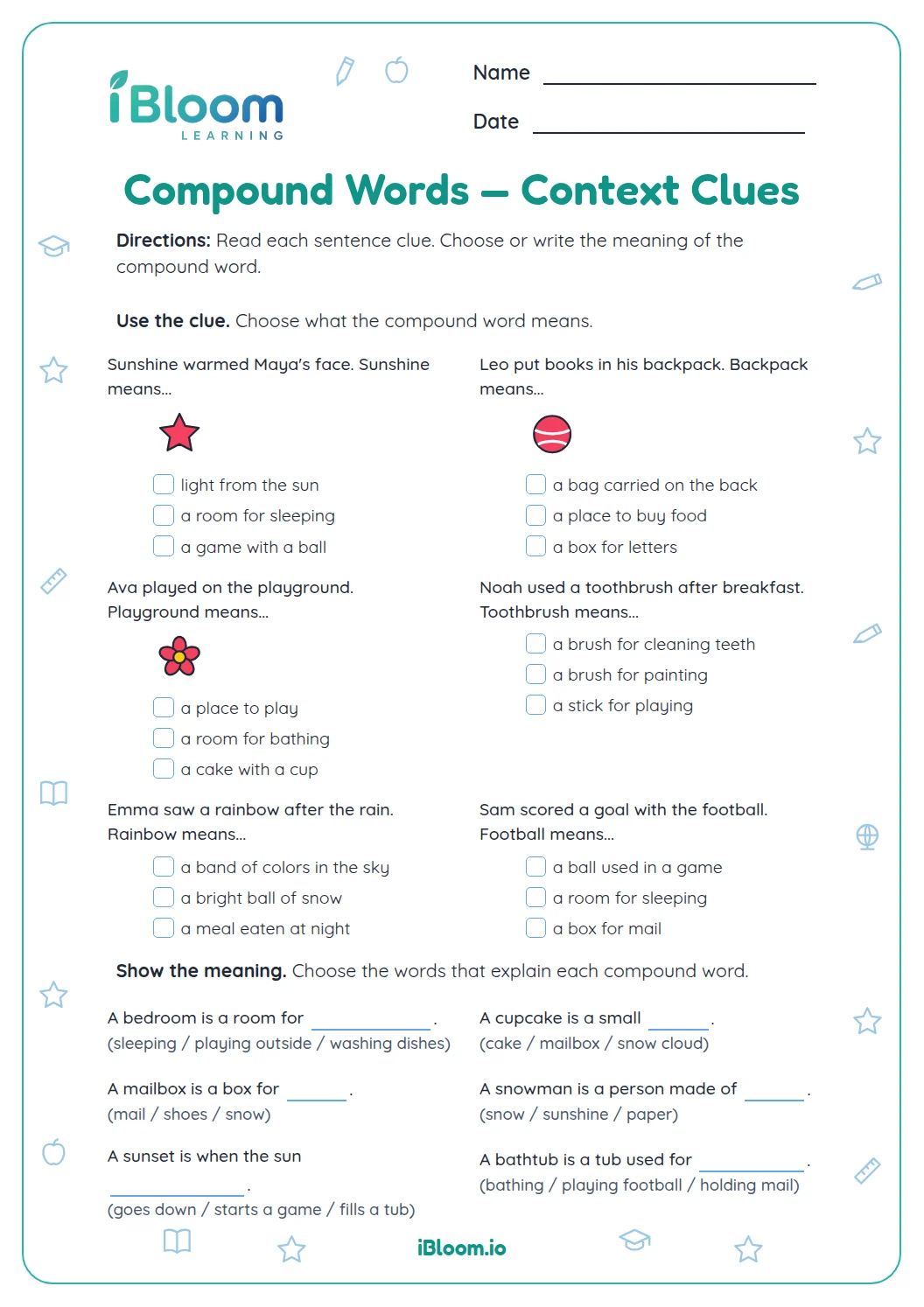
This free printable is for Grade 1 learners practicing compound words in context. Across 18 questions, children first choose a compound word that fits a sentence, then write a compound word to complete a clue-rich sentence. The separate answer key makes it easy to check spelling and meaning. The sentence clues connect to CCSS L.1.4a, using context to determine a word’s meaning.
Aligned to L.1.4a
What is a compound word?
A compound word joins two smaller words to make one word, such as sun + shine = sunshine. The new word has a meaning that fits the sentence. Young writers can look for clues about where something is, what it does, or when it is used.
Examples on the page include snowman, mailbox, toothbrush, and bedtime.
How do sentence clues help?
The words around the blank describe the missing idea. A letter going into a box near the road points to mailbox. Reading the whole sentence again with the word in place checks both meaning and spelling.
- 1I sleep in my ___ at night.
- 2The clue is sleep in; the word names a place to sleep.
- 3Join bed and room into one word.
- 4Answer: bedroom.
What kinds of words are on the worksheet?
Part A uses three answer choices and a sentence clue. Parts B and C ask learners to write the full compound word in the sentence. Familiar ideas such as rain, a bed, a bird, a ball, and the moon keep attention on how the word fits the clue.
The question types shift from recognizing a word to recalling and spelling one independently.
How to use this worksheet
- 1Read the complete sentence before looking at the choices or blank.
- 2Name the thing or idea the clue describes.
- 3Say the two smaller words that combine to make it.
- 4Write the whole compound word as one word.
- 5Reread the sentence with your answer in the blank.
- 6Check both meaning and spelling with the answer key.
Common mistakes and quick fixes
The mistake
Writing the two smaller words with a space.
The fix
Join them into one compound word, such as birdhouse.
The mistake
Choosing a word that fits the topic but not the clue.
The fix
Reread the sentence and check that the compound word makes the whole sentence sensible.
The mistake
Leaving out a letter while joining two words.
The fix
Say each smaller word, then reread the whole written word slowly.
Common Core alignment
This practice connects the named skill to a Common Core goal.
Use a sentence clue to identify the compound word that fits.
On this sheet: Each item uses a sentence clue to select or write the compound word that completes its meaning.
Show the official wordingHide the official wording
Use sentence-level context as a clue to the meaning of a word or phrase.
What to practice next
Make more practice
Questions parents and teachers ask
What is a compound word?
A compound word joins two smaller words to make one word with its own meaning. Snowman combines snow and man; mailbox combines mail and box. On this worksheet, learners use a sentence clue to choose or write the compound word that completes the idea.
Does the answer need a space between its parts?
No. The target words on this page are closed compound words, written as one word with no space. For example, bed and room join to make bedroom, while mail and box join to make mailbox. Learners should write the full compound as one word in each blank.
What does question 7 ask learners to write?
Question 7 asks learners to complete “I sleep in my ___ at night.” The answer is bedroom: a bed is where someone sleeps, and a room is the place. Joining those two words names the place and fits the whole sentence.
Can I read the clues aloud?
Yes. Read the sentence naturally and let the learner use its meaning to think of a word. If needed, ask what the sentence describes or where the thing might be found. This keeps the focus on using context and writing the compound word.
How many questions are on the worksheet?
There are 18 questions across two worksheet pages. Six are multiple choice, and twelve ask learners to write a compound word in a sentence. A separate two-page answer key lists the correct choices and written words, so families can check each part as they go.