



About this worksheet
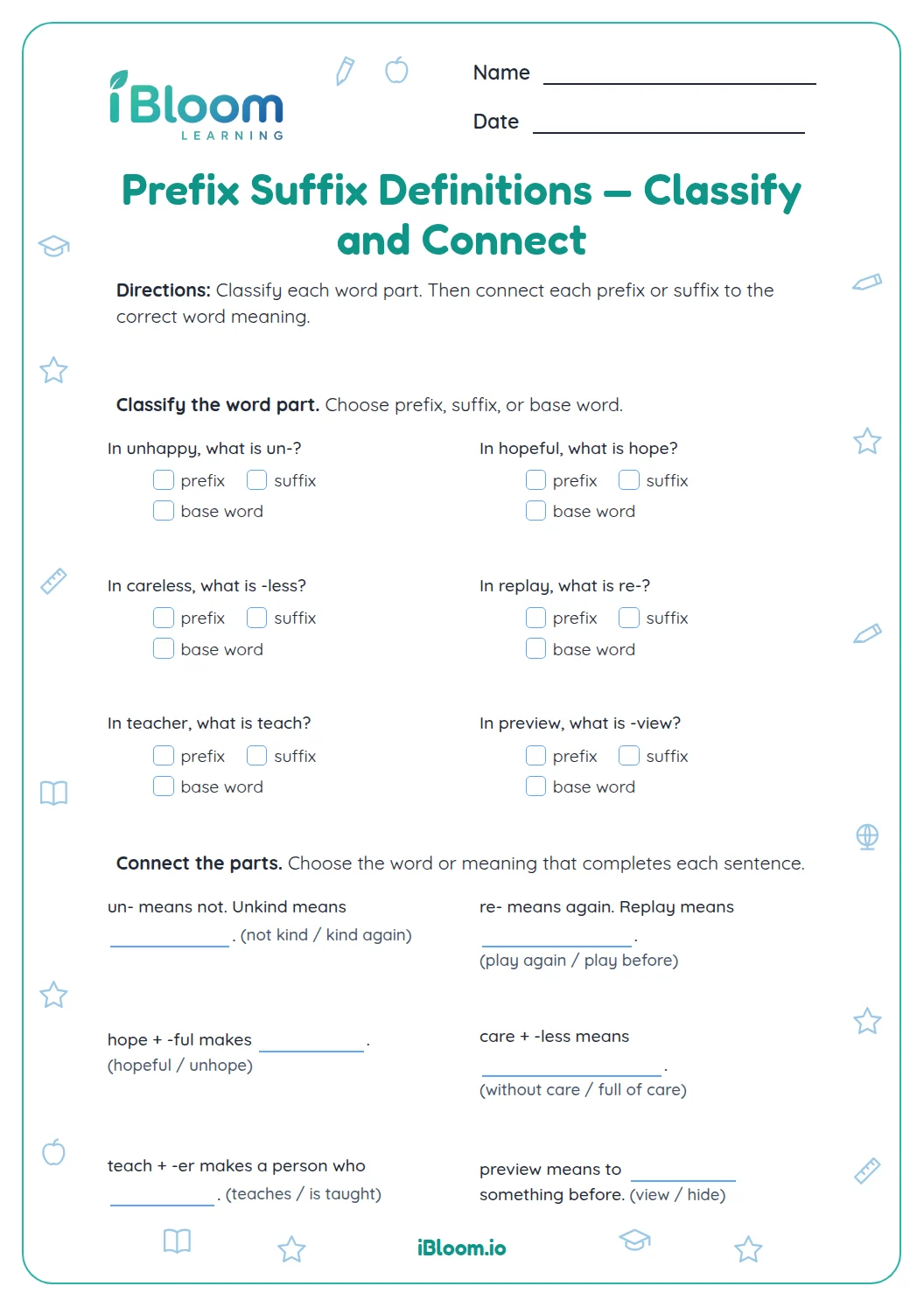
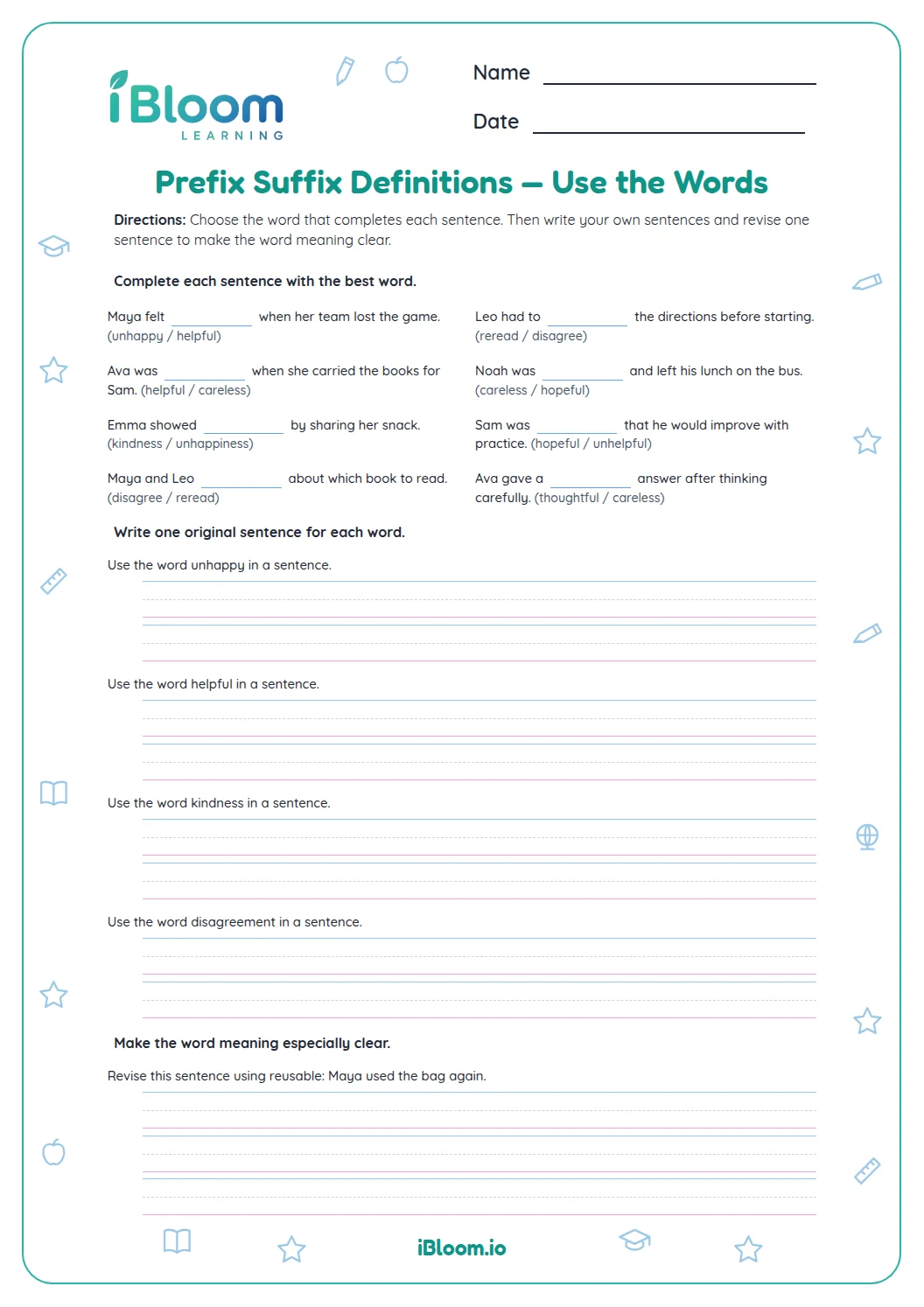
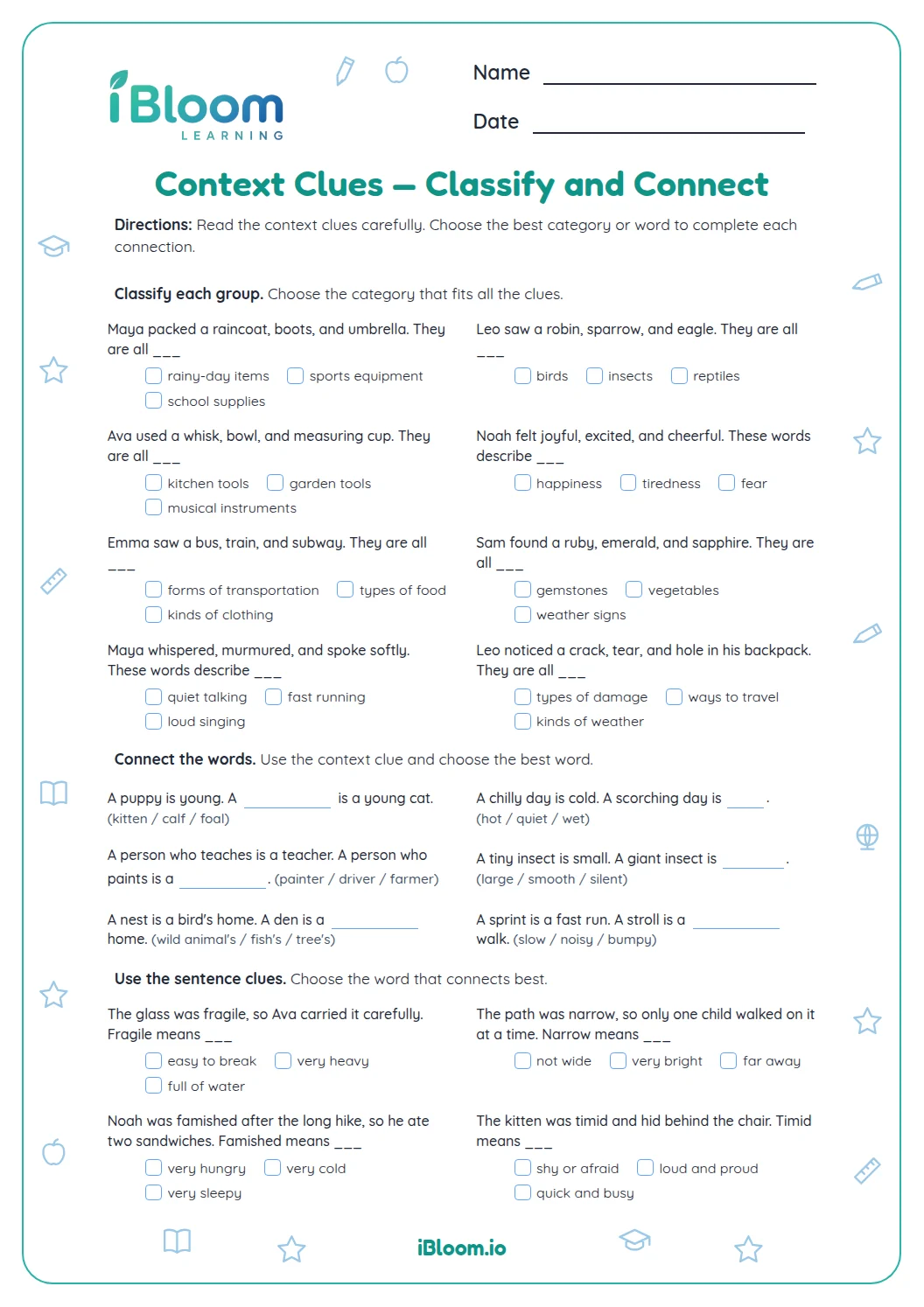
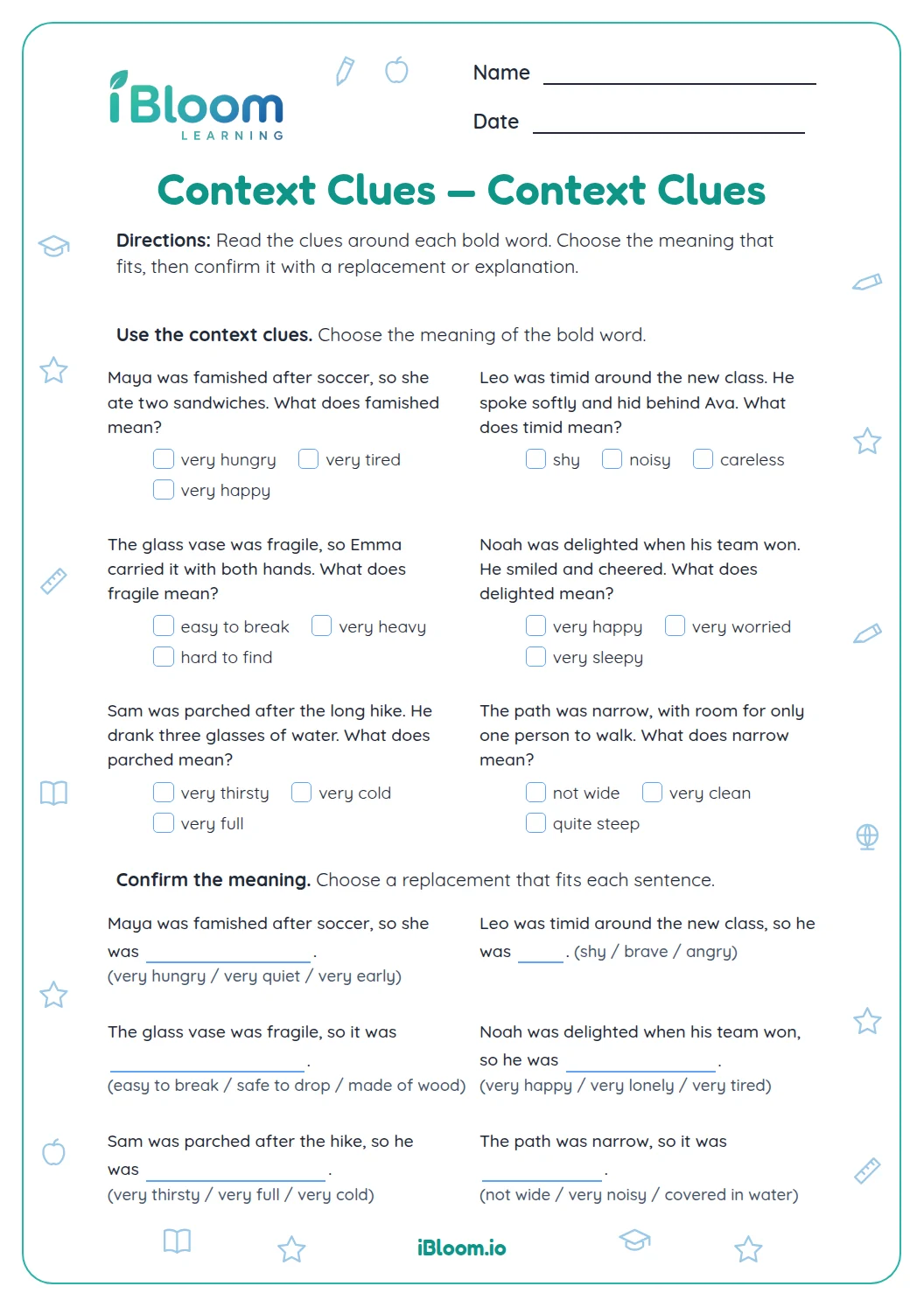
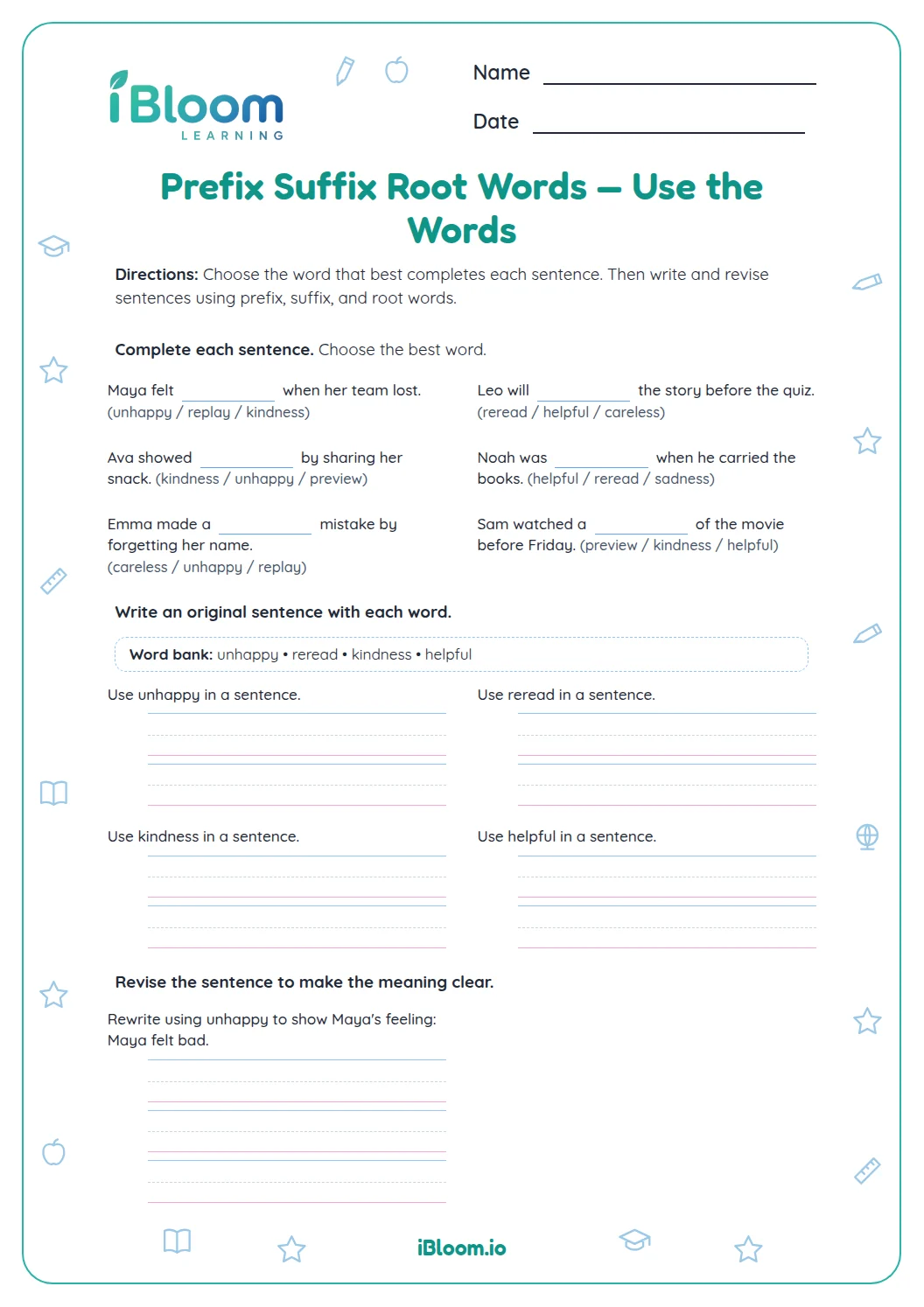
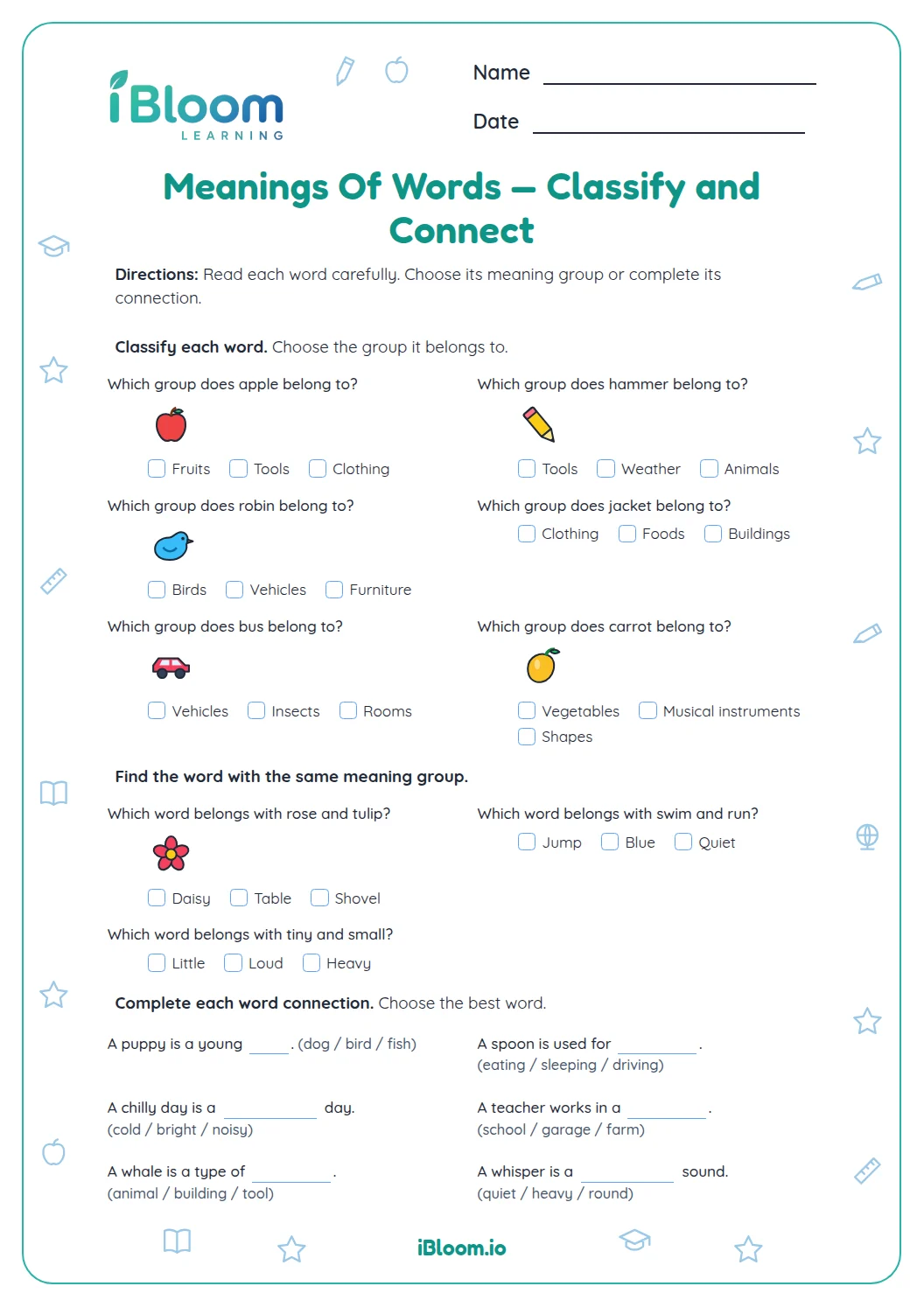
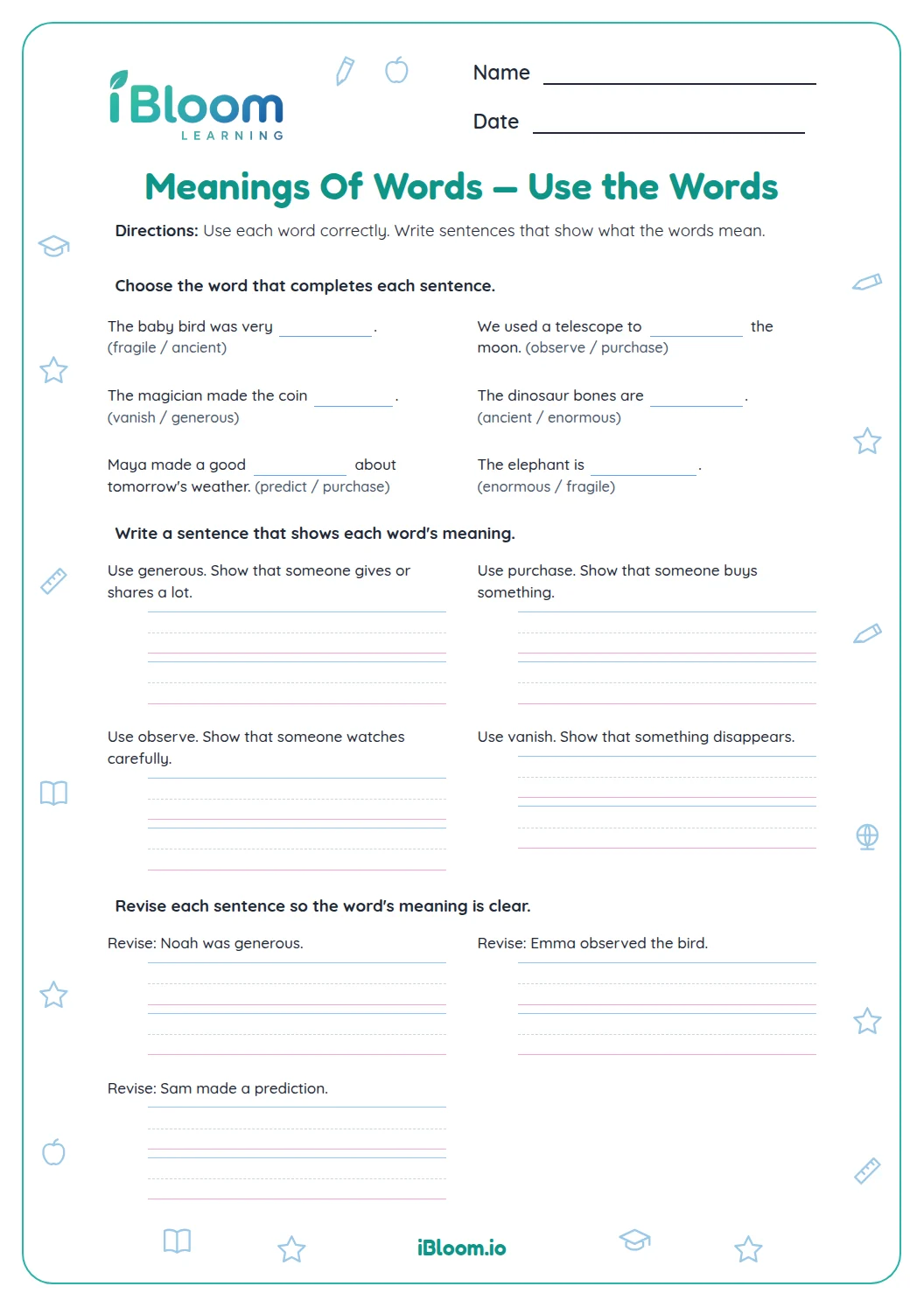
This printable Grade 3 worksheet gives children focused practice with prefixes, suffixes, and context clues. It includes 14 questions across 8 affix meaning choices, 6 context clue choices, moving from recognition to using the skill in new examples. The answer key is provided on its own page. The worksheet aligns with L.3.4b, L.3.4a.
Aligned to L.3.4b and L.3.4a
How do prefixes and suffixes change a word?
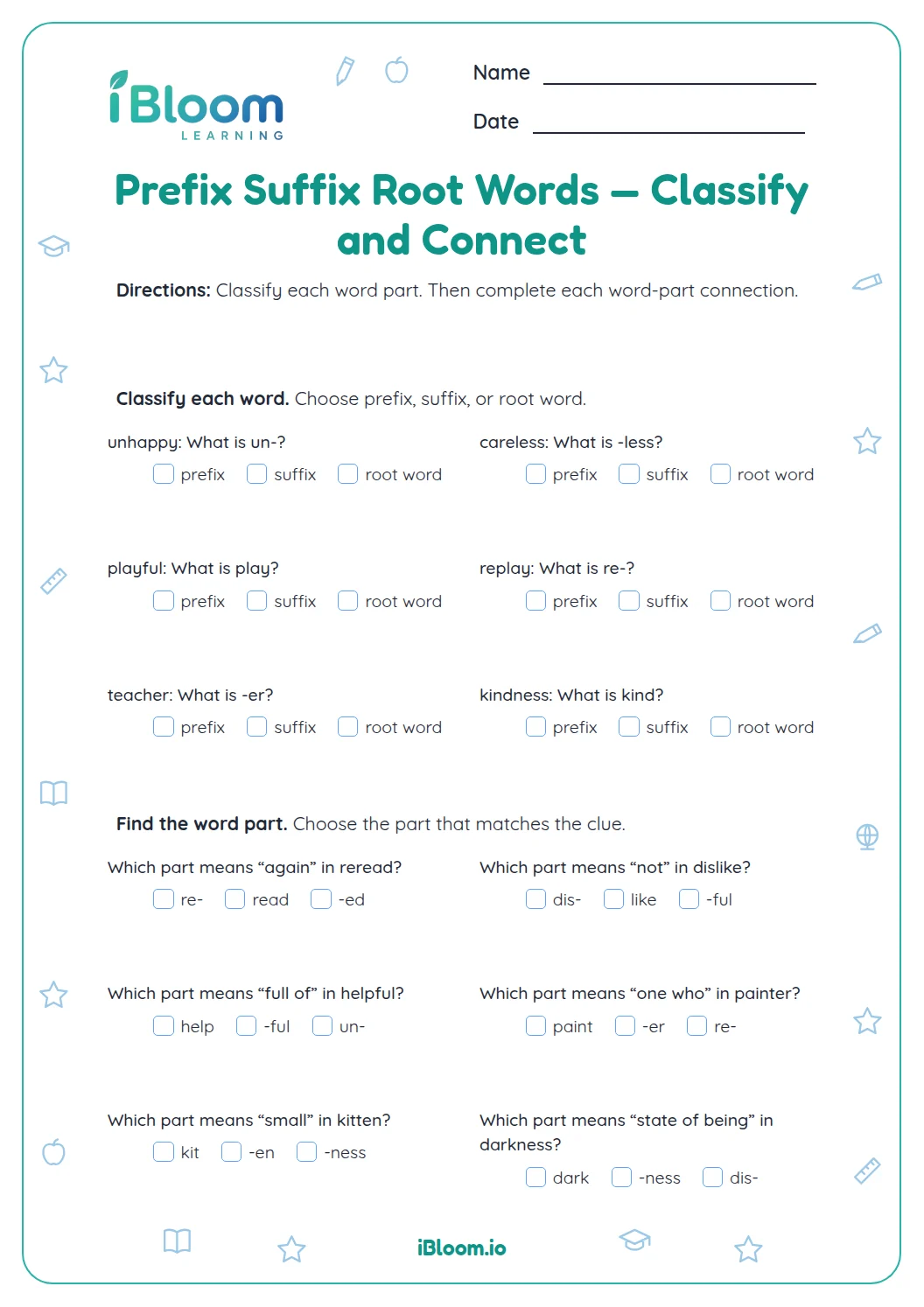
A prefix comes before a base word; a suffix comes after it. In rewrite, re- means again, so rewrite means write again. In careless, -less means without, so careless means without care. The first part asks learners to apply familiar affixes to familiar words.
How do sentence clues help?
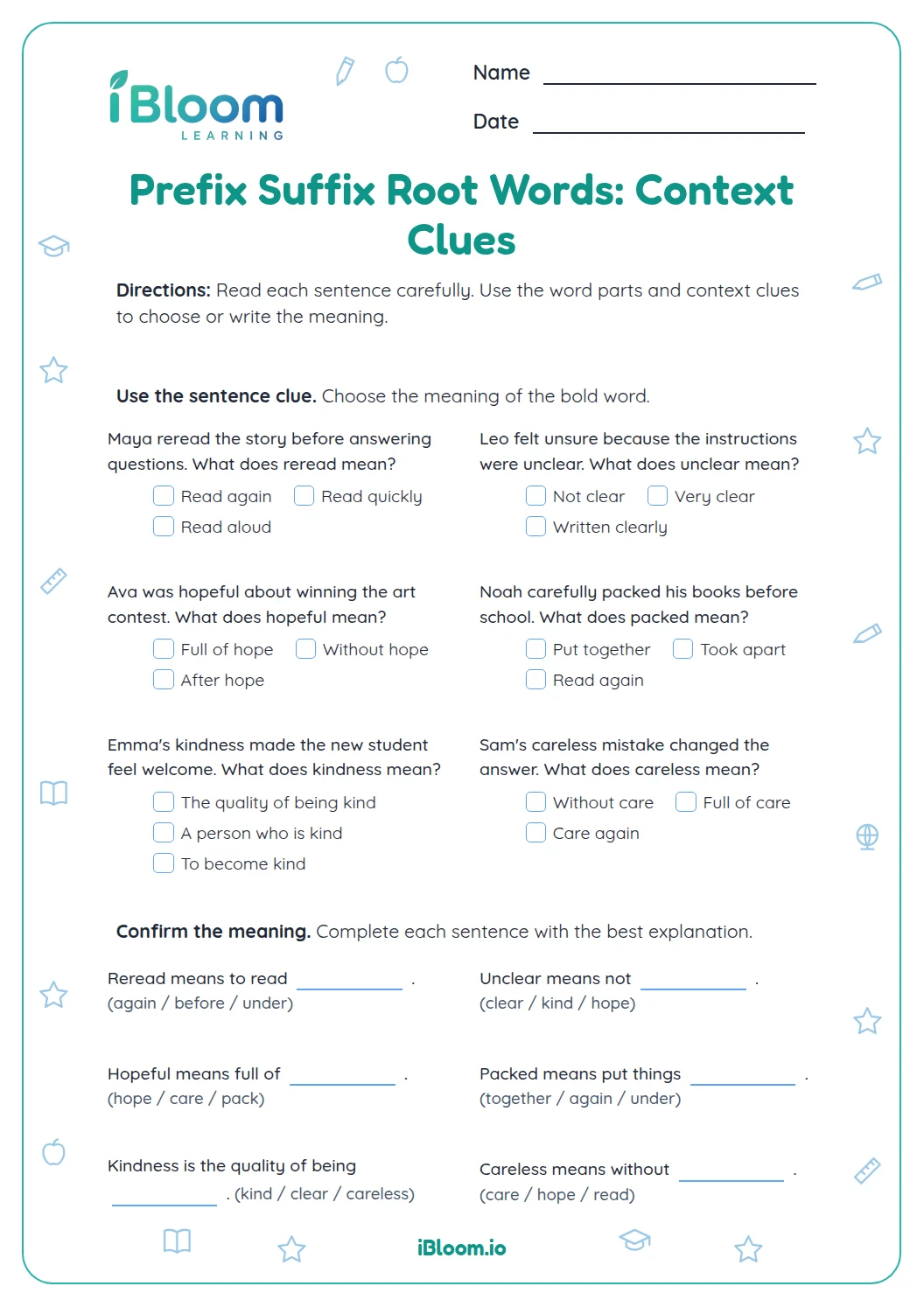
Word parts are useful clues, but the whole sentence can confirm a meaning. In “After the rain, the muddy boots left wet dirt on the floor,” rain and wet dirt help show that muddy means covered with wet dirt. Encourage the learner to reread the full sentence before choosing.
- 1Mia reread the note to find the time.
- 2The prefix re- means again.
- 3Reread means read again.
What will children practice on this page?
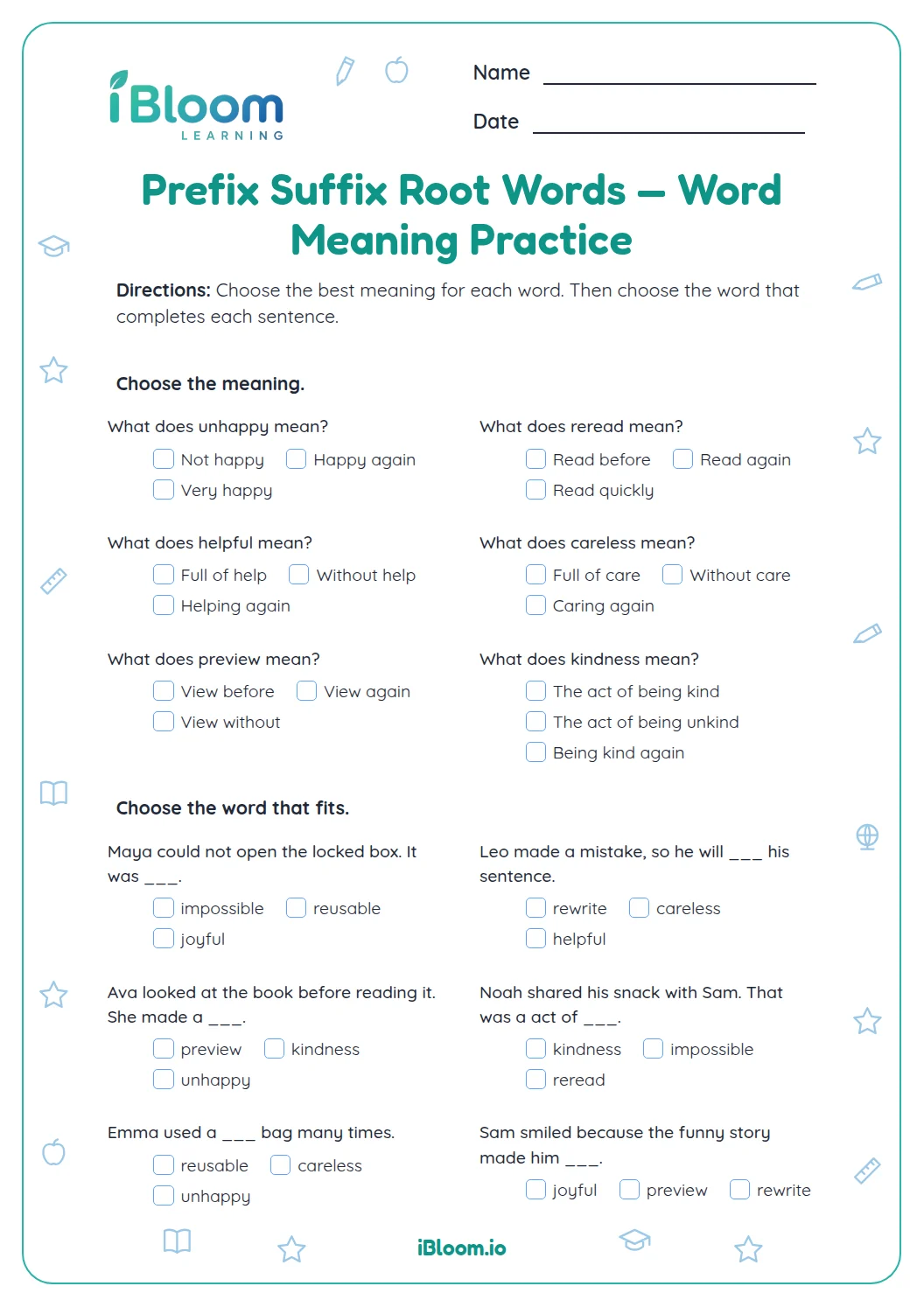
Part A has eight multiple-choice questions about common prefixes and suffixes, including re-, pre-, mis-, un-, -less, and -ful. Part B has six short sentence questions. One illustrated backpack cue accompanies repack; children still use the word part and sentence to select its meaning.
How to use this worksheet
- 1Read the base word before looking at its choices.
- 2For Part A, say the affix meaning and test it with the base word.
- 3For Part B, reread the sentence and check which meaning fits.
- 4Use the key to review the word part behind a missed answer.
Common mistakes and quick fixes
The mistake
Treating re- as a word ending.
The fix
Point to the start of rewrite or reread; re- comes before the base word.
The mistake
Assuming -less means full of.
The fix
Compare careless with helpful: -less means without, while -ful means full of.
The mistake
Picking a meaning from the target word alone.
The fix
Read the sentence around muddy or fearless and use its details as a clue.
Common Core alignment
This worksheet practices the listed Grade-level language or mathematics skills through short, varied items.
Use a known affix to determine a new word’s meaning.
On this sheet: Part A and several Part B items use familiar prefixes and suffixes to infer word meanings.
Show the official wordingHide the official wording
Determine the meaning of the new word formed when a known affix is added to a known word (e.g., agreeable/disagreeable, comfortable/uncomfortable, care/careless, heat/preheat).
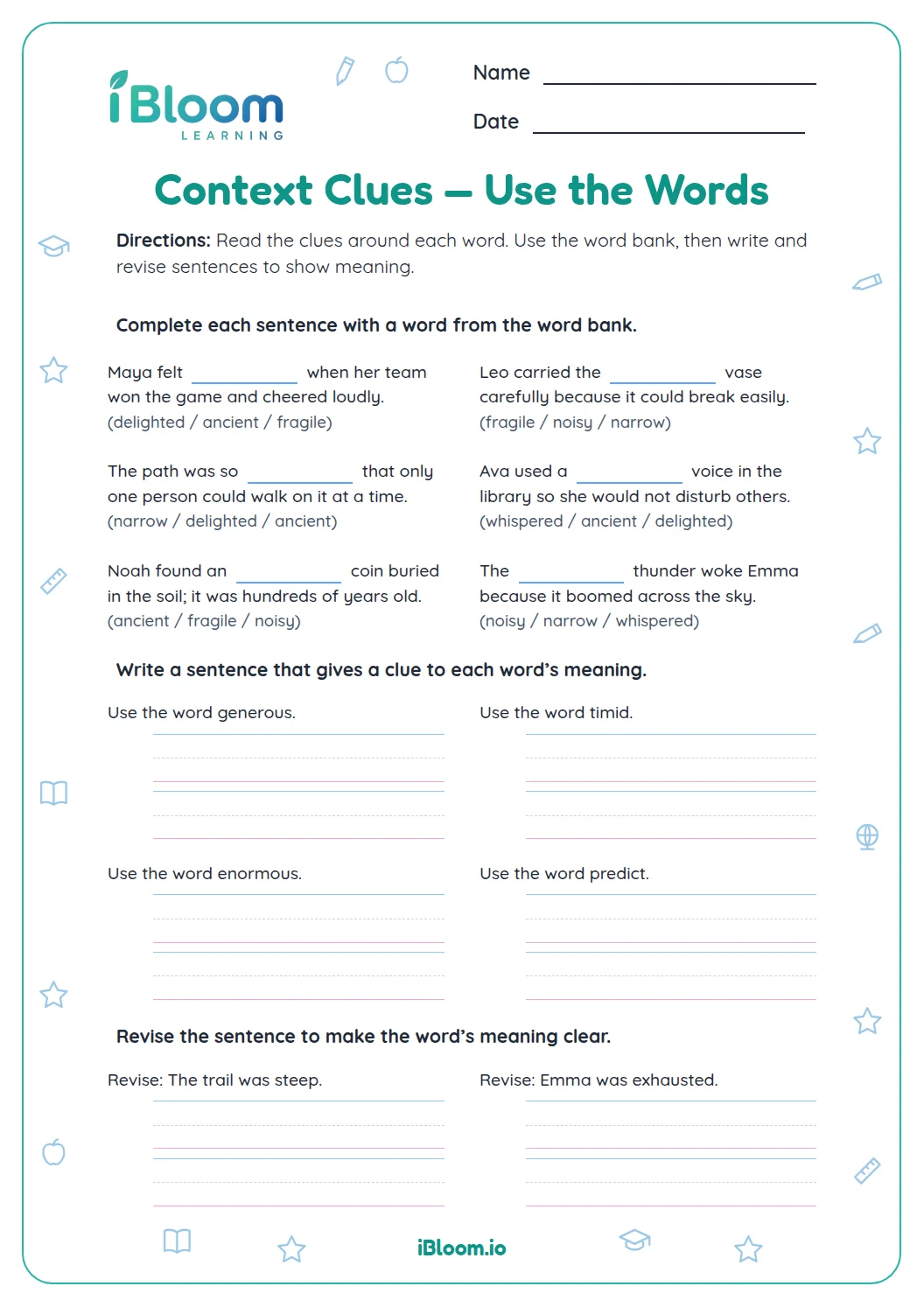
Use sentence clues to work out a word’s meaning.
On this sheet: Part B uses sentence context to clarify the meaning of target words.
Show the official wordingHide the official wording
Use sentence-level context as a clue to the meaning of a word or phrase.
What to practice next
Make more practice
Further reading
Questions parents and teachers ask
What is a prefix?
A prefix is a word part added to the beginning of a base word. In rewrite, re- comes before write and means again. The first eight questions use common word parts such as re-, un-, pre-, -less, and -ful to help Grade 3 learners reason about meaning.
What is a suffix?
A suffix is a word part added to the end of a base word. In careless, -less changes care to mean without care; in helpful, -ful means full of help. Part A asks children to use both kinds of affixes with familiar Grade 3 words.
How are context clues used in Part B?
Children read a complete sentence and use its details to confirm a word meaning. For example, the muddy ground and slow walking suggest wet dirt. Six questions ask about words such as reread, repack, fearless, helpful, reuse, and sadness. Ask what the word part contributes to the complete word.
Is the answer key included?
Yes. A separate answer key gives the correct choice for each of the 14 questions. When reviewing a missed item, ask the learner to name the prefix or suffix, or point to the sentence detail that supports the meaning. Rereading helps confirm the meaning in context.
Can I read the questions aloud?
Yes. An adult may read the Part B sentences and choices aloud while the learner does the meaning work. Pause after the sentence and ask which clue or word part helped. Part A can also be read aloud if a child needs support with a word.