

About this worksheet
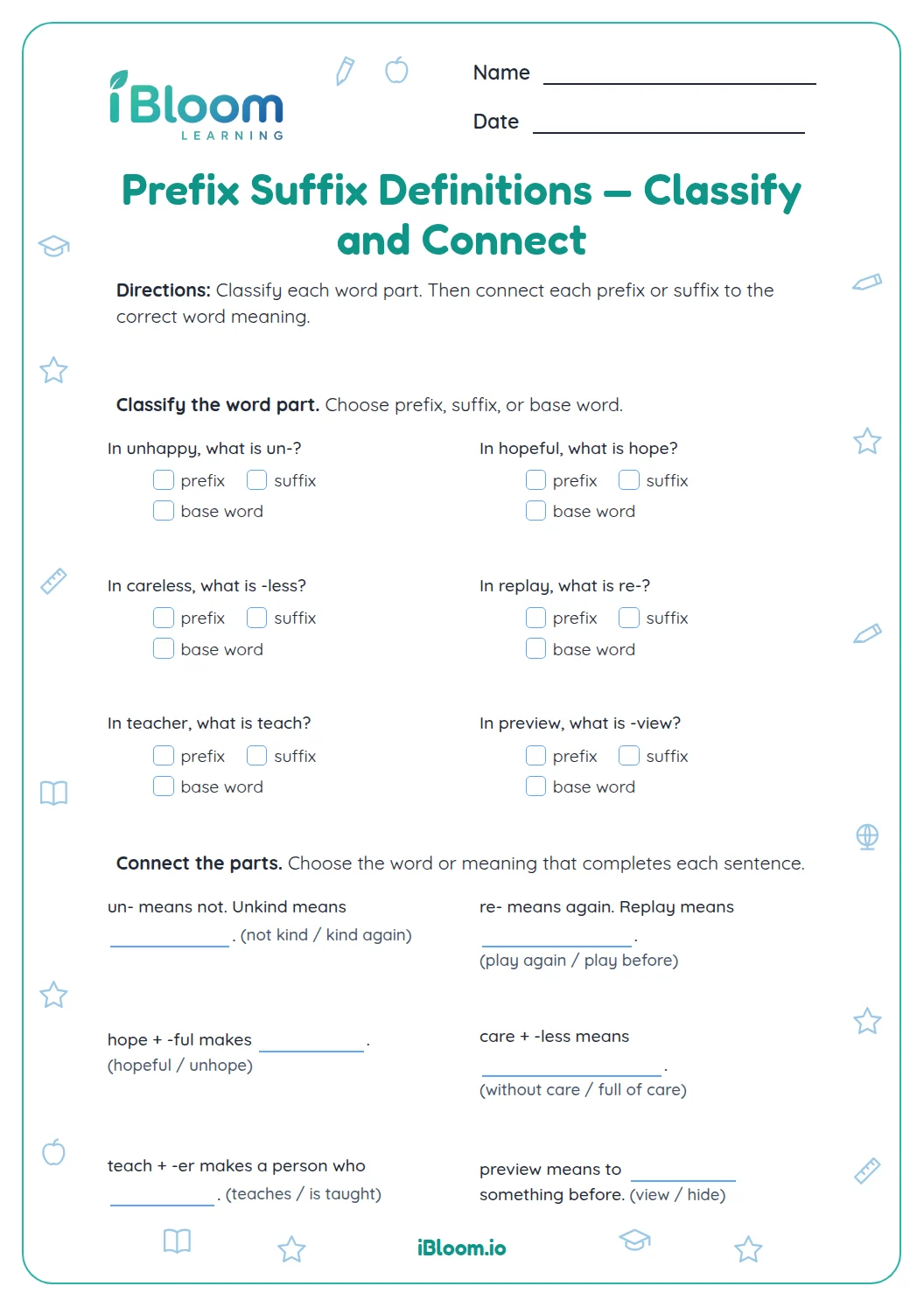
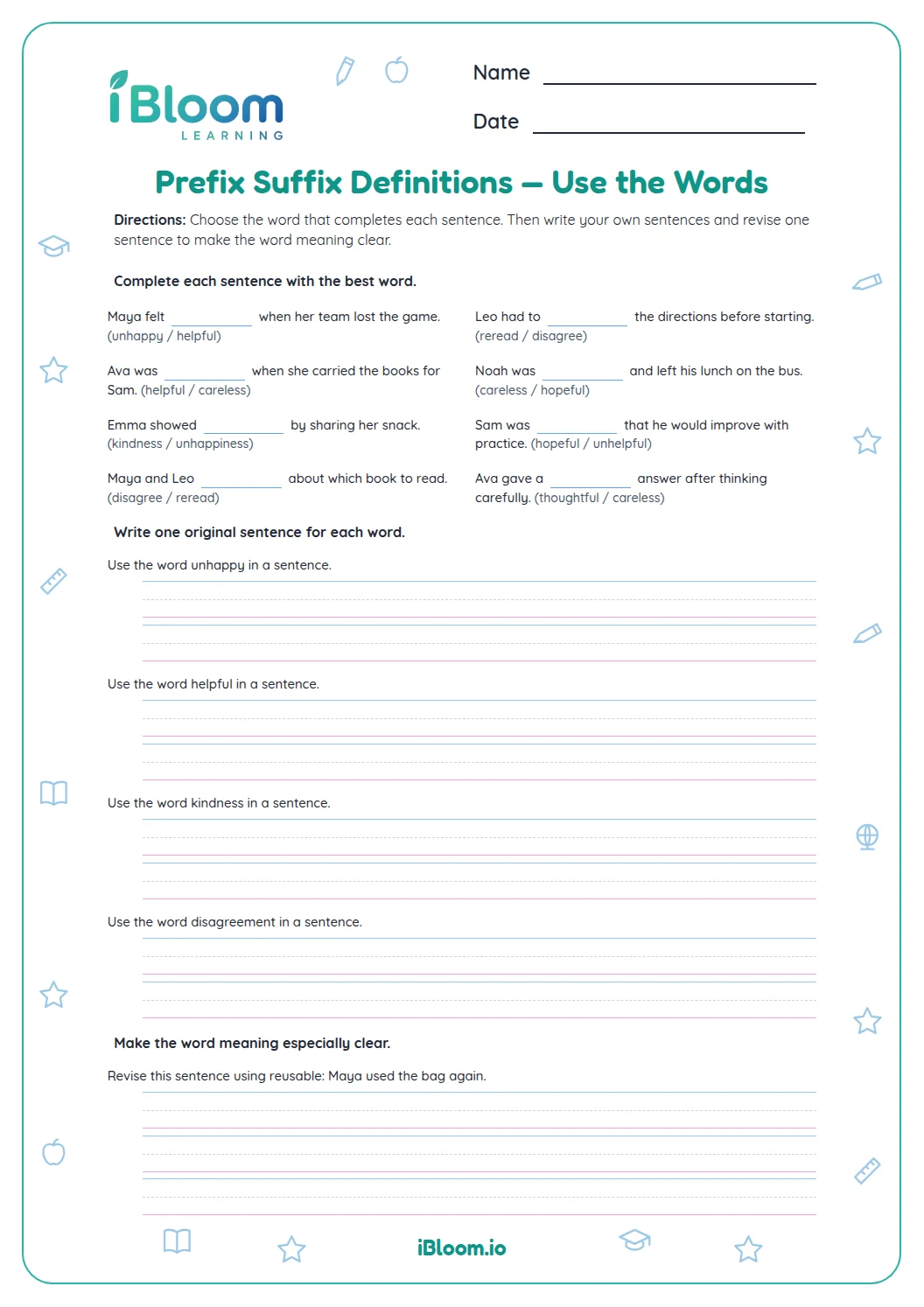
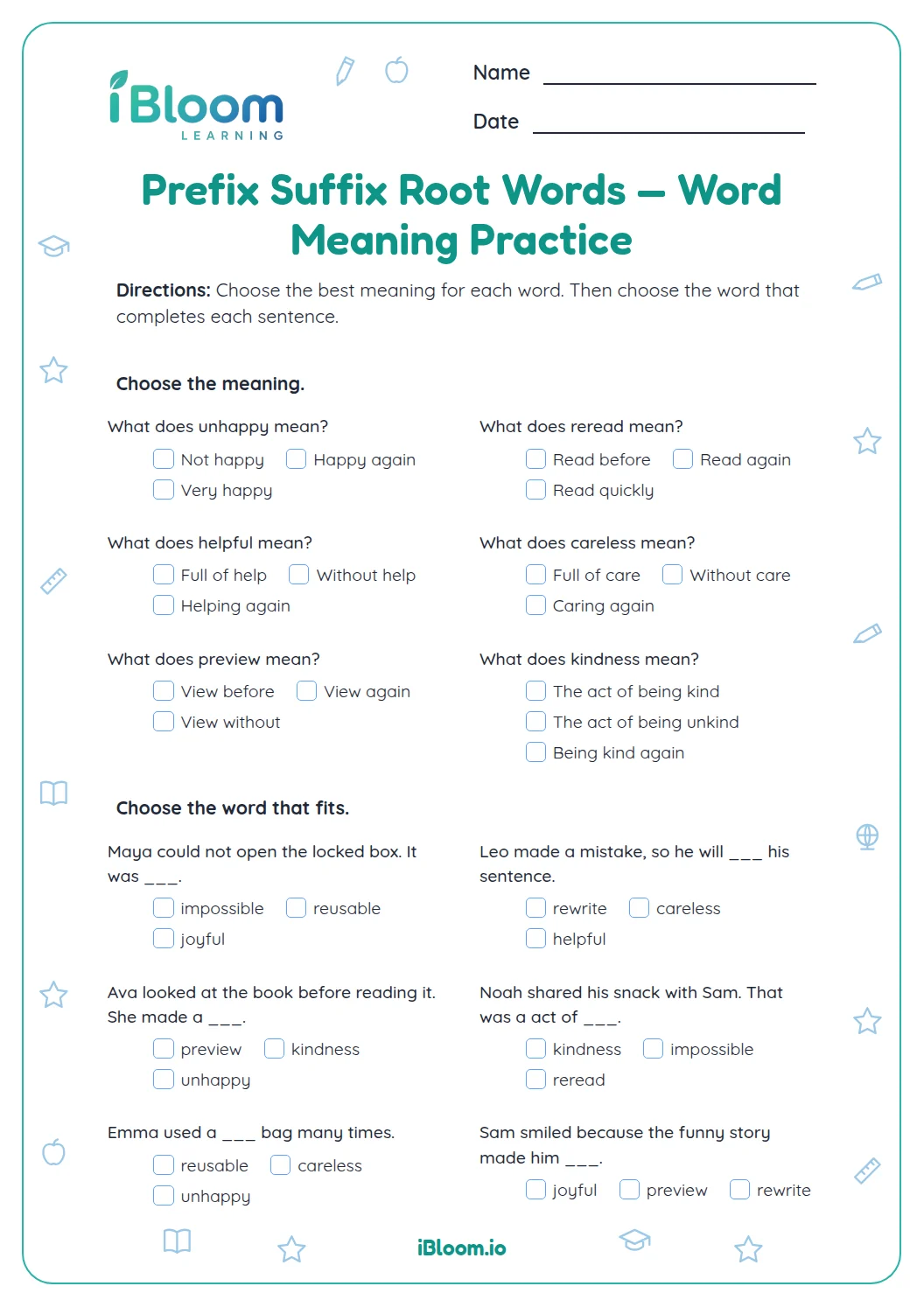
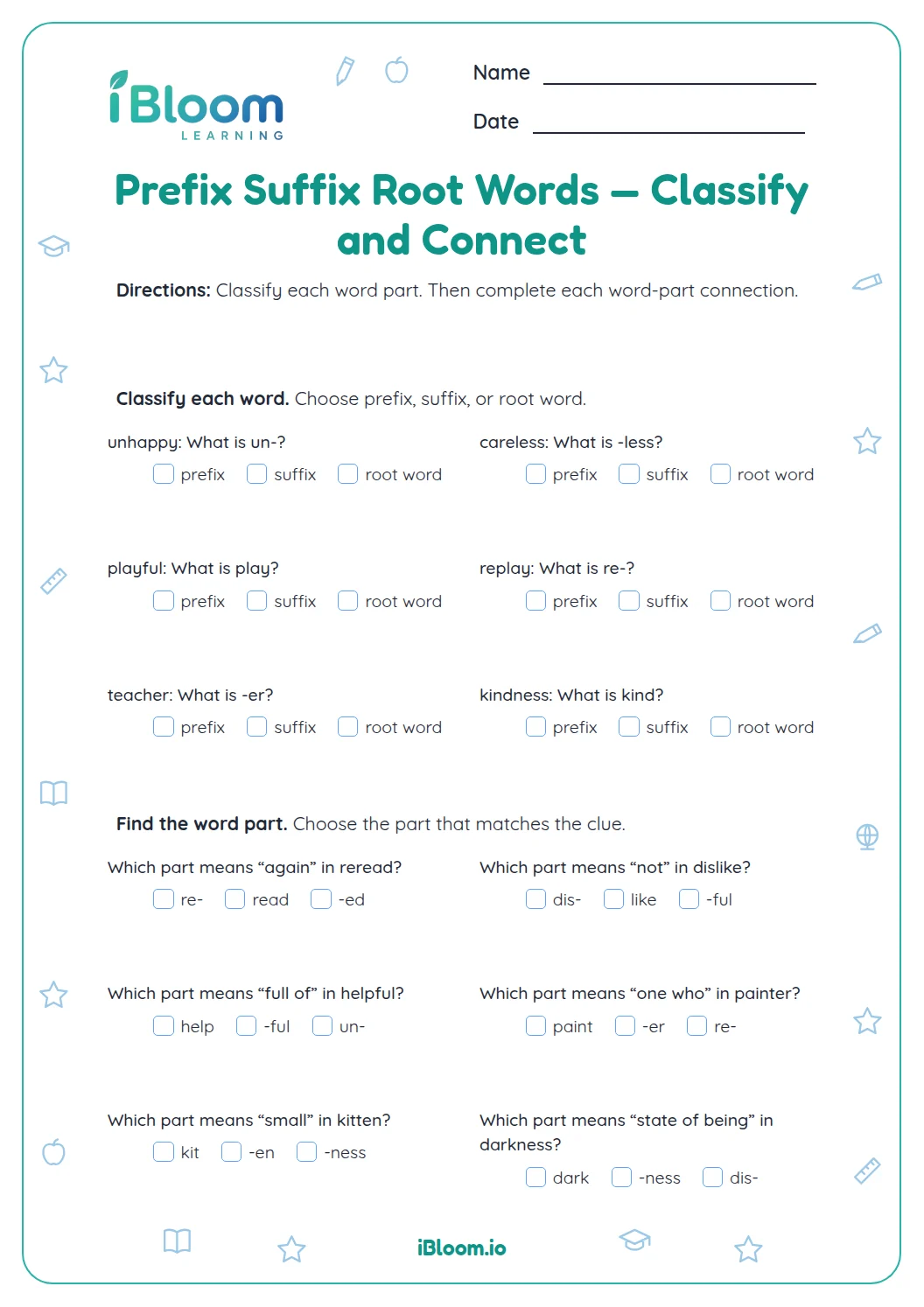
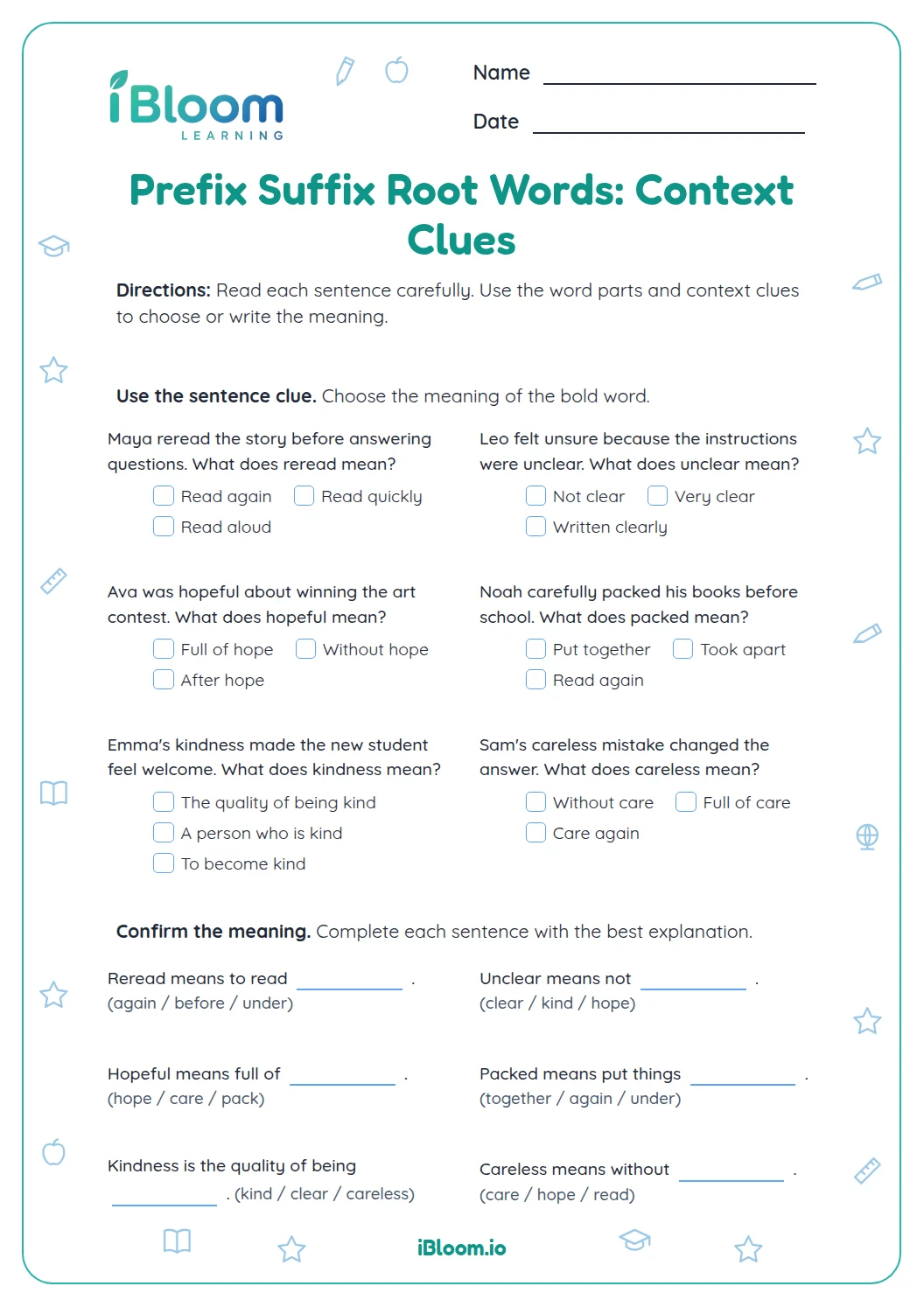
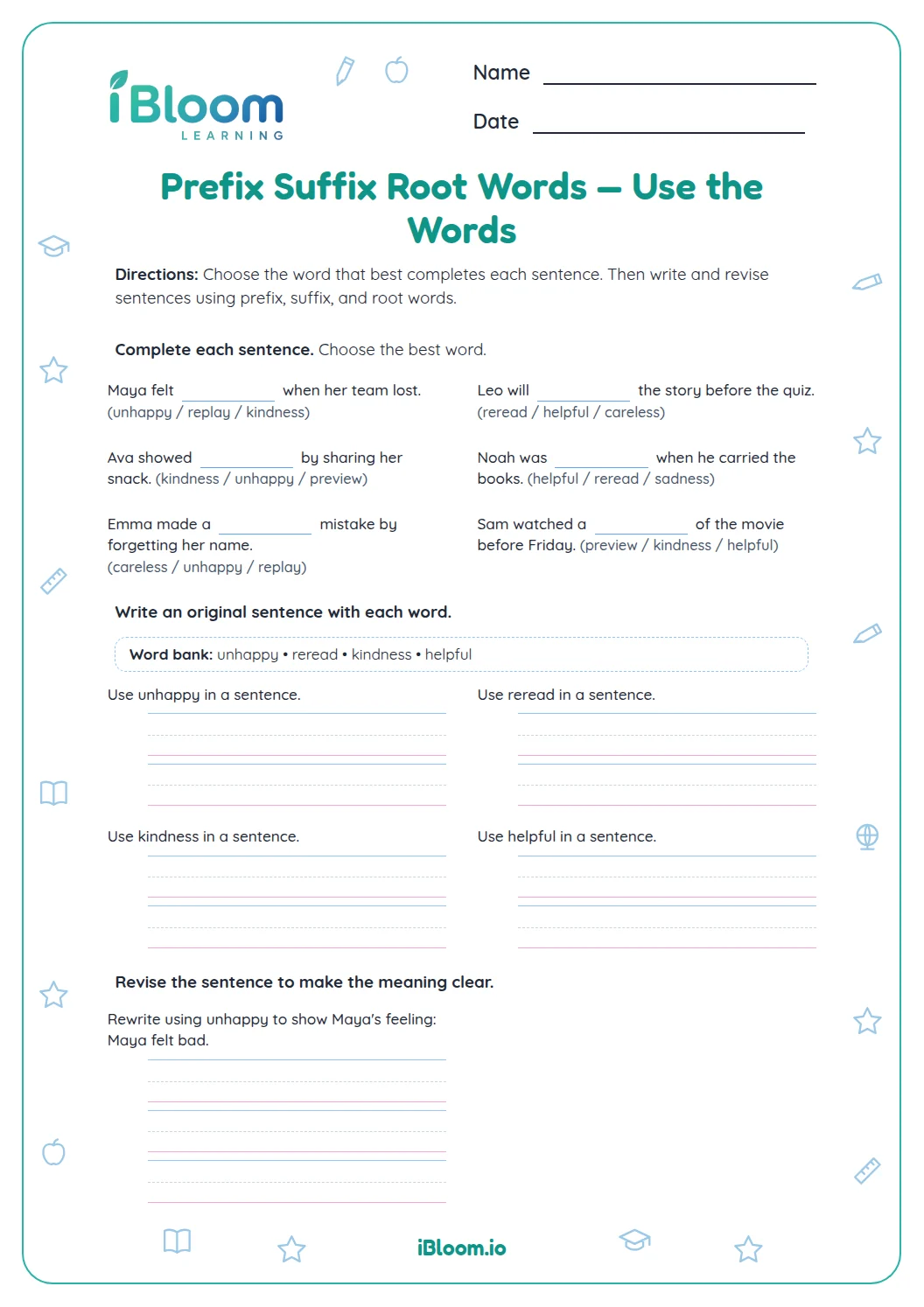
This Grade 3 vocabulary worksheet helps students reason about how a familiar affix changes a base word. Part A asks students to choose meanings for words such as reread, careless, and kindness. Part B focuses on the meaning contributed by an affix, and Part C asks for short explanations using examples. The questions practice CCSS L.3.4b: determining the meaning of a new word formed when a known affix is added to a known word. A separate answer key includes sample responses.
Aligned to L.3.4b
How can a word part give a meaning clue?
A prefix comes before a base word, and a suffix comes after it. The added part can change the meaning. In reread, re- means again, so reread means read again. In careless, -less means without, so careless means without care.
- 1Word: reread
- 2Prefix: re- means again
- 3Reread means read again.
How can readers check an affix meaning?
First find the base word. Then use the affix meaning and put the parts together. Check whether the whole meaning makes sense in a sentence. Some affixes have more than one use, so use the context as a check.
What does each part ask students to do?
Part A matches familiar affixes to word meanings. Part B asks for the meaning of an affix in a word. Part C gives children space to explain how a word part changes meaning. The key includes sample explanations for those written responses.
How to use this worksheet
- 1Read the whole word aloud.
- 2Identify the base word and the added prefix or suffix.
- 3Recall the familiar meaning of the word part.
- 4Combine the meanings and check whether the result makes sense.
- 5For Part C, explain how the affix changes or adds to the base word.
Common mistakes and quick fixes
The mistake
Using only the base word meaning.
The fix
Include what the prefix or suffix contributes.
The mistake
Mixing up -ful and -less.
The fix
Remember -ful means full of and -less means without.
The mistake
Assuming un- means not in every word.
The fix
Check the whole word and its sentence; un- may reverse an action, as in unlock.
Curriculum alignment
This worksheet gives children direct practice with the skill named in the standard.
Use a known affix to determine the meaning of a new word.
On this sheet: Students use familiar prefixes and suffixes to explain whole-word meanings.
Show the official wordingHide the official wording
Determine the meaning of the new word formed when a known affix is added to a known word (e.g., agreeable/disagreeable, comfortable/uncomfortable, care/careless, heat/preheat).
What to practice next
Make more practice
Further reading
Questions parents and teachers ask
What is a prefix?
A prefix is a word part placed at the beginning of a base word. In reread, re- comes before read and means again. The worksheet asks students to use familiar prefixes such as re-, un-, pre-, and mis- to reason about whole words.
What is a suffix?
A suffix is a word part placed at the end of a base word. In helpful, -ful follows help and means full of. This sheet also practices -less, -er, and -ness so students can connect the ending to the new word meaning.
How should a child solve a word like careless?
Find the base word care, then use the suffix -less, which means without. Put the parts together: careless means without care. A child can check the meaning by reading the word in a simple sentence. A quick reread of the completed item can confirm the answer and make the word relationship clear.
Can an affix have more than one meaning?
Yes. Some word parts can work in more than one way depending on the word. For example, un- can mean not in unhappy, while unlock means to reverse the action of locking. Read the whole word and use context to choose a sensible meaning.
What is on the answer key?
The answer key gives the matching meanings, missing affix meanings, and sample explanations for both written questions. Students may phrase explanations differently; their response should accurately connect the affix to the meaning of the whole word. The whole word and its sentence help confirm the intended meaning.