


About this worksheet
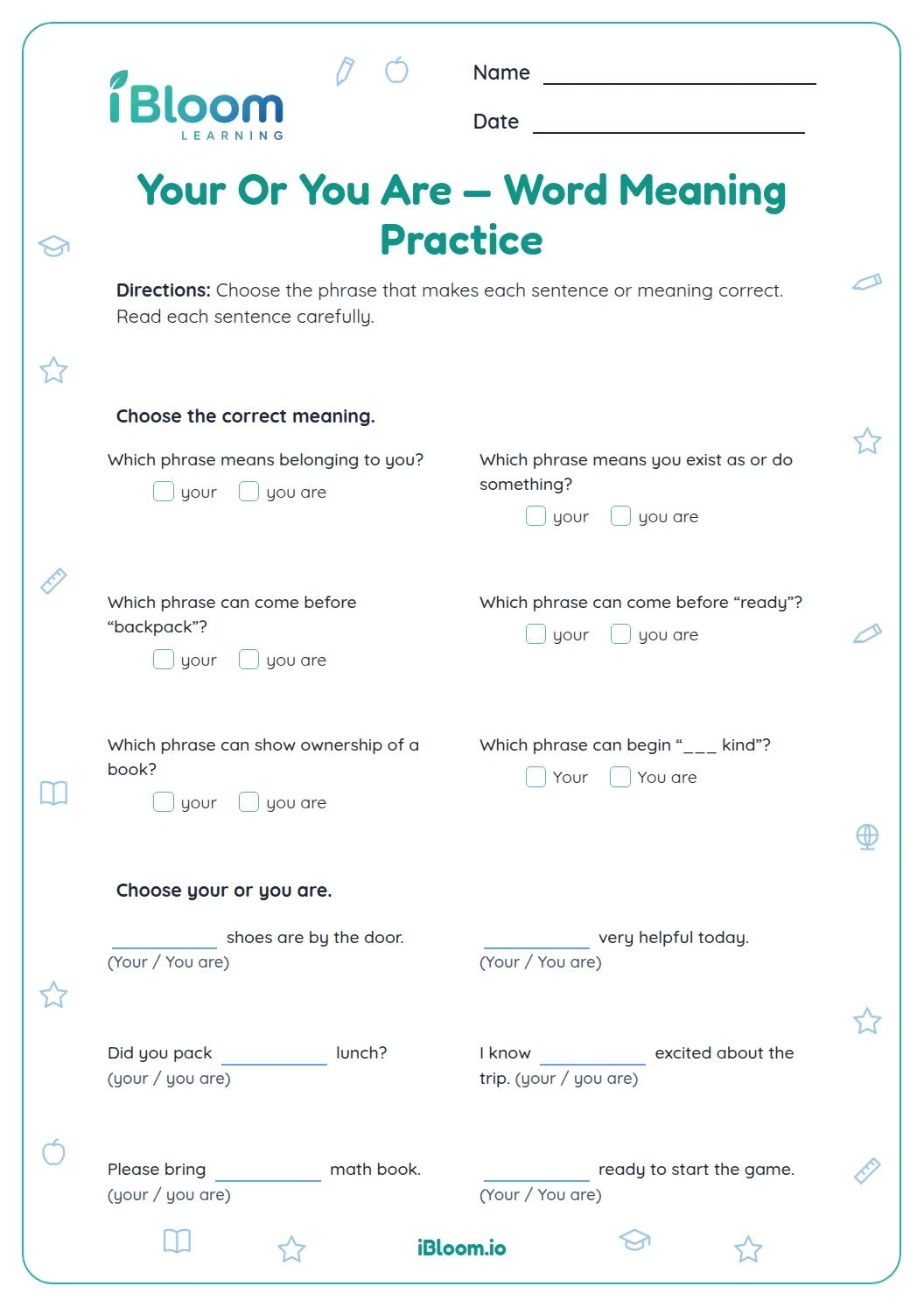
This free Grade 3 worksheet helps children decide when a sentence needs its and when it needs it is. Part A gives six choices, Part B asks children to fill six blanks, and Part C asks them to explain two examples. Context clues include a turtle’s head, a bicycle’s bell and a game that is easy to learn. The 14 questions practice standard English usage under CCSS L.3.1. A separate answer key provides each choice and sample explanations. Children work with the full words it is, making the meaning easy to test aloud.
Aligned to L.3.1
What does its tell the reader?
Its connects an animal or thing with something belonging to it or associated with it. In question 3, the bell belongs to the bicycle. In question 9, the leaves belong to the tree. Ask “Whose bell?” or “Whose leaves?” to make the connection explicit.
The word its has no apostrophe. Children do not need to add punctuation when they write it in the blanks. The important first step is recognizing the belonging relationship in the sentence.
How can the it is test help?
Try the full two words in the blank and read the entire sentence. “The bicycle lost it is bell” does not express the intended meaning. “Please wear a coat because it is cold outside” does. The test uses both grammar and what the sentence is telling us.
- 1The bicycle lost ___ bell on the bumpy path.
- 2The bell belongs to the bicycle.
- 3“The bicycle lost it is bell” does not fit.
- 4Write its: The bicycle lost its bell on the bumpy path.
How does the worksheet move beyond choosing?
Part A offers both forms beside each sentence. Part B removes those printed choices, asking children to recall and write the correct form. Each part includes belonging sentences and sentences that need it is.
Part C asks why each form fits. Children identify the robot’s arm as what belongs to it, then explain what it is says about a heavy backpack. Short answers can use different wording from the sample key if the meaning is clear.
A sentence-checking routine
- 1Read the two forms aloud: its, then it is.
- 2For question 1, ask whose head is being described before choosing.
- 3Try the full words it is in each blank and listen to the whole sentence.
- 4Write the correct form in Part B without adding an apostrophe to its.
- 5Answer the two Part C questions with a clue from each sentence.
- 6Check against the key and reread any corrected sentence aloud.
Mistakes to check together
The mistake
Writing it is before tail in “The puppy wagged ___ tail.”
The fix
Ask whose tail it is; the tail belongs to the puppy, so use its.
The mistake
Choosing its in “___ too hot to eat” because soup was already named.
The fix
Read “it is too hot to eat” aloud; the sentence needs the verb is to describe the soup.
The mistake
Adding an apostrophe to the possessive form its.
The fix
Keep its without an apostrophe for belonging. The contraction it’s means it is in these examples.
Common Core alignment
Use its and it is correctly when completing and explaining sentences.
On this sheet: Children distinguish a possessive form from a pronoun and verb, then explain their choices in writing.
Show the official wordingHide the official wording
Demonstrate command of the conventions of standard English grammar and usage when writing or speaking.
What to practice next
Make more practice
Further reading
Questions parents and teachers ask
What is the difference between its and it is?
Its shows belonging or a connection, as in the puppy and its tail. It is combines the pronoun it with the verb is, as in “it is sunny today.” On this worksheet, children read each whole sentence to decide whether it needs a belonging word or a statement.
Does the worksheet use the contraction it’s?
The printed questions use the full words it is. This makes the two-word test visible while children learn to distinguish a statement from belonging. After checking the page, you can show that it’s can replace it is in these sentences, while possessive its keeps no apostrophe.
Which clues help with the belonging sentences?
Look for an animal or thing and something connected to it. The turtle has a head, the bicycle has a bell, and the tree has leaves. Ask whose head, bell or leaves the sentence names. Those relationships explain why its fits the corresponding blanks on this sheet.
How should I check the two written explanations?
Check that the child identifies the meaning, even if the wording differs from the key. In question 13, the arm belongs to the robot. In question 14, it is tells us the box is light to carry. The sample answers show one clear way to express each idea.
Can children use the same test for every blank?
Yes. Read the sentence with the full words it is in the blank, then consider whether it describes something sensibly. If the sentence instead names something belonging to an animal or object, use its. Finally, reread the chosen form in the whole sentence to confirm the meaning.