


About this worksheet
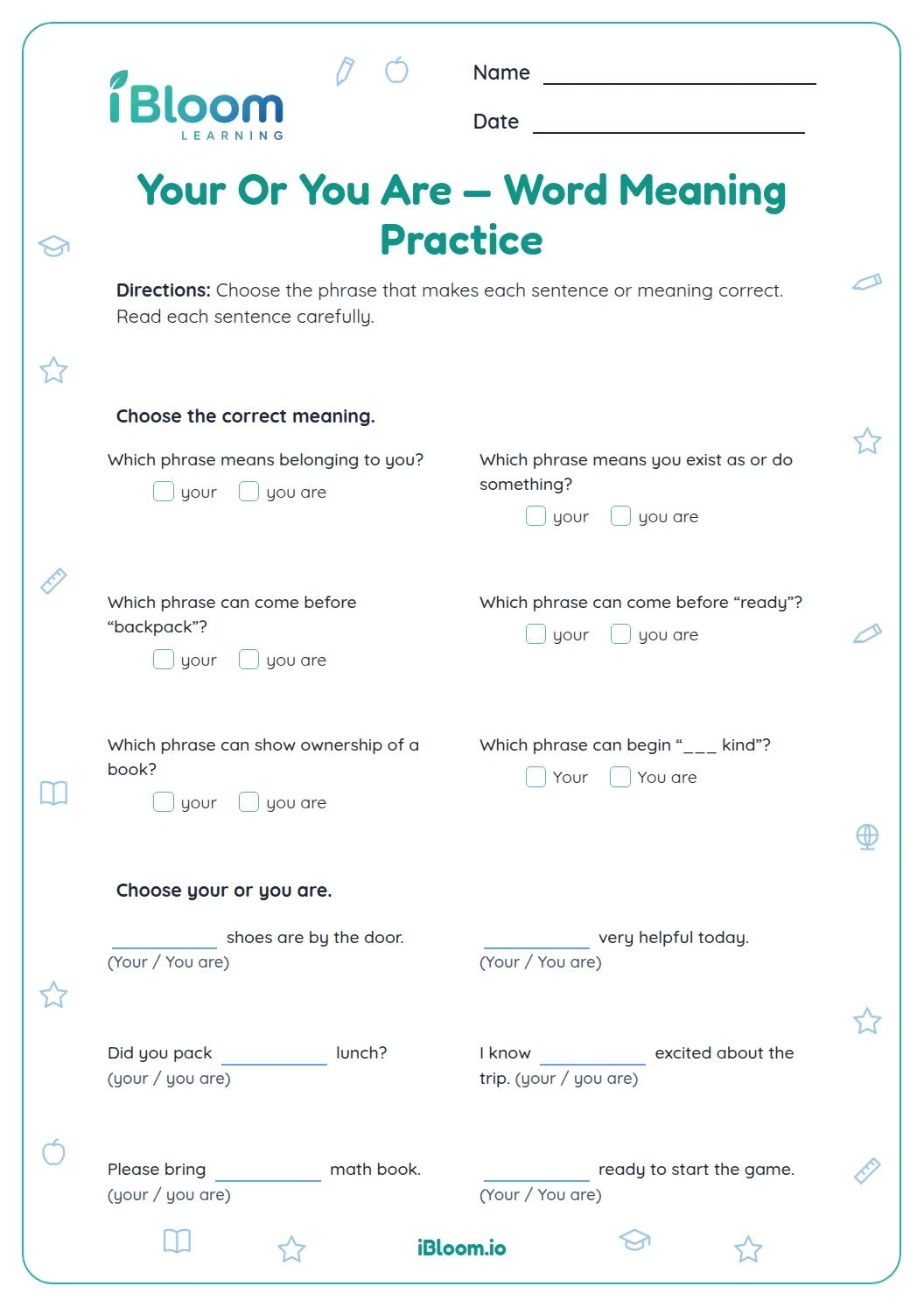
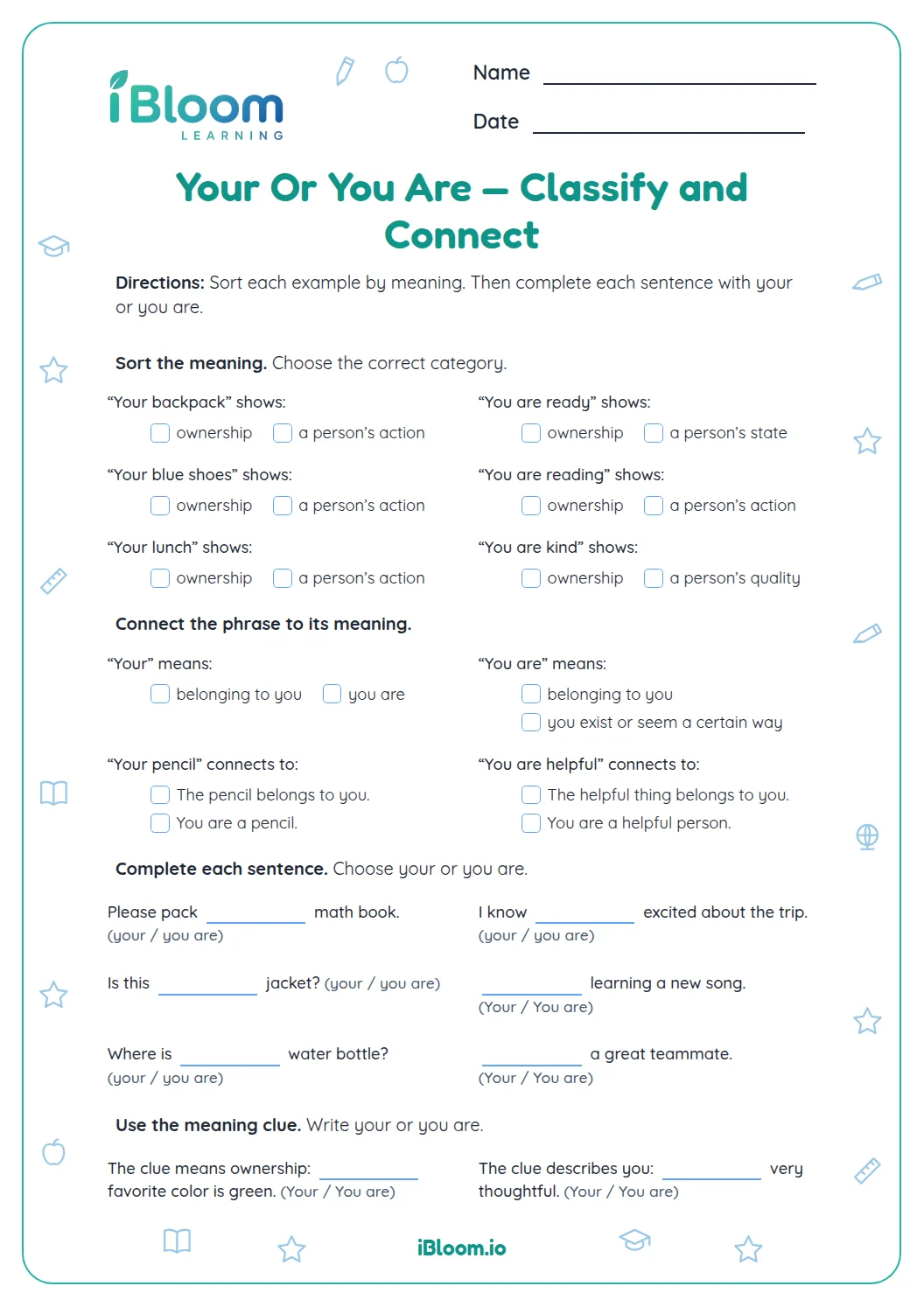
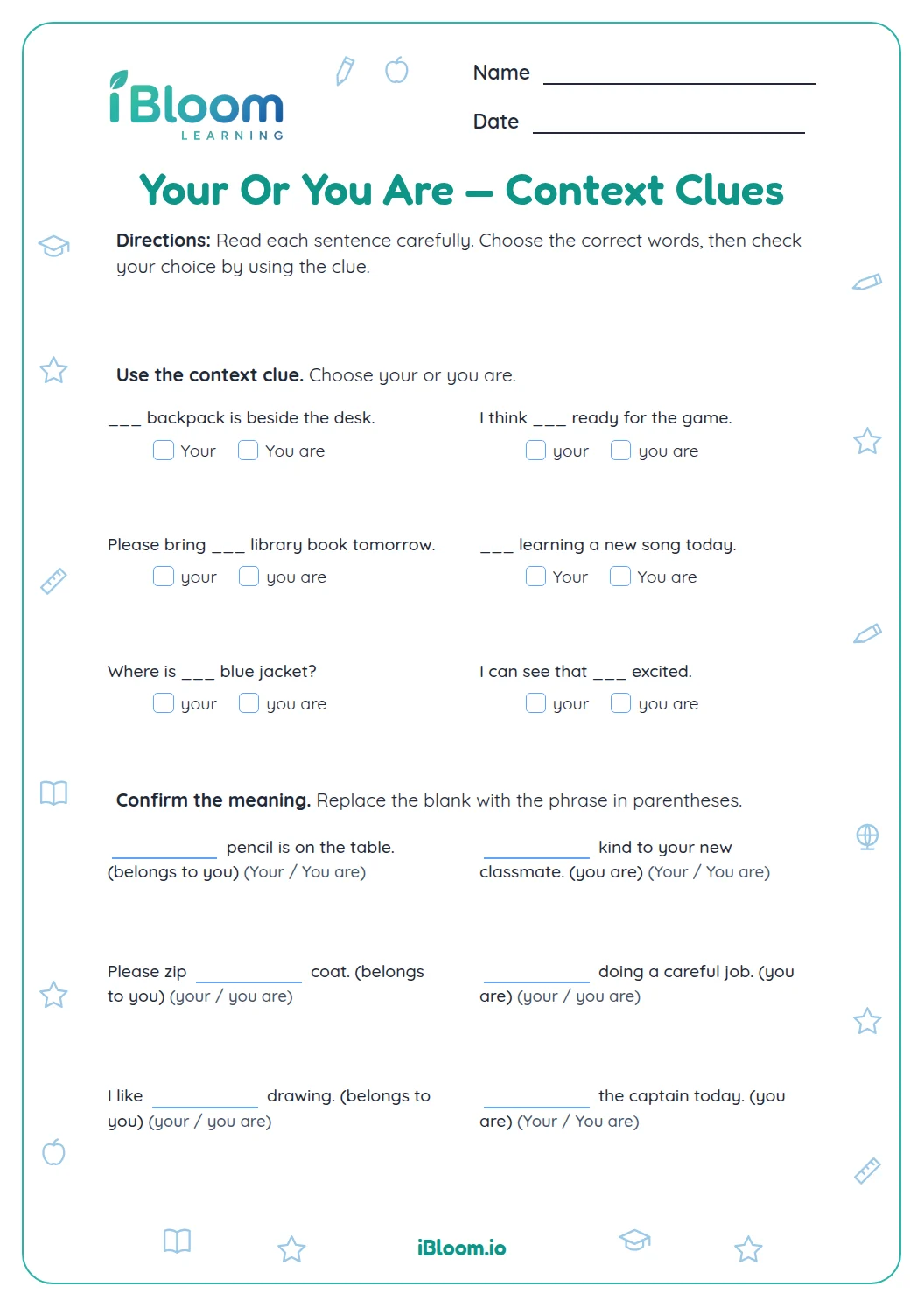
This Grade 3 language worksheet helps students choose between your and you are by using sentence meaning. Students complete sentences, rewrite ideas using the requested form, edit a possessive form, expand a contraction, explain meaning, and write one original sentence. The answer key gives expected rewrites and a sample for the open response.
Aligned to L.2.2.c
What clue tells you to use your?
Your comes before a noun and shows that the person being addressed has or is connected to something. In “Is this your lunch box?” the noun lunch box follows your.
- 1Is this your lunch box?
- 2Lunch box is the thing connected to the person being addressed.
When can you use you are or you’re?
You are names the person and a state or action. You’re is a contraction with the same meaning. Read the whole sentence with you are in place of you’re to check it.
How can you proofread these forms?
Look after the word: a noun often follows your, while you are is followed by a description or action. Then read the sentence aloud to confirm that its meaning is clear.
How to use this worksheet
- 1Read the whole sentence before filling the blank.
- 2Look for a noun that belongs to or is connected to the person being addressed.
- 3Use you are when the sentence means the person is doing or being something.
- 4Expand you’re to you are to check a contraction.
- 5Reread the finished sentence for meaning and punctuation.
Mistakes to watch for
The mistake
Writing you’re before a noun, as in “you’re book.”
The fix
Use your before a noun: “your book.”
The mistake
Using your when the sentence means “you are.”
The fix
Replace the word with you are; if the sentence makes sense, use you are or you’re.
The mistake
Leaving out the apostrophe in you’re.
The fix
Write you’re with an apostrophe because it joins you and are.
Common Core alignment
Students use the apostrophe in a contraction and distinguish it from the possessive word your.
Use an apostrophe to form contractions and common possessives.
On this sheet: Students form and expand you’re and choose the possessive word your.
Show the official wordingHide the official wording
Use an apostrophe to form contractions and frequently occurring possessives.
What to practice next
Make more practice
Further reading
Questions parents and teachers ask
What is the difference between your and you are?
Your comes before a noun to show that something belongs to or is connected to the person being addressed. You are names the person and a state or action. You’re is a contraction that means you are, so it can replace those two words.
How can I check whether to use you’re?
Expand the contraction to you are and reread the sentence. If the sentence still makes sense, you’re is likely correct. If the sentence needs to show whose object or idea it is before a noun, use your instead. The answer key provides a clear way to check the result after the student finishes.
What kinds of tasks are on this worksheet?
There are 14 items in four parts: six sentence completions, four rewrites, three editing or meaning questions, and one original sentence. Students practice both forms in context and can check expected responses with the separate answer key. The sample key supports checking the completed sentence.
Does the worksheet ask students to write sentences?
Yes. Several rewrite prompts need a complete sentence, and the last question asks students to write an original sentence using your. The answer key gives a sample for that open response; other clear sentences using your are also acceptable. The answer key provides a clear way to check the result after the student finishes.
Why does the worksheet include you’re?
You’re is included because it is a contraction of you are. Expanding it to the two words helps students distinguish it from your, which shows a connection to a noun. The worksheet asks students to rewrite in both directions. The answer key provides a clear way to check the result after the student finishes.