






About this worksheet
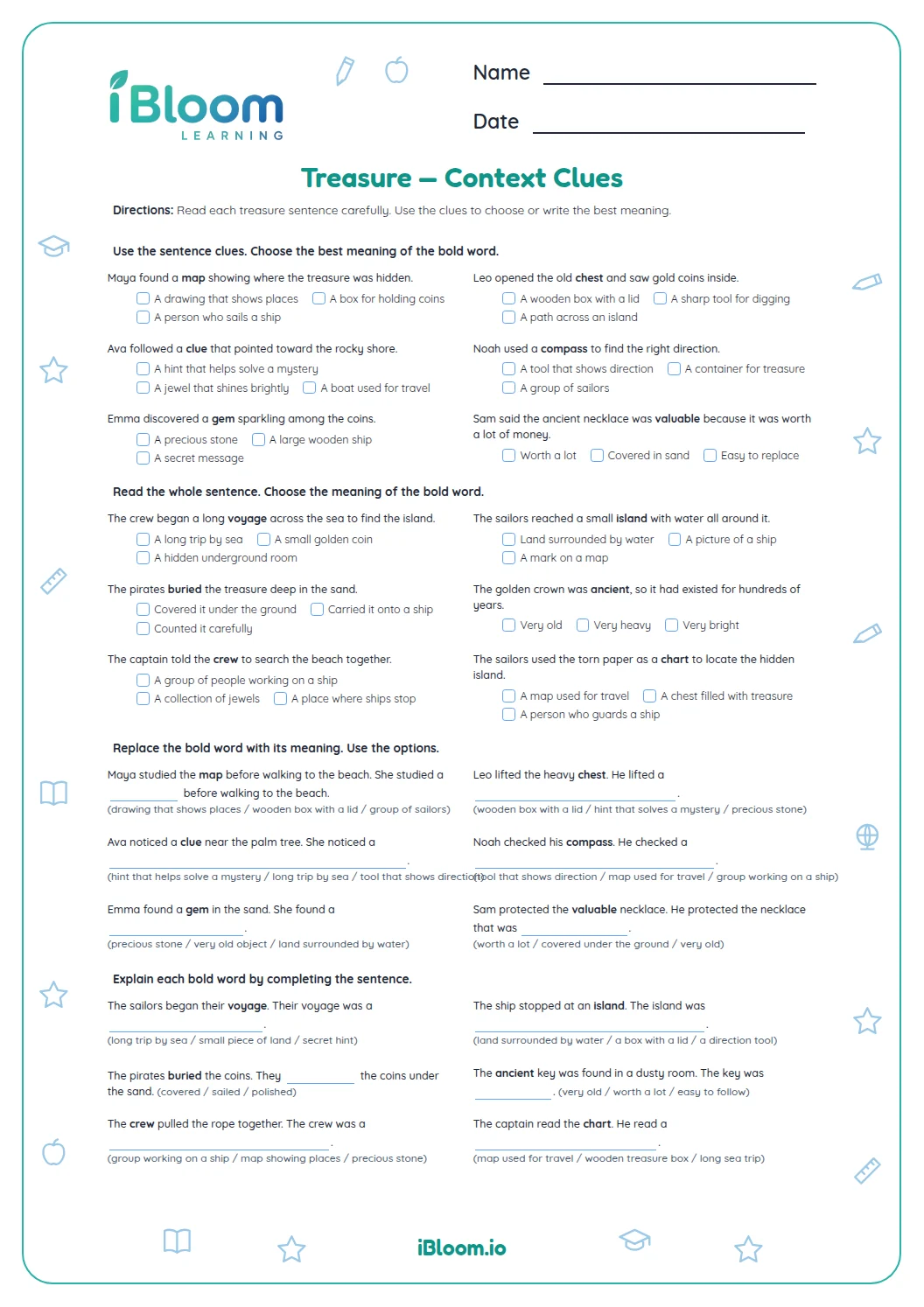
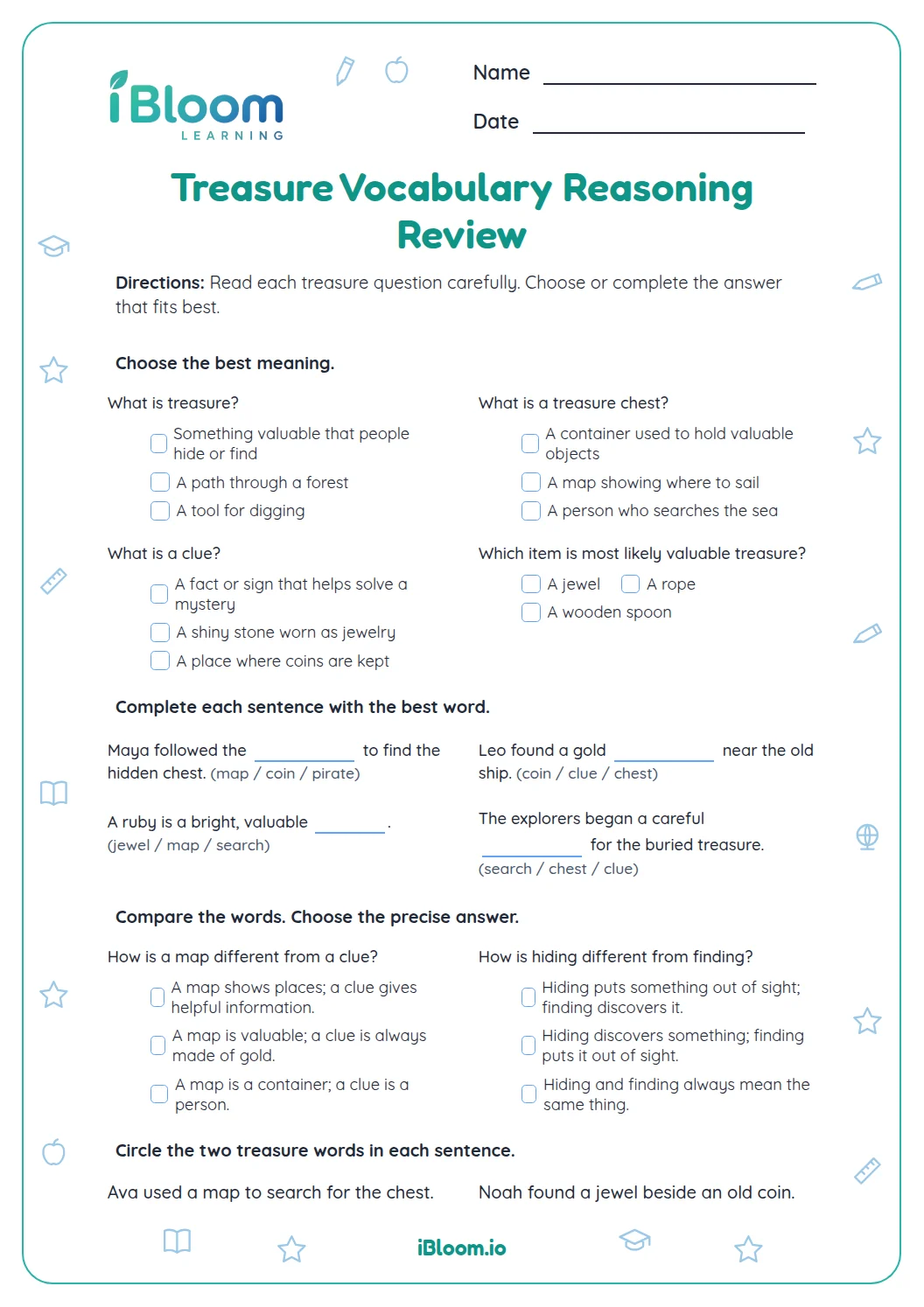
This Grade 3 vocabulary worksheet turns the original treasure category task into a word search followed by meaning and category connections. Students find five words, then use clues about tools, people, places, valuables, and routes to reason about how the words relate. The two-page printable has one word-search activity and 14 follow-up questions, plus a separate answer key. Students practice using context and word relationships instead of sorting each word in isolation.
What words are hidden in the puzzle?
The search includes compass, treasure, island, map, and gold. Finding the words first gives students a word bank to use as they work through clues and category relationships.
- 1Find each of the five listed words in the grid.
How do the clues connect words by meaning?
Part B asks students to complete clues about what a compass does, what a map shows, and who searches for treasure. Read the whole sentence, then use both meaning and grammar to choose the word that fits.
- 1A tool that helps a traveler find direction is a compass.
How can students classify treasure words?
The clues group words into useful categories: a pirate is a person, an island is a place, and gold or a ring can be valuables. Other words name tools or objects used while traveling.
How should students check their choices?
Reread each completed sentence and ask whether the word fits the clue. The word search itself is checked by finding all five listed words in the grid.
How to use this worksheet
- 1Scan the grid for the first letters in the word list.
- 2Mark each complete word and cross it off the list.
- 3Read each sentence clue all the way through.
- 4Use the meaning and category clues to select a word.
- 5Reread the completed sentence and check the answer key.
Common mistakes and quick fixes
The mistake
Choosing a word that matches only one clue word.
The fix
Use the meaning of the entire sentence to decide.
The mistake
Mixing a person, place, and tool category.
The fix
Ask whether the word names someone, somewhere, or something used.
The mistake
Stopping after finding most of the puzzle words.
The fix
Check all five words on the list before moving to Part B.
What to practice next
Make more practice
Questions parents and teachers ask
How many words are hidden in the puzzle?
The grid contains five listed treasure words: compass, treasure, island, map, and gold. Students can cross off each word as they locate it so they can confirm that all five are found. This word list becomes a reference for the clues that follow.
What vocabulary skills does Part B practice?
Part B uses clues about meaning, categories, and how words relate. Students identify a compass as a direction-finding tool, a pirate as a person, and gold and a ring as valuables. The context helps narrow the answer. Each sentence provides enough information to infer the intended word.
Does the worksheet include an answer key?
Yes. The separate answer key gives the answers to all 14 word-meaning and category questions and confirms that students found the listed words in the search. Use it after the child has attempted each clue and checked the word list.
How can a student solve a word clue?
Read the complete sentence and decide what kind of word is missing. A clue about helping a traveler find direction points to a tool, while a clue about who searches for treasure points to a person. Then check which listed word fits that meaning.
How many questions and pages are included?
The printable has 15 numbered activities: one word-search activity followed by 14 short questions. The worksheet fills two pages, and a separate two-page answer key gives the solutions. The same five treasure words appear in the puzzle and the follow-up clues.