



About this worksheet
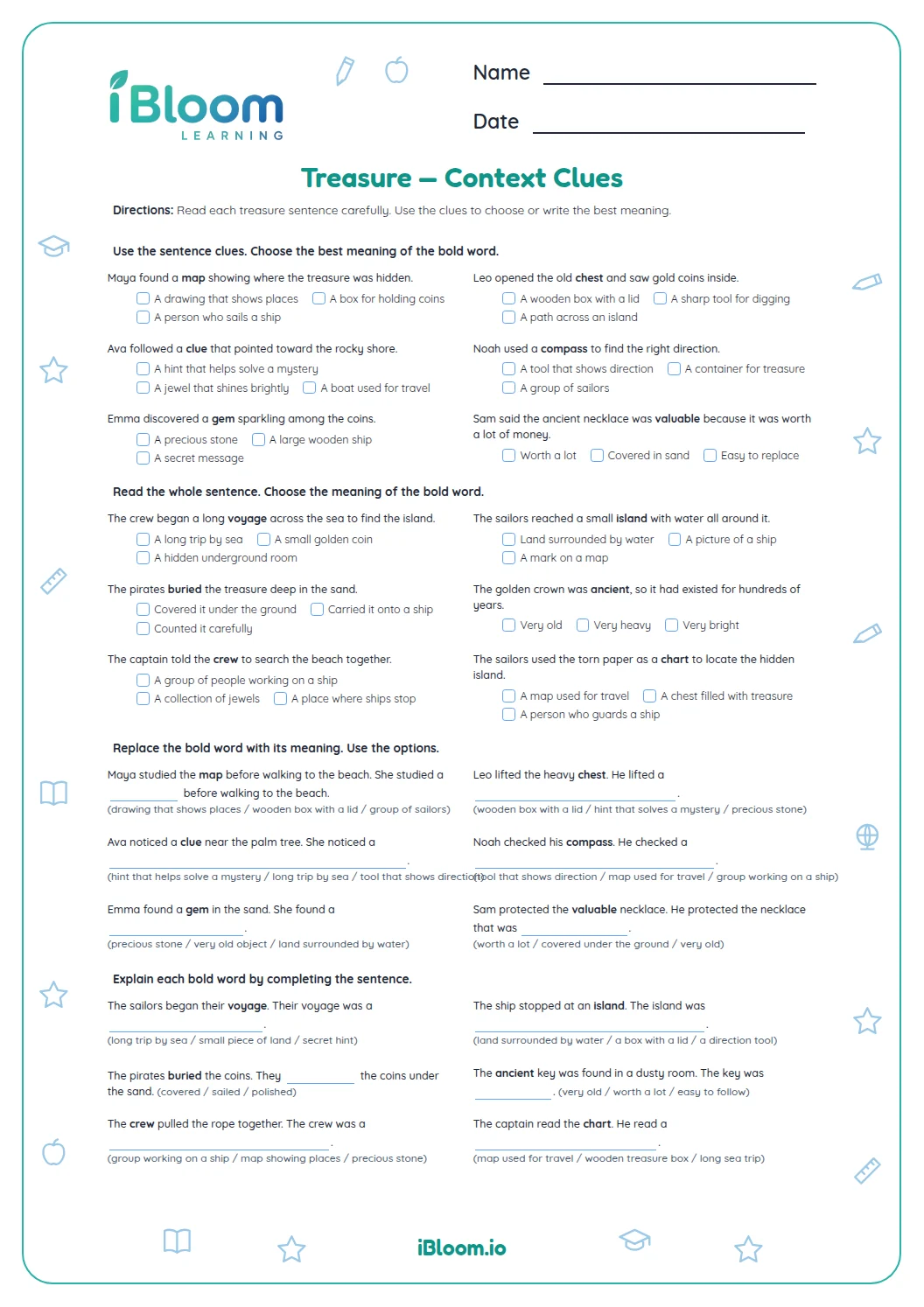
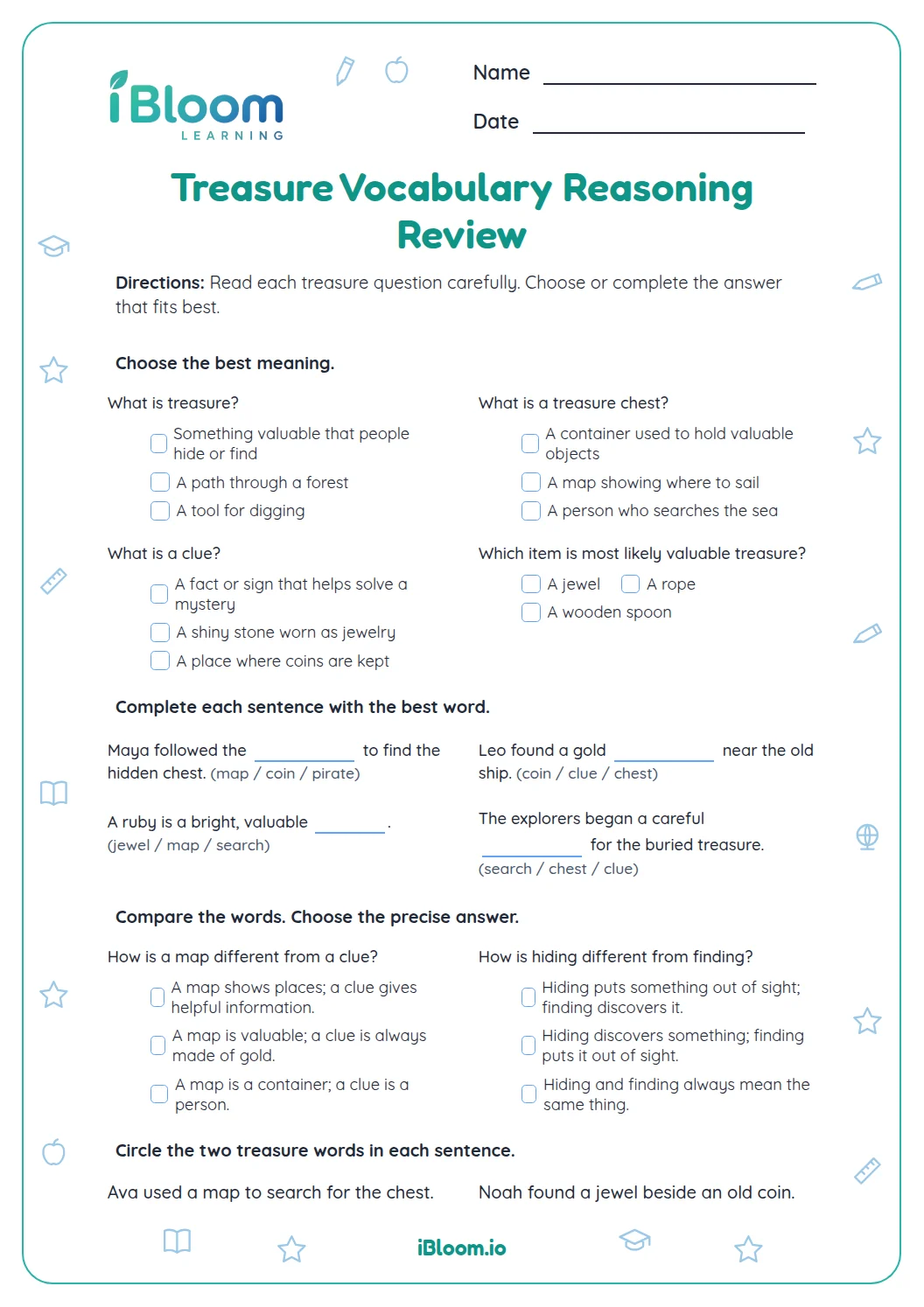
This free Grade 3 printable builds vocabulary through treasure-themed sentences and writing prompts. Children choose words that fit a sentence, use context to complete more ideas, and write their own sentences with target words. The questions practice CCSS L.3.4a by asking children to use sentence context to identify a fitting word. A separate answer key includes the intended choices and sample writing responses.
Aligned to L.3.4a
How do treasure words fit in a sentence?
Children choose among treasure words such as compass, chest, clue, and island in short sentences. They then use context to complete more ideas and apply the words in their own writing.
Read the whole sentence first. A phrase such as “find north” points to compass; rereading with the word inserted checks that it makes sense.
How can a sentence show which word belongs?
Look for what the sentence says about a person, place, or action. In question 2, “followed” and “find the hidden gold” point to map. Insert the choice and reread the sentence to check its meaning.
- 1The pirate followed a ___ to find the hidden gold.
- 2Clue: it helps someone find a place
- 3Choose map
- 4Reread: The pirate followed a map to find the hidden gold.
How can children move from choosing to using a word?
The last four prompts move from using a target word to adding a useful detail and explaining how a compass helps. The key gives sample sentences; other complete responses can work when they use the requested word clearly.
How to use this worksheet at home or in class
- 1Read the entire sentence before choosing a word.
- 2Notice clues such as “find north” or “tiny writing.”
- 3Try the word in the sentence and reread it for meaning.
- 4For the last four prompts, include the requested word and answer the whole prompt.
- 5Add a specific detail when a prompt asks you to improve a sentence.
- 6Use the key to compare the choices and discuss other clear sentences.
Common mistakes and quick fixes
The mistake
Choosing a word because it is about the sea, even when it does not fit the sentence.
The fix
Reread the sentence with the word inserted and check its meaning.
The mistake
Using a word that names an object when the sentence needs an action.
The fix
Check what kind of word completes the idea, then reread it.
The mistake
Adding a detail that does not explain what happened.
The fix
Choose a detail that tells where, when, or how the treasure was found.
Curriculum alignment
The sheet uses sentence context to practice selecting and applying Grade 3 vocabulary.
Use sentence clues to choose a word that fits a meaning in context.
On this sheet: The sentence-completion items ask children to use sentence context to select the fitting word.
Show the official wordingHide the official wording
Use sentence-level context as a clue to the meaning of a word or phrase.
What to practice next
Make more practice
Further reading
Questions parents and teachers ask
Which treasure words does this worksheet use?
The worksheet uses words such as map, jewel, island, compass, coin, chest, clue, pirate, treasure, valuable, discover, and gold. Children choose words in sentences and then apply target words in their own writing. The answer key lists the intended choices and sample responses.
How does the word choice work?
Read the whole sentence before choosing. A clue in the sentence narrows the choices: “find north” points to compass, while “locked inside a wooden ___” points to chest. Reread the completed sentence to check whether the word makes sense in that context.
What does “use the words” mean on this worksheet?
After choosing a word in context, children complete two more sentence choices and write four responses. The final prompts ask for original sentences, a useful detail, and an explanation of how a compass helps a sailor. The key gives samples for the open responses.
Can more than one answer be right for the written questions?
Yes. The ten sentence choices have one intended answer, while the final four writing prompts allow different clear responses. The answer key gives a sample for each one. Accept another complete sentence when it uses the requested word correctly and answers the prompt.
How long does this Grade 3 worksheet take?
Plan for about 20 minutes for the 14 questions. A child may finish sooner if the short choices are familiar, or need more time to write complete sentences. An adult can read the prompts aloud while the child focuses on meaning, spelling, and using each word in a complete thought.