

About this worksheet
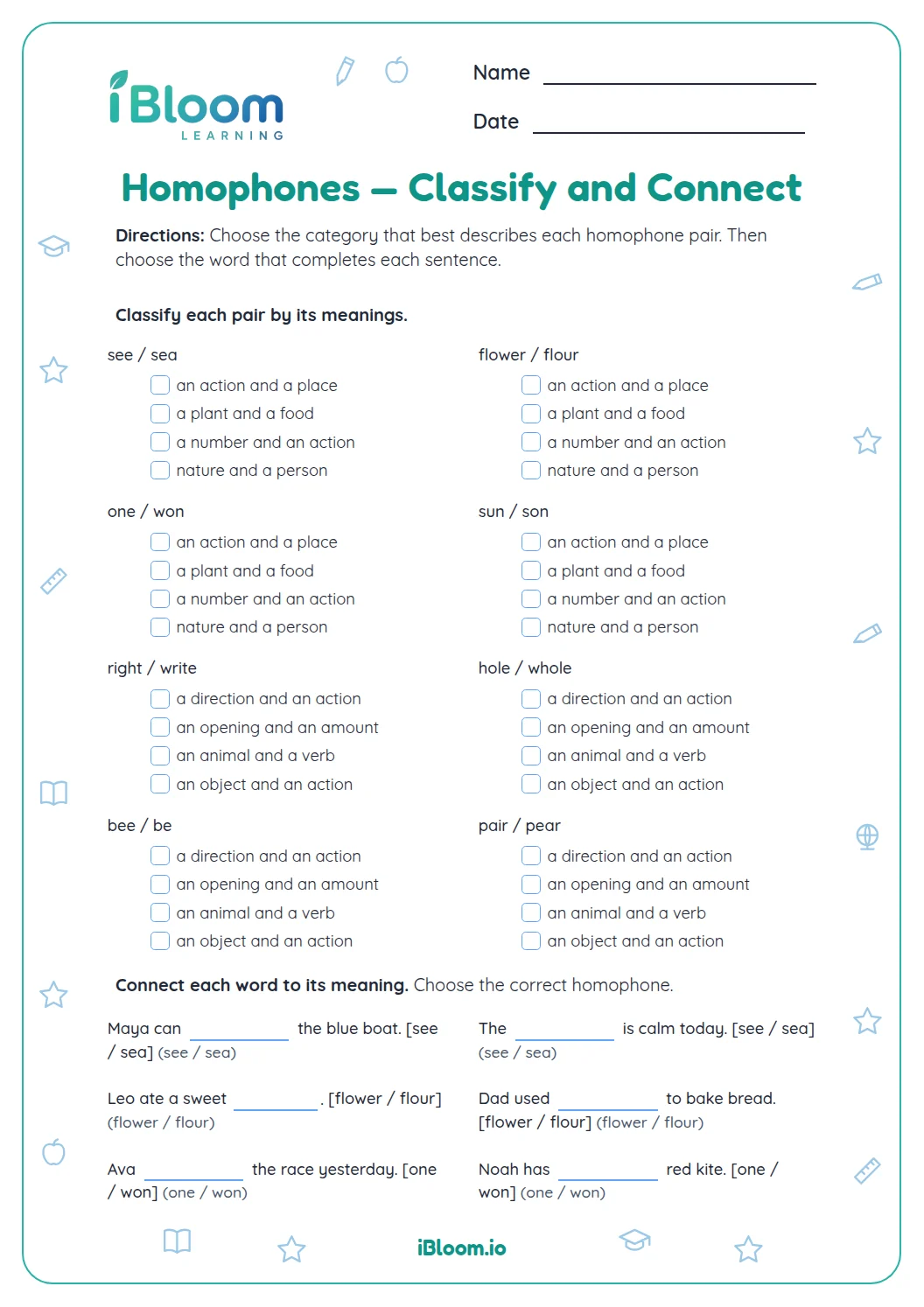
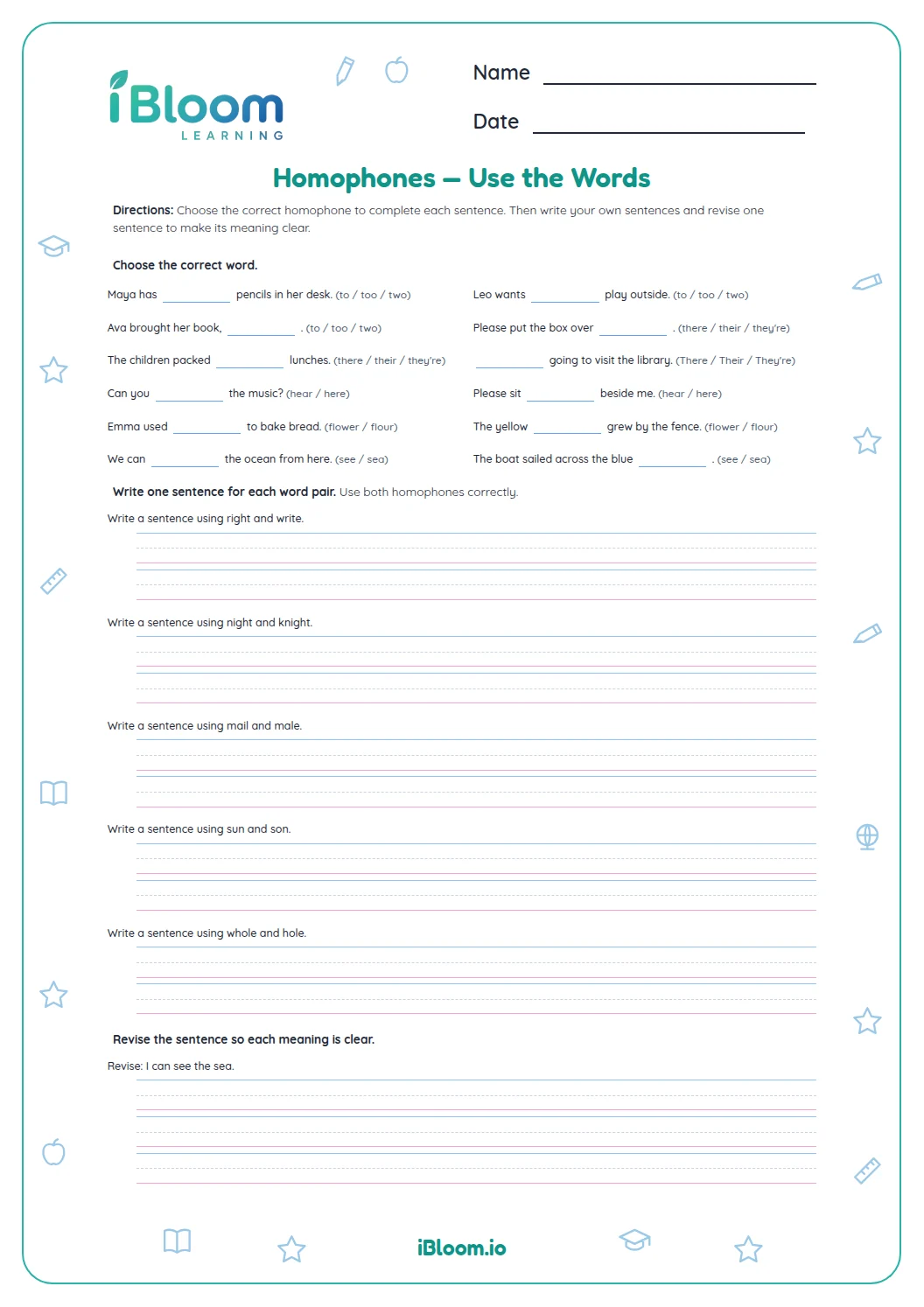
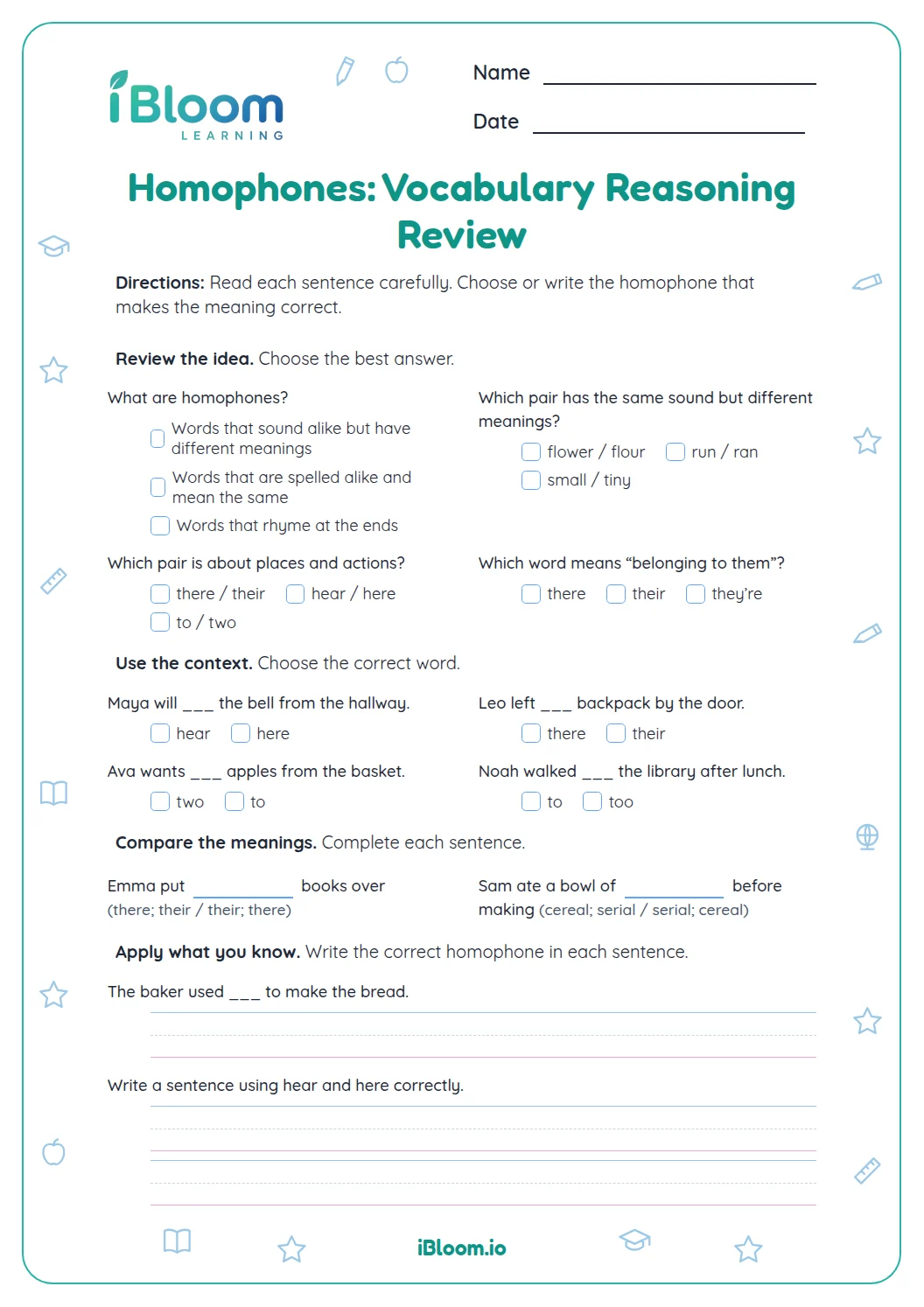
This free Grade 4 vocabulary worksheet asks students to choose homophones by meaning, then explain the clues they used. Fourteen questions include eight multiple-choice sentences, four word-pair completions, and two written explanations. Students work with everyday pairs such as flour and flower as well as principal and principle, stationary and stationery, and the there/their/they’re group. Part C returns to two earlier sentences to make the reasoning visible. The sheet practices Common Core L.4.1g and L.4.4a, using frequently confused words correctly and drawing meaning from context. The answer key includes sample explanations.
Aligned to L.4.1g and L.4.4a
Why should students read the whole sentence first?
Homophones share a pronunciation but have different spellings and meanings. Hearing flour and flower cannot settle which spelling belongs in a sentence. The surrounding words must identify the meaning.
Ask students to pause at each blank and say what kind of thing or action is needed. Leading the school staff points to a school principal, while a forecast warning of rain points to weather.
Which words make a useful context clue?
A useful clue narrows the meaning enough to select a word. In question 2, baker identifies the person preparing food, and bread names what is being made. Together these words point to the ingredient flour.
- 1The baker used ___ in bread.
- 2Choices: flour / flower
- 3Clues: baker, bread
- 4Answer: flour, the baking ingredient.
How do the written questions deepen the practice?
Questions 13 and 14 ask students to name the evidence behind a choice. The baking sentence offers several clues, so a student can explain how they work together. The bike sentence gives a direct restatement: motionless tells what stationary means.
Use these explanations when reviewing errors. A correct choice with a vague explanation can be revisited by asking which exact words made one meaning fit. The written answers can be brief as long as the meaning and clues are clear.
How to use this worksheet
- 1Read the sentence before looking closely at the spellings.
- 2Say what meaning belongs in the blank, such as an end to arguing, an ingredient, or ownership.
- 3Choose or write the spelling that matches that meaning.
- 4Reread the completed sentence to check that it makes sense.
- 5In Part C, cite actual clue words and compare the explanation with the sample key.
Mistakes to check and ways to help
The mistake
Choosing flower because both words sound right in question 2.
The fix
Use the meaning: a baker makes bread with flour, so the sentence needs the name of an ingredient.
The mistake
Choosing there for coats that belong to campers.
The fix
Ask whose coats they are. Their shows ownership; there points to a place.
The mistake
Writing stationery when the bicycle is motionless.
The fix
Use the restated meaning in the sentence: stationary means still; stationery means writing materials.
Common Core alignment
Choose the correct spelling of frequently confused words in sentences.
On this sheet: Students choose homophones that match the meaning and grammar of each sentence.
Show the official wordingHide the official wording
Correctly use frequently confused words (e.g., to, too, two; there, their).
Use sentence clues and a restated meaning to explain a word choice.
On this sheet: Part C identifies baking clues for flour and the restatement motionless for stationary.
Show the official wordingHide the official wording
Use context (e.g., definitions, examples, or restatements in text) as a clue to the meaning of a word or phrase.
What to practice next
Make more practice
Further reading
Questions parents and teachers ask
Which homophones are practiced on this sheet?
The sentence questions practice peace, flour, principal, their, allowed, herd, weather, write, tail, stationary, brake, and blew alongside their sound-alike alternatives. Two final questions revisit flour and stationary. Students therefore make twelve word choices and write two explanations about the clues behind particular choices.
Why are there three choices in the coats sentence?
There, their, and they’re form a group of three commonly confused words. Question 4 needs their because the coats belong to the campers. There refers to a place, while they’re means they are. Substituting those meanings into the sentence helps students test which spelling fits.
How can students distinguish stationary from stationery?
Students can distinguish them by meaning: stationary means not moving, while stationery refers to writing materials. Question 10 supplies the clue motionless right after stationary’s blank. Question 14 asks students to explain that connection, so they practice using an explicit restatement rather than relying only on memorized spelling.
What counts as a good explanation for question 13?
A good explanation names words that connect flour to baking, such as baker and bread. Students do not need to copy the sample sentence exactly. Ask them to explain how those clues show an ingredient being used to make food instead of simply repeating the correct spelling.
Can the sentences be read aloud?
Yes, an adult can read the sentences aloud while the student looks at the printed choices. The spelling still matters because the alternatives sound alike. After listening, the student should identify the meaning needed and point to a clue before choosing or writing the matching word.