
About this worksheet
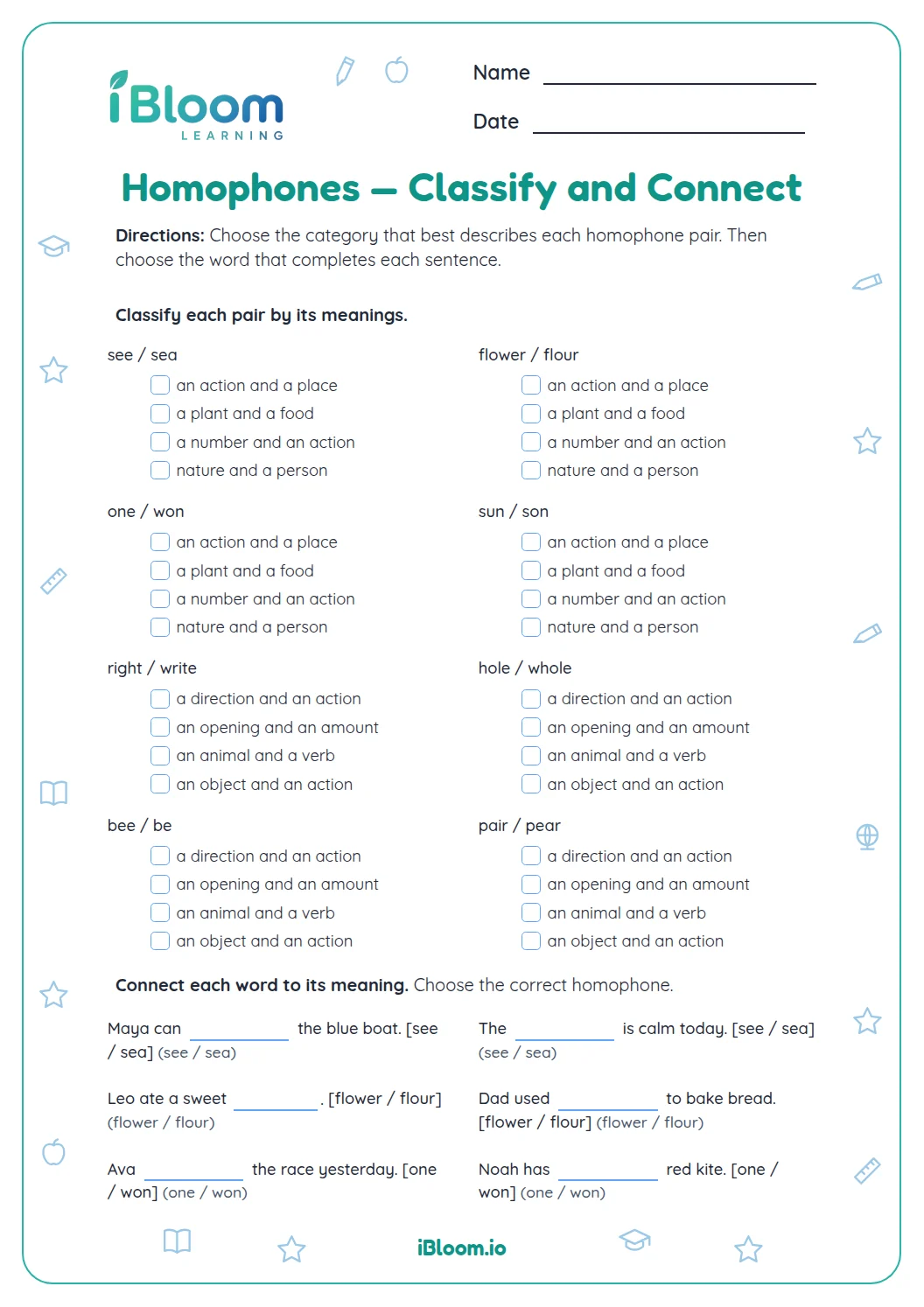
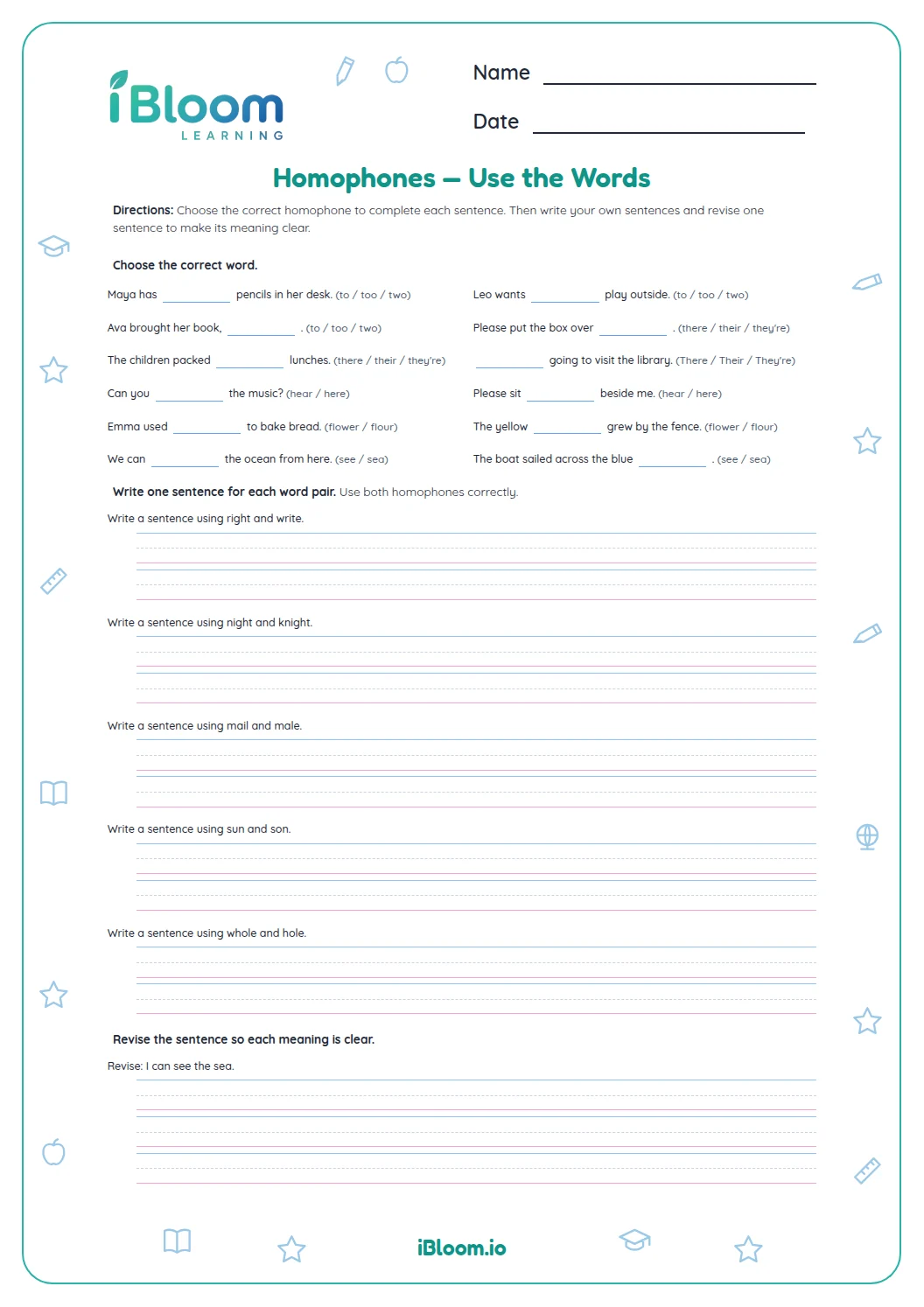
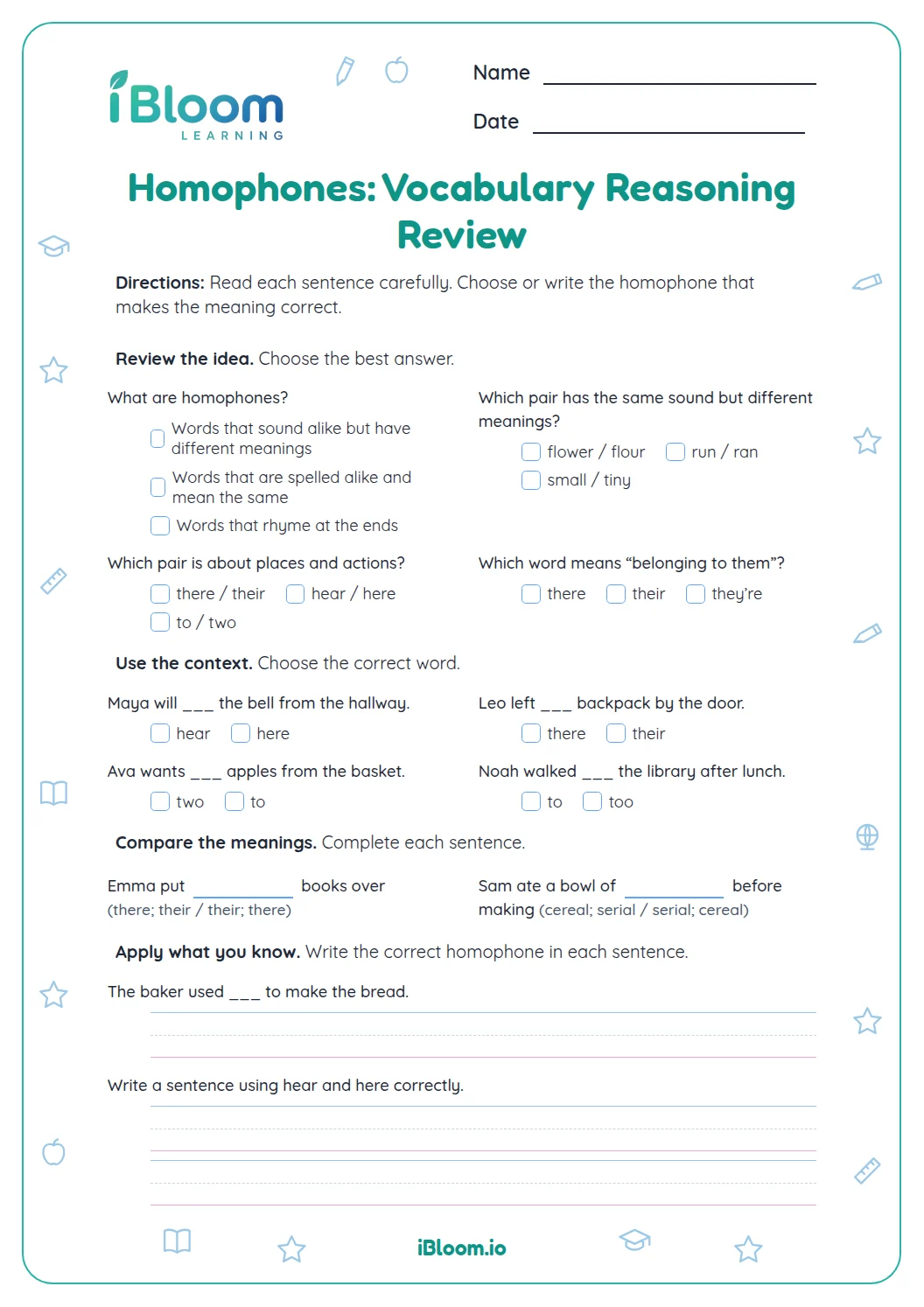
This free Grade 4 worksheet asks children to use meaning to choose between words that sound alike. Part A gives four definitions, Part B gives ten sentences with paired choices, and Part C asks for two brief explanations. The 16 questions include peace and piece, plain and plane, and principal and principle. The work supports CCSS L.4.1g, correctly using frequently confused words. Parents and teachers can check the selected words with the answer key and use its sample explanations to discuss which clues make one spelling fit.
Aligned to L.4.1g
What makes these words homophones?
Each pair has the same pronunciation but different spellings and meanings. Peace names calm or freedom from fighting; piece names a part of something. In print, those different spellings help the reader know which meaning the writer intends.
Part A separates meaning from a full sentence. For example, “a rule or belief that guides actions” points to principle. Children then meet principal in Part B as the person who leads a school.
Which sentence clues help children choose a spelling?
Look for words that tell you what kind of thing or action belongs in the blank. An airport points to plane, and working dough with your hands points to knead. Ask the child to explain the connection before writing the word.
- 1We ate a ___ of the pie.
- 2A pie can be divided into portions.
- 3Piece means a portion; peace means calm or freedom from fighting.
- 4Answer: piece.
How should the explanations be checked?
Part C asks children to explain knight and deer in their sentences. An acceptable explanation connects knight to a person in armor and deer to an animal. The strongest answers also explain why night or dear would change the meaning.
The key offers sample answers. Children can use different wording if they identify the intended meaning accurately. For a short response such as “It is an animal,” ask the child to say which spelling names the animal before checking it off.
Read for meaning before spelling
- 1Read one definition in Part A and have the child explain both choices aloud.
- 2Let the child finish the remaining definitions independently.
- 3For each Part B sentence, identify the words that make the meaning clear.
- 4Write the selected word carefully, then reread the completed sentence.
- 5In Part C, explain the capitalized word and compare it with its partner.
- 6Use the key to check both the spelling and the reasoning.
Mistakes to check together
The mistake
Choosing peace for a portion of pie because the two words sound alike.
The fix
Replace the blank with “portion”; that meaning belongs to piece.
The mistake
Using principle for the leader of a school.
The fix
Connect principal to the person who welcomed students; principle is a rule or belief.
The mistake
Explaining knight only by saying that it sounds right.
The fix
Use the clue armor to identify a person, then contrast night with the dark part of a day.
Common Core alignment
Choose frequently confused words by matching their meanings to definitions and sentences.
On this sheet: Children select homophones in context and explain why a particular spelling expresses the intended meaning.
Show the official wordingHide the official wording
Correctly use frequently confused words (e.g., to, too, two; there, their ).*
What to practice next
Make more practice
Further reading
Questions parents and teachers ask
Which homophone pairs appear on this worksheet?
The 13 pairs are peace/piece, plain/plane, principal/principle, alter/altar, flower/flour, seam/seem, knead/need, write/right, tail/tale, won/one, hole/whole, knight/night and deer/dear. Three pairs return after Part A. Children connect definitions with sentence meanings, then explain why knight and deer fit their contexts in the final two questions.
Why does principal appear after principle?
The two words are deliberately used for different meanings. Part A defines principle as a rule or belief that guides actions. Part B places principal in a school sentence, where it names the school leader. Comparing those two questions helps children attach a meaning to each spelling.
Do children need to write both homophones?
No. In Part A, children choose one word for each definition. In Part B, they write only the word that completes the sentence. Part C asks for brief explanations of knight and deer, where mentioning the other spelling can make the difference in meaning clearer.
What counts as a correct explanation in Part C?
A correct explanation connects the capitalized word with its meaning in that sentence. For knight, it should identify the person in armor; for deer, it should identify the animal. Children may use their own words. The key’s sample answers also explain the meanings of night and dear.
How can I help when both choices sound right?
Ask what the sentence means before reading the choices again. In the dough sentence, the missing word means working dough with the hands, so knead fits. Have the child explain that action, choose the spelling and reread the sentence. Sound alone cannot distinguish the pair.