




About this worksheet
This Grade 4 worksheet gives children 14 questions about renewable resources. They find eight terms in a word search, use context clues to identify vocabulary, classify energy sources, and connect sources with uses. The context-clue practice aligns with CCSS L.4.4.a.
Aligned to L.4.4.a
How do context clues help with resource words?
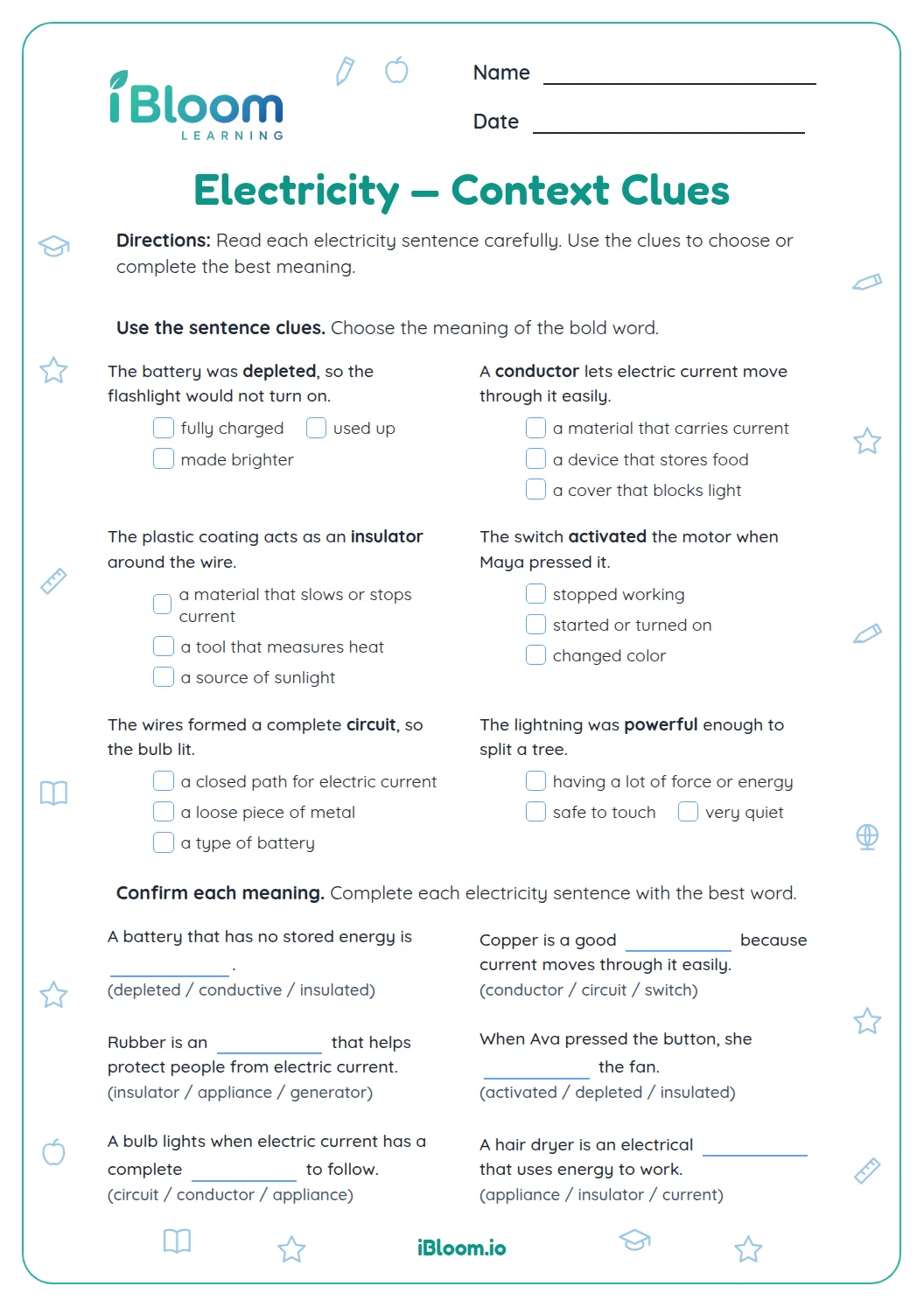
Read the clue around the blank and look for a definition or example. In question 2, a resource “nature can replace over time” is renewable. The clue describes the word rather than repeating it.
- 1A source that nature can replace over time is ___.
- 2The clue is “nature can replace over time.”
- 3That meaning matches renewable.
How are the resources classified?
Solar, wind, and water name energy sources; biomass is plant material that can be used as fuel. Renewable describes a resource nature can replace over time. A turbine is a device that can use moving air or water.
What is in the word search?
The word search contains eight terms: solar, wind, water, sunlight, energy, renewable, turbine, and biomass. Children find the terms, then use vocabulary clues and resource connections.
- Part A finds eight vocabulary words in the grid.
- Part B uses context clues to complete sentences.
- Part C classifies sources and connects them with uses.
How to use this worksheet
- 1Scan the word list and locate one word at a time.
- 2Mark each word in the grid, then cross it off the list.
- 3Read context-clue sentences all the way through.
- 4Sort source words from device words and descriptions.
- 5Use the answer key to check the grid and written response.
Common mistakes and quick fixes
The mistake
Calling a turbine a renewable resource.
The fix
A turbine is a device; wind or water is the source it can use.
The mistake
Thinking renewable means unlimited at every moment.
The fix
The word means nature can replace a source over time.
The mistake
Mixing up biomass and sunlight.
The fix
Biomass is plant material; sunlight comes from the Sun.
Curriculum alignment
This worksheet practices the skills described in the standards below.
Use context clues to clarify topic vocabulary.
On this sheet: Children use definitions and examples to identify renewable-resource terms.
Show the official wordingHide the official wording
Use context (e.g., definitions, examples, or restatements in text) as a clue to the meaning of a word or phrase.
What to practice next
Further reading
Questions parents and teachers ask
What words does the worksheet practice?
Children use the words renewable, energy, turbine, solar, water, wind, and biomass in short clues and choices. The questions distinguish energy sources from a device and from plant material used as fuel.
What does renewable mean here?
Renewable describes a resource that nature can replace over time. Question 1 gives that meaning as a clue, and children use it to complete the sentence with the word “renewable.”
Is a turbine a renewable resource?
A turbine is a device, not a resource. It can use moving air or water to help produce usable energy, so the worksheet asks children to distinguish a device from a source.
How does the worksheet classify resources?
Children identify solar, wind, and water as energy sources and biomass as plant material used for fuel. They also connect moving air with a turbine and sunlight with electricity from a panel.
Is an answer key included?
Yes. The separate key lists answers for the context clues, classification choices, and written connection. The worksheet has two practice pages, so children can complete the questions first and then use the key to review.