



About this worksheet
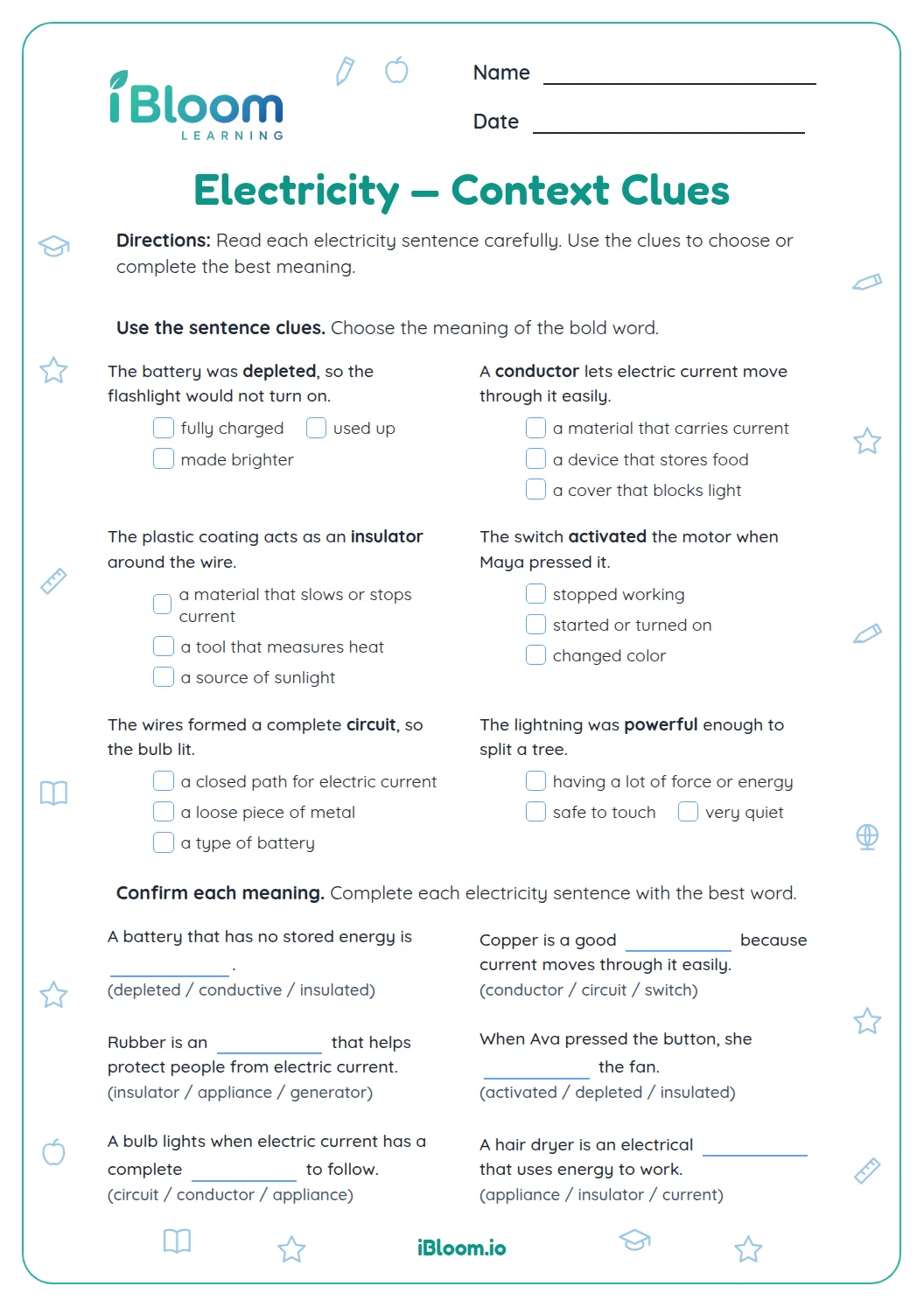
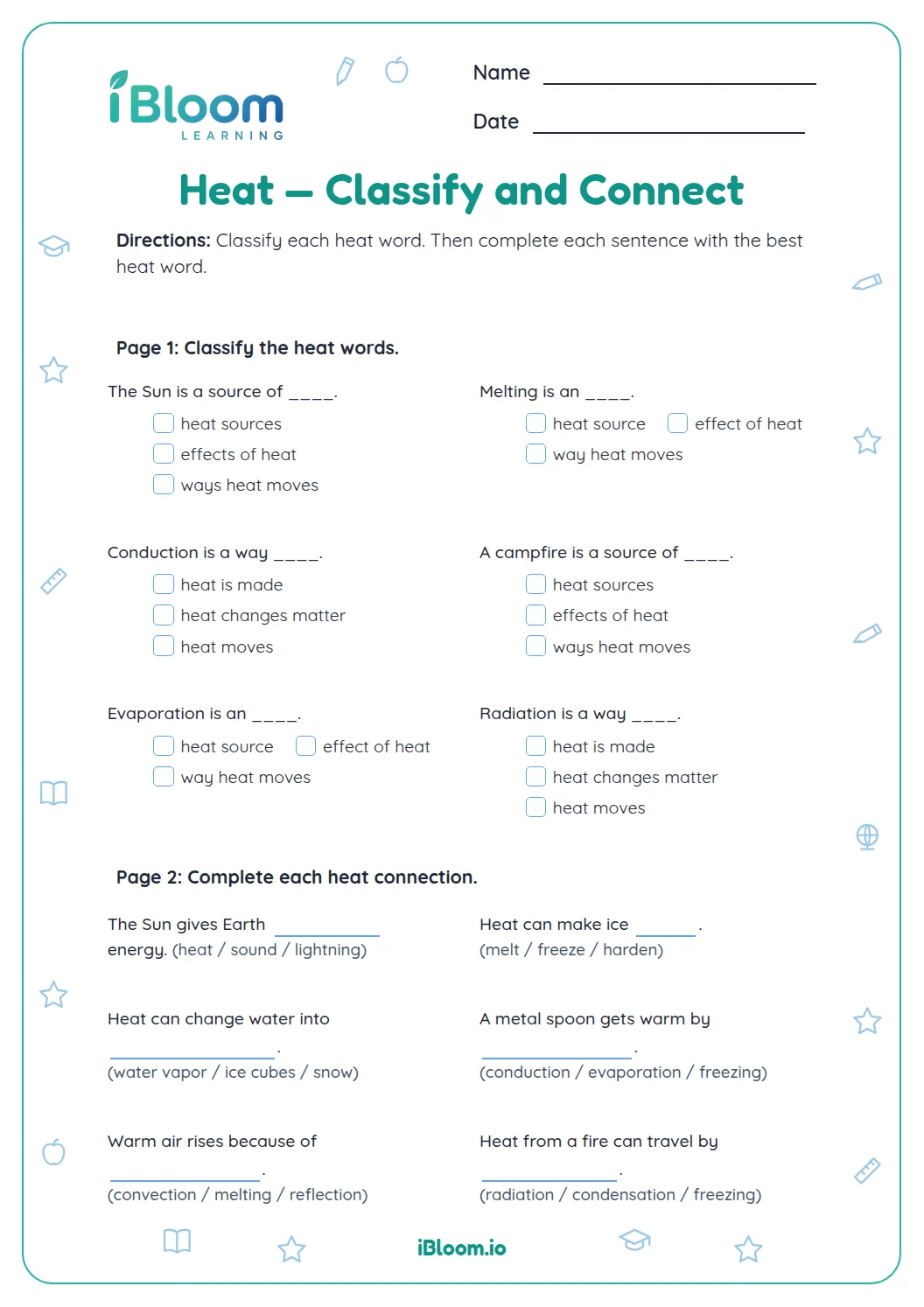
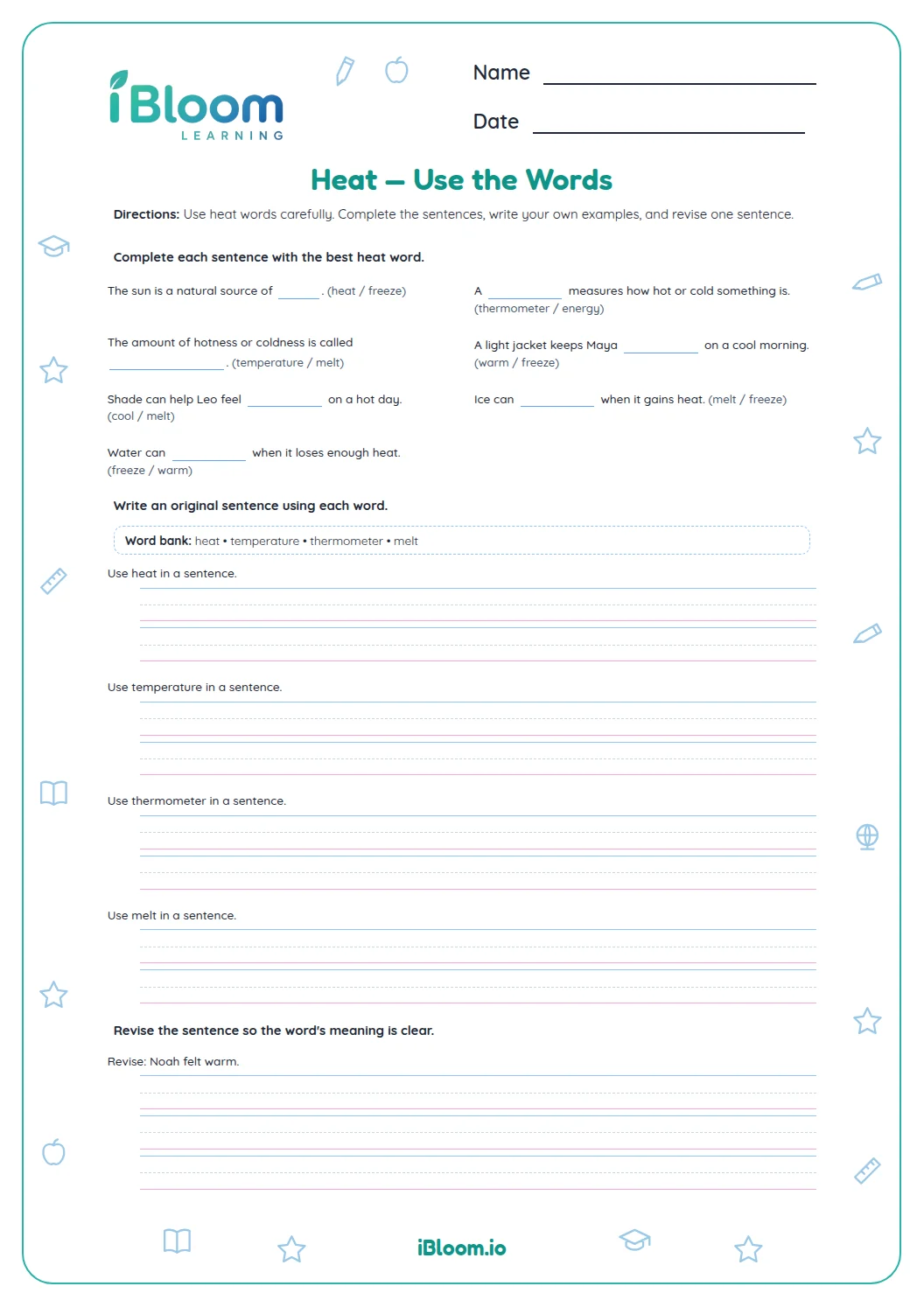
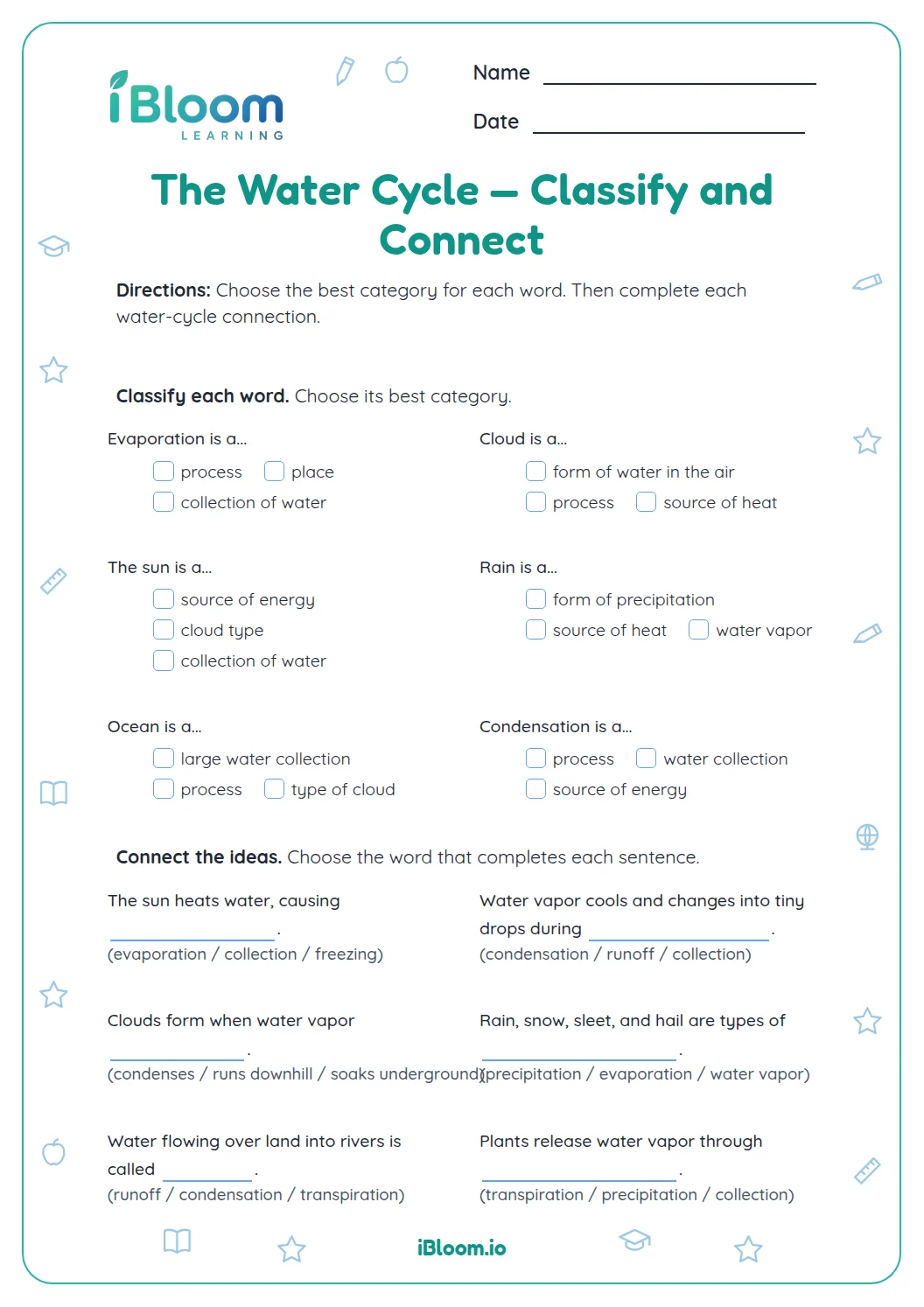
This free Grade 4 vocabulary worksheet gives students 14 short-answer prompts about renewable resources and energy. Each sentence supplies a clue, such as sunlight for solar, moving air for turbine, or nature replacing a resource for renewable. Students explain target words across three parts and can compare responses with the separate answer key. The activity practices CCSS.ELA-Literacy.L.4.4.a: using context to determine word meaning.
Aligned to CCSS.ELA-Literacy.L.4.4.a
What clue explains the word?
A clue may name what something does or give an example. In question 1, sunlight points to the meaning of solar.
- 1“Solar panels collect energy from sunlight.”
- 2Sunlight shows that solar means related to the sun.
How does the sentence define an energy term?
Look for what a device does, what a resource provides, or how people use it. The sentence about a turbine connects moving air with making electricity.
Which meaning fits the resource clue?
Use the detail in the sentence to make a short definition. For renewable, the clue is that nature can replace the resource over time.
How to use this worksheet
- 1Read the entire sentence before defining its target word.
- 2Underline the nearby clue, such as an example, result, or restatement.
- 3Write a concise meaning that fits the sentence.
- 4For a word such as renewable, connect the clue to what nature can replace.
- 5Use the key to compare meanings; accept equivalent wording supported by the clue.
Common mistakes and quick fixes
The mistake
Guessing from the topic instead of the sentence.
The fix
Point to a clue in the sentence before writing the definition.
The mistake
Defining renewable as “it lasts forever.”
The fix
Use the clue that nature can replace the resource over time.
The mistake
Repeating the target word instead of explaining it.
The fix
Write a short meaning, such as “where something comes from” for source.
Students use definitions, examples, and results in sentences to infer word meanings.
Use sentence clues to infer meanings of renewable-resource and energy words.
On this sheet:
Show the official wordingHide the official wording
Use context (e.g., definitions, examples, or restatements in text) as a clue to the meaning of a word or phrase.
What to practice next
Make more practice
Further reading
Questions parents and teachers ask
How do students use context clues on this sheet?
Each item places a renewable-resource word in a sentence with a definition, example, or result nearby. Students read the whole sentence, infer the target meaning, and write a short response. The 14 prompts cover words such as solar, turbine, conserve, efficient, and biomass.
Does the student need to know renewable energy first?
A little topic familiarity can help, but each question includes a clue in its sentence. For example, sunlight helps explain solar, and a battery that keeps energy for later helps explain stores. Encourage the student to use the words on the page before guessing from prior knowledge.
What does the answer key accept?
The key gives a concise meaning for each target word. Accept different wording when it keeps the same idea, such as “save” for conserve or “keep for later” for store. Ask the student to point to the clue that supports the response.
Which vocabulary words receive practice?
The questions include solar, turbine, renewable, generate, installed, reservoir, conserve, steady, efficient, store, biomass, region, and resource. A student may meet one word more than once, so compare the meanings and notice how each sentence gives its own clue.
How long should the practice take?
The two worksheet pages contain 14 short-answer questions, followed by a two-page answer key. About 15 to 20 minutes is a reasonable work period, with extra time if the student discusses which words in each sentence helped reveal the meaning.