



About this worksheet
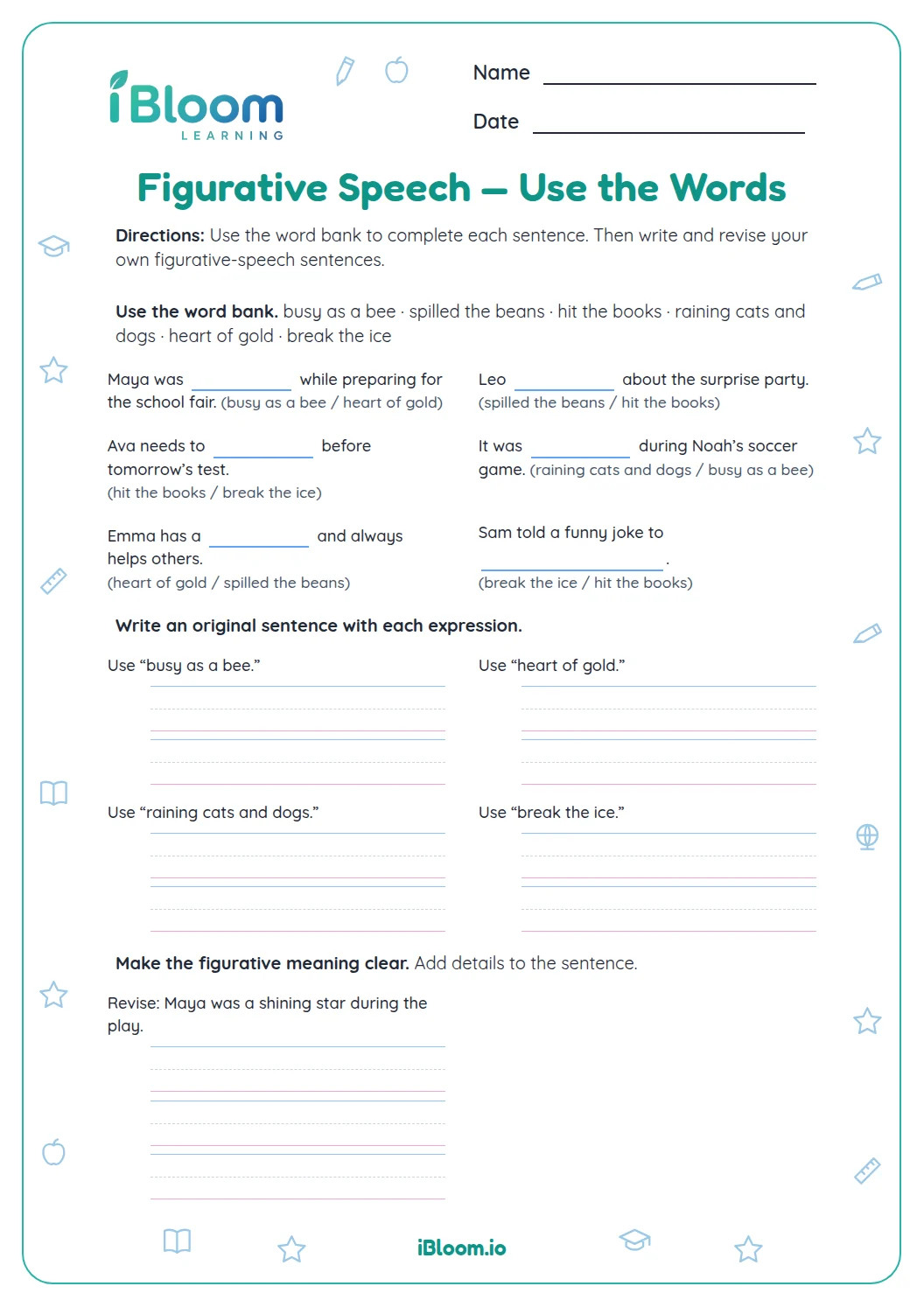
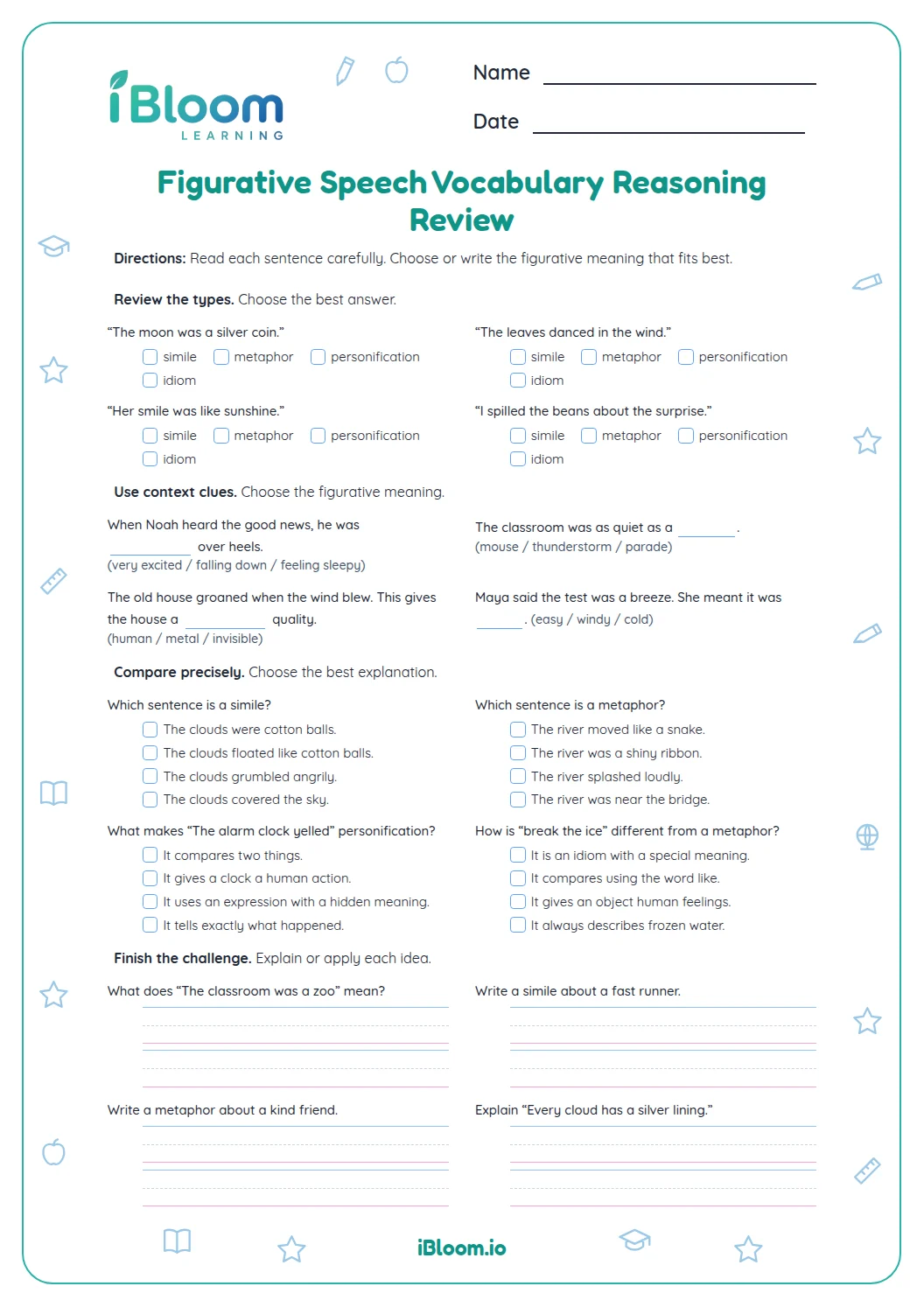
This Grade 5 worksheet asks learners to use context to interpret figurative expressions. Across 14 questions, students read comparisons and personification, identify literal or figurative language, and explain meanings. A separate answer key supports review. The practice aligns with CCSS L.5.5, which includes interpreting figurative language and word nuances.
Aligned to L.5.5
How do context clues reveal a figurative meaning?
A figurative phrase compares, exaggerates or gives a human action to something that is not human. Nearby details help readers work out what the writer means.
- 1“Mina’s backpack felt as heavy as a boulder after the hike.”
- 2The hike is a clue: the backpack felt very heavy, not made of stone.
What kinds of expressions will learners interpret?
The 14 questions move from choosing a meaning to distinguishing literal from figurative language and applying context to a new expression. They include a simile, personification, exaggeration and familiar figurative phrases.
How can an adult help with a tricky phrase?
Ask the learner which words nearby help them picture the situation. Then have them explain the phrase in ordinary words and compare that explanation with the answer key.
How to use this worksheet
- 1Read each complete sentence before choosing a meaning.
- 2Underline a detail that gives a clue.
- 3Ask whether the expression could be literally true.
- 4Put the figurative phrase into ordinary words.
- 5Check answers with the separate key.
Common mistakes and quick fixes
The mistake
Taking “waited forever” as an exact amount of time.
The fix
Ask whether the wait could literally last forever; here it is an exaggeration.
The mistake
Treating a comparison as a real object.
The fix
Use the context to name the shared quality, such as heaviness.
The mistake
Ignoring the surrounding sentence.
The fix
Reread the whole sentence and connect the phrase to the situation.
Curriculum alignment
Interpret figurative language, including similes and metaphors.
On this sheet: Interpret figurative language, including similes and metaphors.
Show the official wordingHide the official wording
Demonstrate understanding of figurative language, word relationships, and nuances in word meanings.
What to practice next
Further reading
Questions parents and teachers ask
How many questions and pages are included?
There are 14 questions in five parts. Learners interpret comparisons and figurative phrases, use nearby clues, distinguish literal from figurative language, and apply context to a new expression. A separate answer key is included for checking each response.
What does “we waited forever” mean?
It means the wait felt very long, not that it lasted forever. The worksheet asks learners to decide whether the phrase is literal or figurative and use the sentence to explain the intended meaning. The key confirms the answer after the learner tries.
What is personification?
Personification gives a human action or quality to something that is not human. In the sentence about the moon watching over camp, the moon seems to guard a quiet, protected scene. Learners use the surrounding words to infer that meaning.
How can I help a child solve an unfamiliar expression?
Have the child reread the sentence and name a detail that hints at the meaning. Then ask them to replace the figurative phrase with ordinary words. The answer key can confirm the intended interpretation after they explain their thinking.
Is an answer key included?
Yes. The separate answer key gives selected meanings and a sample response for the open response item. Use it after the learner tries each question, then revisit any phrase whose meaning was unclear or whose clue was overlooked.