


About this worksheet
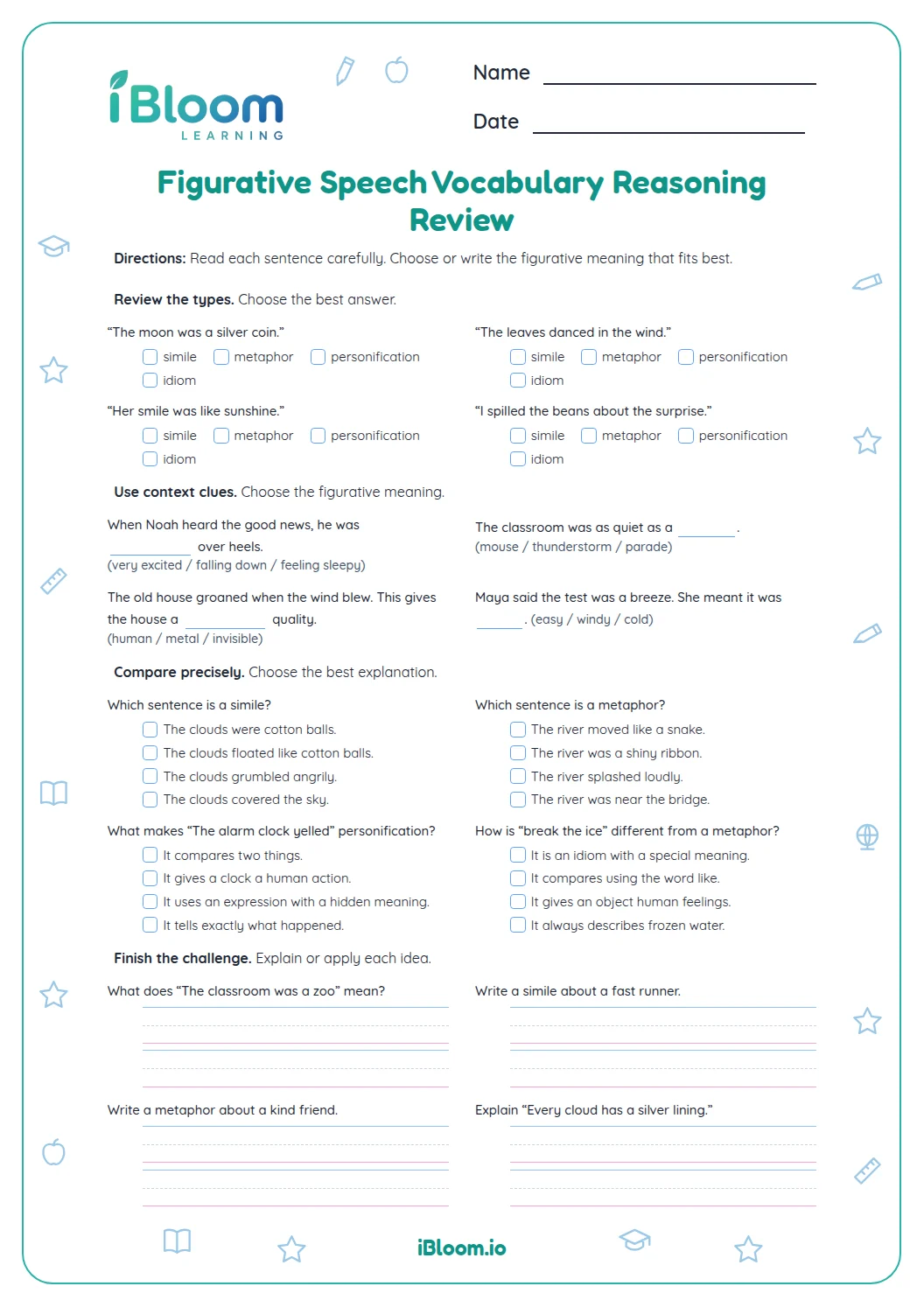
This free printable Grade 5 worksheet asks students to classify figurative language and connect it to meaning. The first six questions classify similes, metaphors, personification and idioms. The remaining eight use focused choices to interpret comparisons and familiar expressions, with one more classification item about personification. These questions practice Common Core L.5.5a and L.5.5b through comparisons, human actions given to things, and idioms in context. The separate answer key marks all fourteen choices. Read the sentences aloud when discussing which words support an answer.
Aligned to L.5.5a and L.5.5b
How do the four kinds of figurative language work?
A simile compares unlike things using like or as, as in “The pond was as smooth as glass.” A metaphor compares them directly, as in “The hallway was a river of students.” Personification gives a thing a human action or quality: the wind whispers and a hungry fire gobbles logs.
An idiom is a familiar expression with a meaning that cannot be worked out just by taking each word literally. In question 4, “let the cat out of the bag” means revealed a secret. The words after the colon make that meaning clear.
How does the sentence help you find the meaning?
Read beyond the expression for clues. A first meeting gives a reason to break the ice by starting a friendly conversation. An upcoming speech helps explain why someone might have butterflies in her stomach. Question 14 calls a room a zoo to suggest that it is very noisy.
- 1Her smile was sunshine on a gloomy day.
- 2Sunshine brightens a gloomy day.
- 3The comparison suggests that her smile brought cheer.
How can students check their choices?
Replace the figurative expression with the chosen meaning and reread. In question 8, clear instructions are easy to understand. Instructions made of glass would not fit the situation.
A figurative sentence can sometimes fit more than one broad description. These questions provide a focused choice set for each sentence, so students can point to the words that support the selected label or meaning.
How to use this worksheet
- 1Explain simile, metaphor, personification and idiom using the examples on this page.
- 2Model question 1 by finding the comparison as smooth as glass.
- 3Read each Part A sentence before choosing between its two labels.
- 4In Part B, say the likely meaning before reading the three choices.
- 5Check the key and ask for words in the sentence that support each revised answer.
Mistakes to notice and fix
The mistake
Treating every sentence containing like as a simile.
The fix
Check that like compares unlike things. “I like apples” expresses a preference.
The mistake
Reading an idiom word by word, so butterflies must be insects.
The fix
Use the situation: Emma is about to give a speech, so the expression describes nervous feelings.
The mistake
Missing personification because the subject is not a person.
The fix
Look at the action: whispering, feeling hungry and gobbling give things human qualities.
Common Core alignment
Interpret similes, metaphors and personification in short sentences.
On this sheet: Students classify comparisons and personification, then connect figurative images to meanings.
Show the official wordingHide the official wording
Interpret figurative language, including similes and metaphors, in context.
Use context to interpret familiar idioms about secrets, conversation and nervous feelings.
On this sheet: Students identify an idiom and interpret break the ice and butterflies in her stomach.
Show the official wordingHide the official wording
Recognize and explain the meaning of common idioms, adages, and proverbs.
What to practice next
Make more practice
Further reading
Questions parents and teachers ask
What kinds of figurative speech are on this sheet?
The sheet includes similes, metaphors, personification and idioms. Questions 1–6 classify the expressions, question 13 adds another personification example, and the other seven questions connect expressions to their meanings. Examples include a smooth pond, a river of students and a room called a zoo.
Does every use of like make a simile?
No, like must introduce a comparison between unlike things to make a simile. “I like apples” expresses a preference. On this worksheet, a brain compared with a sponge suggests soaking up new facts, so the comparison helps the reader picture learning.
How do the idiom questions use context?
Each idiom appears in a situation that helps explain it. Leo tells a secret, a joke starts conversation at a first meeting, and Emma is about to give a speech. Students connect these clues to revealing information, easing conversation or feeling nervous.
Can an adult read the sentences aloud?
Yes, an adult can read the sentences and choices aloud while the student decides. Pause after each expression and ask what it suggests. Keep the printed choices visible so the student can connect the discussion with the words and select an answer independently.
What does the answer key show?
The separate key marks the correct choice for each of the fourteen questions. Seven questions ask students to select a figurative-language label. Seven connect an expression with its meaning. Ask students to explain which words in each sentence support their selection.