




About this worksheet
This free Grade 5 worksheet uses art and artist details to practice context clues. Students infer words such as sketch, recurring, cramped, and intimate from their sentences, then solve one clue about what a picture shows. A final word search reviews five artist names. The separate answer key lists the responses.
How can an art detail reveal a word’s meaning?
Read the complete sentence and connect its details to the missing word. Supplies filling every corner and leaving little room help explain why a studio felt cramped.
Part A has 13 art-themed clues about paintings, artists, and art spaces.
- 1Supplies filled every corner, leaving little room. The studio felt ___.
- 2The clue means there is not much space to move.
- 3Answer: cramped
What does the artist word search review?
Part B asks students to find Leonardo, Picasso, Van Gogh, Kahlo, and Monet in the letter grid. The search is a short review after the context-clue practice.
How can students check a context-clue answer?
Try the meaning in the sentence and see whether it explains all the details. For example, “repeated” fits a subject Monet painted again and again.
How to use this worksheet
- 1Read the complete art-themed sentence.
- 2Notice the details around the missing word.
- 3Use those details to supply a fitting art word.
- 4Read the sentence again with the word inserted.
- 5Find all five artist names in the final grid.
Common mistakes and quick fixes
The mistake
Choosing a meaning from the target word alone.
The fix
Reread the whole sentence and point to the detail that supports the choice.
The mistake
Picking a word that fits art generally but not this sentence.
The fix
Test the choice against every clue in the sentence.
The mistake
Skipping words that describe how an artwork looks or was made.
The fix
Underline those details; they often explain a word such as vivid, recurring, or cramped.
What to practice next
Make more practice
Further reading
Questions parents and teachers ask
How does this worksheet practice context clues?
The 13 art-themed fill-ins give details that point to a missing word’s meaning. For example, supplies filling every corner and leaving little room suggest that a studio felt cramped. Students can underline the clue before writing an answer, then check their responses with the separate key.
What art words appear on the worksheet?
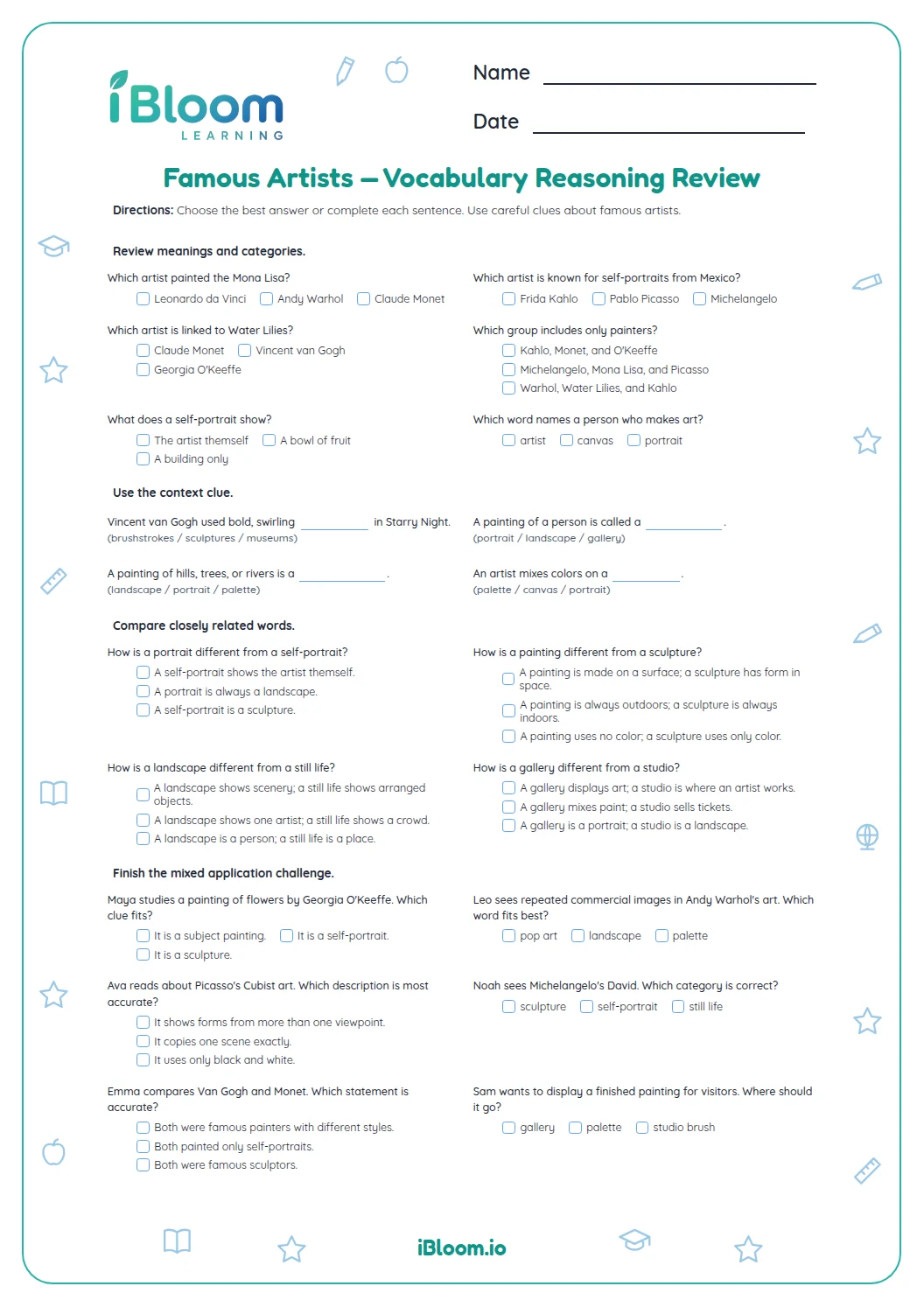
The clues include portrait, vivid, shapes, sketch, recurring, mural, cramped, sculpture, series, intimate, and ordinary. Each word appears in a sentence with a detail that helps explain its meaning. Students can use the key to check all 13 answers; the final word search reviews five artist names.
Does a child need to know the artists already?
The artist names appear in the final word search, while the context clues focus on art vocabulary. The sentences explain the word meanings through details about paintings, studios, and artists’ work. Students can use those details even if some artist names are new to them.
How many questions and pages are included?
There are 14 numbered items: 13 art vocabulary fill-ins and one word-search activity. The worksheet prints on two pages, followed by a separate answer key. Plan about 20 minutes, including time to discuss which sentence detail supports each vocabulary answer.
Which artist names are in the word search?
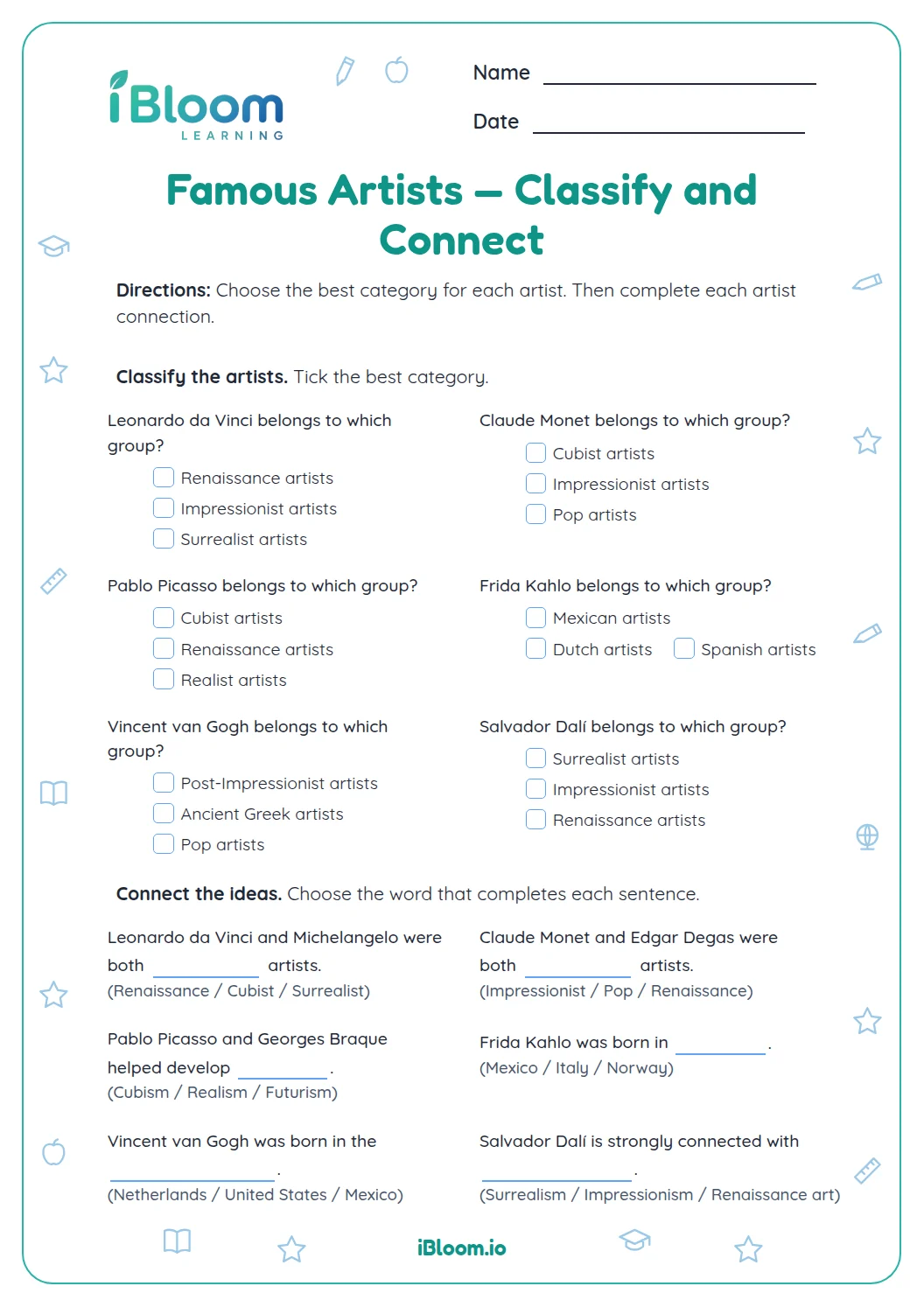
The grid contains Leonardo, Picasso, Van Gogh, Kahlo, and Monet. Each name appears across a row. The key lists the five names so students can check the grid after completing the context-clue questions. They can also connect each artist to a famous work they recognize.
How can I help if a clue feels difficult?
Ask the student to reread the sentence and point to the words that describe the artwork or situation. Then use those details to complete the blank. The answer key confirms the word and helps you discuss why it fits the sentence.