



About this worksheet
This Grade 5 printable combines two word searches with sentence and definition practice for parts of speech. Students find nine word-type names, identify how words function in context, and write one sentence using a noun, verb, and adverb. It practices Common Core L.5.1a and L.5.1. A separate answer key includes the word lists and sample sentence.
Aligned to L.5.1a and L.5.1
Which word types appear in the searches?
The grids include names such as noun, verb, adjective, adverb, and pronoun, followed by preposition, conjunction, interjection, and article. Finding the labels gives students a quick review before they classify words in context.
How does sentence context identify a word’s job?
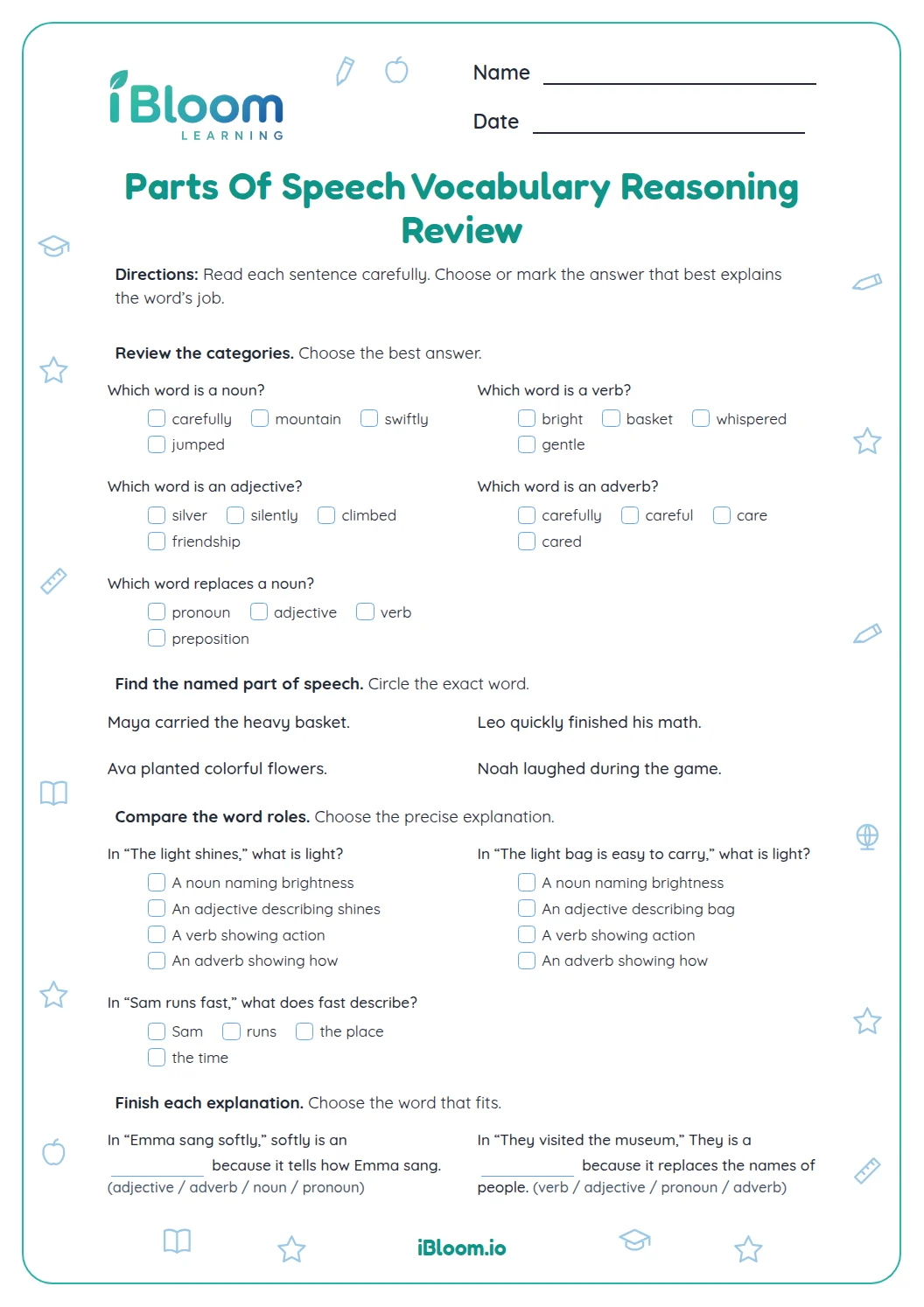
A word’s role depends on how it is used. In “The puppy barked loudly,” loudly tells how the verb barked happened, so it is an adverb. Read the whole sentence before deciding.
- 1The puppy barked loudly. Which word is an adverb?
- 2loudly tells how the puppy barked.
- 3Answer: loudly
How can students use word types in writing?
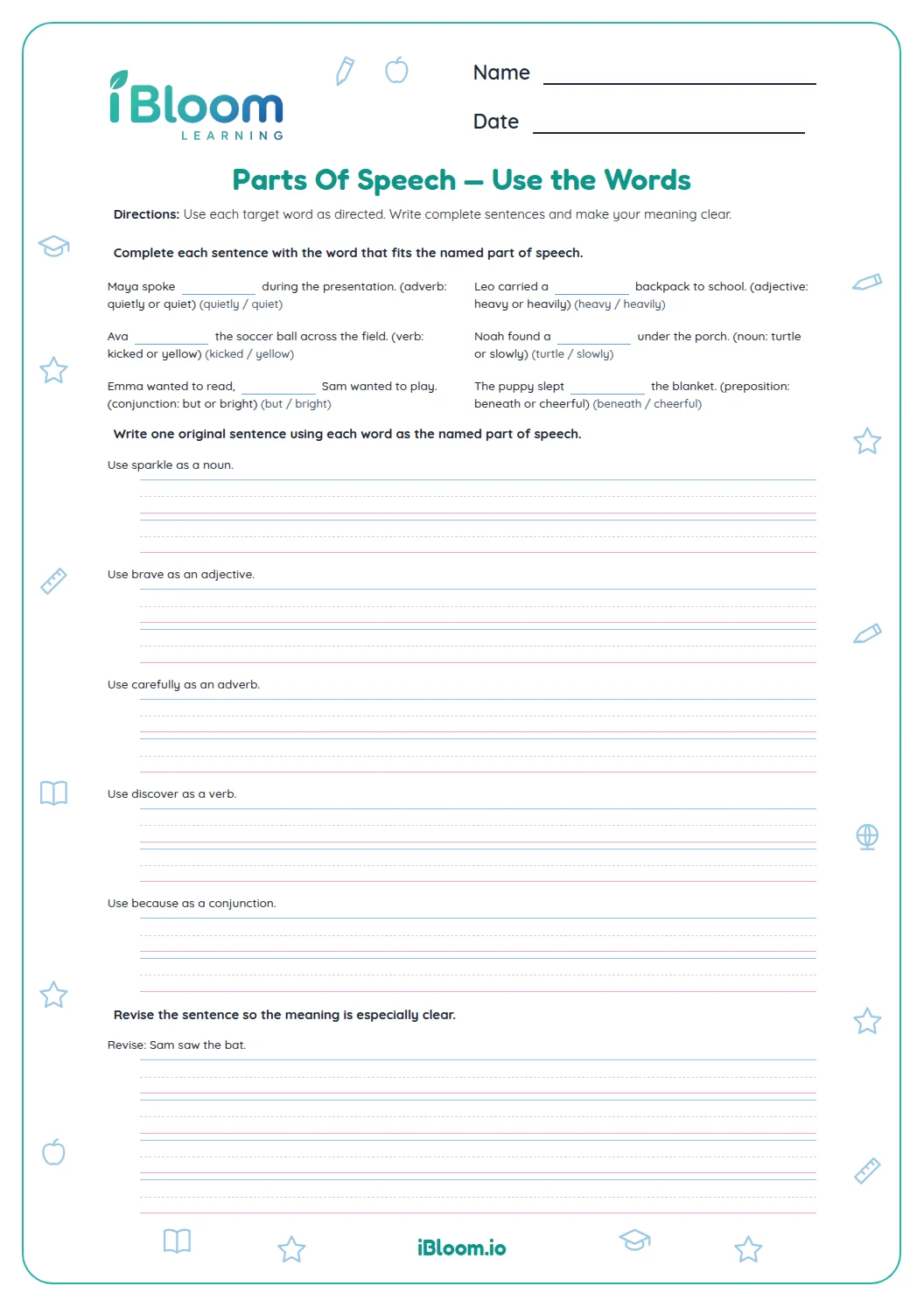
The last prompt asks students to combine a noun, verb, and adverb in one sentence. This checks whether students can use the labels as writing tools, not only spot them in a sentence.
How to use this worksheet
- 1Complete each word search and check off its word list.
- 2Read each sentence all the way through.
- 3Find the word named by the question.
- 4Ask what job the word performs in that sentence.
- 5For the final prompt, write a full sentence and check for all three requested word types.
Common mistakes and fixes
The mistake
Choosing a word type from its spelling alone.
The fix
Use the surrounding words and the role the word plays.
The mistake
Calling a describing word an adjective when it describes an action.
The fix
Ask whether it describes a noun or tells how an action happens.
The mistake
Naming a part of speech without quoting the word.
The fix
Write the actual word from the sentence as the answer.
Common Core alignment
Recognize and use the major parts of speech in sentences.
On this sheet: Questions identify conjunctions, prepositions, and interjections in sentences.
Show the official wordingHide the official wording
Explain the function of conjunctions, prepositions, and interjections in general and their function in particular sentences.
Use and identify conventional English grammar in written sentences.
On this sheet: Students classify nouns, verbs, adjectives, adverbs, and pronouns and write a sentence using them.
Show the official wordingHide the official wording
Demonstrate command of the conventions of standard English grammar and usage when writing or speaking.
What to practice next
Make more practice
Further reading
Questions parents and teachers ask
Which parts of speech appear on the worksheet?
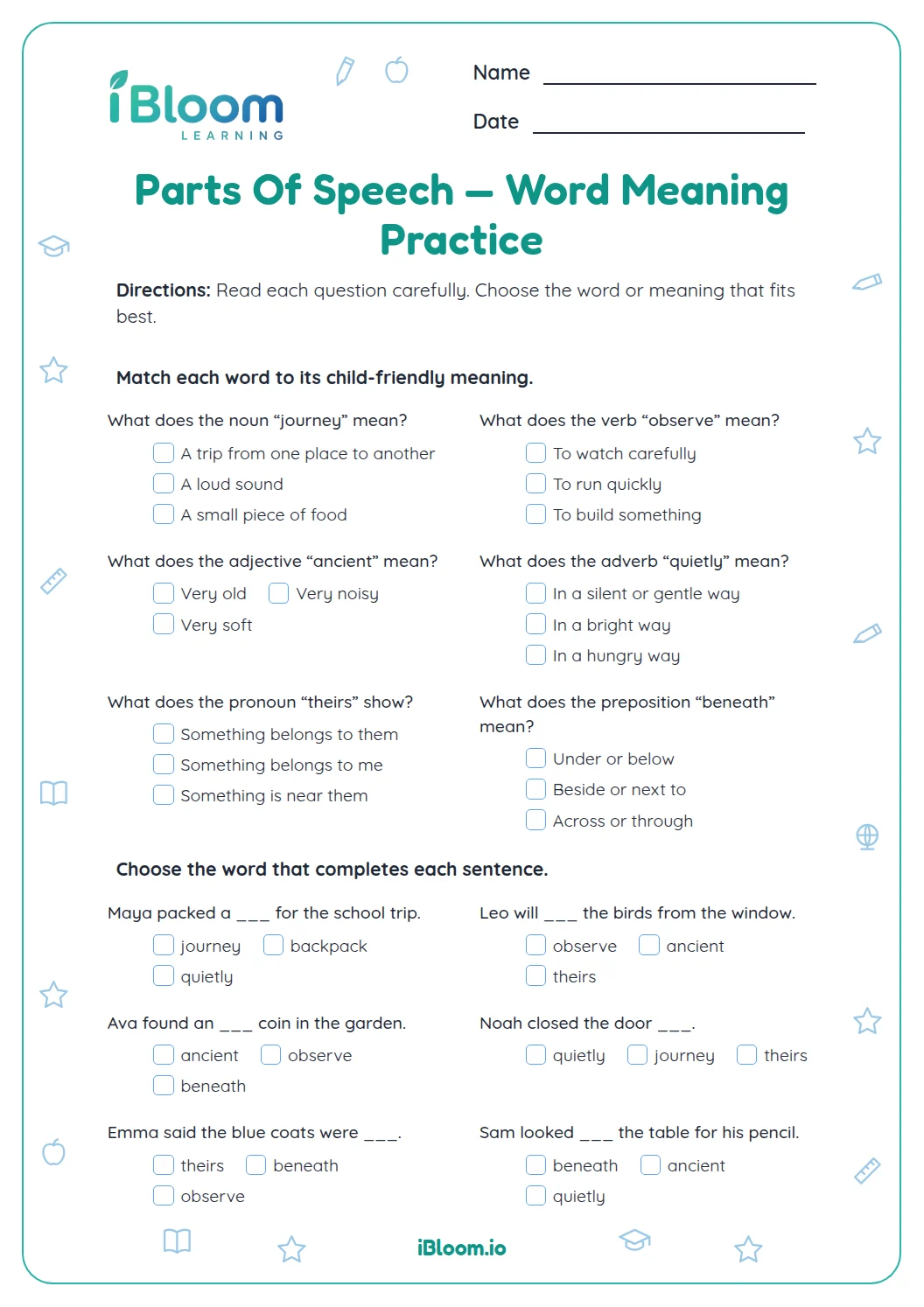
The two searches include nouns, verbs, adjectives, adverbs, pronouns, prepositions, conjunctions, interjections, and articles. Sentence questions focus on how several of these words work in context. The searches place each word type in a straight line across or down the grid.
How many questions are there?
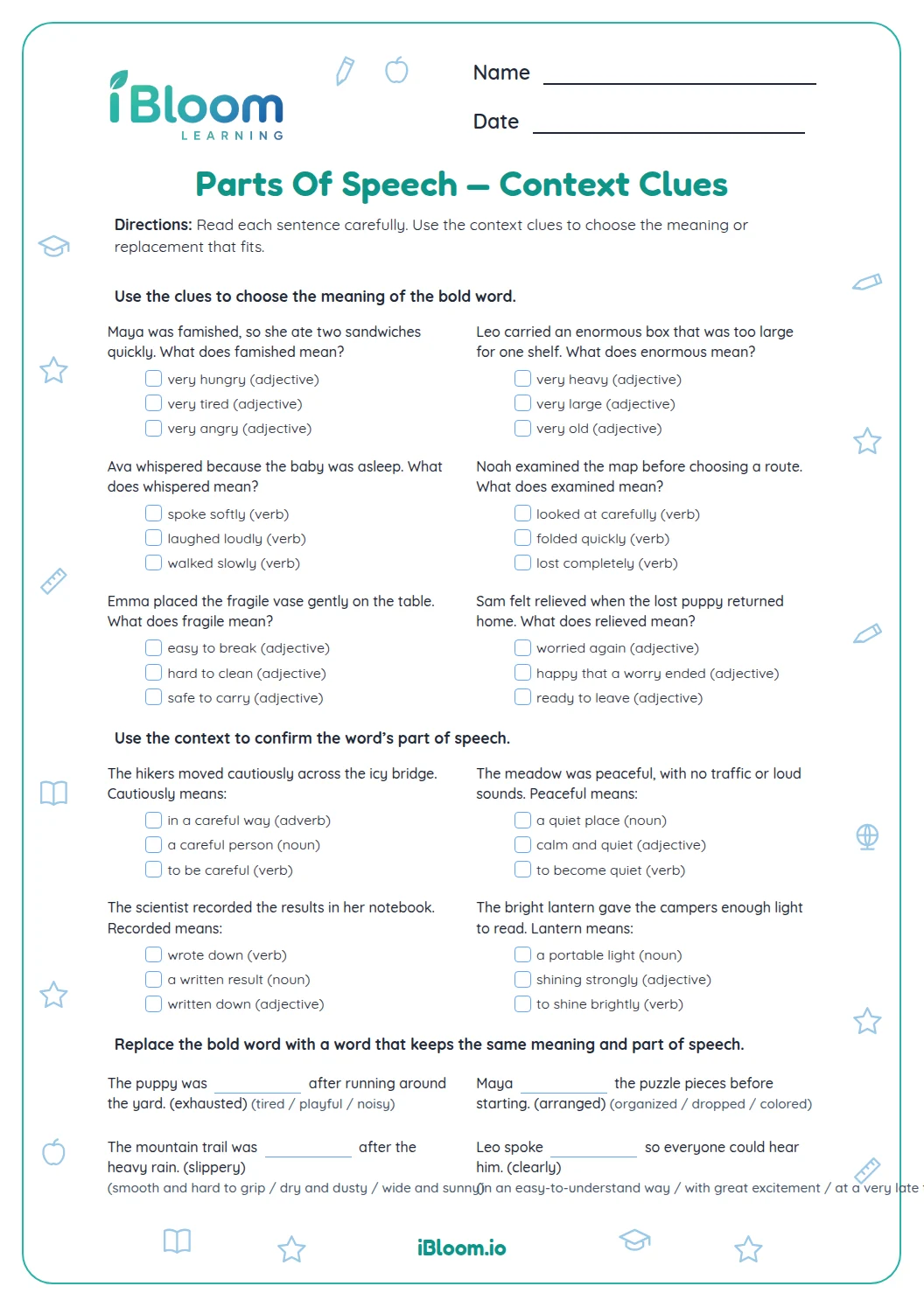
There are 16 activities: two word searches, six sentence-based choices, four definition blanks, and four written responses. The answer key gives the search lists and answers for each classification item. The written questions move from identifying a word to naming its role in a sentence.
What is the difference between an adjective and an adverb?
An adjective describes a noun, while an adverb can describe a verb. In “The puppy barked loudly,” loudly tells how the puppy barked, so it is an adverb. For instance, loudly modifies barked, while careful describes the noun artist.
Why are word searches included?
The grids give students a way to locate and review the names of word types. The later questions move from finding those terms to identifying a word’s job in a sentence. In the sentence questions, students select the word itself rather than its category.
Can a word belong to more than one part of speech?
Yes, some English words can serve different roles in different sentences. These questions provide sentence context so students can identify the particular job each word performs there. The practice includes nouns, verbs, adjectives, adverbs, pronouns, and function words.
Is an answer key included?
Yes. The separate key lists the words hidden in both grids and gives the sentence and definition answers. The last prompt accepts any complete sentence that includes a noun, verb, and adverb. The sample answers are models; other sentences can work if they meet the prompt.