

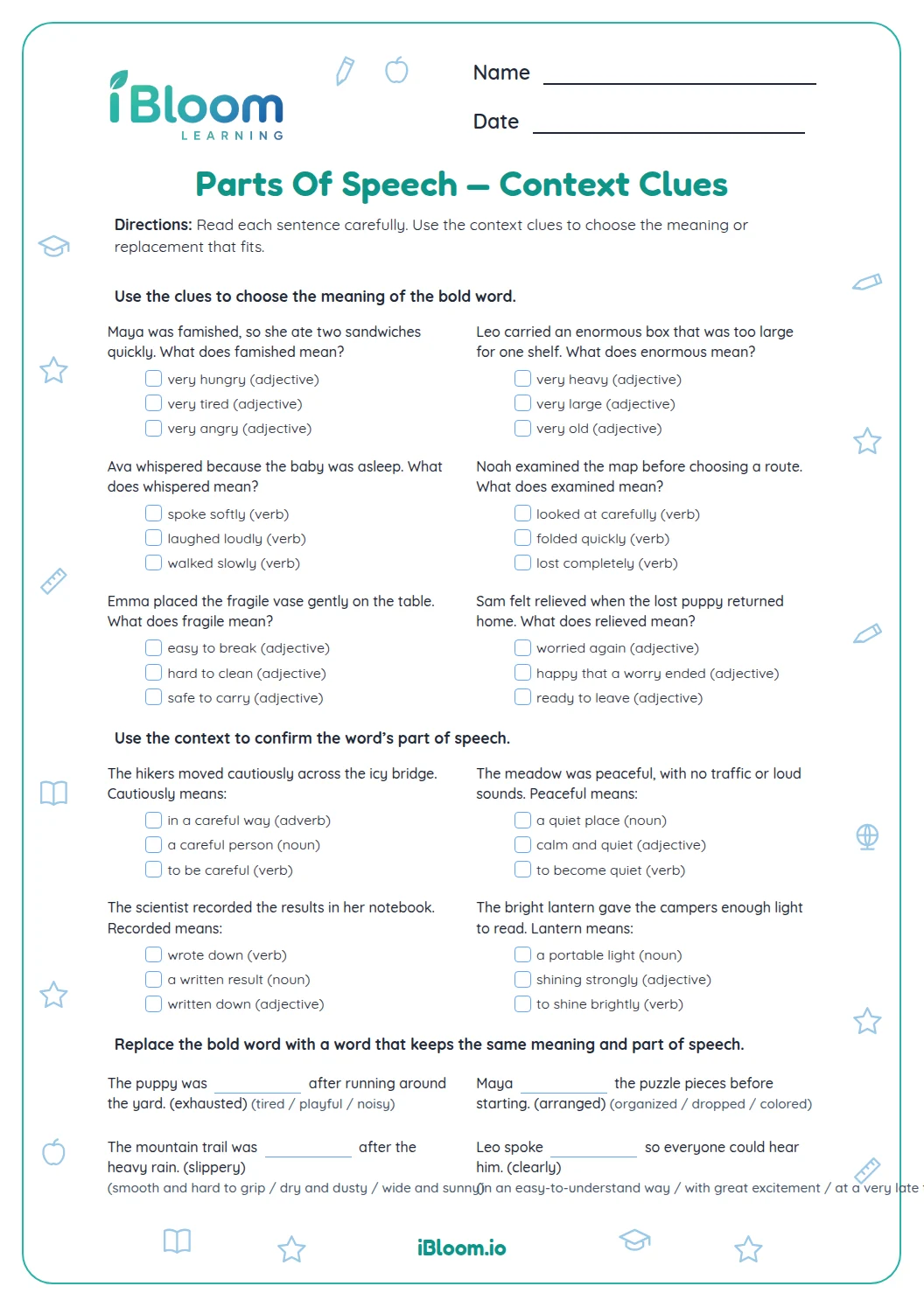
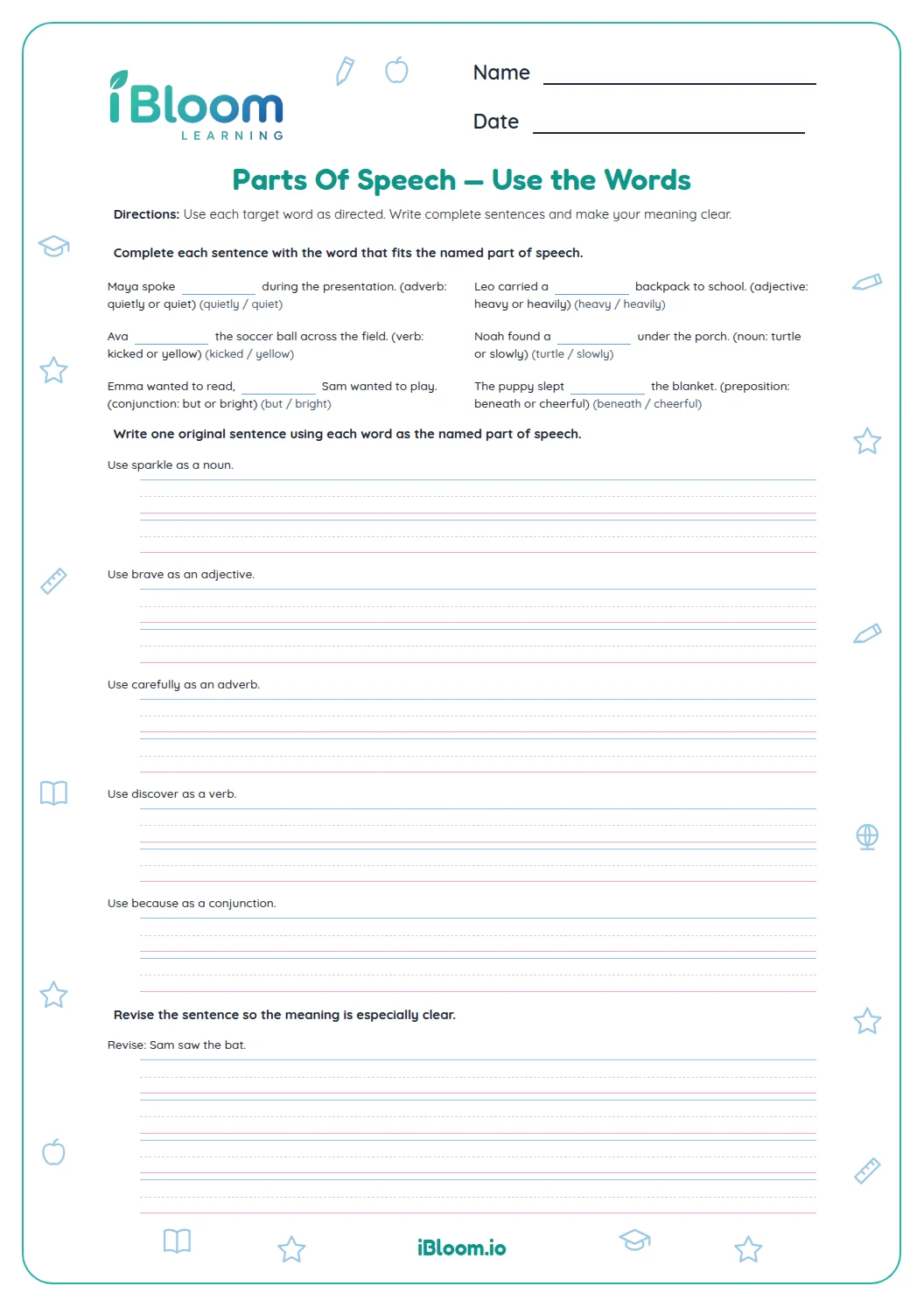
About this worksheet
This Grade 5 vocabulary worksheet connects simple-machine terms to their meanings and to sentence clues. Students identify six machine words, interpret four related words in context, complete two sentences, and apply four more terms to familiar examples. A separate answer key gives all 16 answers. It practices CCSS L.5.4a by using sentence context to identify word meanings.
Aligned to L.5.4a
How do simple-machine words connect to meaning?
A simple machine is a basic tool that changes the direction or size of a force. Knowing the precise word helps a reader picture what the tool does. A lever turns around a fulcrum; a pulley guides a rope; a wedge pushes material apart.
This Grade 5 sheet pairs machine vocabulary with definitions, then asks children to use words such as fulcrum, load, and effort in short contexts.
How can a sentence help identify the right meaning?
Read the whole sentence and ask what job the word is doing. Then compare that clue with the definitions. A fulcrum is the fixed point a lever turns on; the word board and the action tipped describe a lever in motion.
- 1The board turned around the fulcrum as Jo pushed.
- 2A lever turns at a fixed point called a fulcrum.
- 3Answer: fixed turning point.
What does this worksheet ask students to do?
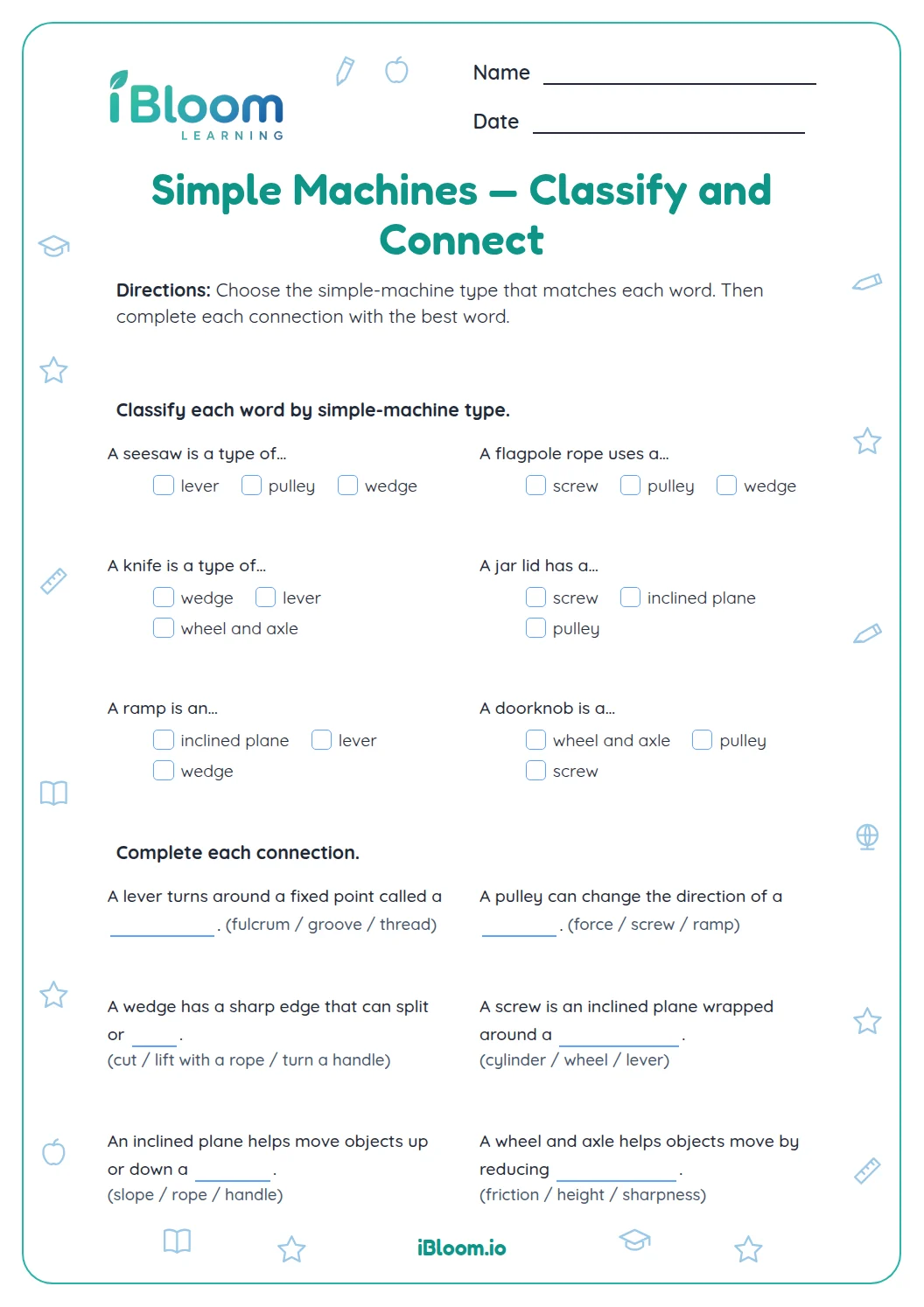
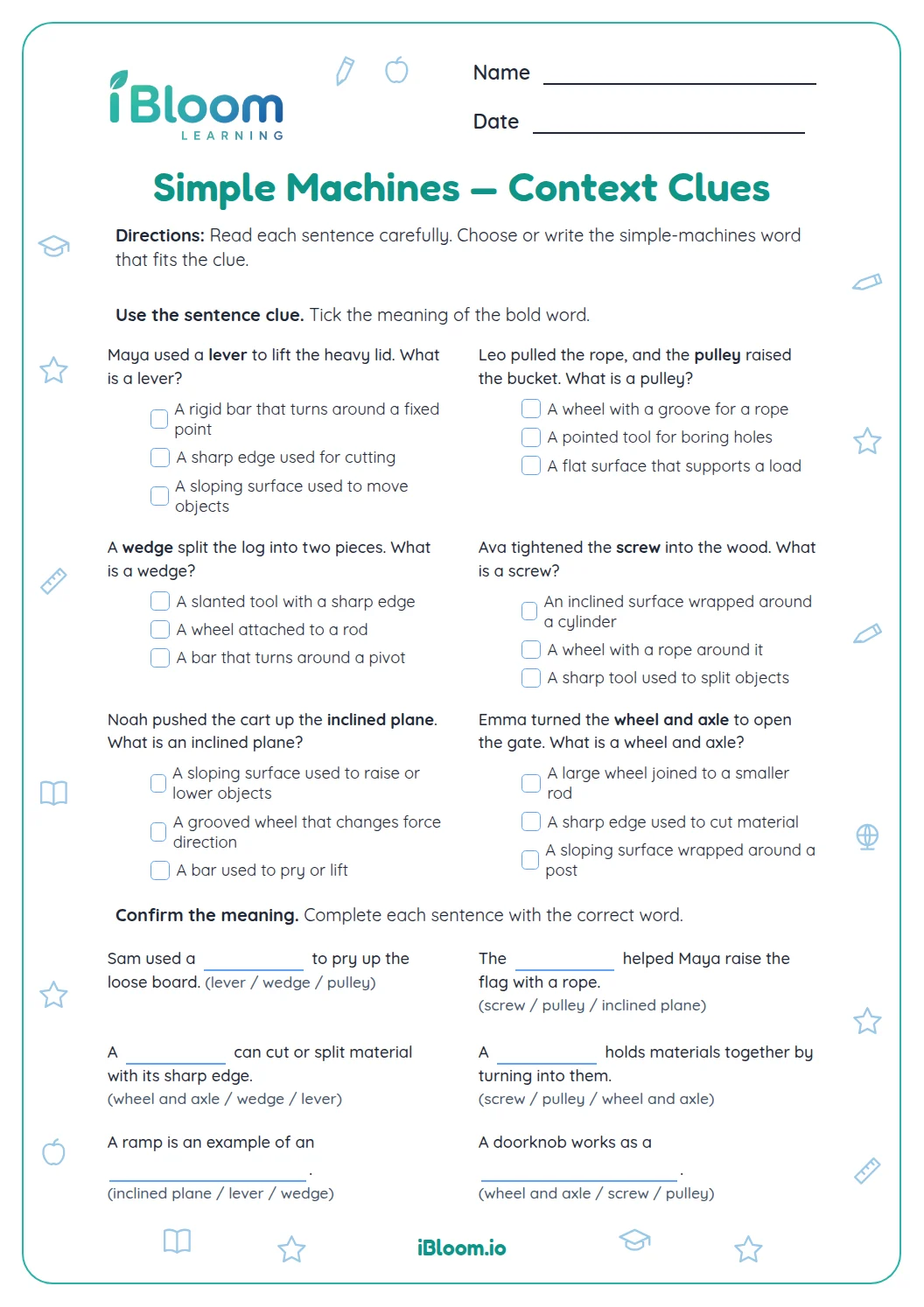
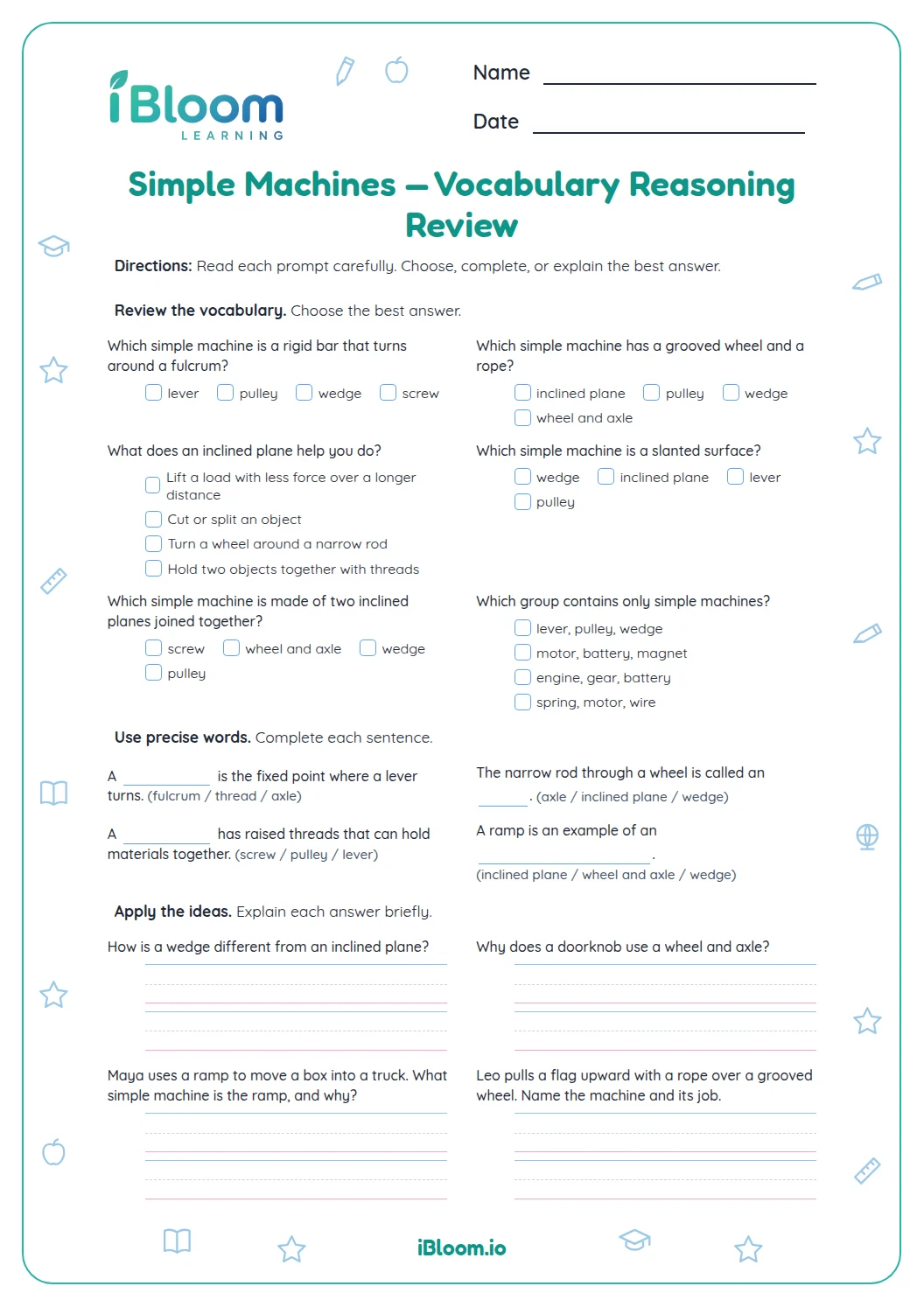
Questions 1–6 match six simple-machine terms to definitions. Questions 7–10 and 15–16 use context or examples to identify machine words; questions 11–14 apply the terms in short sentences. The separate key gives each answer.
How to use this worksheet
- 1Read each machine word aloud and discuss where you might see that tool.
- 2For each definition, underline the clue that names a shape, part, or action.
- 3In the context section, read the entire sentence before choosing.
- 4For the final items, test each choice by reading the completed sentence.
- 5Use the key to check answers and explain one choice in your own words.
Common mistakes and quick fixes
The mistake
Confusing a fulcrum with the load.
The fix
Ask which part stays as the turning point and which object is being moved.
The mistake
Calling every sloping or sharp part a wedge.
The fix
A wedge has a sharp edge that splits; an inclined plane is a sloping surface.
The mistake
Choosing a definition from one familiar word only.
The fix
Match the whole definition to the machine term, including its action.
Common Core alignment
Students use context clues to identify how simple-machine words work in sentences.
Use sentence context to work out what a simple-machine word means.
On this sheet: Questions 7–10 and 15–16 use sentence context to identify word meanings.
Show the official wordingHide the official wording
Use context (e.g., cause/effect relationships and comparisons in text) as a clue to the meaning of a word or phrase.
What to practice next
Make more practice
Further reading
Questions parents and teachers ask
What is the difference between a lever and a fulcrum?
A lever is a bar that moves, while a fulcrum is the fixed point the bar turns around. Question 7 uses a board turning around a fulcrum as Jo pushes. The sentence clue points to the fulcrum as the fixed turning point.
What does “load” mean in a simple machine?
A load is the object or weight a machine helps move. In question 8, the sentence says a pulley lifted a heavy load, so load means the object being moved. The answer choices ask students to use that sentence context to identify the meaning.
How should students answer the definition choices?
Read the machine term, then compare the full definition choices. A pulley guides a rope with a grooved wheel, while a wedge is a sharp tool that splits. Matching the defining feature helps distinguish the terms, instead of relying on one familiar word.
How many questions are on the worksheet?
There are 16 questions: six term-and-definition matches, four sentence-context questions, two sentence completions, and four applications. The answer key gives the correct response for each one. Students can explain which words helped them distinguish the machine terms in each sentence.
How long will this activity take?
Plan for about 15 minutes. Students can work through the six term-and-definition matches first, then read the context sentences carefully. For the final two items, reread each completed sentence to check that the machine word fits and sounds clear.