


About this worksheet
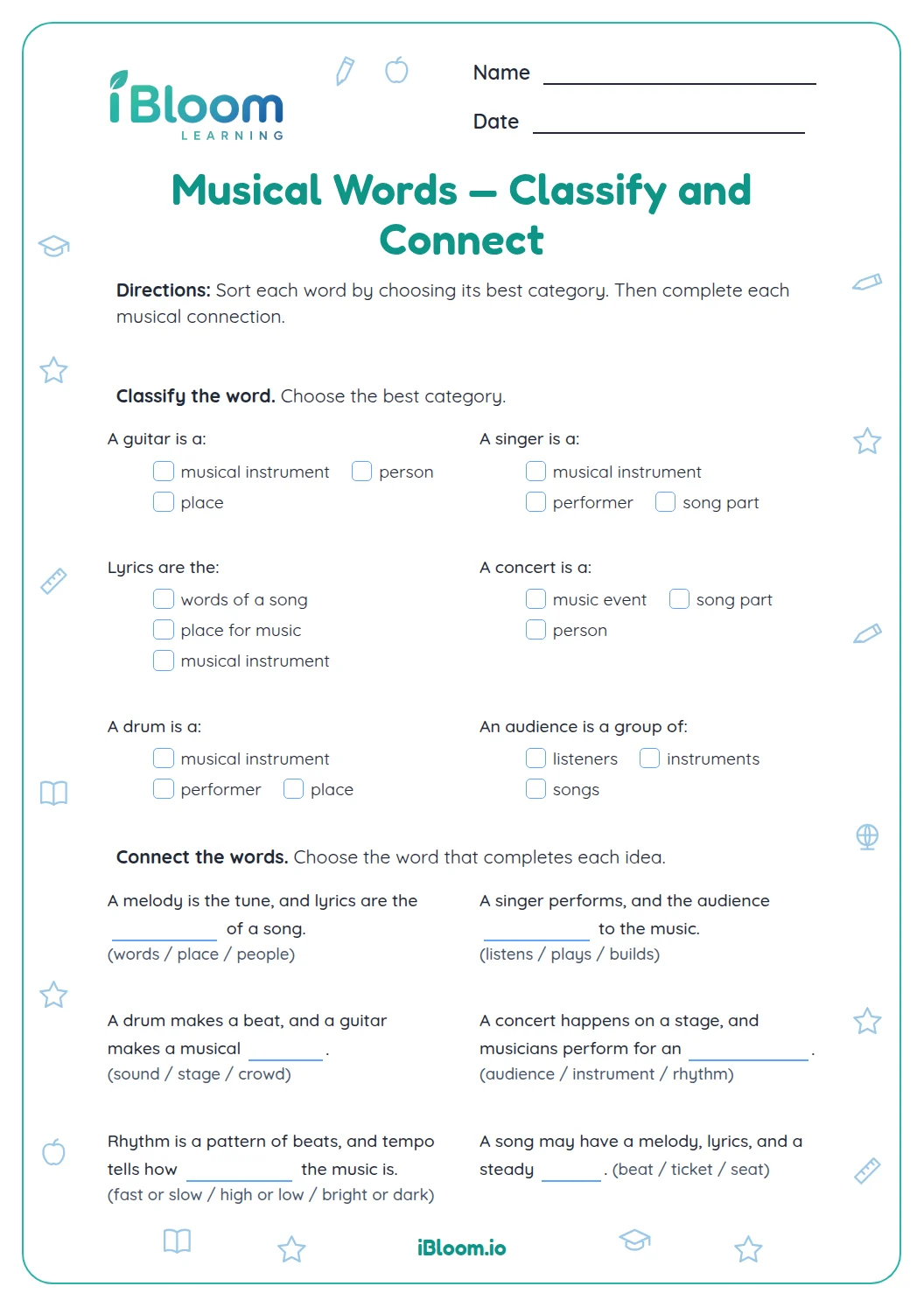
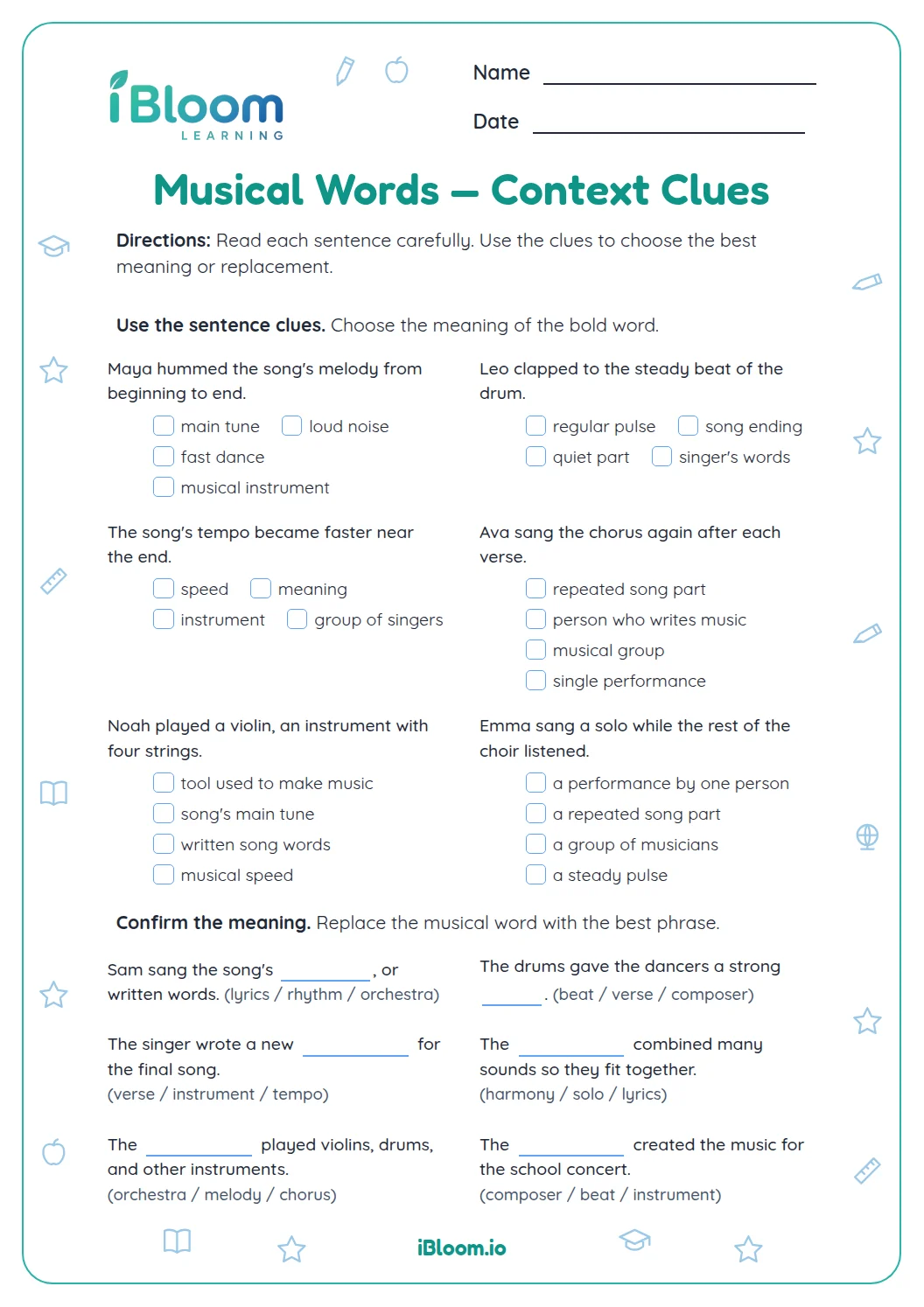
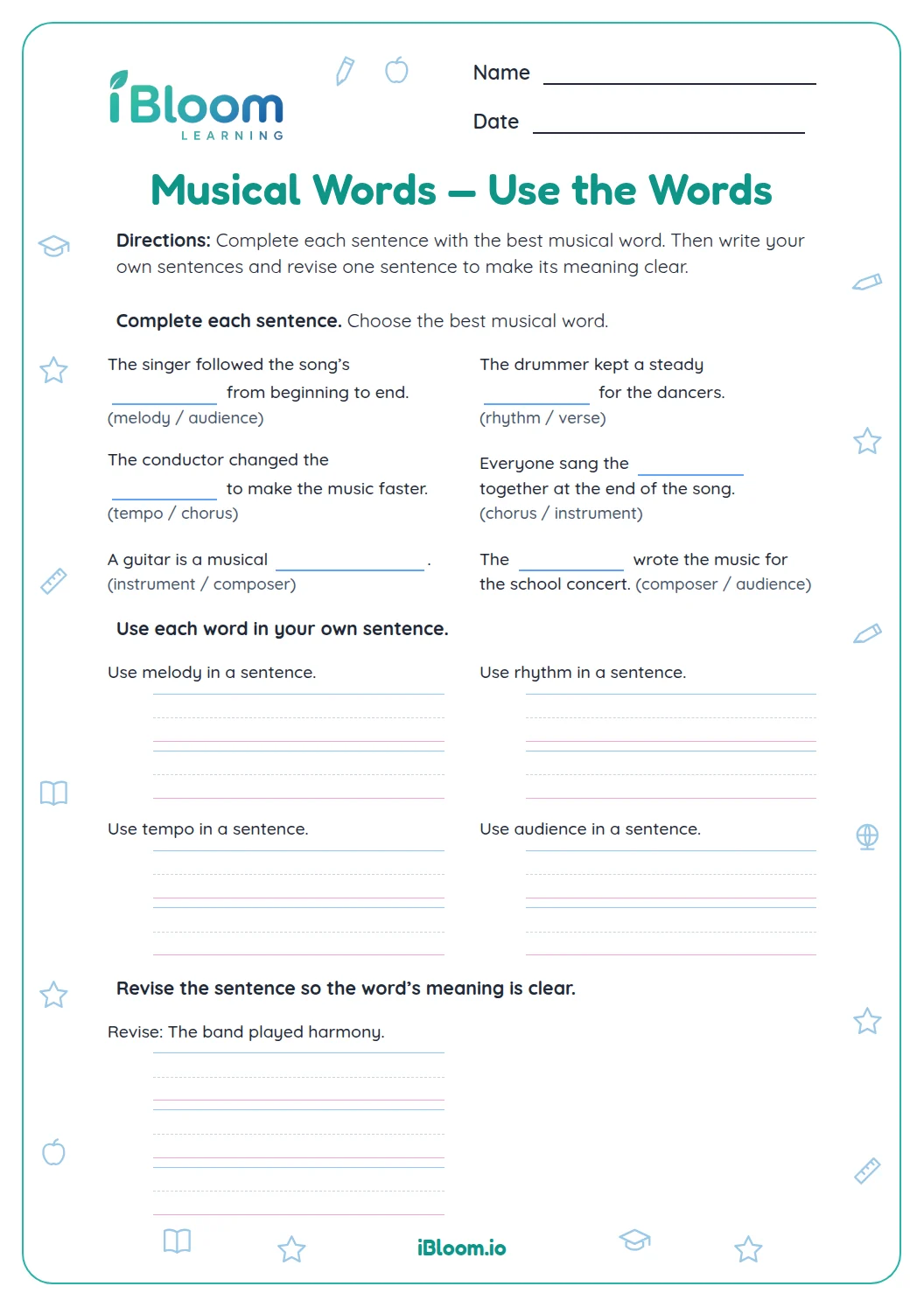
This free printable musical words worksheet helps elementary learners choose precise words for familiar musical experiences. Children identify rhythm, tempo, melody, lyrics, composer, and instrument, then use beat, dynamics, harmony, and chorus in sentences. Two final questions ask them to explain close meanings: beat versus tempo, and lyrics versus melody. The page serves Grades 1–5 with adult reading support as needed. Its sentence clues practice Common Core L.2.4a. The separate answer key provides the correct choices and missing words plus sample explanations, so adults can check both the vocabulary and the reasoning.
Aligned to L.2.4a
Which musical words does the sheet review?
The sheet practices ten terms. Rhythm names a pattern of long and short sounds; tempo describes speed; melody is a tune; lyrics are song words. Composer names someone who writes music, and instrument names an object used to make music.
Part B adds beat, dynamics, harmony, and chorus. The clues focus on a steady pulse, loud and soft levels, notes sounding together, and a returning song section. Each item supplies a choice or a pair of words so children can compare meanings.
How can children separate words with close meanings?
Ask which feature of the music changes. Faster or slower points to tempo; louder or softer points to dynamics. A hummed tune points to melody, while words on a song sheet point to lyrics.
Question 12 makes children apply this distinction to a new situation. Jo keeps the tune and changes the words, so only the lyrics change.
- 1Jo sings the same tune with new words.
- 2The tune is the melody, and it stays the same.
- 3The words are the lyrics, so the lyrics change.
What makes this a vocabulary reasoning review?
The final two questions require more than recalling a label. Children must explain what each term refers to and connect the meaning to a musical situation. “Lyrics, because they are the words” explains the choice in question 12.
Tap a steady pulse, then tap it faster. Each tap still marks a beat, while the tempo has increased. Have the child explain this in question 11. For question 12, hum a tune and then sing its words to make the difference between melody and lyrics audible.
How to use this worksheet
- 1Read the sentences aloud if needed, emphasizing clues such as tune, words, and speed.
- 2Let the child choose the six terms in Part A and explain one choice orally.
- 3Read both words in each Part B pair before filling the blank.
- 4Tap a steady pulse at two speeds to prepare for the beat-and-tempo comparison.
- 5Check the written explanations for correct meanings, allowing wording different from the samples.
Mistakes to discuss and fix
The mistake
Choosing tempo when a sentence describes loud and soft levels.
The fix
Ask whether the clue concerns speed or loudness; question 8 concerns dynamics.
The mistake
Calling a hummed tune lyrics.
The fix
Lyrics are words. Hum without words, then sing the words to separate melody from lyrics.
The mistake
Treating beat and tempo as interchangeable.
The fix
Tap the pulse, then change its speed: the pulse is the beat, and its speed is the tempo.
Common Core alignment
Use clues about musical sounds, actions, and objects to choose precise vocabulary.
On this sheet: Parts A and B supply sentence-level clues that distinguish the target music words from alternatives.
Show the official wordingHide the official wording
Use sentence-level context as a clue to the meaning of a word or phrase.
What to practice next
Make more practice
Further reading
Questions parents and teachers ask
Which music words appear in the questions?
The ten target words are rhythm, tempo, melody, lyrics, composer, instrument, beat, dynamics, harmony, and chorus. The first ten questions introduce or review them through sentence clues. The last two questions revisit beat and tempo, then melody and lyrics, asking children to explain the differences.
Does my child need to read music?
Your child can answer using the sentence clues and everyday musical experiences. The questions describe humming a tune, singing words, tapping a pulse, playing a guitar, and hearing changes in music. If a word is unfamiliar, read the choices together and demonstrate it before returning to the question.
What is the difference between tempo and dynamics?
Tempo describes how fast or slow music goes, while dynamics concern how loud or soft it is. Question 2 uses a speeding-up clue for tempo. Question 8 uses a soft-to-loud clue for dynamics. Ask the child to identify which feature changes before choosing the term.
How can I support a younger learner?
Read the sentences and choices aloud, then let the child explain the choice orally before writing. Demonstrate a steady beat by tapping and a melody by humming a familiar tune. The broad Grades 1–5 range allows adults to adjust reading help while keeping the vocabulary meanings accurate.
What counts as a correct written comparison?
Accept wording that preserves the musical distinction. For question 11, the response should identify beat as the steady pulse and tempo as its speed. For question 12, the lyrics change because the words change, while the melody stays the same. The key supplies sample explanations for both.