

About this worksheet
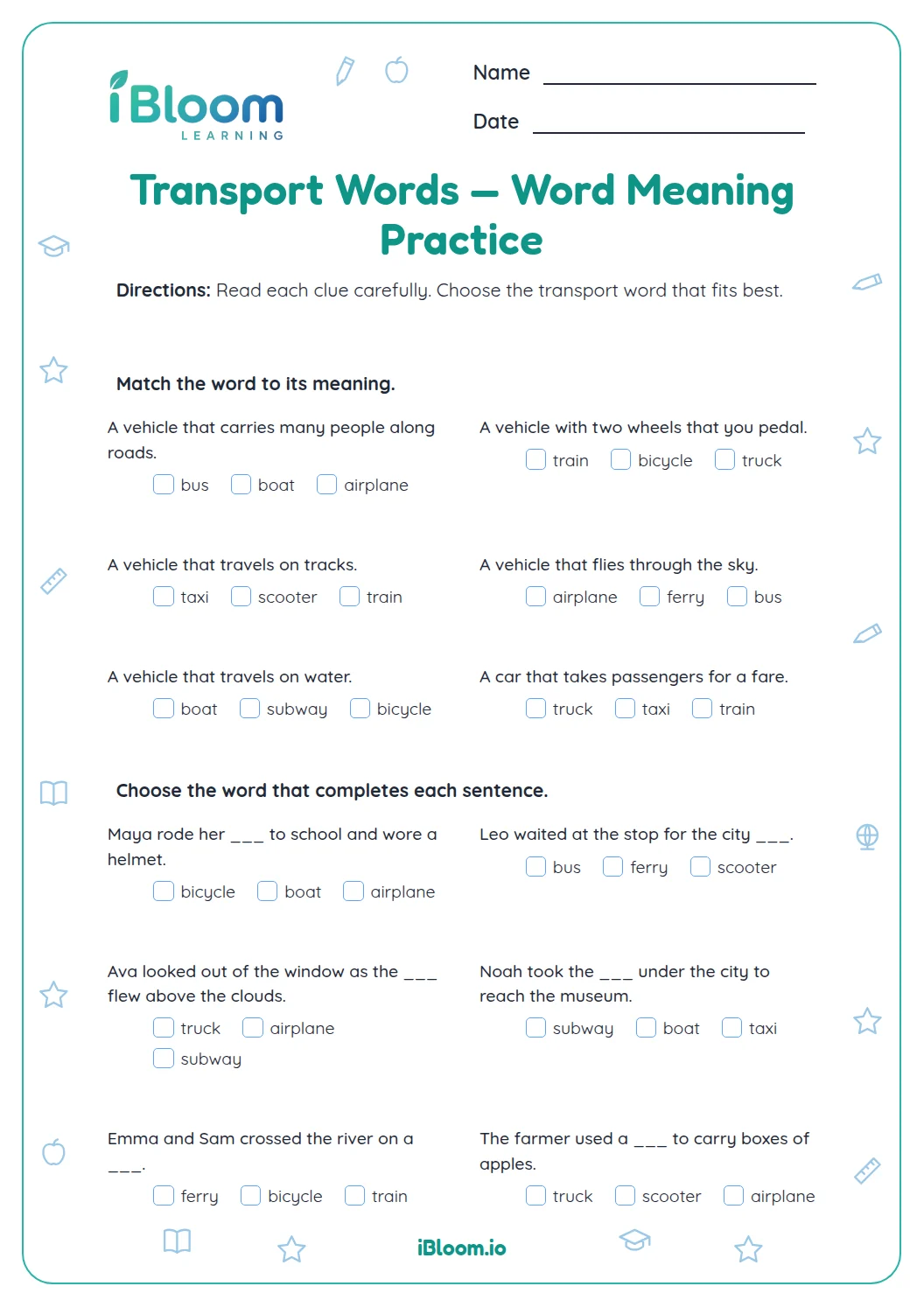
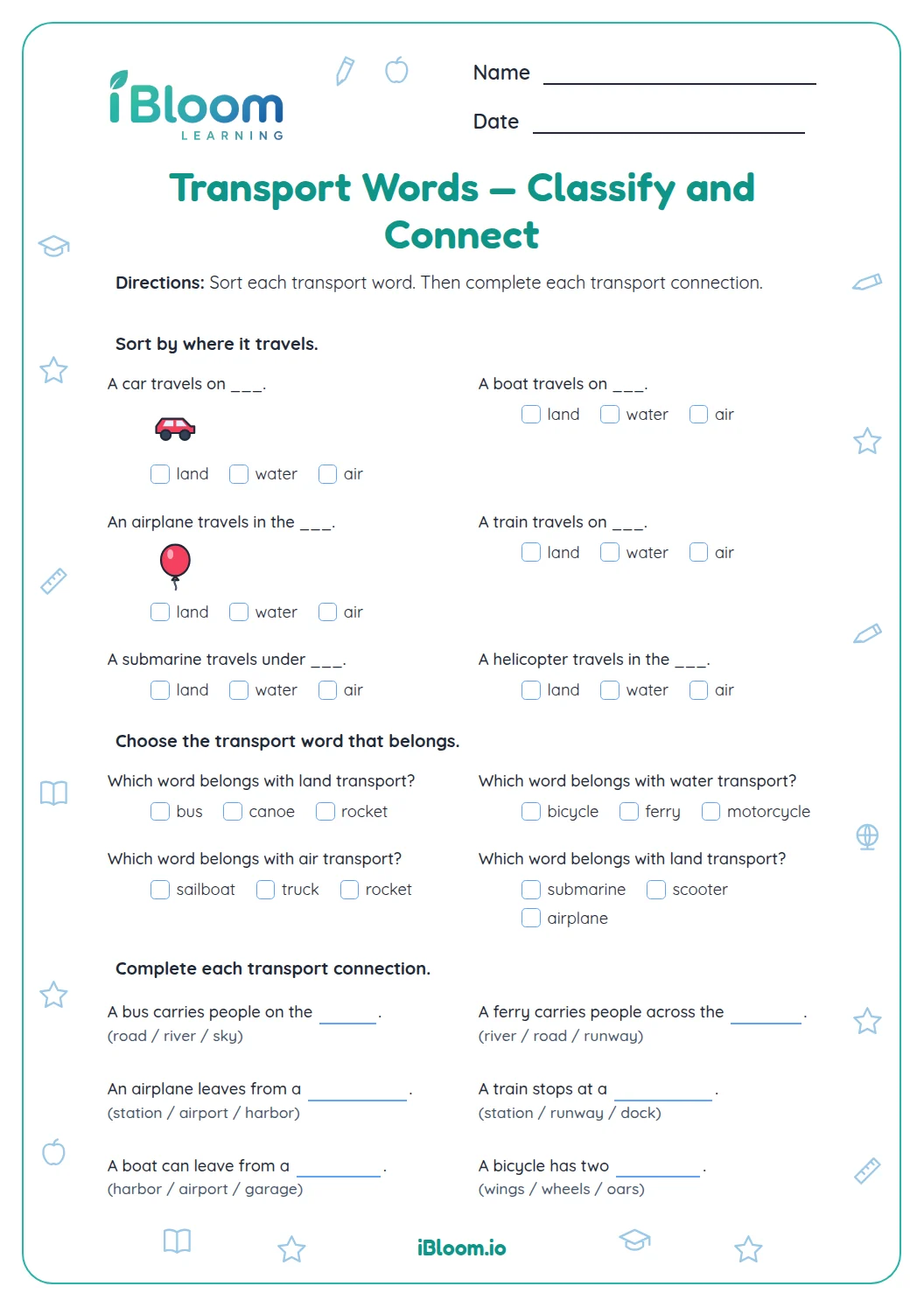
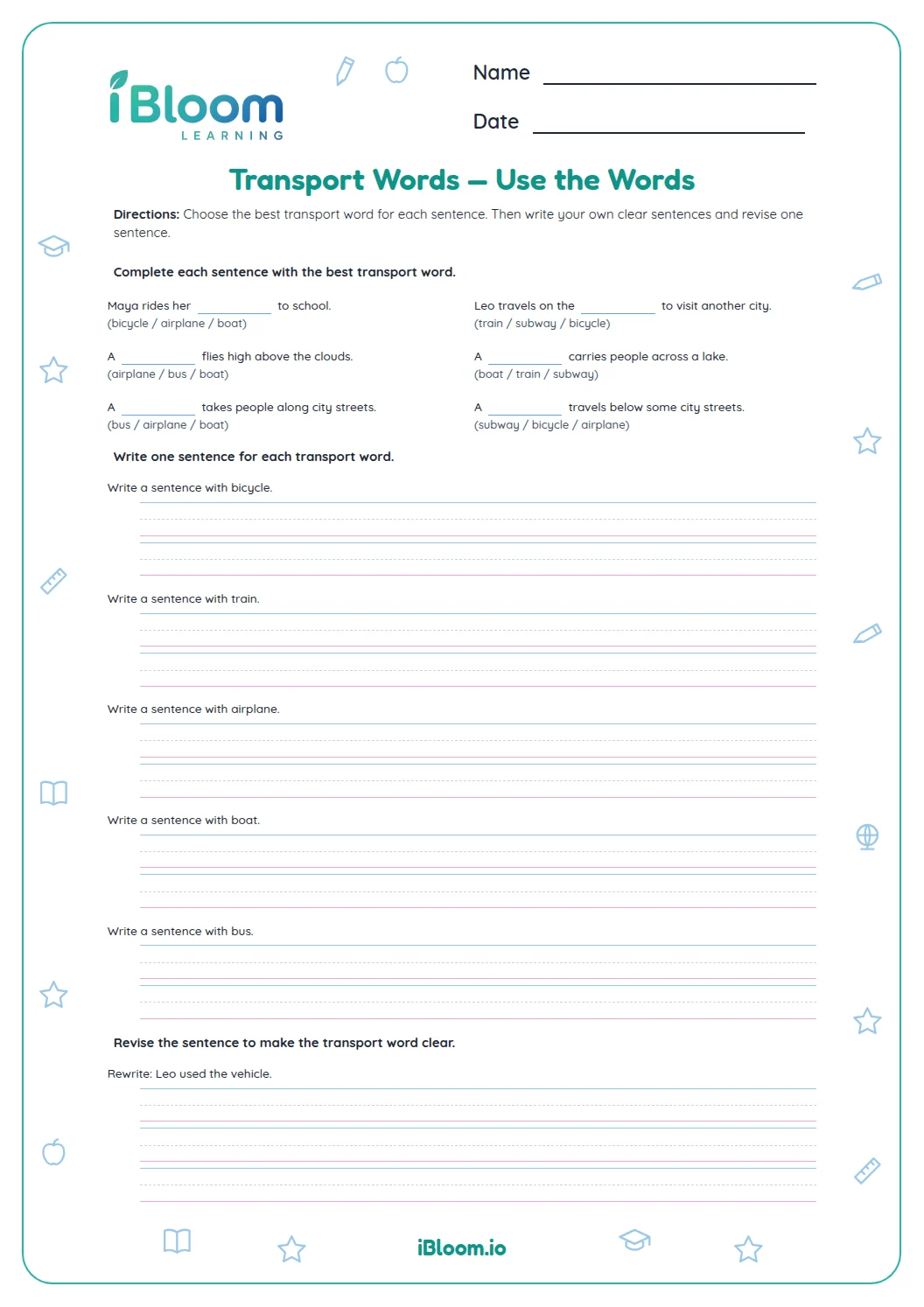
This printable Grade 3 vocabulary review uses familiar transport words such as ferry, railway, cargo, and taxi. Across 14 questions, children match vehicles to routes and purposes, then complete short statements using clues about what a vehicle carries or where it travels. The practice uses sentence context to clarify transport vocabulary and includes a separate answer key.
Aligned to L.3.4a
How can transport words be grouped?
Transport words name vehicles, the places they travel, and the jobs they do. A ferry and a ship travel on water; a train uses tracks; an airplane travels through the sky. Grouping by route or purpose helps readers compare words precisely.
Which sentence clues help explain a transport word?
Look for a vehicle’s route, passengers, load, or action. In “The cargo plane carried crates,” cargo is clarified by carried crates: it means goods being moved. The sentence often gives a clue without stopping to define the word.
How can readers compare two transport words?
Ask what each vehicle carries, where it travels, and how it moves. A taxi and a bus can both use roads, but a taxi is a hired car and a bus commonly carries several riders. A useful comparison names the shared feature and the difference.
- 1A cargo plane carries crates. What is cargo?
- 2Clue: the plane carries crates.
- 3Cargo means goods being transported.
How to use this worksheet
- 1Read the complete sentence before looking at choices.
- 2Notice words about route, passengers, cargo, or purpose.
- 3Test each answer against every clue in the sentence.
- 4For comparison questions, name how two vehicles are alike or different.
- 5Check each choice with the answer key.
Common mistakes and quick fixes
The mistake
Choosing a vehicle based on one familiar word only.
The fix
Reread the whole sentence and use all the route or purpose clues.
The mistake
Mixing up where a vehicle travels and what it carries.
The fix
Ask two separate questions: where does it go, and what does it move?
The mistake
Treating related vehicles as exact synonyms.
The fix
Check the sentence for the particular job, such as hired ride, rail travel, or water crossing.
Common Core alignment
The questions use context clues to clarify transport vocabulary.
Use context clues in a sentence to clarify transport vocabulary.
On this sheet: Readers use sentence details about vehicle routes and purposes to infer word meaning.
Show the official wordingHide the official wording
Use sentence-level context as a clue to the meaning of a word or phrase.
What to practice next
Make more practice
Further reading
Questions parents and teachers ask
What kinds of transport words appear?
The questions include road, rail, air, and water vehicles, along with words for routes, loads, and purpose. Examples include ferry, train, airplane, taxi, kayak, and cargo. Children use sentence clues to choose or complete a transport word. The two parts include both choices and written completions.
What does cargo mean?
Cargo means goods being transported. In question 7, a cargo plane carries crates, so the crates are the clue that cargo refers to items being moved. Readers can point to the words that support their answer. A cargo plane carries goods; the crates are one example of cargo.
Why are some answer choices similar?
Related vehicles can share a route or purpose, so children need to notice the sentence’s specific clue. A bus and a taxi both travel on roads, but a taxi is a hired car and a bus carries many riders. The best choice fits every detail.
How many questions are included?
There are 14 questions in two parts: seven multiple-choice items about transport words and purposes, followed by seven short answers that complete clue-based statements. The separate key lists all answers in worksheet order. Children can check the choices first, then review the completed sentences.
Can an adult read the questions aloud?
Yes. Reading aloud can help a child focus on the vocabulary reasoning. Pause after the sentence and ask which words give a clue about route, passengers, cargo, or purpose. Let the child point to the clue before responding. The child can then explain why the word fits.