






About this worksheet
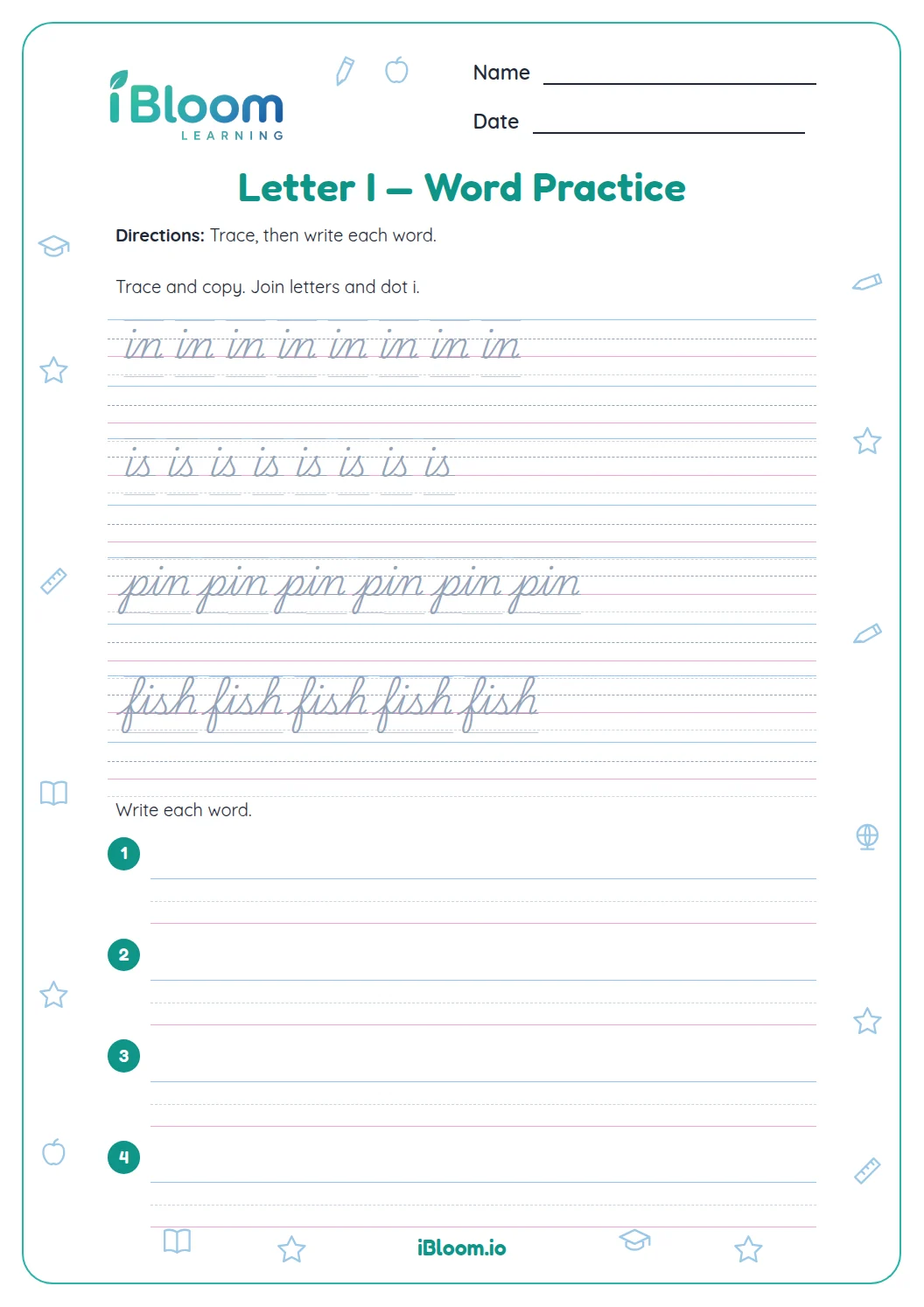
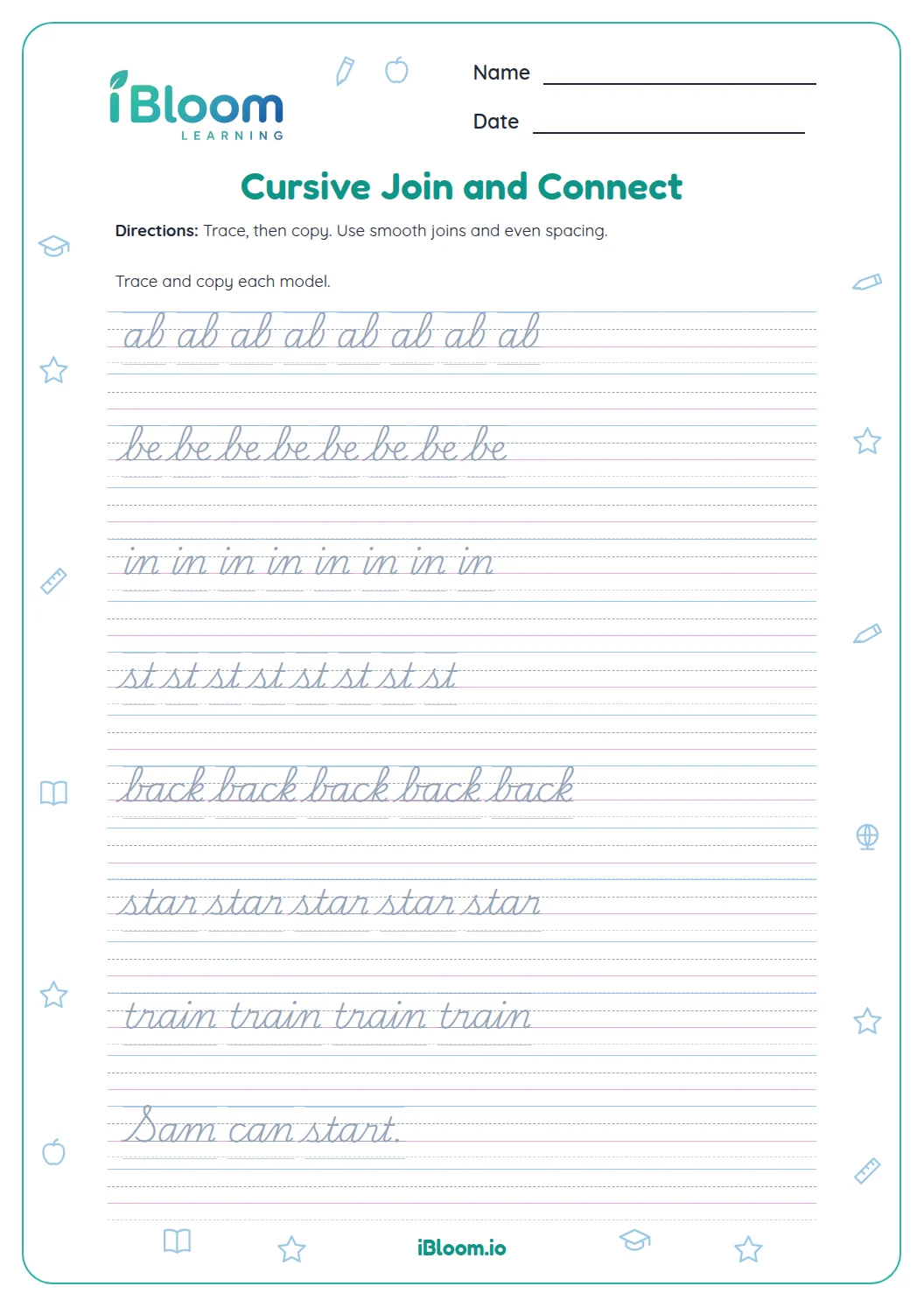
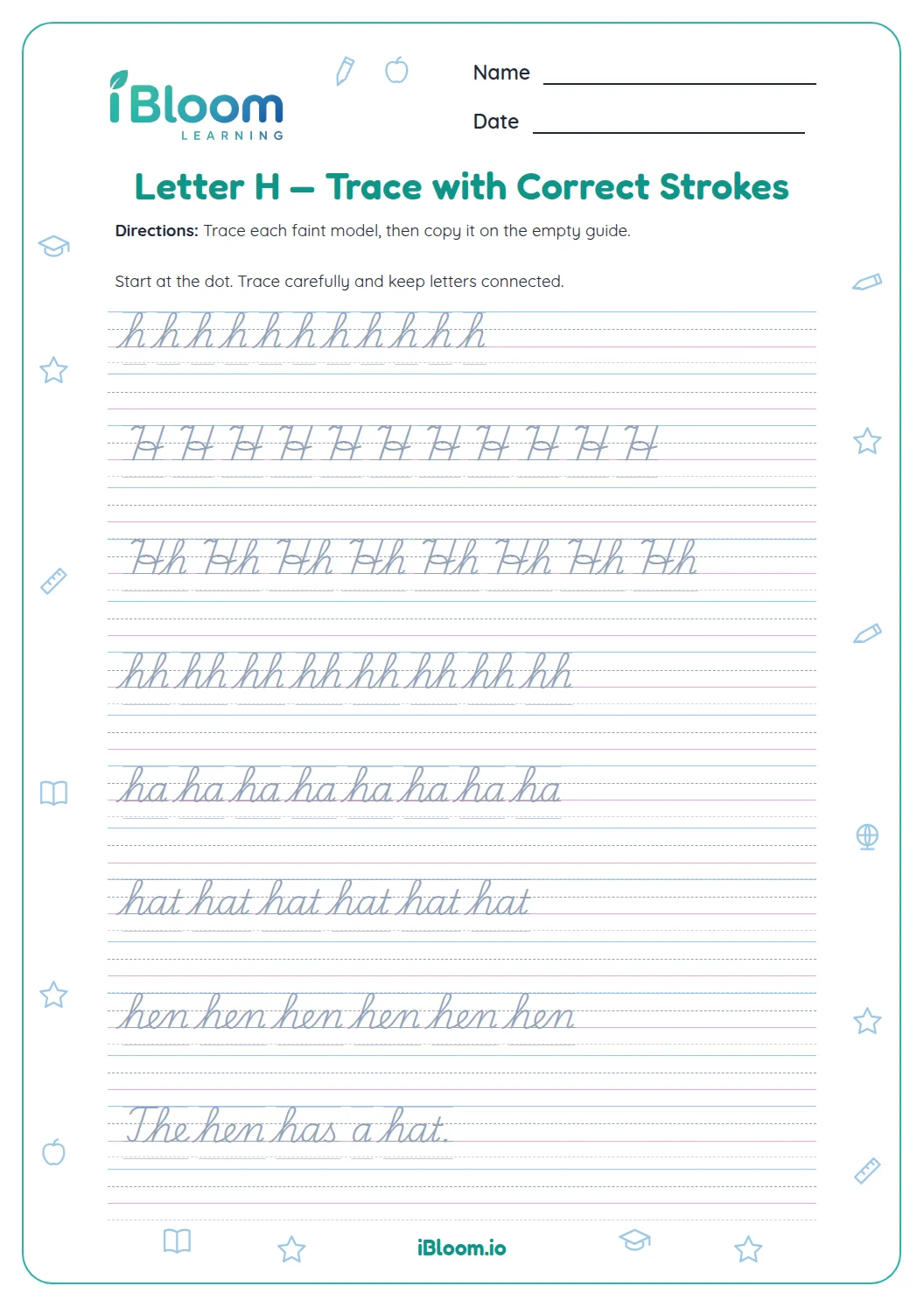
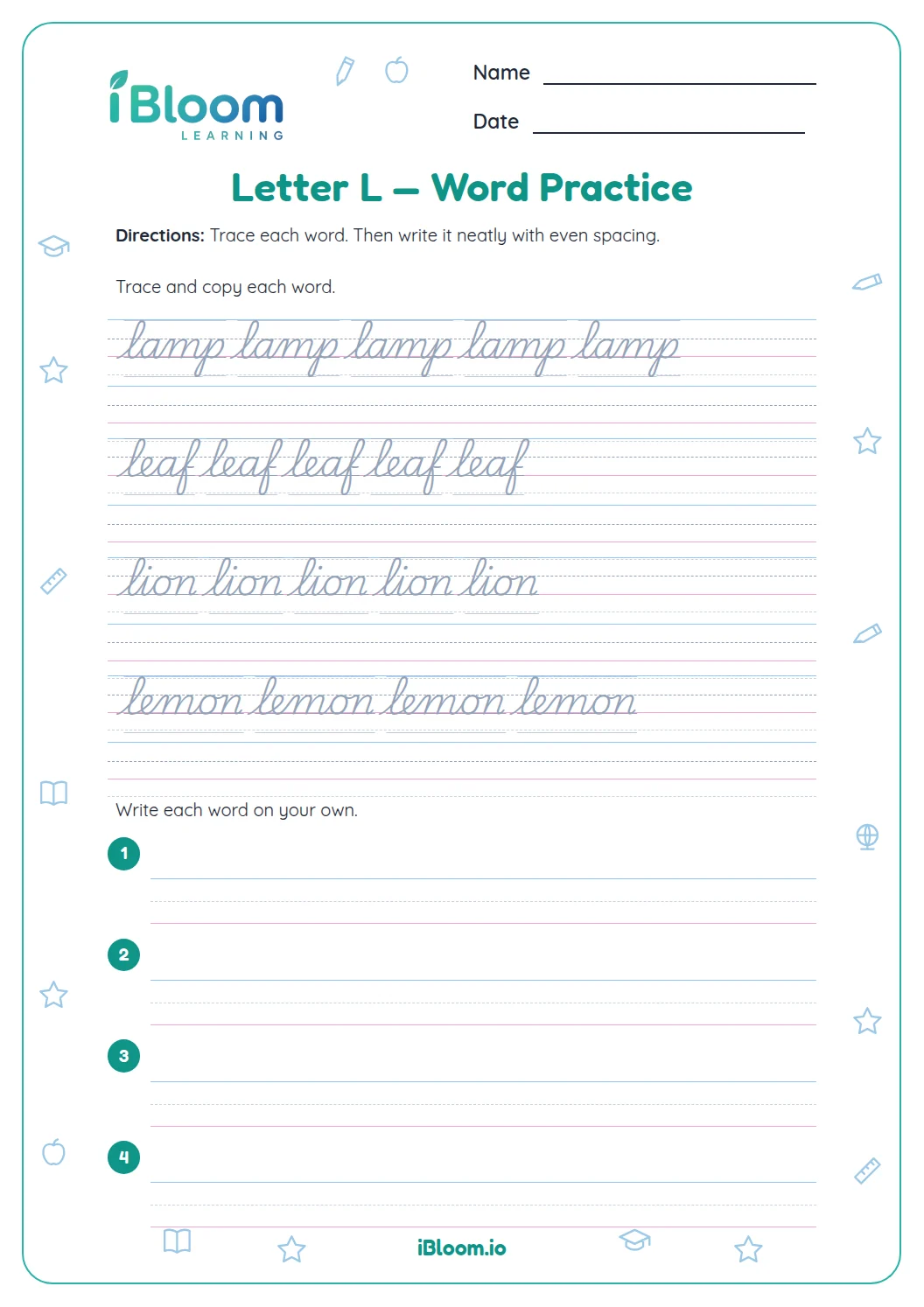
This free printable cursive letter I review gives children in Grades 2–5 practice moving from letter strokes to connected writing. Seven items cover lowercase i and l, the joins in and it, the word inside, a model sentence, and two familiar sentences to write from memory. The tracing rows reinforce the letter shapes and connections used on the original sheet; the final prompts ask children to recall complete sentences. A separate model key helps adults check letter forms, dots, spacing and readable joins.
What does this letter I review include?
Part A has three rows for lowercase i, lowercase l, and the joins in and it. Part B copies inside and the sentence “I will visit India.” Part C gives two familiar sentences to write from memory, following the original sheet’s final activity.
The tracing rows provide a model before children write independently. For the final prompts, read the sentence, cover it, and let the child recall the words before checking the model key.
How do you keep the i readable inside a word?
Keep lowercase i shorter than l, and place each dot above its own i. In inside, notice how i and n connect before the next letter begins.
Question 4 repeats inside so children can practice the same joins across a whole word. Trace the model first, then copy the word while keeping each letter connected.
- 1Trace the model inside.
- 2Keep lowercase i short beside the taller d and l.
- 3Connect letters within the word.
- 4Place a dot above each i.
What should an adult check on the finished sheet?
The two final prompts use sentences from the original sheet: “I sit in a big city” and “I see six fish.” Have children read each, cover the words, and write what they remember.
Compare the result with the key for the intended words, readable letter forms and spaces. Accept natural differences in handwriting when every word can be read.
How to use this worksheet
- 1Point to uppercase I and lowercase i in the first two items and compare their sizes.
- 2Trace each gray row, then copy the same text on the empty row.
- 3In Part B, keep i short beside the tall l letters in inside.
- 4Write each sentence with spaces between its words and a period at the end.
- 5Compare with the model key and choose one join to practice again.
Mistakes to notice and how to help
The mistake
Making lowercase i as tall as l in hill.
The fix
Use the middle guide to compare the short i with the two tall l letters.
The mistake
Leaving out the dot or placing it above the next letter.
The fix
Finish the word, locate each i, and put its dot above that letter.
The mistake
Connecting the end of one word to the next word.
The fix
Lift the pencil and leave a visible space at each word break in the model.
What to practice next
Make more practice
Questions parents and teachers ask
Which forms of I does this sheet practice?
It practices lowercase i and l, the joins in and it, the word inside, and a complete sentence. Two final prompts ask children to write familiar sentences from memory, matching the original sheet’s progression from letter practice to connected writing.
Does each item include space to write independently?
Yes. The first five items have a trace-and-copy model row. The final two show a sentence prompt and provide space to write it from memory; a child can read the sentence, cover it, write it, and then uncover it to check.
Should my child dot each i immediately?
The sheet includes inside, where each i needs a dot, and I will visit India, which has a capital I and two lowercase i letters. Finish the connected writing first, then add dots above the lowercase i letters. Add each dot directly above its lowercase i.
How should I use the answer key for handwriting?
Use the key to compare the intended letter forms and the exact text. A successful copy should be readable, have the correct letters and dots, and keep spaces between words. It does not need to look mechanically identical to the model to show useful handwriting practice.
Can we split this review into shorter sessions?
Yes, you can practice the letter and join rows first, then return to words and sentences. Keep the printed models nearby during both sessions. Before moving to the sentences, ask your child to identify a clear i in one copied word and explain what makes it readable.