




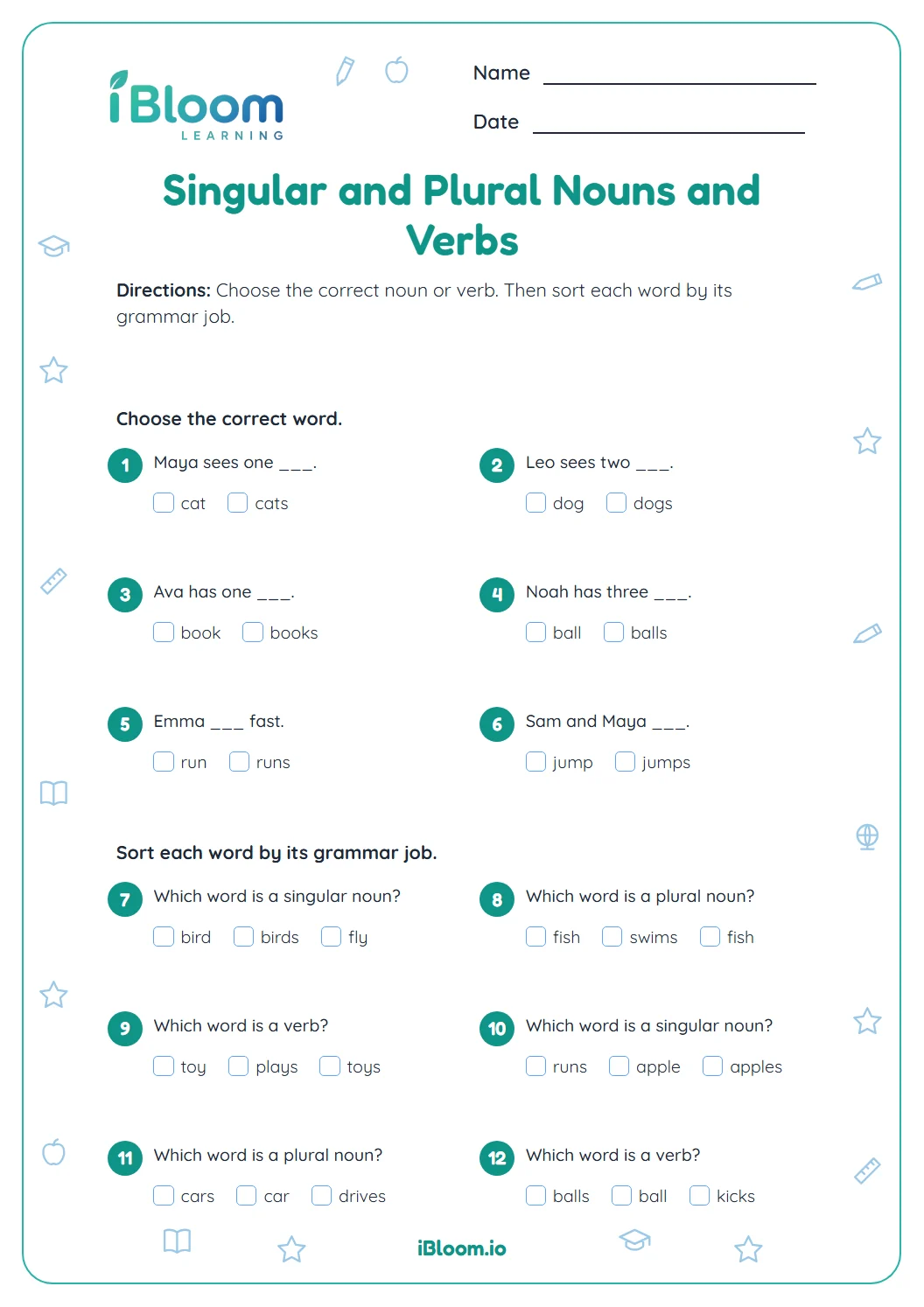
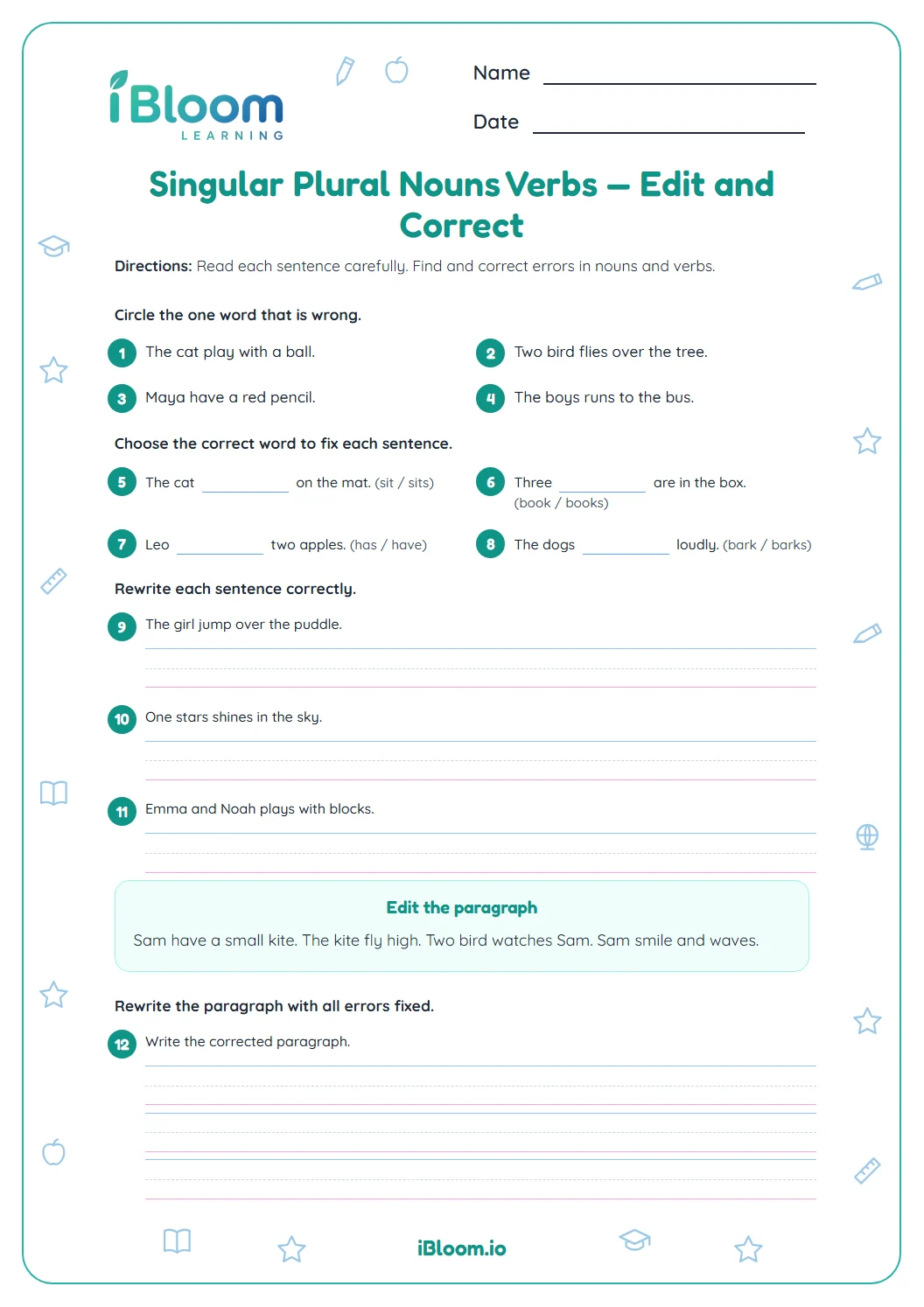
About this worksheet
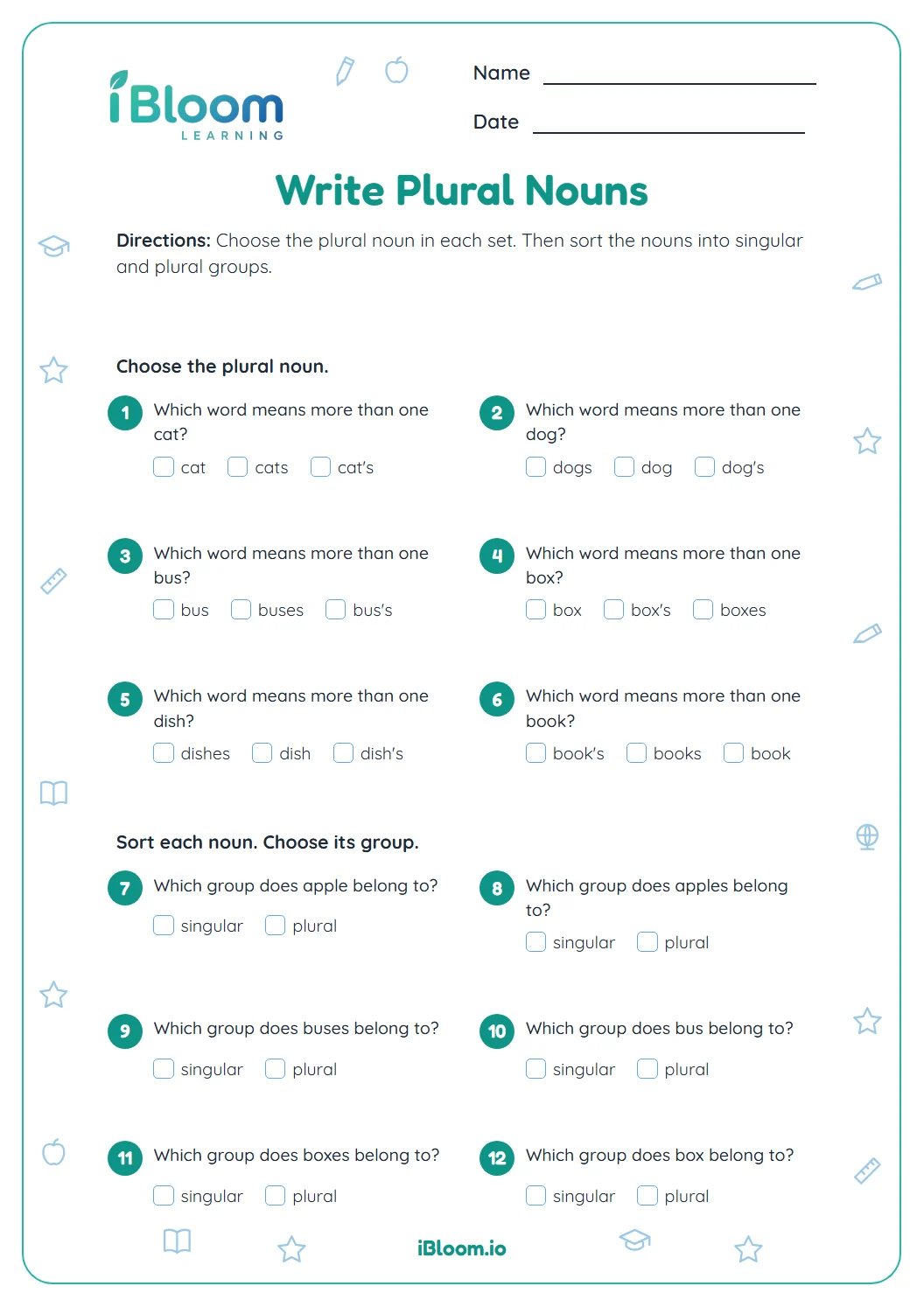
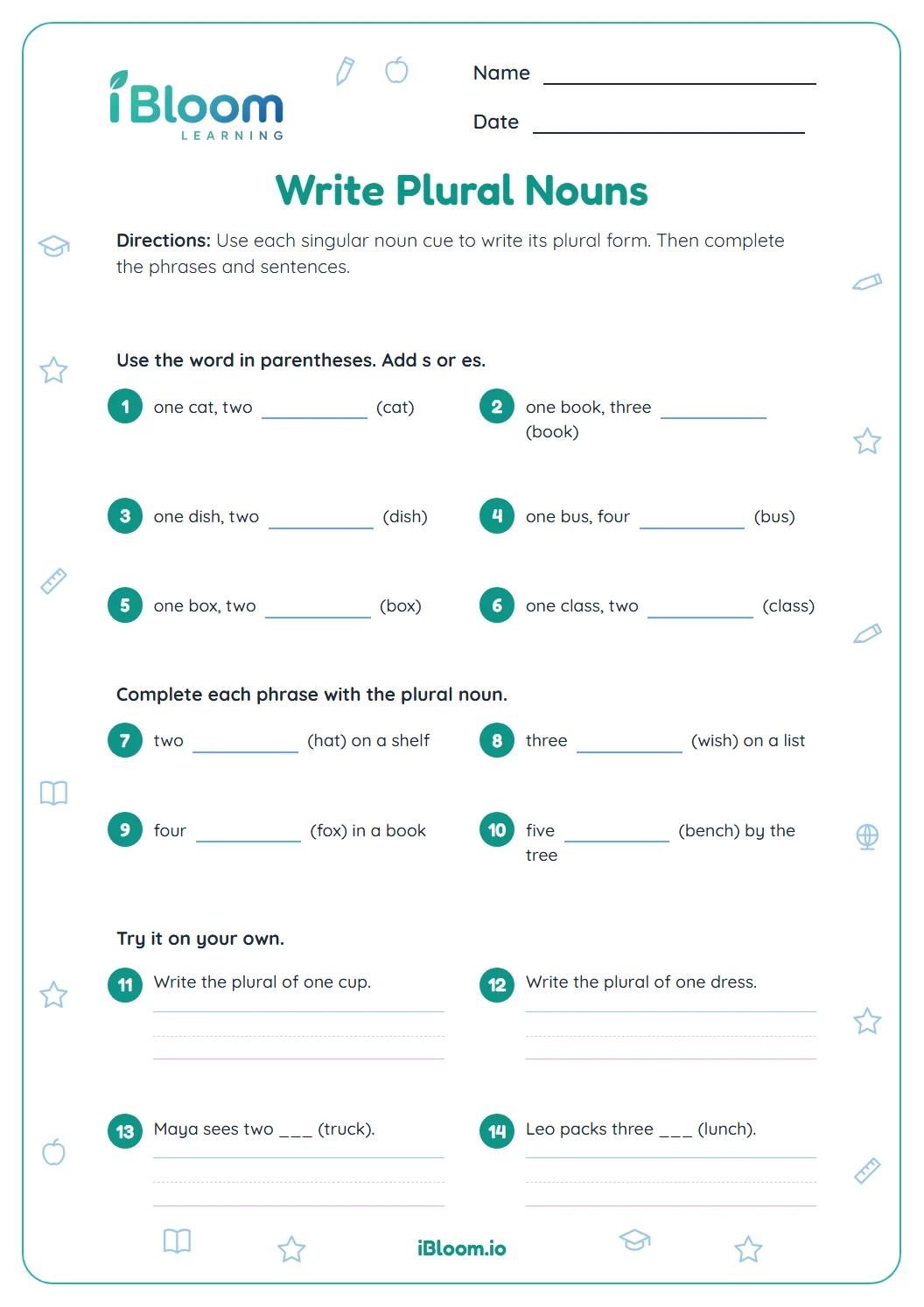
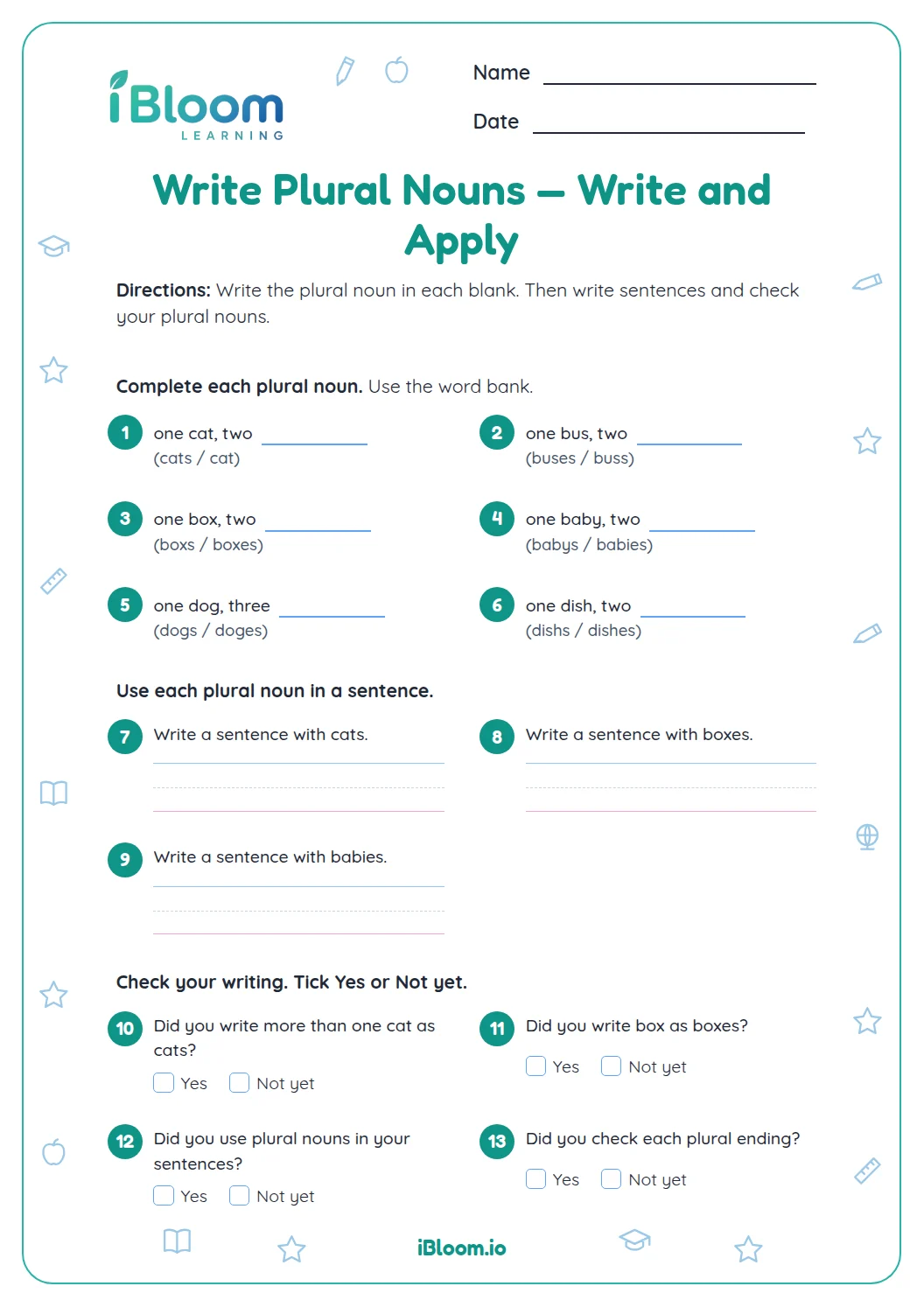
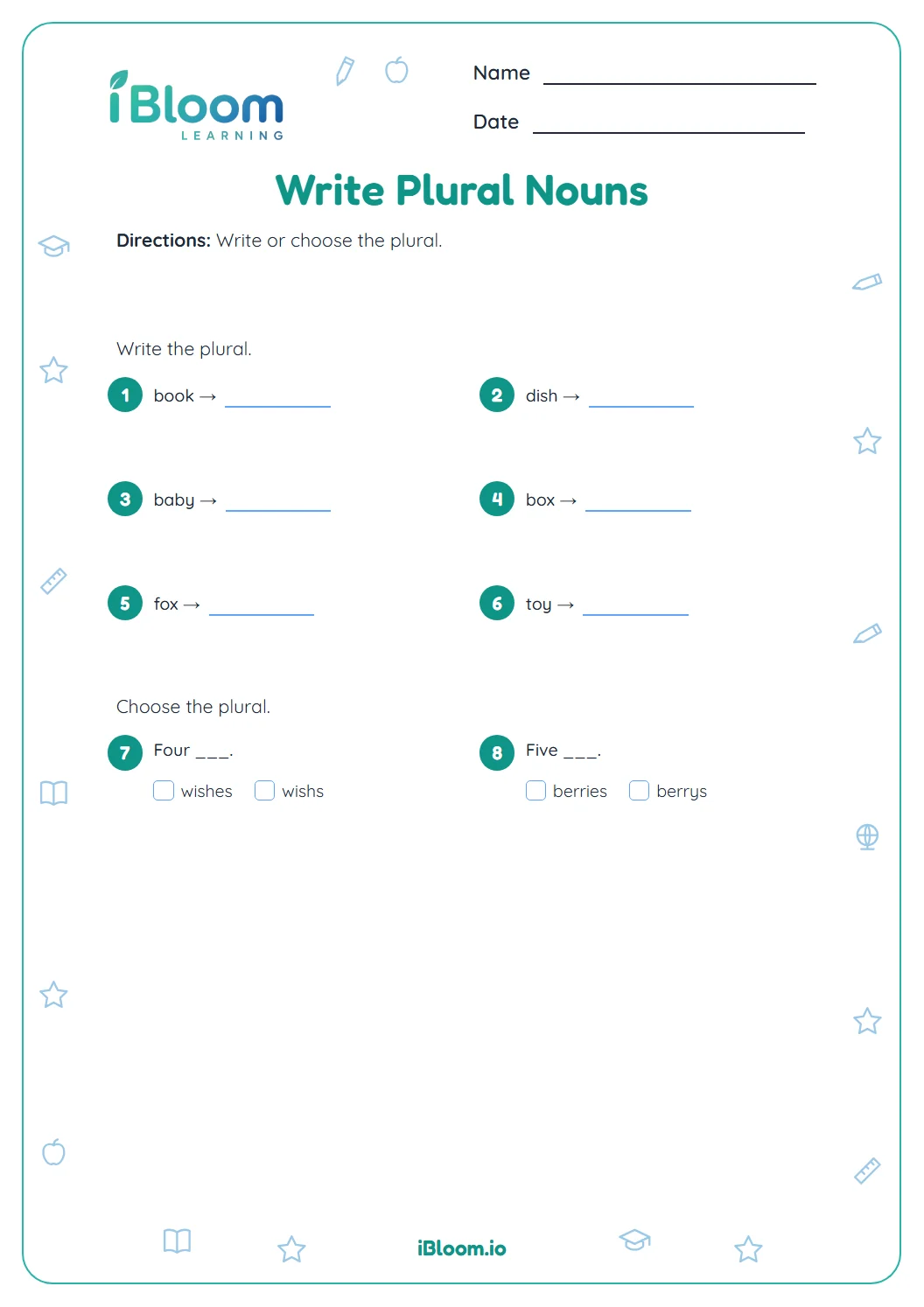
This free printable Grade 1 worksheet gives children focused practice forming and using plural nouns. Across three parts, learners choose a plural spelling, fill in a missing plural noun, and complete a sentence with a noun that names more than one. The examples include adding s or es and changing consonant plus y to ies. The work connects plural forms with the Common Core expectation to use singular and plural nouns with matching verbs in basic sentences. Print the two worksheet pages and use the separate answer key to check each response.
Aligned to L.1.1c
How does a noun become plural?
A plural noun names more than one person, place, animal, or thing. Many nouns add s, as in cat and cats. Nouns ending in sh, x, or s often add es, as in dish and dishes.
When a consonant comes before y, change y to ies: puppy becomes puppies. When a vowel comes before y, keep the y and add s: toy becomes toys.
How do you complete a plural noun sentence?
Read the whole sentence, look at the number word, and make the noun name the right amount. Then check that the spelling matches the noun ending.
- 1The ____ are in the nest. (bird)
- 2The word are tells us the sentence is about more than one bird.
- 3Add s: bird becomes birds.
- 4Answer: birds
What appears in each part?
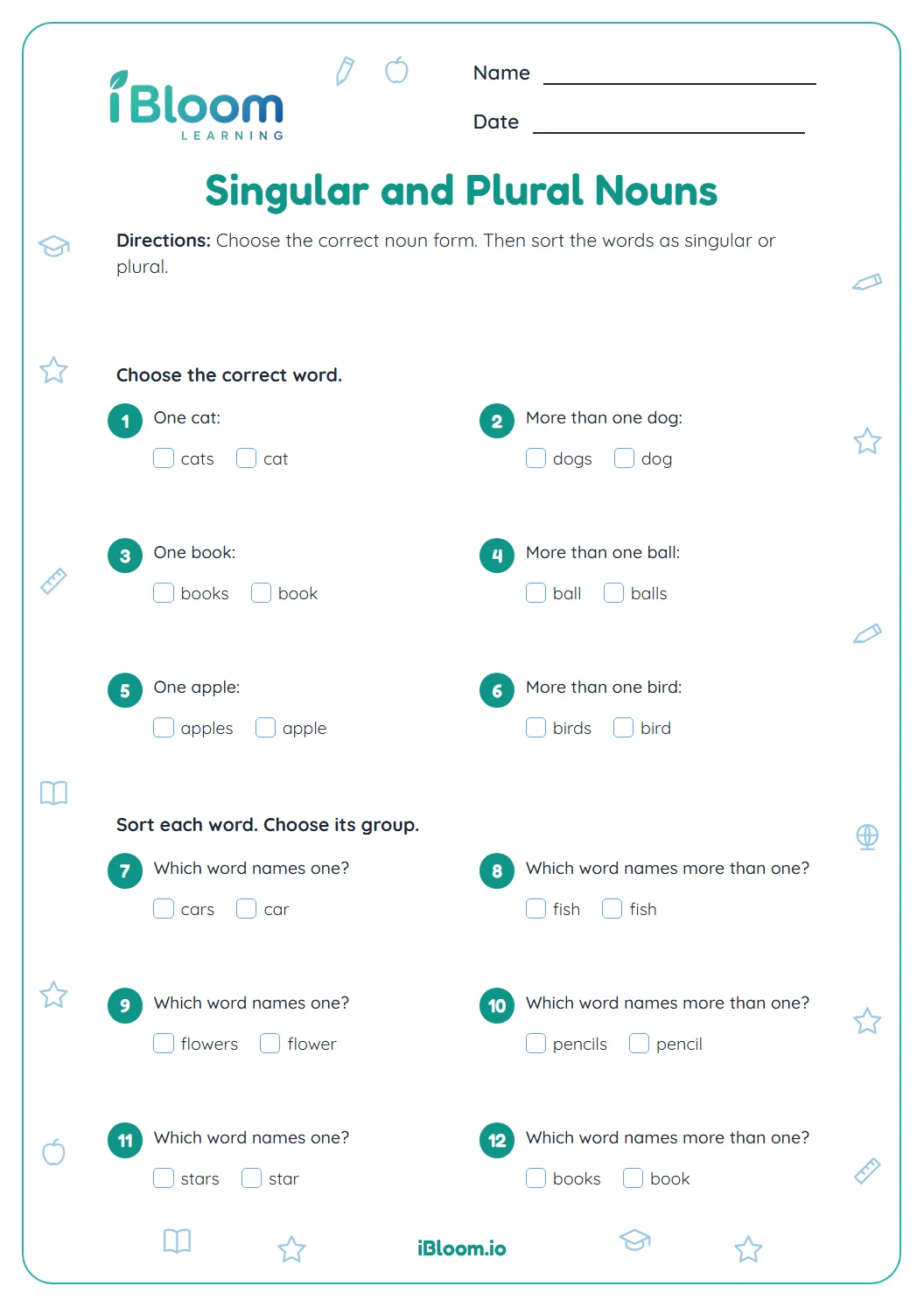
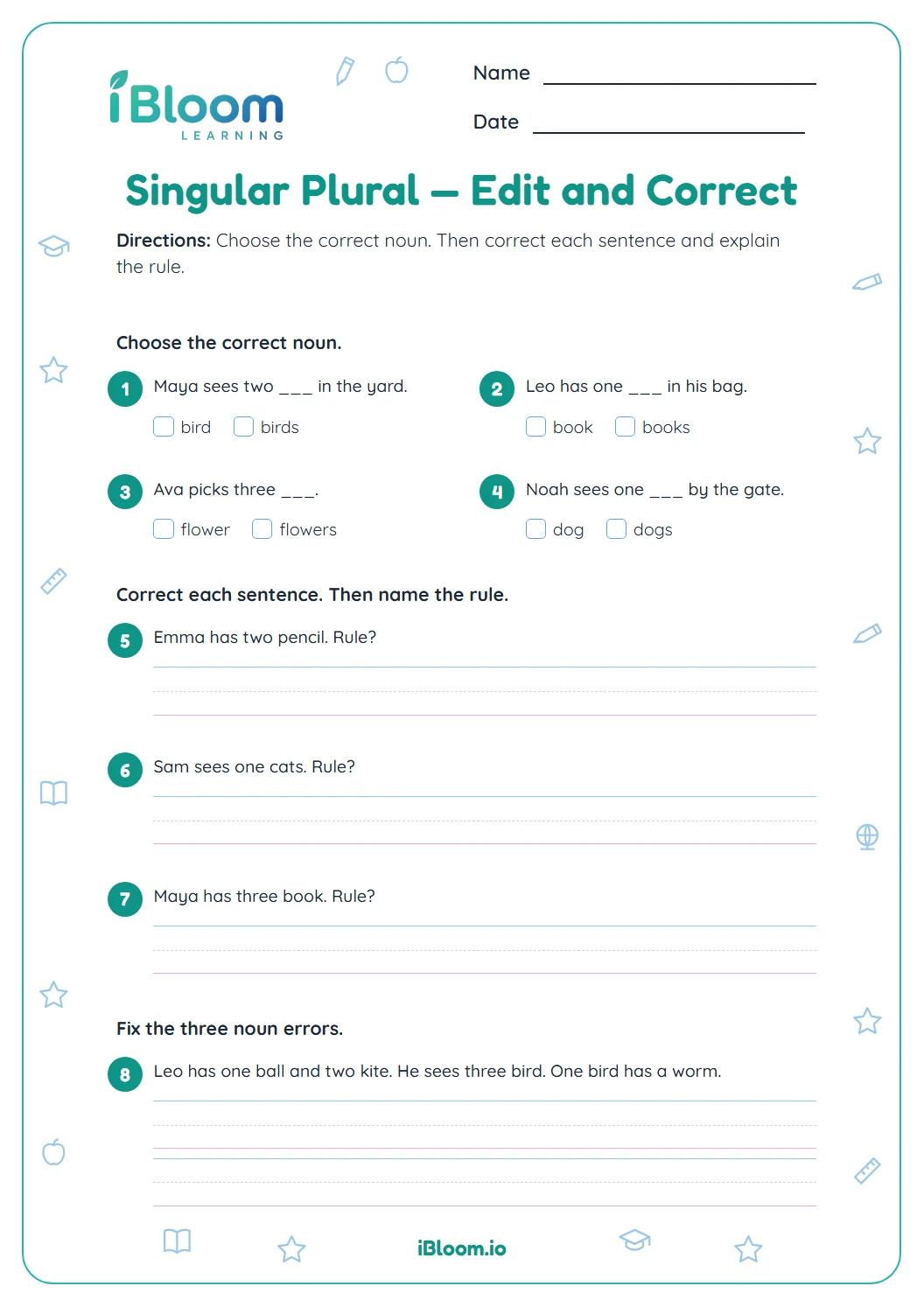
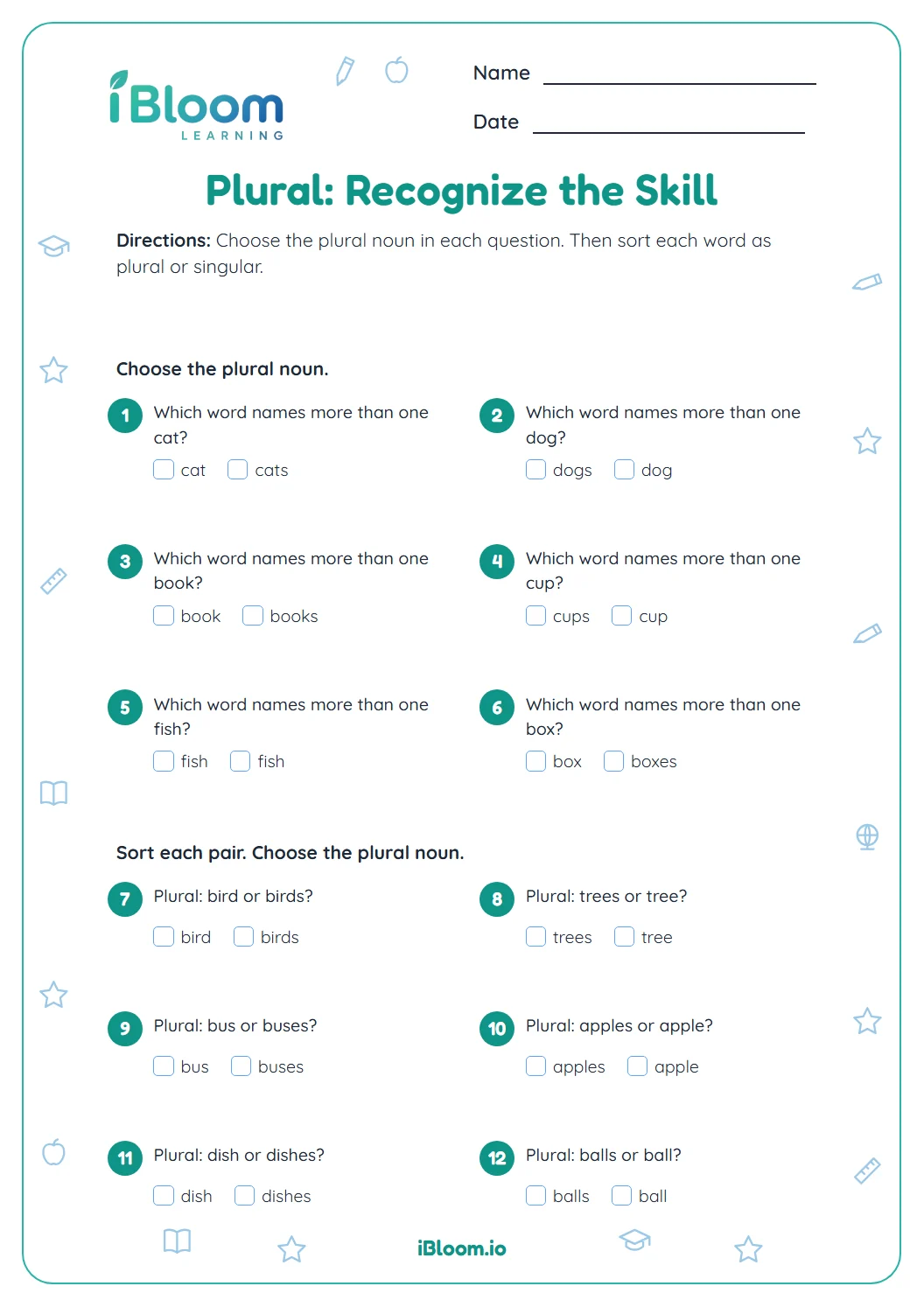
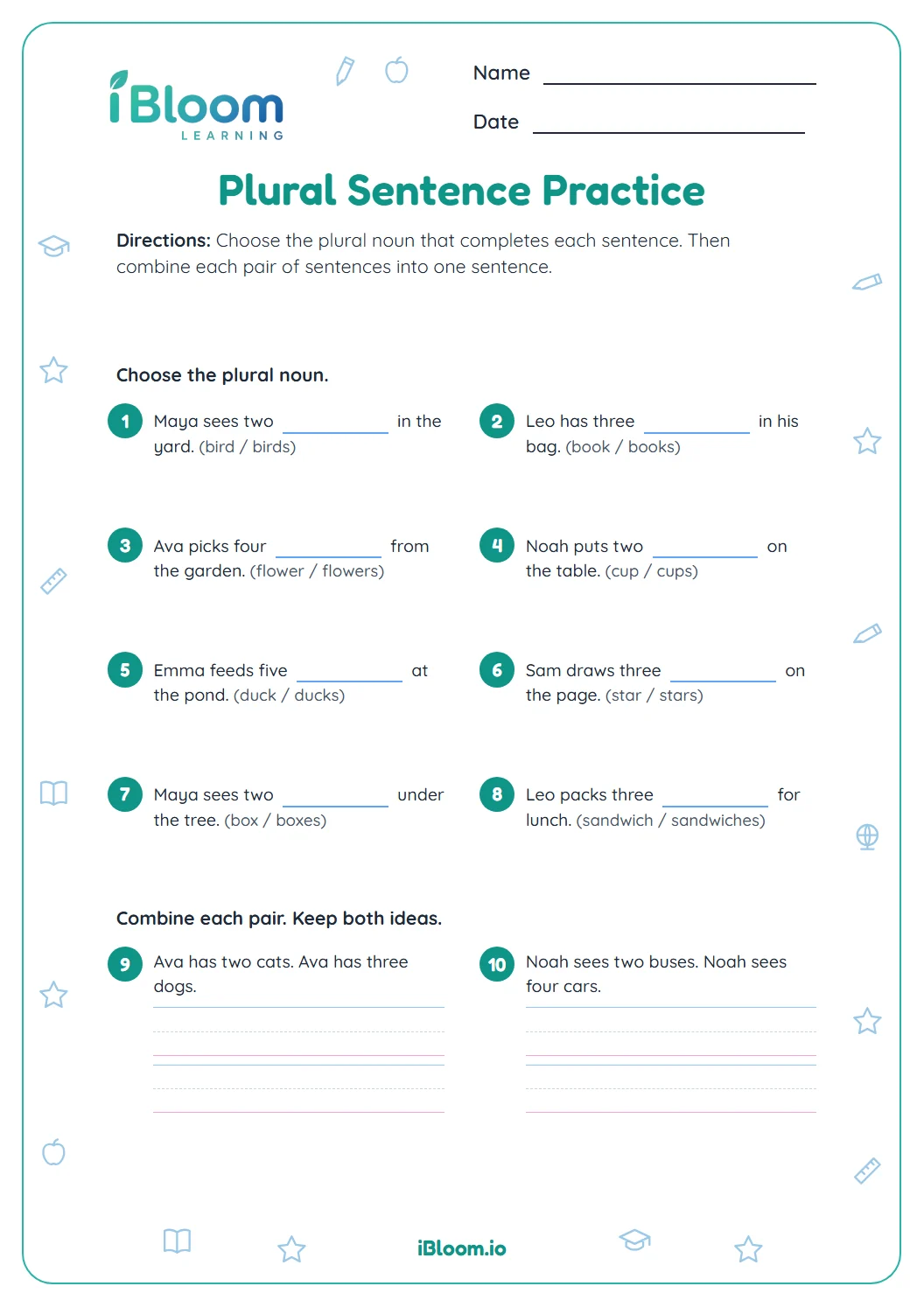
Part A asks children to choose a plural spelling for six nouns. Part B asks for a written plural in five short “one / two” prompts. Part C uses plural nouns to complete four sentences.
The sheet includes common s and es endings, y-to-ies spelling, and sentence contexts that make the plural meaning clear.
How to use this worksheet
- 1Read the noun and notice whether the prompt means one or more than one.
- 2For a spelling choice, say each option aloud and check the noun ending.
- 3In Part B, use “two” as a clue that the answer must be plural.
- 4In Part C, read the whole sentence after filling the blank.
- 5Check the answer key and correct the ending, not just the final letter.
Common mistakes and quick fixes
The mistake
Adding s to every noun, such as dishs.
The fix
For sh, x, or s endings, try adding es and read the word aloud.
The mistake
Changing every y to ies, including toy.
The fix
Check the letter before y: a vowel keeps y and adds s.
The mistake
Writing a plural that does not fit the sentence.
The fix
Use number words and the verb to check that the sentence names more than one.
Curriculum alignment
This practice connects the worksheet tasks with the listed learning standard.
Use singular and plural nouns with matching verbs in basic sentences.
On this sheet: Children write plural nouns and use them to complete short sentences.
Show the official wordingHide the official wording
Use singular and plural nouns with matching verbs in basic sentences (e.g., He hops; We hop).
What to practice next
Make more practice
Further reading
Questions parents and teachers ask
What does this plural nouns worksheet practice?
This Grade 1 sheet has 15 questions in three parts. Children choose plural spellings, write plurals after one-and-two clues, and finish sentences with plural nouns. The answer key lists a correct response for each item, so you can review the spelling change together.
How many questions are on the sheet?
There are 15 questions: six spelling choices, five plural blanks, and four sentence completions. The two worksheet pages are followed by two answer-key pages. Learners can work through the parts in order, then use the key to check each plural form.
Which endings appear?
The items practice adding s or es, changing a consonant plus y to ies, and changing f to ves in leaves. A toy keeps its y and adds s. Ask the learner to compare the last letters of the singular noun with the plural before checking the key.
How can I help with a tricky plural?
Ask the learner to say the singular noun, then decide whether it names one or more than one. For words ending in sh, x, or s, the worksheet practices adding es; for a consonant before y, it changes y to ies. Reread the completed sentence to check meaning.
Can a child complete it independently?
The prompts are short, but a first grader may benefit from hearing a sentence read aloud. The child can still choose or write the plural form independently. Invite them to explain which letters changed and why the sentence calls for more than one.
What should I review after the worksheet?
Yes. A separate answer key gives the expected plural for every question. If a response is misspelled, compare the singular and plural forms, identify the ending pattern, and have the learner write the corrected word in the sentence.