




About this worksheet
This free Grade 1 worksheet helps children write a short expository paragraph that teaches general facts about a topic. Four choice questions distinguish facts about a group from one person’s experience. Children then choose birds, cats or bicycles and plan a beginning, two facts and an ending. In the final part, they put their sentences together and improve one fact. The 10 tasks practice Common Core W.1.2: name a topic, supply facts and provide closure. A separate key supplies fixed answers for the choices and brief models for the writing tasks.
Aligned to W.1.2
What is a general fact?
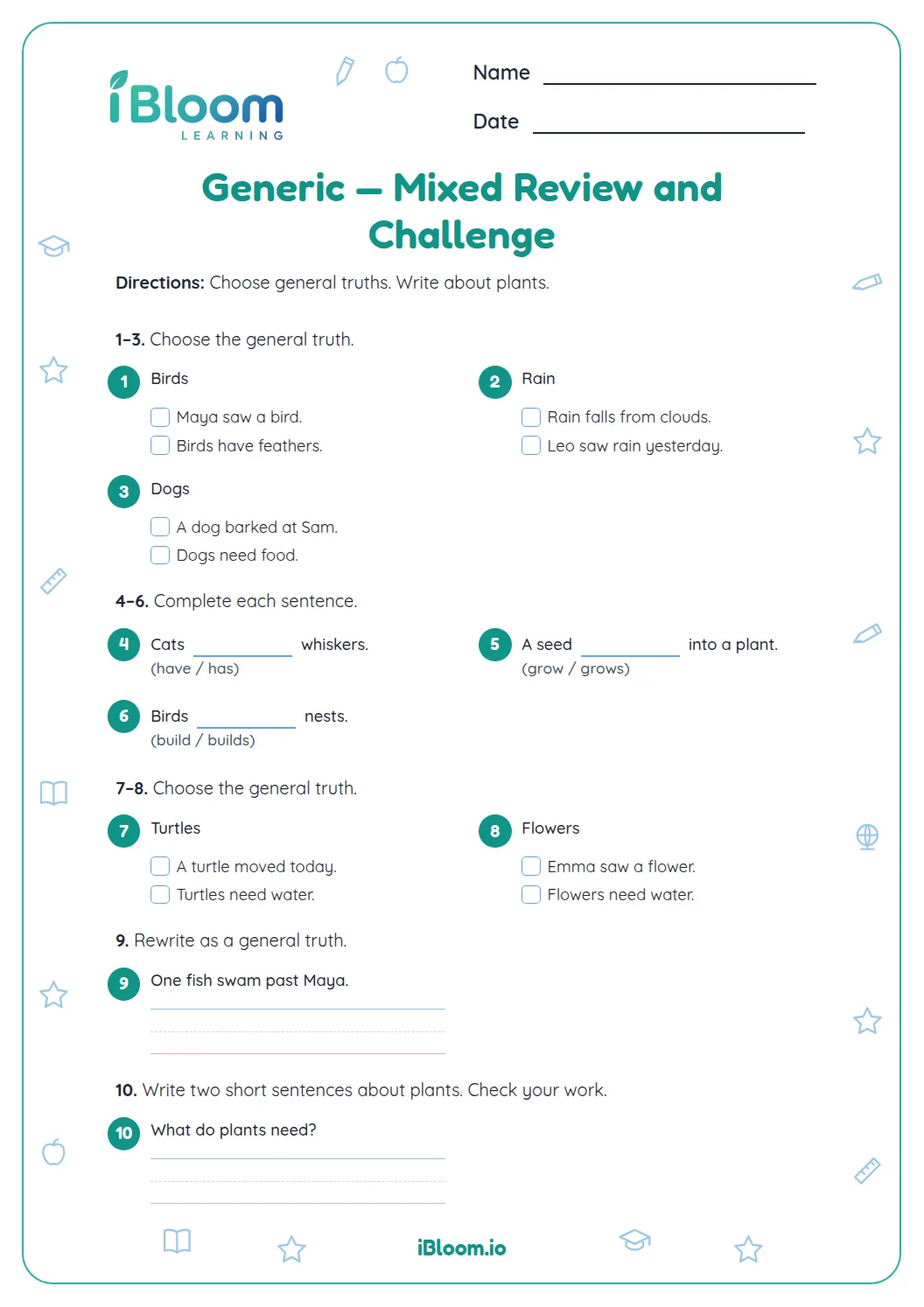
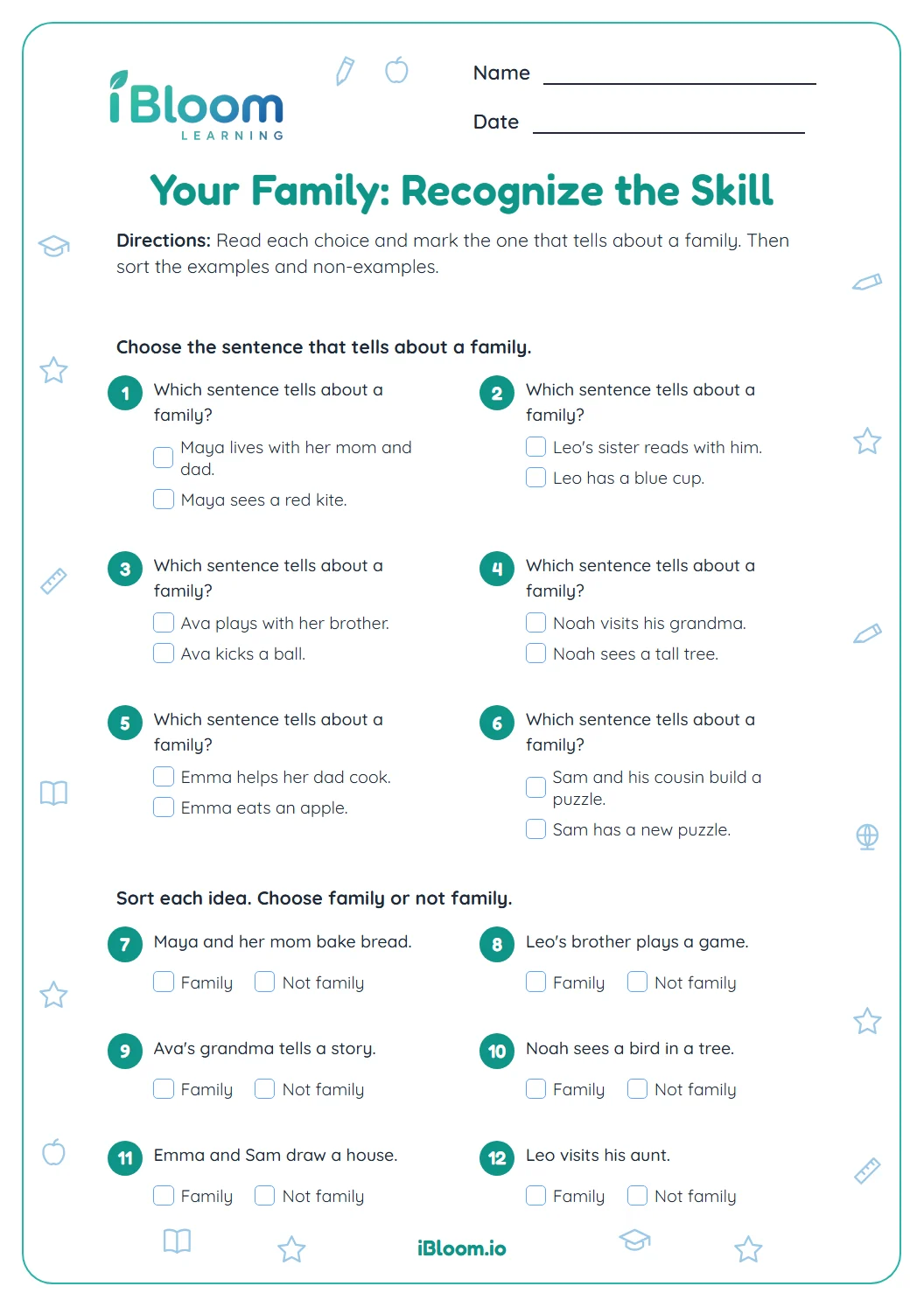
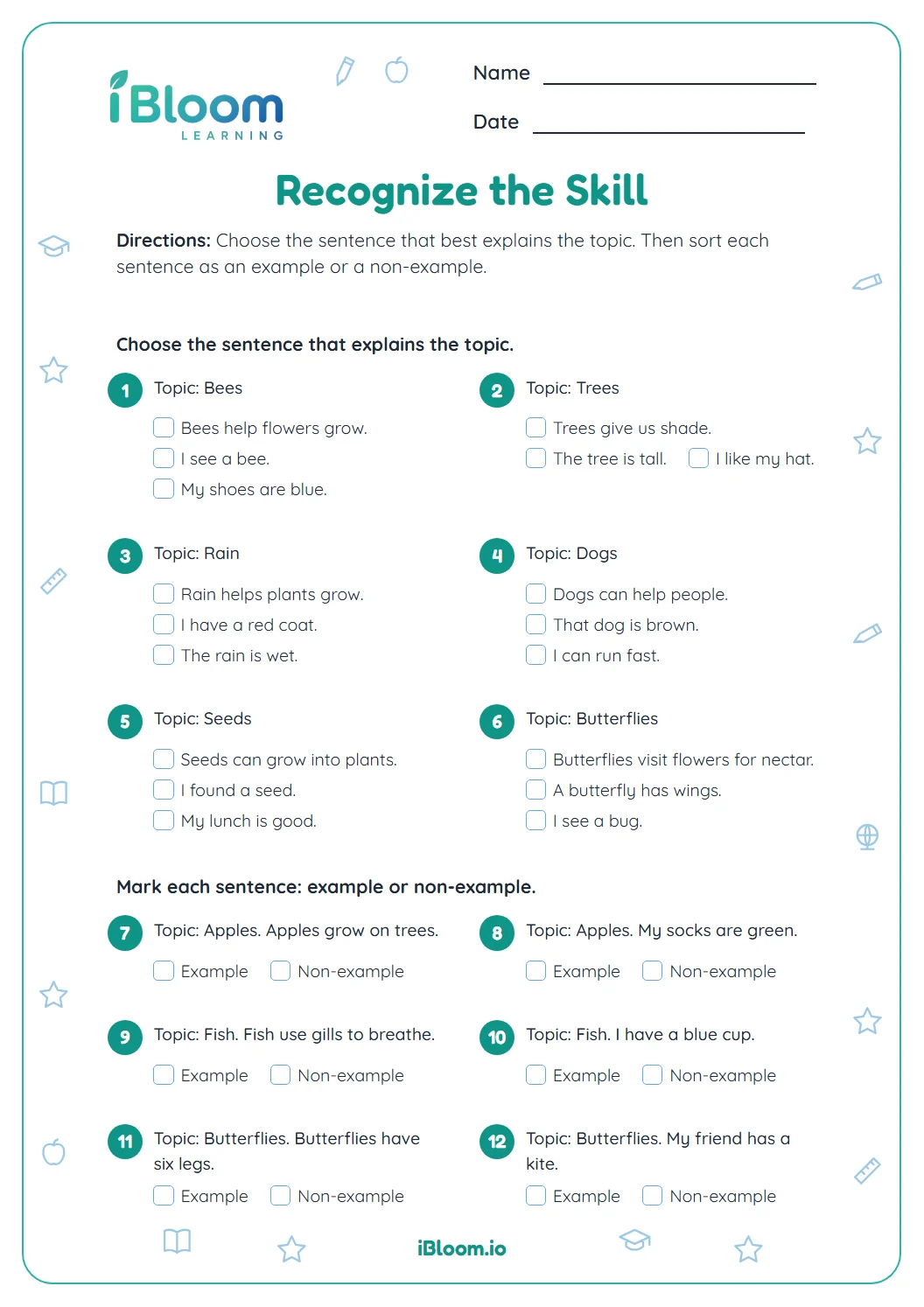
A general fact teaches something about a group, such as “Birds have feathers.” A sentence about one named bird or one trip describes a particular experience. Both kinds of sentences can be true. Part A asks children to choose the one that teaches about a whole group.
Read each pair aloud if needed. Ask which sentence helps a reader learn about cats, birds, bicycles or trees as a group. Use the word “general” in discussion, then return to the child-friendly question, “What does this teach us?”
- 1Birds have feathers. / I saw a bird.
- 2“Birds have feathers” teaches a fact about birds as a group.
- 3“I saw a bird” tells about one person’s experience.
- 4Choose: Birds have feathers.
How do the planning questions build a paragraph?
Part B offers three familiar topics: birds, cats and bicycles. Question 5 asks for a beginning that names the chosen topic. Questions 6 and 7 ask for different general facts, and question 8 asks for an ending that returns to the topic.
A child writing about birds might plan: “Birds are animals. Birds have feathers. Birds lay eggs. These are facts about birds.” The ending is simple, but it signals that the information is complete. Children can use another accurate ending that fits their own facts.
What changes when the child writes the paragraph?
Question 9 brings the four planned sentences together in order. Read the result aloud to hear whether each sentence follows the one before it. Children should keep the same topic throughout and leave spaces between words.
Question 10 asks children to improve one fact by adding a true detail. For example, “Birds have feathers” could become “Birds have feathers on their bodies.” After writing the improved sentence, children can point to the sentence it would replace in their paragraph.
Guide the child from facts to a paragraph
- 1Read the two choices in Part A and pick the general fact in each pair.
- 2Choose birds, cats or bicycles for all of Part B and Part C.
- 3Say a beginning sentence, then two different facts, before writing them.
- 4Plan an ending that reminds the reader of the topic.
- 5Write the four sentences together in question 9 and reread for capitals and ending marks.
- 6Add a true detail to one fact in question 10 and read the improved sentence aloud.
Mistakes to watch for
The mistake
Writing “My cat is Max” as a general fact about cats.
The fix
Ask what the sentence teaches about cats as a group. Try a checkable fact such as “Cats have whiskers.”
The mistake
Changing from birds to bicycles halfway through the paragraph.
The fix
Point to the topic named in the beginning. Check each fact against that same topic.
The mistake
Ending with an unrelated fact instead of closing the paragraph.
The fix
Return to the topic with a sentence such as “These are facts about birds.” Read it after the two facts to hear the ending.
Common Core alignment
Write a short factual paragraph with a named topic, two facts and an ending.
On this sheet: Parts B and C guide children to plan and write a complete informative paragraph.
Show the official wordingHide the official wording
Write informative/explanatory texts in which they name a topic, supply some facts about the topic, and provide some sense of closure.
What to practice next
Make more practice
Further reading
Questions parents and teachers ask
What does expository writing mean here?
Expository writing teaches the reader about a topic using facts. Here, children choose general facts and then write about birds, cats or bicycles. Their paragraph names the topic, gives two facts and ends with a closing sentence, following the structure practiced in the four planning prompts.
Can I read the worksheet aloud?
Yes. Read the directions and answer choices aloud, then let the child decide which sentence teaches a general fact. During planning, invite the child to say each sentence before writing it. Keep the wording in the child’s voice while helping them check that each fact is true.
How long should the paragraph be?
The worksheet asks for four sentences: a beginning, two facts and an ending. Each planning prompt prepares one of those sentences, so the child has a clear starting point for question 9. Short, complete sentences are enough when they stay on the same topic and teach accurate information.
Must the child copy the sample paragraph?
No. The key’s paragraph about birds is one possible response. Children may choose cats or bicycles and write different accurate facts. Check for a named topic, two relevant facts and a closing sentence. The samples show the expected structure and help adults judge answers that vary.
What should I check before spelling?
First check that the paragraph teaches facts about one topic and has a clear beginning and ending. Then read each sentence aloud together to check that it makes sense. Finish by checking capitals, spaces and ending marks, using question 10 to improve one fact with a true detail.