




About this worksheet
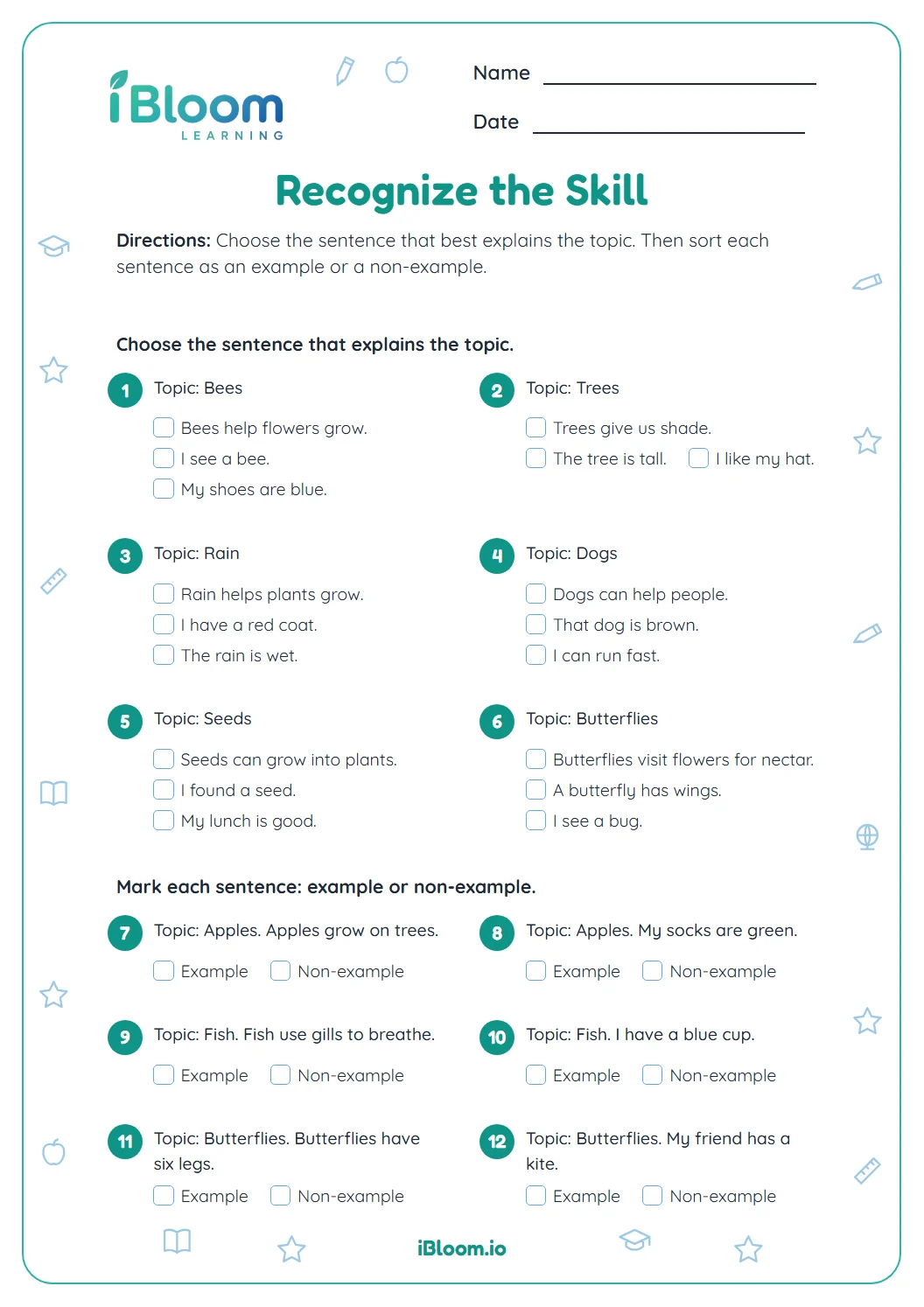
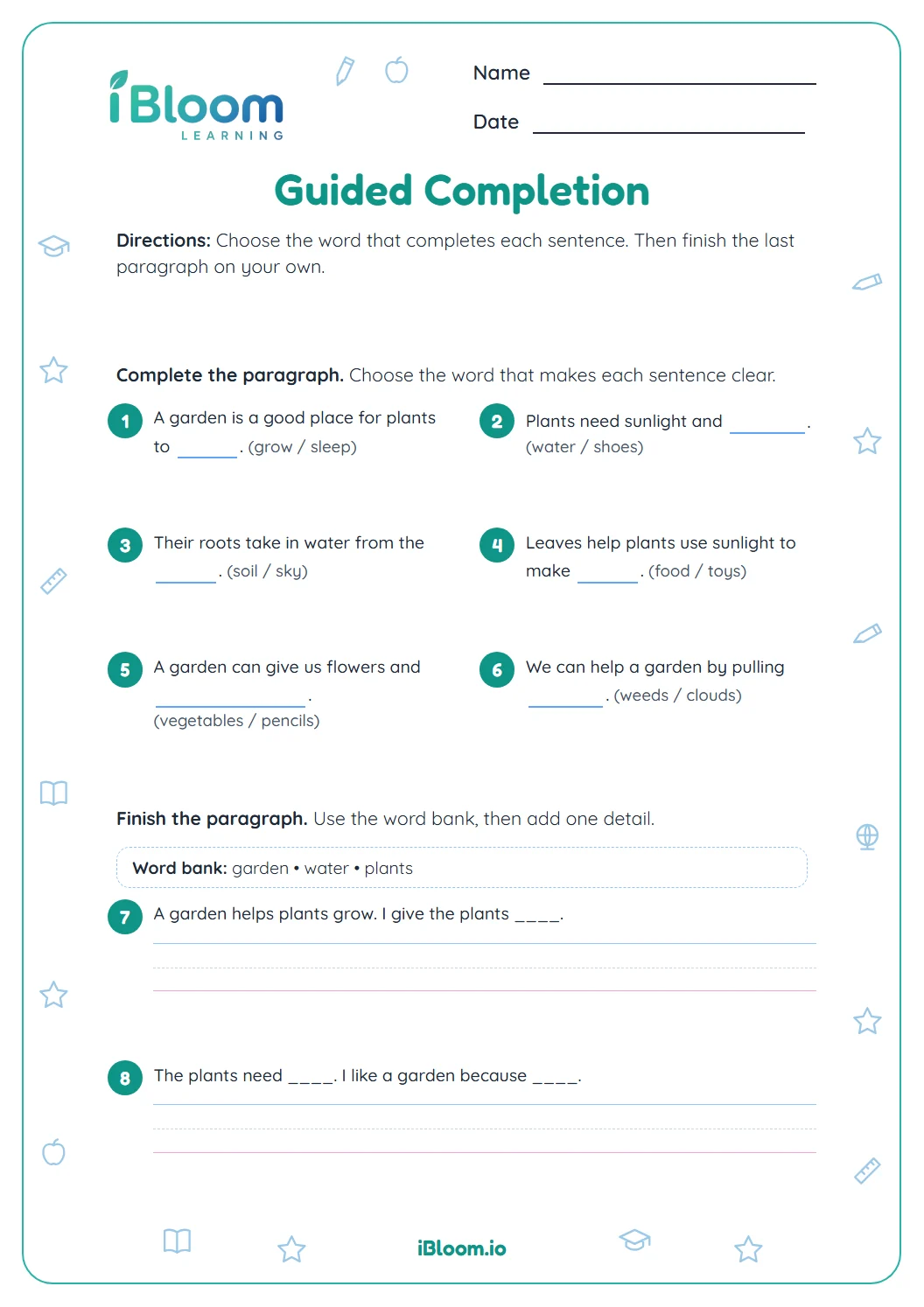
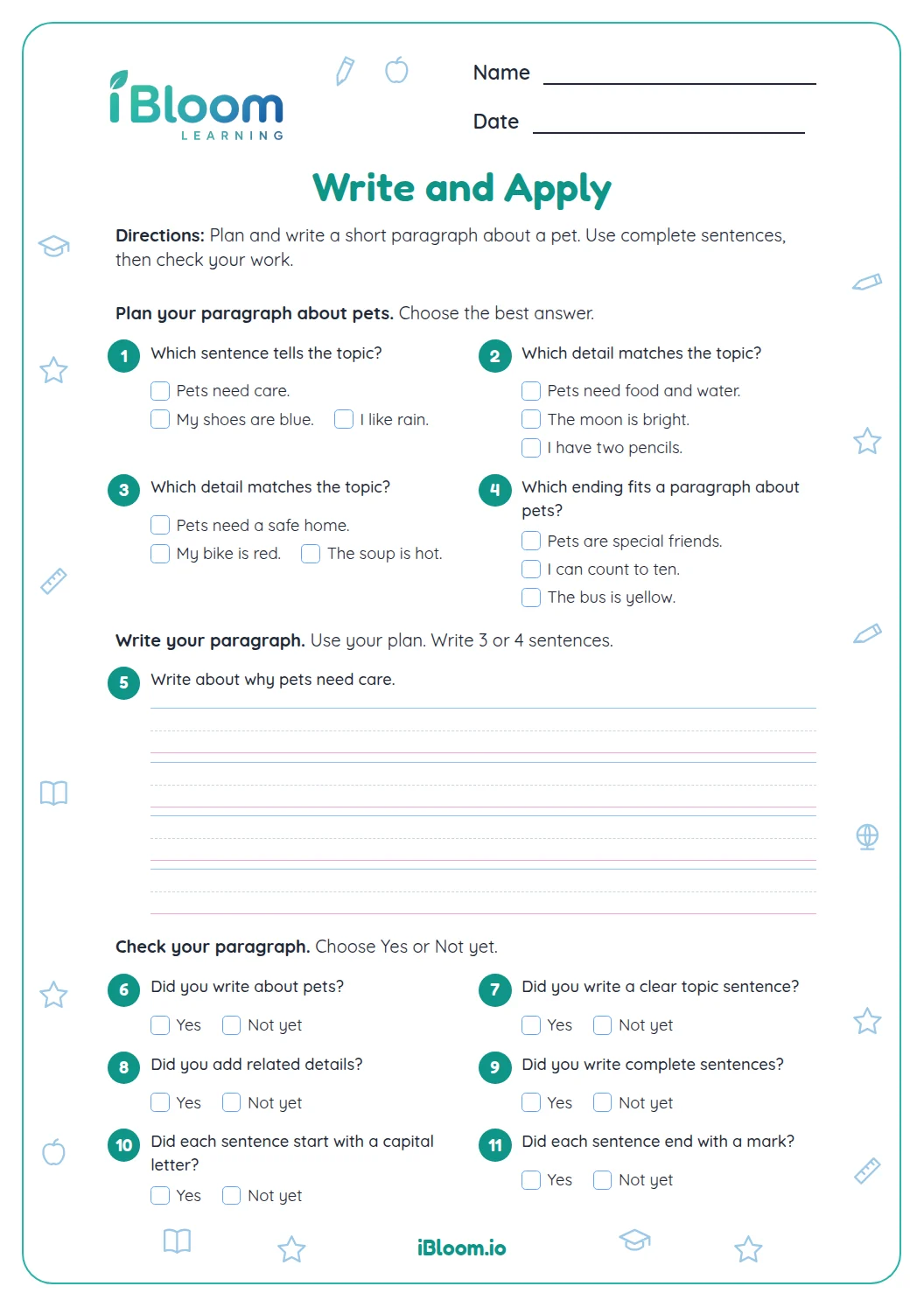
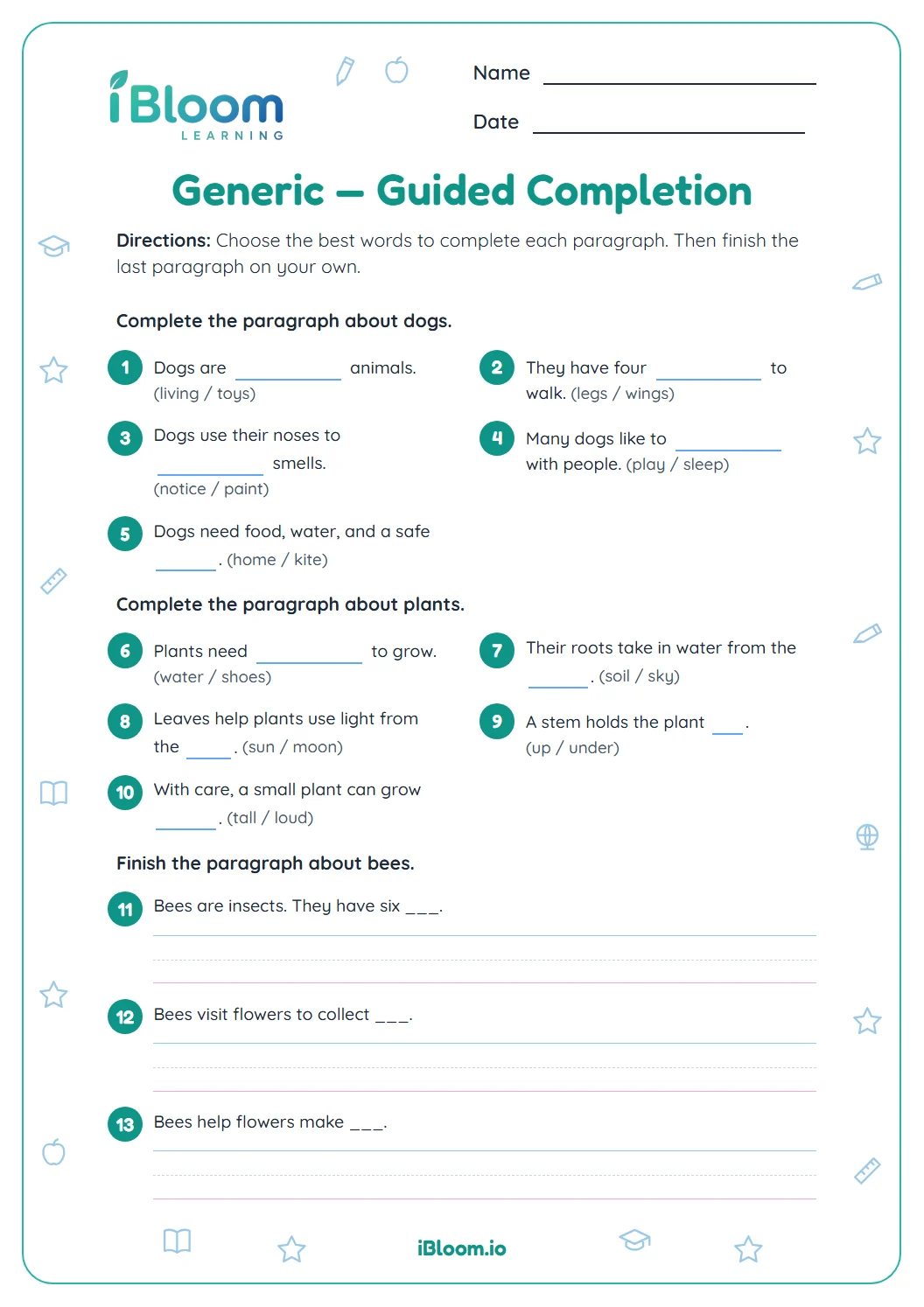
This Grade 1 printable moves from recognizing clear sentences to writing a short set of facts about frogs. Children review complete thoughts, capitals, and periods, then practice the parts of an informative paragraph: a topic sentence, details, and a closing. The two-page worksheet includes 14 questions and a separate answer key. It supports CCSS W.1.2.
Aligned to CCSS W.1.2
What makes a complete sentence?
A complete sentence tells a whole idea. It begins with a capital letter and ends with punctuation. A paragraph groups sentences that explain one topic.
How does the worksheet build a paragraph?
Part A recognizes complete and on-topic sentences. Part B checks basic sentence conventions. Part C uses one topic—frogs—to practice a topic sentence, supporting facts, and a closing.
- Part A: choose clear sentences and words.
- Part B: complete sentence-part clues.
- Part C: write four connected sentences about frogs.
What can a supporting fact do?
A supporting fact gives the reader information about the topic. It should connect to the idea named in the topic sentence.
- 1Topic sentence: A frog is an animal that can live on land and in water.
- 2Detail: A frog can live near a pond.
- 3The detail tells more about frogs.
How to use this worksheet
- 1Read the directions and complete Part A before moving on.
- 2Read each sentence or expression fully before choosing or calculating.
- 3Mark the clue, factor, or operation that supports your answer.
- 4For written work, reread the response and check that it answers the prompt.
- 5Use the separate answer key to check each response and revisit any missed step.
Common mistakes and quick fixes
The mistake
Answering from one familiar word or number without reading the full prompt.
The fix
Read the whole item and identify the clue or operation it asks you to use.
The mistake
Stopping after a first step when the item needs more reasoning.
The fix
Check whether the prompt asks for a meaning, a greatest value, or a final result.
The mistake
Copying an answer without checking that it fits the sentence or calculation.
The fix
Read the completed response again and compare it with the original question.
Curriculum alignment
This worksheet practices the following Common Core standard.
Name a topic, add facts about it, and provide a sense of closure.
On this sheet: Part C asks children to name the frog topic, supply related facts, and write a closing sentence.
Show the official wordingHide the official wording
Write informative/explanatory texts in which they name a topic, supply some facts about the topic, and provide some sense of closure.
What to practice next
Further reading
Questions parents and teachers ask
What does a topic sentence do?
A topic sentence tells what an informative paragraph is about. In Part C, the first sentence names frogs as the topic. The next sentences add facts, and the final sentence gives the group a closing. Together, the four prompts help a child plan connected writing rather than unrelated sentences.
What should a Grade 1 sentence begin and end with?
Begin with a capital letter and finish with an end mark. A telling sentence often ends with a period. Read it aloud to check that it shares one complete idea, then check that the first word begins with a capital. Part B practices these conventions.
What makes a detail useful in an informative paragraph?
A useful detail gives information about the topic. For a paragraph about frogs, a detail might say where a frog lives or what it eats. A fact about an unrelated subject would distract the reader. Part C keeps its topic on frogs so children can practice choosing related information.
How can a child check a written response?
Read the sentence aloud. Check that it tells a complete idea, begins with a capital letter, ends with punctuation, and fits the topic. Add a fact or detail when the prompt asks for more information. The answer key provides sample responses for the open writing prompts.
What is included in this printable?
The worksheet has two pages and 14 questions, followed by a two-page answer key. It starts with sentence choices and checks, then ends with four connected writing prompts about frogs. The sample responses show one possible way to answer each open prompt.